Lifestyle
A Silver Lake remodel saves a tree that's 'the soul of the house' — and still gets a killer view

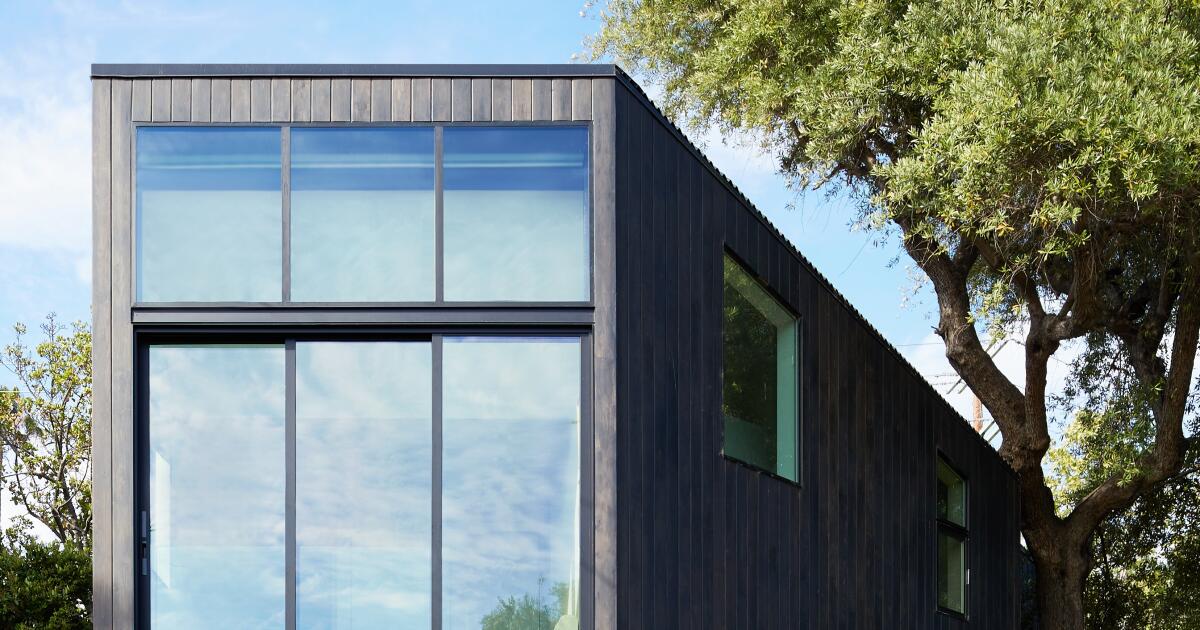
Under the canopy of the enormous olive tree that shades his home, Daniel Gerwin’s 11-year-old son ascends the tree’s gnarled trunk like an expert climber while his brother, 7, reads a book a few feet away inside the house.
Standing nearby, architect John K. Chan, who recently renovated the interiors and designed a modern 500-square-foot addition, can’t help but smile as he watches the boys’ parents cook dinner amid all the activity.
“It’s so wonderful to see the house working for them,” Chan says as the family and their dog, Phoenix, circulate in and out of the house through sliding glass doors — a classic California indoor-outdoor move. “As an architect, the sweetest gift you can get from your clients is seeing the house working. Sometimes Daniel will text me, ‘This is happening right now,’ with a photo of the kids doing something we designed, and it’s so gratifying.”
“The olive tree is the soul of the house,” says homeowner Daniel Gerwin. “So we built the house around it.”
(Jason Armond / Los Angeles Times)
Gerwin and his wife saw plenty of promise in the 1,100-square-foot home when they purchased it in 2016. Like many traditional homes built during the 1930s, the house featured a simple floor plan with two bedrooms, one bathroom, a living room with a fireplace, and a formal dining room and entryway.
Despite its compact layout, the house had many perks: It was within walking distance of a good elementary school and across the street from the Ivanhoe Reservoir. The majestic olive tree, which the couple guesses is as old as the house, was another bonus.
At first, the house was fine.
But as their family grew and they adopted a large Rhodesian Ridgeback, the single-story home’s compartmentalized rooms began to feel claustrophobic.
“The boys’ room was OK when it was just a crib and a toddler bed,” Gerwin says, noting the tiny bedroom connected to the primary bedroom through a Jack-and-Jill bathroom, “but it was not sustainable.”
Adds Chan: “It was a traditional house carved into rooms.”
Chan, who began rethinking the house in 2016, says his challenge was to add everything the family wanted — an open floor plan, storage and natural light — on a small, triangular lot.
They also wanted to preserve the olive tree, which absorbs noise from the preschool across the street and shades the house and backyard.
“The olive tree is the soul of the house, and we feel connected to it,” says Gerwin, an artist. “It feels good to have a huge olive tree anchoring our house.”
The silvery green leaves of the olive tree resonate throughout the house, including the front door.
Daniel Gerwin and his family’s renovated Ivanhoe Vista house is built around a giant olive tree.
The modern addition, left, and the traditional home, right, can be seen from the backyard where architect John K. Chan plays with the family dog.
(Jason Armond / Los Angeles Times)
Chan agreed as someone interested in architecture as a cultural project. “When we do research for a house, we need to meet the client’s needs and address the practical concerns, but we are also interested in the poetics of the site, the specific cultures and ecologies of sites and their narratives,” he says, recalling the wooden cover that shielded the Ivanhoe Reservoir in the 1930s.
“The house’s sensibility is very East Coast,” Chan adds, noting the neighborhood’s Spanish, Tudor and Modernist homes by architects Richard Neutra, Gregory Ain, R.M. Schindler and John Lautner. “We decided to tailor the addition to the site’s landscape.”
The newly remodeled house, which took a year to complete, demonstrates Chan’s vision. The silvery and green hues of the olive leaves repeat throughout the house, in the living room furniture, the kitchen’s stained oak cabinets and the olives and leaves preserved in the concrete flooring.
“Every day you see the tree, you sense its roots,” Gerwin says. “It’s nice to see it resonate throughout the house.”
To open up the interiors, Chan removed walls and the fireplace, enlarged the narrow galley kitchen, and added a two-story, 500-square-foot primary bedroom and bathroom that overlooks the reservoir, connecting the family to the lake, the walking path and an olive grove in the pocket park across the street.
When you enter the house, the kitchen faces an open dining room and living room bathed in natural light thanks to the shifting rooflines that create transitions instead of walls. Adding further drama is a giant bay window in the living room that overlooks the backyard. When it frames the boys playing outdoors, Gerwin likens it to a “diorama in a zoo or natural history museum.”
The cabinets in the kitchen are painted a gray tone that echoes the olive tree outside.
(Stephen Schauer)
Walls were removed to open up the partitioned interiors of the traditional home. “A lot of exciting plane changes occur inside the house,” says the homeowner.
(Stephen Schauer)
“One of the things that I enjoy about the house is the geometry,” Gerwin says. “A lot of exciting plane changes occur inside the house. It takes a certain kind of person to want to invest time and energy into something like that. John is that person. It continues to be a pleasure for me as I live here.”
The elevated reading nook above the kitchen allows the children and guests to visit Gerwin while he cooks. It also offers a reverse panorama of the house. Instead of being shut off in separate rooms, the family can face one another while cooking and doing homework in what Chan describes as an “egalitarian” design choice.
“Socially, the kitchen is not for the servants; it’s for the whole family,” he says.
Daniel Gerwin fixes dinner while his son reads in a nook.
(Jason Armond / Los Angeles Times)
Because their home sits on a corner lot and is exposed to hundreds of people who walk around the reservoir daily, Gerwin and his wife were acutely aware that their new bedroom, which faces the pedestrian walkway, would have a fishbowl effect.
Chan felt it was important to connect the addition to the reservoir. “The house has its protected spaces, and oddly, as an inversion, it profoundly connects them to the lake,” Chan says. “The bedroom brings you to the lake.”
If you’ve walked around the Silver Lake and Ivanhoe reservoirs, you can’t miss the addition, with its modern spiked roof, glass picture window, corrugated roof and dark cedar siding.
The homeowners say they are comfortable with being exposed this way.
“It forces me to make the bed,” Gershwin jokes. “I often see people looking up at me from the walking path. But we aren’t in our bedroom during the day. In the morning, I can open the top of the blackout roller shades and still have the bottom portion closed for privacy.” (Chan installed a clear glass guardrail in front of the sliding glass doors for safety, allowing easy access to the windows and sliding glass doors and an uninterrupted view of the lake.)
When Gerwin looks out the bedroom window, he sees a community and, eventually, when the Ivanhoe Reservoir is refilled with water, a sea of blue.
The windows of the primary bedroom connect the home to the Silver Lake reservoir, its community and the pocket park across the street.
(Jason Armond / Los Angeles Times)
The house, seen as a speck in the suburban landscape, overlooks the Ivanhoe Reservoir in 2022 before it was drained for new aeration and recirculation infrastructure.
(Stephen Schauer)
Similarly, in the new bathroom, where the pitched rooflines and angles converge, the color of the cement tile echoes the reservoir and the sky.
Below the house on the ground floor, a previously unpermitted tandem garage conversion now is a part of the house. Chan updated the side-by-side spaces to include an art studio for Gerwin, an office and guest room with a Murphy bed and a small existing bathroom.
Chan considered permitting the garage as an ADU, but it wasn’t a priority for the family. Although Gerwin predicts one of his sons may inhabit the space someday, until then, it works as a guest room for the couple’s parents and for work needs.
The art studio functions well for Gerwin, who previously had a studio in Lincoln Heights. “It’s a little narrow, but I can open the doors for ventilation, and at night, I can close the bug screen so I don’t have to scrape insects off my paintings.”
Photos by Stephen Schauer
Artist Daniel Gerwin in his studio, directly below his bedroom and facing the street.
(Jason Armond / Los Angeles Times)
He can also do carpentry in the driveway and work in the evenings when his family is asleep.
“If I have a one-hour window, I can walk downstairs and work instead of driving to a studio,” he says. As the president of the Barnsdall Art Park Foundation, Gerwin also can hold board meetings in the office space.
Chan, who argues that the addition reconnects the family to where they live, says that by embracing the olive tree’s narrative, it became the house’s substance.
“It was important for the house to emerge from the foliage,” he says. “The roof’s pitch is designed to accommodate the tree growing at this angle. It has a strong presence but is integrated in its context. The large hedge and the shade of the olive tree looming over the house are all important aspects. “
To many people, the Silver Lake Reservoir is an oasis in a frenetic city. But for this family, it’s an extension of their home.
“It’s fun to see people walk or run by,” Gerwin says as he walks Phoenix along the pedestrian path. “Living near a lake is a pleasure. How many people get to do that?”


People visit the Liberty Bell on the eve of Independence Day in Philadelphia on July 3, 2025. The crack in this symbol of U.S. freedom echoes the paradox between national pride and civic ignorance revealed in a new national poll.
Juan Mabromata/AFP/Getty Images
hide caption
toggle caption
Juan Mabromata/AFP/Getty Images
A new national poll reveals a striking paradox in public sentiment ahead of America’s 250th anniversary: a disconnect between Americans’ strong patriotic pride and their lack of civic knowledge.
According to a survey from the libertarian Cato Institute think tank of more than 2,000 U.S. adults conducted in late June, 86% of respondents said they are grateful to be American and 70% believe the nation’s founding principles remain relevant.
However, nearly half of Americans (46%) don’t know that America’s 250th anniversary commemorates the adoption of the Declaration of Independence.
This civic ignorance extends to basic governance: Nearly 60% do not know the main purpose of the U.S. Constitution is to limit government power, and do not know why the colonies declared independence from Great Britain.
Furthermore, the report highlights deep anxieties about the future of American liberty.
The majority of those surveyed believe the country has strayed from its founding principles, and more than half fear the U.S. could cease to be a free country within the next 50 years, citing corruption and the abuse of power as primary threats. The majority of both Republicans and Democrats share these fears.
The concerns are especially pronounced among Gen Z respondents, who exhibited both the lowest levels of civic knowledge and the least favorable views of the nation’s founders. The majority of Gen Z failed to cite the adoption of the Declaration of Independence as the source of the 250th anniversary.
“The lack of civic knowledge is a great disaster,” said Coe Professor of History and American Studies and Professor of Political Science Emeritus at Stanford University Jack Rakove. “Any democratic system of government to succeed requires having an informed electorate.”
The Pulitzer Prize-winning authority on the drafting of the Constitution and the Declaration of Independence blamed the problem on the fragmented media landscape and schools prioritizing STEM subjects over civics and history.
“Our educational system is highly decentralized. So the idea that you could have one clean, neat, sweeping educational reform that will cope with the problem is hard,” Rakove said. “And of course, and we do live in this disaggregated information environment where people pick the sources they like. If you assume that a Democratic society depends upon well-rounded deliberation of being exposed to the views of other people, the information environment itself is not conducive to the underlying foundation of Democratic debate.”

Unpacking my third suitcase in our new West Hollywood home, a sharp pain shot through my chest. I felt dizzy and short of breath before sprawling out on our mattress, which was still covered in plastic.
“What’s wrong?” David asked.
An hour later, on a gurney in the emergency room at Cedars-Sinai, I waited to be admitted overnight. What a great start to our new life — back in L.A. after seven years in New York City — David sleeping alone at our apartment while I was to keep close to the paddles and operating room in case what had just happened was a heart attack.
I was 33, practicing yoga and exercising almost daily. A few months earlier, my New York doctor noticed I had high blood pressure, and I was feeling terrible, so something clearly was going on. Was an artery blocked? Nope, the tests revealed; physically, I was fine. What had happened was a panic attack.
“Your health will be better in L.A.,” David had promised before returning to L.A.
Now I took no pleasure in his being wrong.
After growing up in Temple City (hardly L.A.), I went on a high school trip to the Big Apple and knew it was where I needed to be.
Exactly five years later, the time to escape California arrived after a miserable breakup from a three-year relationship with a guy that I hid entirely from my family. I was desperate and depressed, down 15 pounds from not eating much, my diet consisting largely of cigarettes and red wine. At the Archstone, my Studio City apartment, I did ecstasy alone on a Wednesday. One has to take a good look at himself when he’s in his bedroom, by himself, rolling, and so I decided it was time to start over in New York.
On the other side of the country, I thought it was normal to hook up with a new guy every third night. Which I suppose, for a gay man who’d spent the first 27 years of his life denying his sexuality to a family he feared wouldn’t understand, it was. My self-esteem was in the gutter, though you wouldn’t have known it from the outside.
After a three-digit number of hookups on Grindr, I met David, a guy who lived on the same Manhattan corner as I did. We did what people do on Grindr and hooked up a couple of times.
But one morning, we bumped into each other on 9th Avenue. I left our short chat feeling uplifted by how smiley and polite he was in daylight and while we were sober. That night, we went on our first date, and the rest is history. But I hid what I assumed wouldn’t be well-received.
“Let’s move back to L.A.,” he said after four years of life together in New York.
“I’m really not ready,” I said. I loved living in New York and never, ever expected to leave. He understood, but he wanted to return to “the coast.” I knew that in a healthy relationship, it couldn’t be just what I wanted. So eventually, we packed up and moved to an apartment on North Flores Street in West Hollywood.
And now, I was in the hospital.
After having to cancel the welcome home party our L.A. friends had planned for us, and being released from Cedars, my life fell apart. But being the one who kept everything together, I kept it together better than most would, at least in the presence of others.
I’m fine, I told myself, but I worried my heart was broken, and there was something medically wrong with it. To heal it, I’d need to accept truths that I didn’t want to.
Growing up was devastatingly hard for me. Being gay and misunderstood, with the unacknowledged pain of it kept inside, was quite literally eating me alive. Being back in L.A. meant being near my past. I told my mom I was gay before leaving for New York. She said she still loved and accepted me, but to this day, the struggle has never been discussed or acknowledged. I knew I was a disappointment to my family.
I went to Westwood what felt like 70 times, and after visiting a bunch of UCLA’s specialists, I found myself in the office of a neurosurgeon who took one look at me and said, “You don’t belong here. What you’re suffering from is plain old anxiety, and you’re going to have to work with your therapist on this.”
“I have been,” I said, “and it’s not helping.” But before I finished, he had walked out the door.
Before long, the panic attacks got so bad, I could hardly drive. David chauffeured me, under the palm trees and bright sun, around as much as his schedule allowed, and when he couldn’t, I made the best of it, lugging my laptop with me for the hour-long trek to yoga-teacher training at Equinox in the South Bay, using that extra time in the back of an Uber to write.
For almost my entire adult life, I’d been in therapy, but it was couples therapy with David where I felt supported enough to admit, first to myself, that I’d been terrified of being fully myself. I was afraid he’d leave me if he saw the real me. Secretly I had been keeping a lifetime of pain bottled up inside because of fear — I didn’t want to risk losing him by being too emotional or having too many feelings.
Three months after that therapy session, the pandemic arrived, and being together 100% of the time for the next year, I let him in fully. He didn’t run — instead, he proposed.
It’s been eight years since that neurologist, and six since I’ve been able to fully drive again. And here in L.A., in a city characterized by its distance, I have, with David, built a close chosen family that supports and fully understands me.
Now, I feel “at home” at our Spanish-style Hancock Park house, the one we bought because we wanted to start a family of our own, only after L.A. allowed me to heal and live peacefully, and now, anxiety free.
Had David not dragged me back, I wouldn’t have learned what I did about myself, my story of origin and living a life that’s so beautiful and that’s so true to me.
And certainly, we wouldn’t be bringing our baby daughter, Lucy, named after Lucille Ball (who’s more Hollywood?), home in mid-July by way of surrogacy.
The author is a writer and coach who helps established business owners build lives that feel as good as they look. He lives in Hancock Park. He’s on Instagram: @iammattgerlach.
L.A. Affairs chronicles the search for romantic love in all its glorious expressions in the L.A. area, and we want to hear your true story. We pay $400 for a published essay. Email LAAffairs@latimes.com. You can find submission guidelines here. You can find past columns here.

Could you see your life just as easily with children as without?
What if you’re not cut out for parenthood? What if you grow lonely in your old age? Or what if you have a loving partner, but you disagree on this choice? Deciding between parenthood and a child-free life requires clarity about your fears and deepest desires — no easy task. This episode, psychotherapist and author of the book, The Baby Decision, Merle Bombardieri, helps us get clear. She discusses minimizing regret, normalizing feeling ‘stuck’ and why waiting to have a baby at 38 may be best.
Want more about the decision to have kids?
Many women don’t want kids. And for good reason.
Why are people freaking out about the birth rate?
Support Public Media. Join NPR Plus.
Follow Brittany on Instagram: @bmluse
For handpicked podcast recommendations every week, subscribe to NPR’s Pod Club newsletter at npr.org/podclub.
Additional support for this episode came from Alexis Williams. It was edited by Neena Pathak. Our Supervising Producer is Cher Vincent. Our Executive Producer is Barton Girdwood. Our VP of Programming is Yolanda Sangweni.
-

 Minnesota4 minutes ago
Hope lost: Minnesota AG closes unit that freed wrongfully convicted prisoners
-

 Mississippi6 minutes ago
Mississippi Lottery rolls out 4 new scratch-off games for July – SuperTalk Mississippi
-

 Missouri12 minutes ago
Missouri Highway Patrol investigates death of staffer at youth ranch in Reynolds County; 1 juvenile arrested
-

 Montana19 minutes ago
Montana DEQ warns of algal blooms ahead of holiday weekend
-

 Nebraska22 minutes ago
Some Nebraska communities ban fireworks in year marked by drought, wildfires
-

 Nevada27 minutes ago
How Chinese-Americans contributed to mining in Nevada
-

 New Hampshire34 minutes ago
Man From Concord Arrested On Drug Sale, Subsequent Possession Charges: Concord Police Log
-

 New Jersey37 minutes ago
Mikie Sherrill welcomes July 4 tall ships to NJ at Sandy Hook

