Lifestyle
A death educator and a knitter walk into a cemetery — it's “Grieving & Weaving”


Death educator Gabrielle R. Gatto and artist Mary Pat Klein host “Grieving & Weaving” at The Green-Wood Cemetery on July 23, 2024.
Mengwen Cao for NPR
hide caption
toggle caption
Mengwen Cao for NPR
Late last year my dad was diagnosed with amyotrophic lateral sclerosis — or ALS — an objectively terrifying neurodegenerative disease. It’s progressive and fatal. It’s already taken my dad’s ability to talk and eat normally. There is no cure. When he told me about his diagnosis, I knew two things right away: I wanted to spend as much time with him as possible and if I was going to be living in my childhood home, I would need a hobby.
Enter: the granny square.
I’m not very crafty, but I do like textiles. My mom knits, but in her youth, she’d crocheted a granny square blanket and was game to re-learn how to do it. Meanwhile, my dad — who has a funny sense of humor — decided his coping mechanism would be binge-watching “Grey’s Anatomy.” Granny squares and Grey’s became the after dinner routine and soon I was churning out dozens of multicolored squares. And it felt like this project was, maybe, helping?
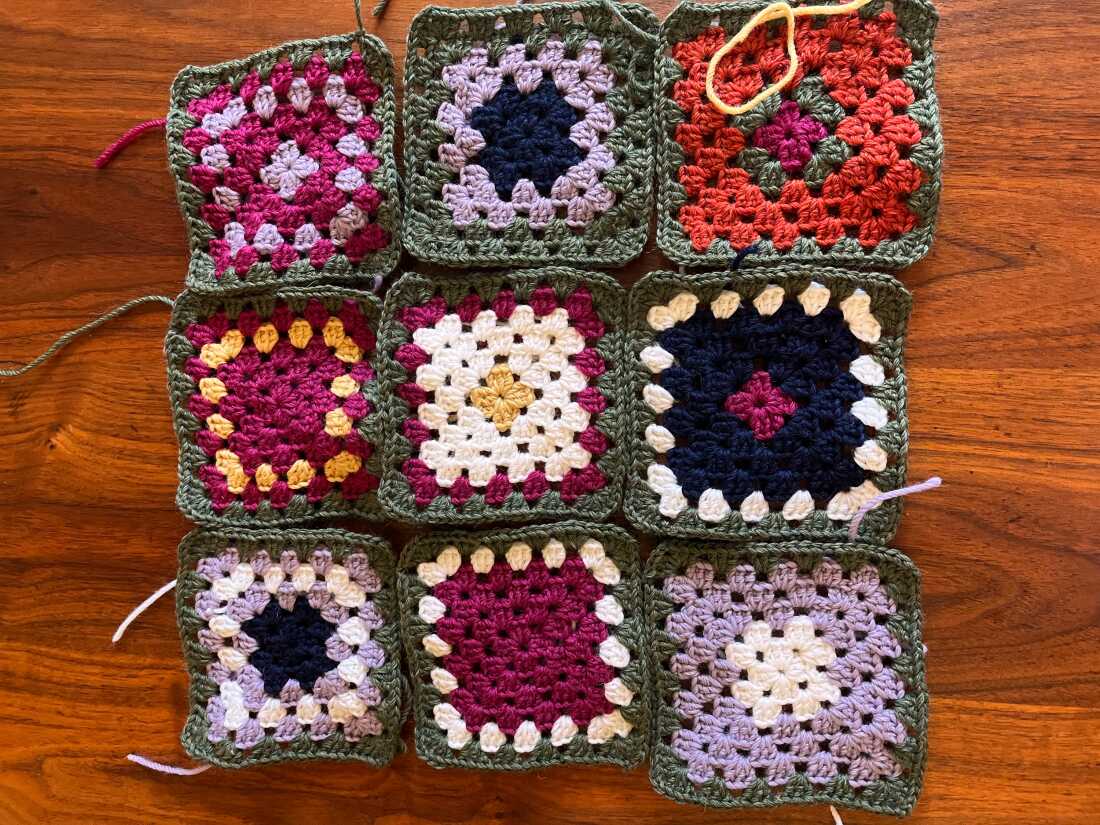
A selection of granny squares that Samantha Balaban crocheted this year
Samantha Balaban/NPR
hide caption
toggle caption
Samantha Balaban/NPR
“It’s incredibly meditative,” says Gabrielle Gatto, a death educator and Manager of Public Programs at Brooklyn’s Green-Wood Cemetery. “And that’s part of ritual. That’s part of really sitting with something.”
On a Tuesday evening, Gatto sets up a snack table inside the cemetery’s chapel, preparing for the start of her monthly interactive workshop, “Grieving & Weaving.”
“I think it was important to have that in the name as well,” she says, laughing a little at her rhyme. “The bold honesty of, hey, we are going to talk about grief. We are going to talk about death, dying and loss. But we’re also going to create happy memories together and eat a bunch of food and drink a bunch of things.”

Gabrielle R. Gatto, coordinator of public programs at The Green-Wood Cemetery. “We are going to talk about grief. We are going to talk about death, dying and loss. But we’re also going to create happy memories together,” Gatto says.
Mengwen Cao for NPR
hide caption
toggle caption
Mengwen Cao for NPR
Tess Rafferty is sitting in the front row, knitting a sweater vest out of beautiful copper-colored wool.
“It’s squishy, it sheds, it pills. But I love it. Smells like sheep,” she says.
It’s a project that had been sitting in her closet for months. Earlier this year, after both her grandmothers died, she lost what she calls the “knitting light” for a while. Rafferty, who is also a therapist, says she almost skipped the workshop to stay home with her dog, but she’s glad she didn’t — being here is therapeutic.
“We just don’t talk about death, right? Like death education,” she explains. “I think so much of what I struggle with, what my clients struggle with, is trying to ignore the awareness that we are not here forever. Staring that right in the face is empowering in a way.”
One thing to note — even though the series is called “Grieving & Weaving,“ you don’t have to be doing either to participate. Mary Pat Klein, who co-facilitates the event along with Gatto, says they’re just trying to create community.

Mary Pat Klein teachers beginners how to crochet at “Grieving & Weaving”
Mengwen Cao for NPR
hide caption
toggle caption
Mengwen Cao for NPR
“Recently somebody asked me — they embroidered, could they come? And it’s like, yes, please! So we’re trying to open it up. Just come and be creative,” she says.
Klein has been knitting since she was seven years old — she comes from a family of knitters and crafters — she brought quilting squares that her mom cut out long ago and she’s wearing an ivory-colored shawl her grandmother made for her decades ago. Klein is also a professional: she’s knitted items for Broadway and television productions.

Professional craftsperson Mary Pat Klein at The Green-Wood Cemetery. “We’re just trying to create community,” she says of the event series.
Mengwen Cao for NPR
hide caption
toggle caption
Mengwen Cao for NPR
They’ve turned the chapel into something like an art classroom. There’s a huge tub of donated yarn, as well as clay, colored pencils, markers, and books. Klein asks the people filling the pews for a show of hands — is anyone here to learn to knit? To crochet? Several people, including Virginia McLure, say they are.
McLure isn’t grieving a death — but she did recently get divorced — she says she’s grieving a time in her life that’s now over. “It’s a new chapter,” she says. “It’s exciting and sad. There’s a lot of like, trying to figure out what to do.” Klein teaches her the single crochet stitch — maybe this is something she’ll like to do.

Virginia McLure learns how to crochet from Mary Pat Klein. “I’m so pleased,” she said of her progress.
Mengwen Cao for NPR
hide caption
toggle caption
Mengwen Cao for NPR
Some people chat with their fiber friends, others keep to themselves. One attendee is putting the finishing touches on a beaded costume, another is making an ashtray out of clay, and someone else is embroidering a very elaborate dragon. Susan Refice didn’t know what she’d feel like doing, so she brought her entire bag of projects: a cotton and silk test swatch for a future sweater, a crocheted penguin head for her niece, and a blanket.
“When my partner’s mother died — she was a knitter and a crocheter — she had a ton of yarn,” Refice explains. “I raided her stash. So this is yarn that belonged to her.”
Nancy Jewell loved to create. Refice hadn’t even been going out with her partner for a year before Jewell made her a quilt. It has a patch on it that says: “For Susan from David’s mom.”
When Jewell went into a nursing home, Refice thought it would be nice to make her something. So she bought rainbow yarn and made her a shawl.

At “Grieving & Weaving,” any craft goes. Some people play with clay, embroider, quilt, draw with markers, and write on sticky notes.
Mengwen Cao for NPR
hide caption
toggle caption
Mengwen Cao for NPR
“It was like, her favorite thing before she passed away,” Refice remembers. “All the people in the nursing home said it looked like butterfly wings.” Refice plans to give the blanket she’s working on now to her partner, something to remember his mom by. And, she adds, there’s also something kind of nice about making something with his mother’s yarn.
“When I’m using her yarn, I think about her. And I think about what she was doing when she originally bought the yarn,” Refice explains. “That’s the nice thing when you make stuff for people, and you think about them, those memories are always going to be there.”
Death educator Gabrielle Gatto says, after all, it’s not the end product that’s the therapy. It’s the act of doing it.
“A big thing with grief is moving through it both mentally and physically,” Gatto says. “And that’s exactly what we do here. We bring something that is maybe heavy on our minds or our hearts. And then we work with our hands. We work with it, and we work together.”

Fiber friends laugh together at “Grieving & Weaving”
Mengwen Cao for NPR
hide caption
toggle caption
Mengwen Cao for NPR
I think she’s right. I’ve crocheted several finished blankets, and some unfinished blankets, over about 17 seasons of “Grey’s Anatomy.” But what I’ve loved the most is the ritual — having something to do with my hands, a quiet space for my brain: thinking about the people I’ll give my blankets to and the memories of all the nights I’ve gotten to spend on the couch, just being with my dad.


If you’re struggling to use up leftovers like a half-eaten rotisserie chicken, turn the assignment into a creative exercise, says chef Margaret Li. It’ll make the cooking process more fun and less guilt-driven.
Pulse/Getty Images/Corbis RF Stills
hide caption
toggle caption
Pulse/Getty Images/Corbis RF Stills
On a recent weeknight, I opened up my fridge and found an assortment of half-eaten or ignored food.
That included takeout that I didn’t find appetizing enough to eat for lunch. A rotisserie chicken with most of the meat picked off. A couple of raw vegetables from the farmers market that were starting to wilt.
“There’s nothing to eat,” I told myself. Yet even I knew that was ridiculous. There was plenty of food in my fridge. I just didn’t feel inspired to cook with it.
So I asked some chefs for guidance. How could I more consistently use leftovers and the other ingredients I tend to overlook?
Start with a mindset shift, says Margaret Li, chef and co-author of the cookbook Perfectly Good Food: A Totally Achievable Zero Waste Approach to Home Cooking. Think about cooking with leftovers as a creative, experimental exercise, not a guilt-driven one.
“It ends up being this fun game where you are creating something from what seems like nothing and solving this puzzle, and then you get to eat it,” she says.
There are other good reasons to use up your food scraps. Nationally, about a quarter of food products go to waste, according to the nonprofit ReFED. In my own household, where we spend about $200 a week on groceries, that means I might be throwing out the equivalent of $50 of food — an unnecessary burden on my wallet, not to mention the environment.
The chefs I spoke to had some practical tips about using up more of the food we buy. Here are a few that I put to the test.
Find your “hero recipes”
Build up an arsenal of go-to recipes that are flexible enough to use up just about any ingredient. Li calls them “hero recipes.”
I tried one of these from her cookbook, called “Make-It-Your-Own Stir-Fry.” (Scroll down for the recipe.) It includes loose ingredients like “1 pound crisp-crunchy vegetables” or “4 cups leafy greens.”
In the spirit of the recipe, I pulled vegetables out of my fridge at random and did not measure them out. The sauce was a simple mixture of soy sauce, vinegar, sugar and water. By the time I topped my bowl with chopped scallions, the dish looked like a gourmet meal, not an afterthought.

Other ideas: “You could put anything in a frittata, and it’ll be great,” says Tamar Adler, chef and author of The Everlasting Meal Cookbook: Leftovers A-Z.
Or, if you have day-old rice on hand, cook it alongside other ingredients to make fried rice. “Saute some aromatics — ginger, garlic, onion — in oil,” Adler says. Then add your rice and whatever leftover bits you have, like the rotisserie chicken and older produce I had in my fridge.
“Just take the approach of making it more flavorful and crispy and then spicy, and then usually adding a squeeze of lemon,” Adler says.
Label your leftovers
Keep a permanent marker and painter’s tape in your kitchen to label and date your leftovers, Li says. “That is a classic chef’s method for knowing what something is and when it was made. That saves you the guessing game.”
Adler takes the concept a step further and labels her leftovers with their intended use. Leftover blueberries are labeled “muffins-to-be on Tuesday,” she says. “I really like doing that — assigning the destiny of the food.”

So after a night of Ethiopian takeout, when we ended up with an entire container of leftover injera, I followed Adler’s advice and thought about what it might become in the future.
I imagined scrambling the spongy, tangy bread with eggs, akin to scrambling matzo into matzo brei. “Injera for eggs,” I wrote on the container. Sure enough, their destiny was fulfilled the following morning.

Li keeps a dedicated bag in her freezer just for scraps from which to make chicken or vegetable stock. That bag houses carrot peels, the ends of onions, extra garlic cloves and chicken bones.
Flavia Morlachetti/Getty Images/Moment RF
hide caption
toggle caption
Flavia Morlachetti/Getty Images/Moment RF
Don’t forget your odds and ends
Adler encouraged me to never, ever throw away the stems of herbs. Stems don’t get as much glory as tender, pretty leaves, but they still have the same herby taste.
“I’m going to chop these herbs up or stick them in a blender with a clove of garlic,” she says. Then add olive oil. “And then it’s just gonna be my base sauce for everything.”
So I foraged a few varieties of half-cut herbs from my refrigerator drawers, most of them sad looking and unidentifiable.
I threw out the stems that had turned brown and gooey and put the rest in a blender. I added garlic on Adler’s instructions, nuts and kale for bulk, and plenty of olive oil and salt. Then, on a whim, I added a splash of olive juice for brightness.
The result was somewhere between a pesto and a chimichurri, and it elevated that night’s otherwise routine dinner. And Adler was right: Once the stems were blended, it tasted exactly the same as the leaves. (The same idea applies for broccoli stems in a cheesy broccoli soup, Li says.)
Li likes to keep her odds and ends organized with an “Eat Me First” box in her fridge. That’s where she keeps half-used lemons, leftover coconut milk or produce that’s starting to get wrinkly. “You kind of have an idea for, OK, here’s where you look first,” she says.
Don’t strive for perfection
Cooking these meals did feel like a game, as Li had suggested. It brought me unexpected joy to use up as many existing ingredients as possible — to the point where I often spent much longer in the kitchen because I kept thinking of new ideas: If I turn these wrinkly sweet potatoes into a soup, then I can caramelize this half-cut onion for a topping, and then I can use the leftover soup as a sauce tomorrow …
Did I cook more often, though? Probably not. My cooking energy burned brighter but fizzled out after a few nights, at which point I ordered takeout.
So I was glad to hear Li’s take: If you’re too hard on yourself, you’re not going to enjoy it at all. “ I try not to be too obsessive about eating absolutely everything,” she says. If my takeout was truly terrible, I’m allowed to toss it or, better yet, compost it.
If you really want to use up everything, you can always chuck ingredients into the freezer. Li has dedicated freezer bags for different dishes, like vegetable scraps for soups or fruit discards for smoothies. (She labels them, of course.)
And how does that smoothie taste? It’s “delicious,” she says, “even if it’s made up of all the things that have been rejected in the past,” she says.
Recipe: Make-It-Your-Own Stir-Fry
Excerpted from Perfectly Good Food: A Totally Achievable Zero Waste Approach to Home Cooking. Copyright ©2023 by Irene Li and Margaret Li. Used with permission of the publisher, W. W. Norton & Company, Inc. All rights reserved.
Sauce
- 1 tablespoon soy sauce
- 1 tablespoon water
- 1 teaspoon sugar
- 1 teaspoon black vinegar, rice vinegar, lime juice, or other acid
- 1 tablespoon neutral oil, or enough to lightly coat the bottom of your wok or skillet
- 1 garlic clove, thinly sliced or minced, or more as desired
- ½-inch piece fresh ginger, minced or grated (optional)
- Pinch chili flakes or 1 small chile pepper, diced (optional)
- 4 cups leafy greens, torn into bite-size pieces, or 1 pound crisp-crunchy vegetables, cut into chunks
- Kosher salt
Stir the sauce ingredients together in a small bowl and set by the stove.
Heat a wok or large skillet over high heat until just smoking, then add the neutral oil and tilt to coat the bottom of the pan.
Add the garlic, ginger (if using), and chili flakes (if using) and stir-fry for 10 seconds. Add the greens and/or vegetables, in stages as necessary, and toss in the garlicky oil, then add the sauce and cook to your liking, stirring frequently.
Vegetable chunks may need 4 to 7 minutes — if you want to speed up the process, cover the pot so the vegetables steam for a minute or two, then uncover and toss again. Sturdy greens may need 3 to 5 minutes to get tender (we like to let them sit for a bit and char for extra texture).
Lighter leaves will need less than a minute to wilt down. Stir in a spoonful of any additional sauce you like, season with salt to taste, then sprinkle with your favorite garnishes and a generous drizzle of sesame oil.
A sprinkle of crunch is a great way to finish a stir-fry. Our favorites include crushed cashews or peanuts, toasted sesame seeds, thinly sliced scallions, and fried onions or shallots.
Your turn: What are your favorite go-to leftover recipes?
We’d love to hear from you! Share your recipe with us at lifekit@npr.org with your full name. We may publish it on NPR.org.
The story was edited by Malaka Gharib. The visual editor is CJ Riculan. We’d love to hear from you. Leave us a voicemail at 202-216-9823, or email us at LifeKit@npr.org.
Listen to Life Kit on Apple Podcasts and Spotify, and sign up for our newsletter. Follow us on Instagram: @nprlifekit.

Stephen Malkmus & the Jicks perform onstage during day two of the Boston Calling Music Festival at Boston City Hall Plaza on September 26, 2015 in Boston, Massachusetts. (Photo by Mike Lawrie/Getty Images)
Mike Lawrie/Getty Images
hide caption
toggle caption
Mike Lawrie/Getty Images
This week’s show was recorded in Chicago with host Peter Sagal, judge and scorekeeper Alzo Slade, Not My Job guest Stephen Malkmus and panelists Emmy Blotnick, Joyelle Nicole Johnson, and Gianmarco Soresi. Click the audio link above to hear the whole show.
Who’s Alzo This Time
Pool Problems; Don’t Forget to Hydrate; The Rise of Hot Podium Guy
Panel Questions
TSA Gets A Dressing Down
Bluff The Listener
Our panelists tell three stories about game shows in the news, only one of which is true.
Not My Job: Stephen Malmus, lead singer and guitarist for Pavement, answers our questions about road construction
Indie rock legend and founder of Pavement, Stephen Malkmus, joins us to play a game called, “Pavement repairs are underway!” Three questions about road construction.
Panel Questions
The Battle Over A Home Sale; The Best Three Words To Get Over A Loss and Out of a Meeting?; A New Job in the Dating World
Limericks
Alzo Slade reads three news-related limericks: Good News For Gym Slobs; Cruisin’ For A Tattooin’; Fringe Food Benefits
Lightning Fill In The Blank
All the news we couldn’t fit anywhere else
Predictions
Our panelists predict what will find after the reflecting pool is emptied

When Julio Miranda-Martin began his apartment search, he had one nonnegotiable: He wanted a dedicated dining room to entertain his friends. He was scouring Zillow in 2025 when a listing for a railroad-style, one-bedroom on the edge of West Hollywood came up that included the requisite dining room. It was also walking distance to his part-time job as a marketing coordinator at furniture store Lawson-Fenning. More importantly, at $2,500 a month it was within his budget.
-
Share via
Miranda-Martin met with his landlord the same day he found the listing, who told him he looks like his son. Feeling like finding this 950-square-foot apartment was kismet, Miranda-Martin signed the lease and set about creating a sophisticated and color-saturated sanctuary. Miranda-Martin decided he needed to make two major investments before moving in: painting the walls and changing the lighting. “I was finally able to move into a place that I actually like, not just out of necessity. I was like, let’s make it feel like my own,” says Miranda-Martin, who refers to the space as his “living canvas.”

In this series, we spotlight L.A. rentals with style. From perfect gallery walls to temporary decor hacks, these renters get creative, even in small spaces. And Angelenos need the inspiration: Most are renters.
The apartment is on the second floor of a fourplex, up a windowless staircase. Miranda-Martin embraced the lack of light and painted it a high-gloss crimson. Without natural light, he hard-wired sconces found on Facebook Marketplace that recall ornamental 18th century candlesticks. They cast a dim but moody light throughout the staircase, ending with an ornate mirror at the top. The mirror shows a glimpse of the apartment’s interior in its reflection when Miranda-Martin opens the door. “Every time people walk in, especially at night, it’s such a dramatic entry,” he explains. “It’s very cinematic,” agrees friend and co-worker Kristin Reeder, who is often a guest at his soirees, “like something from ‘Eyes Wide Shut.’ ”
1

2

3

1. Julio Miranda-Martin’s apartment decor starts in the bold staircase that leads to his door. 2. A mirror at the top of the staircase offers extra depth. 3. Julio Miranda-Martin fills the bookshelf in his dining room with books and treasures.
In contrast, the living room offers a calmer palette of sky blues and earthy browns. Miranda-Martin tends to choose paint colors based on the light. The living room, with abundant west-facing windows brings in soft, bright light. Miranda-Martin painted it with Benjamin Moore’s Navajo, a flat white, as a backdrop to the softer hues of the furniture he designed at his furniture and lighting company, Studio MM. “It adds a stillness,” he says.
The room is anchored by a large velvet couch in a rich brown. The modular couch is anchored on each side with Art-Deco influenced side tables, lamps and light blue slipper chairs he designed, setting up a cozy tableau for hosting his friends. Pale pink cushioned ottomans provide additional seating that can easily be moved around the room to accommodate additional guests.

A velvet couch acts as a statement piece in the apartment living room.
(Etienne Laurent/For the Times)
French doors separate the living room from the dining room. The chartreuse-infused dining room returns to a more dramatic colorway. With less natural light, Miranda-Martin wanted to play up the idea of dining-room-as-treehouse, reflecting the second-floor foliage visible from the small windows. Rather than trying to brighten the room, he leaned into the moodiness by buying inexpensive, USB battery-powered spotlights that are mounted on the ceiling with magnets. Taking an alcohol marker, he tinted the lights a soft amber, allowing him to highlight the art in the room without adding harsh overhead lighting.

The dining room is meant to reflect the foliage just outside the window.
(Etienne Laurent/For the Times)
A shell-adorned mirror anchors the wall facing the windows and built-in shelving, making the room feel larger. Miranda-Martin sourced two shell-shaped sconces that flank the mirror at an estate sale in San Francisco. Most of the art and home decor comes from Facebook Marketplace and Craigslist, or is thrifted from local stores. Estate sales are also a source, though Miranda-Martin feels the rising popularity of these sales in Los Angeles has led to an increase in pricing. “They’ve gotten so over the top now in L.A. [They’re] super expensive. You’re not really gonna find a deal,” he laments, citing the armed security checking bags recently at some of the hottest estate sales.
In addition to changing the lighting and painting the walls, Miranda-Martin prioritized the window treatments, with pinch pleat curtains from Ikea. “Drapery can just make a space feel super elevated,” he advises. He prefers a mix of new and vintage decor, balancing both for an eclectic but deeply personal look to his home. He tries not to overthink his aesthetic choices. “I think it’s very instinctual. I’m not really thinking, ‘Is this in good taste or is this going to be weird?,’ ” he says.
Down the hall, the bedroom’s mostly white design theme returns to a more serene composition, providing a quiet sanctuary. Miranda-Martin removed the headboard from his bed, making it seem like it’s floating between the night tables he designed. “Everything feels sort of streamlined and smooth,” says Miranda-Martin. Like the living room, the bedroom is painted the same flat white but the quality of the eastern light filtering into the bedroom casts a buttery glow.
1

2

3

1. Ceramics fill inset shelves in the kitchen. 2. A glass case in the apartment corridor between the dining room and the bedroom. 3. With its lighter decor, the bedroom was meant to be a sanctuary.
The small kitchen retains its midcentury charm, but open shelving above the counter provides an airier, more contemporary cupboard to show off Miranda-Martin’s dish and glassware collection. The easier access comes in handy when he’s entertaining. His apartment is the perfect pre-game space for him and his friends before a night on the town. He tries to make sure he pre-batches cocktails before his guests arrive.
He also likes to host more elaborate dinner parties and game nights. He attributes his love of entertaining to his upbringing as an only child in Downey. “I like hosting because I enjoy being around more people than when I was growing up,” explains Miranda-Martin. His goal, ultimately, is to bring together disparate groups of people from different spheres in a space everyone will feel comfortable in. Dinner parties at Miranda-Martin’s “feel like an event,” says Reeder. “It’s something you’re excited for and you want to get dressed up for.”
“I’m kind of going through a phase right now where I need to be around people,” admits Miranda-Martin. “I think I just hate being alone.”
-
Lifestyle1 minute ago
This mindset shift can help you get better at using up your leftovers
-

 Technology11 minutes ago
TMD’s keyless bike lock is a $280 solution to a $60 problem
-

 World17 minutes ago
American rescue teams pull infant alive from rubble in Venezuela days after devastating twin earthquakes
-

 Politics24 minutes ago
Trump scores another endorsement win with Louisiana Senate runoff victory
-

 Health26 minutes ago
New blood test detects 90% of aggressive prostate cancer cases, beating current screenings
-

 Sports32 minutes ago
2026 World Cup Round of 16 Odds: Which Teams Will Make It?
-

 Technology39 minutes ago
Apple raises prices as AI chip costs surge
-
 Business41 minutes ago
Wildfire rebuilding boosts L.A. County job growth in May

