Lifestyle
A daughter reexamines her own family story in ‘The Mixed Marriage Project’


Dorothy Roberts (left) is the George A. Weiss university professor of law & sociology at the University of Pennsylvania. Her parents, Robert and Iris, married in the 1950s.
Cris Crisman/Simon & Schuster; Dorothy Roberts
hide caption
toggle caption
Cris Crisman/Simon & Schuster; Dorothy Roberts
Almost a decade after her father’s death, legal scholar Dorothy Roberts still had 25 boxes of his research that she had yet to sort through. When she moved from Chicago to Philadelphia, she brought the boxes — and finally opened them.
Roberts’ father, Robert Roberts, was a white anthropologist who spent his career at Roosevelt University in Chicago. The boxes contained transcripts of nearly 500 interviews he had conducted with interracial couples across the city, including interviews with couples who were married in the late 1800s, all the way to couples who are married in the 1960s.
“They were absolutely fascinating,” Roberts says of the transcripts. “I learned so much about the racial caste system in Chicago, the Color Line, the Black Belt.”
Initially, Roberts saw the project as a chance to finish her father’s work, but as she examined the documents, she learned more about her own family — including the fact that her mother, Iris, a Black Jamaican immigrant, had assisted in her husband’s research.
“When I got to the 1950s interviews, I discovered that my mother was conducting all the interviews of the wives, while my father conducted the interviews for the husbands,” Roberts says. “Finding out that my mother was involved … created curiosity I had about my family, about their marriage, and then I began to think about how it related to me and my identity as a Black girl with a white father.”
In her new book, The Mixed Marriage Project: A Memoir of Love, Race, and Family, Roberts dives into her parents’ research and her surprise at learning that she was included as participant number 224 in the files. She also shares her own thoughts on interracial relationships.
“My father thought that interracial intimacy was the instrument to end racism, and I think it’s really flipped the other way,” she says. “We end racism when we will see the possibility of truly being able to love each other as equal human beings.”
Interview highlights

The Mixed Marriage Project, by Dorothy Roberts
Simon & Schuster
hide caption
toggle caption
Simon & Schuster
On white European immigrant women marrying Black men in the early 20th century
These were immigrant women coming from Europe who had no familiarity at all with the racial caste system in Chicago. … So when they marry Black men, in fact, they thought that marrying an American citizen would help them assimilate into American culture. So they had no idea … that if they married a Black man, it would do the opposite to them. They would be lower in their status than they were as white immigrants. And so many of them would say, “I found out that I had to live in a colored neighborhood. I had to leave my white neighbors. I had left my family in order to marry this Black man and move into the Black Belt. I now couldn’t even tell my employer my address, because if they found out my address, they’d know I must be living with a Black man.” Why else would a white woman be living in the Black Belt?
They were afraid they would lose their jobs, and many reported that they were fired as a result of their employer finding out that they were married to a Black man. They were met with stares when they got on the streetcar. Many said that if they were going on a streetcar in Chicago, they would go on separately and pretend they didn’t know each other so that no one would know that they were married.
On the difference between her father’s and mother’s notes in the project
My father, much to my horror, was very anthropological in terms of the physical traits of the people he interviewed. He wrote about the “Negroid traits” and whether the child had any trace of “Negroid blood” and that sort of thing. Again, remembering he was doing this in the 1930s.
My mother was much more interested in the personality traits of the people she interviewed and what their furniture looked like and her own emotions. And there’s just so many delightful things. The way in which she interacts with the children when she’s interviewing the wives — there’s a lot more attention to what the children are doing. I can’t remember a single interview where my father really describes the children’s behavior. He describes their physical appearance, but my mother would describe their behavior and their interaction with the mother. All of that is part of the interview and her notes, and she writes it almost like a screenplay. It’s really, really wonderful to read.
On the fetishization of interracial intimacy and biracial children
There was this visceral feeling I felt whenever a Black man, a Black husband, would talk about his preference for being with white women. These ideas that interracial intimacy has an extra excitement to it. It has an extra titillation to it — that kind of idea came up in many of the interviews — and I just have a very visceral revulsion at that kind idea, a sort of a fetishization of interracial intimacy and also of biracial children. The idea that whitening children makes them more attractive or makes them more intelligent or more appealing, more lovable. And whenever that came up, I just, sometimes I had to just throw the interview down because I couldn’t stand that kind of thinking.
On her decision to identify as Black in college and hide her dad’s whiteness
I now regret that I hid the fact that my father was white, that I denied him that part of my identity or denied the reality that he was part of my identity. … I think I very wrongly believed that if they knew my father was white, I somehow wouldn’t be as much an integral part of these groups, that they might feel differently about me. …
I realized by the end of working on the memoir that I am a Black woman with a white father [and] I should not deny all that my father contributed to my identity. I would not be the Black woman I am today, I probably would not have done the work against racism and against the demeaning of Black women, I would have not done the [work] to uplift Black women if it weren’t for my father and all that he taught me. And I need to appreciate and acknowledge all that my father contributed to the Black woman I am today.
On what this project has taught her about love and race
It showed me more powerfully than anything I’d ever read before how the invention of race, the lie that human beings are naturally divided into races, can erase the very ties of family. … In my own case, my father’s younger brother, my uncle Edward, disowned him when he married my mother. And even though he lived in the Chicago area and I had cousins who lived there, I never met them because of this rift, this divide between my father and his brother.
Working on the memoir also made me realize that all the work I’ve been doing throughout my career was trying to answer this question of, what does it take to love across the chasm of race? That’s what these couples are telling us, even the ones who were still racist. … They’re telling us what it takes to challenge and dismantle structural racism in America. And so, to me, these interviews persuaded me even more that we can believe in our common humanity. We can overcome the seemingly unbreakable, unshakable shackles of structural racism. But it can’t be simply by pretending that the sentiment of love or even loving someone across the racial lines will do it. We have to see the work that it’s going to take to do that.
Anna Bauman and Nico Gonzalez Wisler produced and edited this interview for broadcast. Bridget Bentz, Molly Seavy-Nesper and Meghan Sullivan adapted it for the web.





Bruce Campbell
I’m Battling Cancer
Published
Bruce Campbell has revealed he has cancer, but says it’s a type that’s treatable, though not curable.
“The Evil Dead” actor shared the news Monday in a message to fans, writing, “Hi folks, these days, when someone is having a health issue, it’s referred to as an ‘opportunity,’ so let’s go with that — I’m having one of those.” He continued, “It’s also called a type of cancer that’s ‘treatable’ not ‘curable.’ I apologize if that’s a shock — it was to me too.”

Campbell said he wouldn’t go into further detail about his diagnosis, but explained his work schedule will be changing. “Appearances and cons and work in general need to take back seat to treatment,” he wrote, adding he plans to focus on getting “as well as I possibly can over the summer.”
As a result, Campbell says he has to cancel several convention appearances this summer, noting, “Treatment needs and professional obligations don’t always go hand-in-hand.”
He says his plan is to tour this fall in support of his new film, “Ernie & Emma,” which he stars in and directs.
Ending on a determined note, Campbell told fans, “I am a tough old son-of-a-bitch … and I expect to be around a while.”

Neve Campbell in Scream 7.
Paramount Pictures
hide caption
toggle caption
Paramount Pictures
The OG Scream Queen Neve Campbell returns. Scream 7 re-centers the franchise back on Sidney Prescott. She has a new life, a family, and lots of baggage. You know the drill: Someone dressing up as the masked slasher Ghostface comes for her, her family and friends. There’s lots of stabbing and murder and so many red herrings it’s practically a smorgasbord.
Follow Pop Culture Happy Hour on Letterboxd at letterboxd.com/nprpopculture

Abriana Vicioso is the host of the Flower Hour, which takes place monthly.
(Jennifer McCord / For The Times)
Each flower carries a personal history. For Abriana Vicioso, the calla lily was her parents’ wedding flower — a symbol of her mother’s beauty. “She had this big, beautiful white calla lily in her hair,” Vicioso says. “I love my parents. They’re the reason I’m here. I’ll never forget where I came from.”
The Flower Hour begins with Vicioso announcing, with a warm smile: “Today is about touching grass.” The florist-by-trade gestures behind her to hundreds of flowers contained in buckets — blue thistles, ivory anemones and calla lilies painted silver — all twisted and unfurling into the air. “Tonight is going to be so sweet and intimate,” Vicioso says, eyeing the beautiful chaos at her feet. A grin buds across her face.
Moments before the workshop, participants sit at candlelit tables exchanging horoscopes and comparing their favorite flowers. A mention of the illustrious bird-of-paradise flower elicits coos and awe from the women. Izamar Vazquez, who is from Jalisco, Mexico, reveals her fondness for roses, which make her feel connected to her Mexican roots.
Vicioso hosts her flower-themed wellness workshop near the iconic Original Los Angeles Flower Market in downtown L.A. In January, the first Flower Hour event sold out, prompting her to make it a monthly series. Vicioso describes the event as a “three-part journey” where participants are invited to drink herbal tea, smoke rose-petal-rolled cannabis joints and create a floral arrangement. “The guide is to connect with the medicine of flowers,” Vicioso says.


Rose petal joints, tea and flower arranging are all part of The Flower Hour event’s offerings.
The event is hosted at the Art Club, a membership-based co-working space. “The Flower Hour is really beautiful. Everyone gets to explore their creativity while meeting new people,” says Lindsay Williams, the co-owner of the Art Club.
The idea for Flower Hour came to Vicioso during a conversation with her mother. “We joke all the time that flowers were destined to make their way into my life,” she says. She works as a florist and models on the side, even appearing in the pages of Vogue. Vicioso grew up in a Caribbean household, where flowers and offerings were part of daily life. “In my culture and religion, a lot of my family practices — an Afro-Caribbean religion — we build altars.”
Like many cultures, flowers carry sentimental value in her religion. “I’m Caribbean, so a lot of my family practices a Yoruba religion, which comes from Africa. In the Caribbean, it’s well known as Santería.”

-
Share via
After a difficult year and a breakup, Vicioso wanted to marry her love of flowers with community building. Because Vicioso uses cannabis medicinally, the workshop naturally includes a smoking component. “My family has smoked cannabis for a lot of reasons for a long time. It’s a really healing plant,” she explains.
In the workshop, even the cannabis gets the floral treatment. Vicioso presents her rose-petal-wrapped joints on a silver platter at each table. She rolled each by hand. “If you’ve never smoked a rose-petal-rolled joint, the difference with this is it’s going to have roses that have a slight tobacco effect,” she announces.
During the workshop, Vicioso stresses the importance of buying cannabis from local vendors. The cannabis provided was purchased from a Northern Californian vendor. The wellness workshop aims to reclaim the healing ritual of smoking cannabis. “This is a plant that has been commercialized,” Vicioso says. “There’s a lot of Black and Brown people who are in jail for this plant.”
The resulting workshop is what Vicioso describes as “an immersive wellness experience that is the intersection of wellness, creativity, community and an appreciation of flowers.” The workshop serves as a reminder to enjoy Earth’s innate beauty in the form of flowers — including cannabis. “It’s this gift that the universe gave us for free and that I have this deep connection with,” Vicioso says.


Conversation cards to generate discussion among participants (top, letf). The workshop serves as a “third space” for Angelenos to engage in tactile creativity and community building outside of traditional nightlife settings.
After enjoying lavender chamomile tea and smoking a joint, Vicioso introduces the flowers to the group before inviting them to pick their own. She emphasizes each flower’s personality traits, describing green dianthus as a “Dr. Seuss” plant. Then, there are calla lilies with their “main character moment.” It gets personal. “Start thinking of a flower in your life that you can discover,” she says. “If you’re feeling like you need inspiration, you can always remember that these flowers have stories.”
Vicioso infuses wisdom into her instruction on floral arrangements: There are no mistakes. Let the flowers tell you where they want to go, she urges. Intuition will be your guide — the wilder, the better.
“Hecho in Mexico” reads a sticker on a bunch of green stems. “Like me,” says Vazquez with a laugh. “They’re all doing their own thing. Like a family,” she says later, arranging stems.

The Flower Hour participants and Vicioso, center, chat as they build their own floral arrangements at the sold-out event.
Two participants — Vazquez and Rebeca Alvarado — are friends who run a floral design company together called Izza Rose. Like Vicioso, the friends have a connection to flowers through their Latin American culture. They met Vicioso in the floral industry and were overjoyed to discover her workshop.
“This is a great way to connect with other people,” says Vazquez.
Alvarado agrees, adding: “You’re getting to know people outside of going to bars. You can connect in different ways when there’s an activity.”
Vazquez uses flowers to stay connected to her Mexican heritage, adding that she prefers to support Mexican vendors. In recent months, the downtown L.A. flower market has struggled to recover from ongoing ICE raids. “Some are scared to come back,” says Vazquez.


Hand-rolled cannabis joints wrapped in rose petals are presented on a silver platter at The ArtClub (top, right). The Flower Hour aims to reclaim the healing rituals of cannabis and flowers.
Another participant, Barbara Rios, was attracted to the workshop for stress relief. “You can hang out with your friends, but it’s nice to do things with your hands,” she says. “I work a stressful job, and it’s nice to have that third space that we’re all craving.”
On this February night, the participants were predominantly women, save for one man. In the future, Vicioso hopes that more men learn to engage with flowers. “There’s a statistic about men receiving flowers for the first time at their funerals, and I think we have changed that,” she says.
To conclude the workshop, Vicioso encourages participants to build lasting friendships and incorporate flower arranging into their daily practice — even if it’s just with a small, inexpensive bouquet.
“Get some flowers together, go to the park, hang out with each other and hang out with me,” she says. Participants leave with flower arrangements in hand. In the darkness of the night air, it briefly looks as though the women carry silver calla lilies that are blooming from their palms.


Why the Microsoft 365 Copilot bug matters for data security

California gas is pricey already. The Iran war could cost you even more
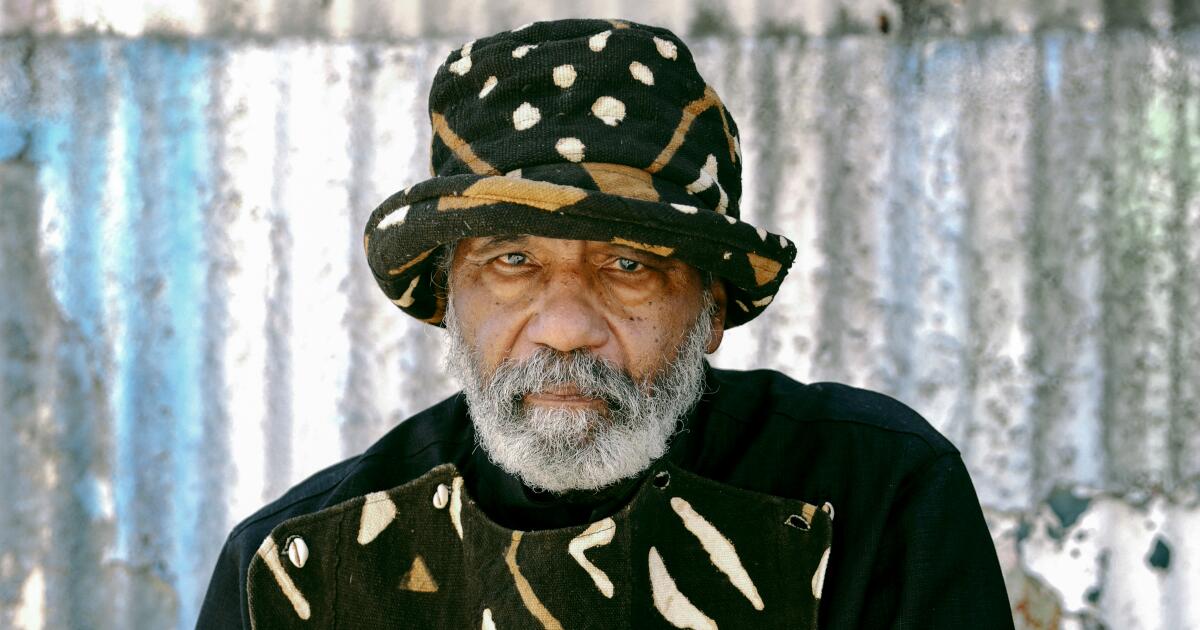
Ulysses Jenkins, Los Angeles artist and pioneer of Black experimental video, dies at 79

‘Evil Dead’ Star Bruce Campbell Reveals He Has Cancer

Rep. Kevin Kiley opts against challenging fellow Republican Tom McClintock

Florida High School Football Rankings: Top 25 teams – Oct. 21

Cleary's 21 help Le Moyne down Central Connecticut State 69-64 in OT

How old is Bo Nix? What to know about Oregon quarterback ahead of 2024 NFL Draft

99th annual Pony Swim held in Virginia

Indiana Members Credit Union announced as new anchor tenant at Bottleworks District

Unexpected birth brings hope to near-extinct Amazon tribe

Supreme Court blocks redrawing of New York congressional map, dealing a win for GOP

Map: Earthquake Shakes Central California

Gas prices could jump as Middle East tensions threaten global oil supply

Pakistan calls troops, orders 3-day curfew as 24 killed in pro-Iran rallies
-

 World5 days ago
Exclusive: DeepSeek withholds latest AI model from US chipmakers including Nvidia, sources say
-

 Massachusetts5 days ago
Mother and daughter injured in Taunton house explosion
-

 Denver, CO5 days ago
10 acres charred, 5 injured in Thornton grass fire, evacuation orders lifted
-

 Louisiana1 week ago
Wildfire near Gum Swamp Road in Livingston Parish now under control; more than 200 acres burned
-

 Technology1 week ago
YouTube TV billing scam emails are hitting inboxes
-

 Politics1 week ago
OpenAI didn’t contact police despite employees flagging mass shooter’s concerning chatbot interactions: REPORT
-

 Technology1 week ago
Stellantis is in a crisis of its own making
-

 News1 week ago
World reacts as US top court limits Trump’s tariff powers