Lifestyle
10 of fall’s finest drops, pop-ups and art happenings


Van Cleef & Arpels pop-up at South Coast Plaza
The ultimate in luxury, Van Cleef & Arpels has a pop-up at South Coast Plaza this fall. Interact with the Ludo collection, an array of Art Deco-influenced pieces inspired by Louis Arpels’ nickname. Created in 1934, the Ludo bracelet features updates like delicate mesh in hexagon and briquette motifs, woven by the maison’s craftsmen to heighten the effect of a supple ribbon. The metal is studded with precious and hard stones. Oct. 11–27. Jewel Court at South Coast Plaza, 3333 Bristol St., Costa Mesa. vancleefarpels.com
Perez Bros at Charlie James Gallery

(Yubo Dong / ofstudio photography; Courtesy of the artists and Charlie James Gallery, Los Angeles.)
Born into a family of self-described “motor heads,” identical twin artist duo the Perez Brothers present “Firme,” a collection of detailed, monochrome paintings in vivid color, evoking the one-of-a-kind murals synonymous with lowrider car culture. Painting together, the brothers chose their subjects from a personal archive of photographs, gathered over a lifetime immersed in the lowrider scene. On view Sept. 21–Oct. 26. 969 Chung King Road, Los Angeles. cjamesgallery.com
Ganni Eyelet Ballerina Bow Ballet Flat

Are you a Ganni girl yet? The Danish brand has been taking over, winning admirers with its comfortable, fun designs and ambitious sustainability goals. You’ve probably seen its Buckle Ballerina flat everywhere, and this fall it’s launching a new silhouette that blends the delicate, feminine charm of a ballerina shoe with Ganni’s signature eyelet hardware. The Eyelet Bow Ballerina flat comes in shiny red, black patent and dark denim options, making it the most versatile style for fall. Available now. ganni.com
Keen X Highsnobiety

Part of Highsnobiety’s Not in New York collection, the latest drop from the streetwear publication turned fashion shopping destination features a collaboration with performance footwear and accessories brand Keen. The limited-edition shoes are a rework of Keen’s Jasper style in two colorways. The Downtown pair is dressed in pink suede while the Uptown pair is clad in polished black leather. Both have a durable rubber sole that’s fit for hiking or lifestyle wear. Available now. keenfootwear.com
“The Tennis Court” at Skylight Books

“The Tennis Court” by Nick Pachelli
In “The Tennis Court,” award-winning journalist (and former competitive tennis player) Nick Pachelli profiles and photographs 200 of the world’s most beautiful and significant tennis courts. He explores not just the heavyweights like Wimbledon’s All England Lawn Tennis Club and Arthur Ashe but also epic indoor, urban and destination courts. This event is a must if you’re tennis-obsessed. Oct. 18, 7 p.m. 1818 N. Vermont Ave., Los Angeles. skylightbooks.com
Birkenstock X Union Bimshire

(Birkenstock X Union Los Angeles)
“It’s a dream come true to be working with Birkenstock, a brand that I have been wearing damn near since before I hit puberty,” says Union owner and creative director Chris Gibbs about his upcoming collaboration with the storied footwear brand. Gibbs personally designed the Bimshire, a new hybrid clog featuring a combination of details from his favorite perennial Birkenstock styles, the Boston and the Zurich. With desert tones of gray, taupe, and sandy pink, the Bimshire is affectionately named after the island of Barbados, paying homage to Gibbs’ Bajan roots. Available Nov. 7. store.unionlosangeles.com
American Artist & Magdalena Suarez Frimkess at LACMA

American Artist: The Monophobic Response
(Courtesy of the artist and LACMA)

Magdalena Suarez Frimkess and Michael Frimkess, “Mercado Persa,” 1996.
(Marten Elder Courtesy of the artists Kaufmann Repetto and the Michael Frimkess Trust)
Add these two exhibitions to your LACMA list. “The Monophobic Response” is a continuation of an ongoing series titled “Shaper of God” by American Artist, inspired by science fiction author Octavia Butler’s prophetic 1993 novel “Parable of the Sower.” Also on view this fall is “The Finest Disregard,” the first museum exhibition of Venezuelan-born, L.A.-based artist Magdalena Suarez Frimkess, whose playful, humorous and deeply influential work spans five decades. “The Monophobic Response” on view Nov. 1-4, “The Finest Disregard” on view through Jan. 5. 5905 Wilshire Blvd, Los Angeles. lacma.org
Denim Dudes X American Rag Cie

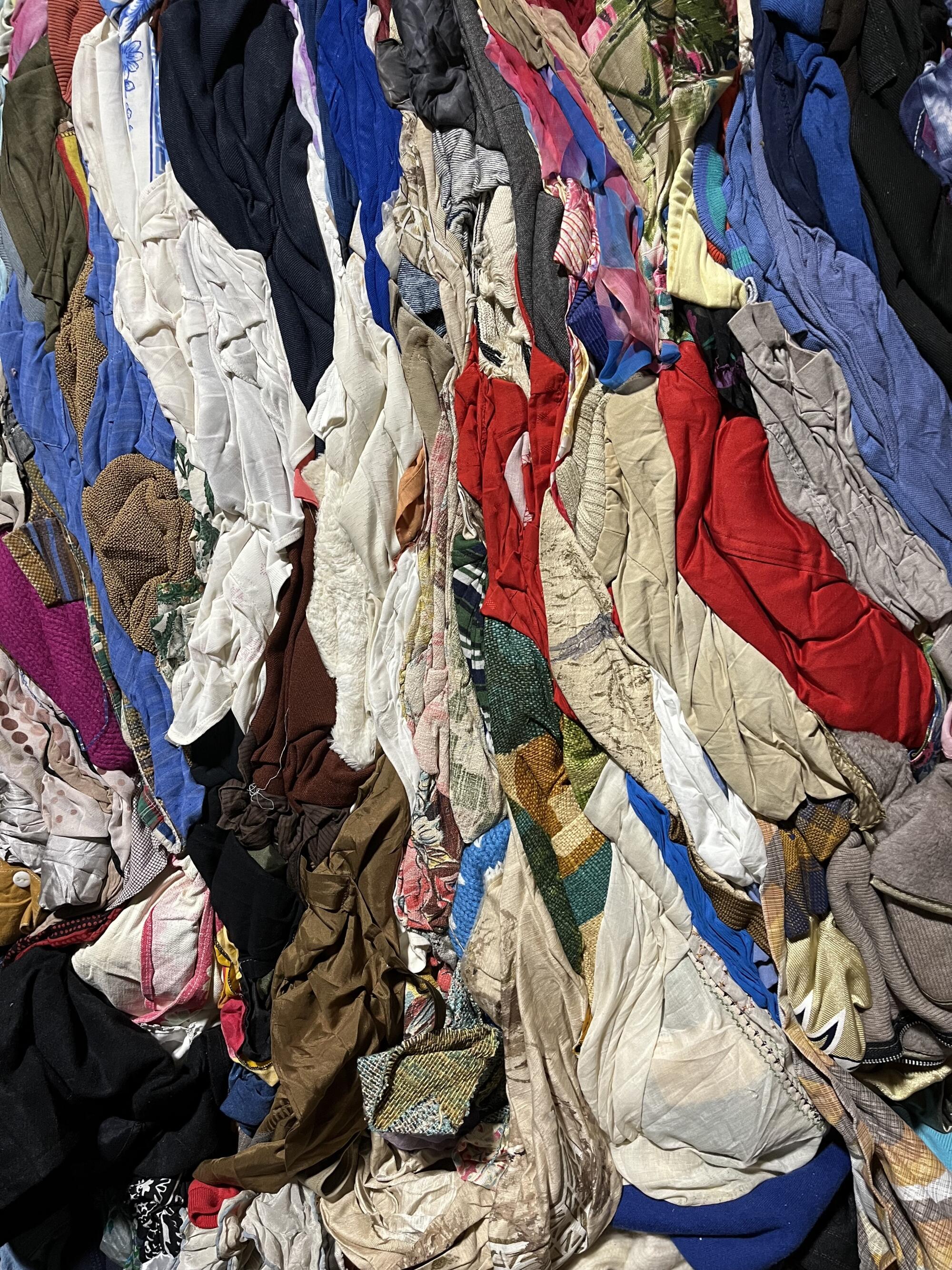
Koske from Clutch Golf and Masato Kawajo at American Rag Warehouse.
(Denim Dudes X American Rag Cie)
Since 1984, American Rag Cie has been at the forefront of the L.A. vintage retail scene. This fall, it is partnering with Denim Dudes, a visionary in denim and casualwear, to launch Nothing New — offering seven L.A. brands the chance to mine American Rag’s vintage archive to create exclusive capsule collections. Brands include denim knitwear pioneer Knorts (as seen on SZA and Addison Rae), L.A.’s favorite embellisher and embroiderer Masato Kawajo, and expert upcyclers Object From Nothing. Available now. americanrag.com
Tee A. Corinne at Webber Gallery

(Courtesy of the artist and Webber Gallery)
“A Forest Fire Between Us” is an exhibition of works by West Coast-based photographer, lesbian sex activist and educator Tee A. Corinne (1943-2006) — and the most extensive solo presentation of Corrine’s photos to date. In her 2001 book “Intimacies,” Corrine writes: “If I became a ‘visible and accessible lesbian artist,’ it is because of the images I made to fill a perceived void, to fill those blank spaces where desire and questioning and transcendence converged, where my intellectual longings and seven years of university art training responded to the social and cultural forces set in motion in the 1960s.” On view Sept. 14–Nov. 30. 939 S. Santa Fe Ave, Los Angeles. webberrepresents.com
“Rising Signs: The Medieval Science of Astrology” at the Getty Museum

“Rising Signs: The Medieval Science of Astrology”
(The J. Paul Getty Museum)
Rare astrology alert! “Rising Signs” explores medieval representations of the 12 signs of the zodiac through a fascinating selection of illustrations and devotional books from pre-modern Europe. The ornate and carefully preserved drawings showcase the mysteries of medieval astrology as it intersected with medicine, divination and daily life in the Middle Ages. On view Oct. 1–Jan. 5. 1200 Getty Center Drive, Los Angeles. getty.edu
Romany Williams is a writer, editor and stylist based on Vancouver Island, Canada. Her collaborators include SSENSE, Atmos, L.A. Times Image and more.


Lifestyle
L.A. Affairs: It’s hot when a man drives to me. But would this new guy make the trek from the Valley?

I met Dan on Hinge.
He lives in Woodland Hills, and I live in Venice. In Los Angeles, this is considered a long-distance relationship. In another city it might be nothing. Here, it’s a factor.
But I believe that with the right person, you can make anything work, so I stay open. I’m a native New Yorker, and if I were living in Brooklyn and a guy lived on the Upper West Side, that would be a 45-minute subway ride, which is truly nothing in New York. So with that same logic, I try to have flexibility with men in L.A.
When we started planning our first date, Dan suggested three options: a hike on mushrooms, a wine tasting or a walk on the beach.
A hike on mushrooms is something I’d only do with someone I already trust, not someone I just met online. I don’t do first-date hikes because I don’t like feeling trapped if the guy’s a dud. So I chose the wine tasting.
Then I learned the wine tasting was in West Hills.
On a Friday night, driving there from Venice would be insane. So I said I didn’t want to meet there because of the traffic. He suggested Malibu. That was also not ideal on a Friday.
I was getting annoyed — this was a pink flag because in my dating world, the guy is supposed to come to the woman’s neighborhood in the early days. I’ve gone out with plenty of men from the Valley who effortlessly suggested they come to me. It’s not rare or impossible.
I suggested he come to the Westside. I didn’t specifically say Venice, and in hindsight, I probably should have. He landed on Brentwood, which was manageable for both of us. On our first date, we met at an Irish pub on Wilshire Boulevard. He was cuter and more interesting than I had expected, and with the Guinness flowing, we had fun.
When I got home, he texted me: “Well, I like you 🙂 Less the tik tok and the lack of rock music in your life, but it’s not a deal breaker — there are other qualities 🙂 What are your thoughts?”
I noticed the slight negativity but was mostly dazzled that a man texted immediately after the date to say he liked me. In the modern dating economy, this felt rare.
The next day, both of our evening plans fell through, so we made a last-minute date. The wine tasting he originally suggested still sounded like fun, and although it meant me driving to the Valley, I was up for it now that we’d met.
We sipped flights at Malibu Wines & Beer Garden in its airy, romantic courtyard and played a flirty version of Truth or Dare. Halfway through, he dared me to kiss him.
We ended with sushi on Ventura Boulevard and a short make-out session in his car. He invited me to Thanksgiving at his uncle’s, which felt too soon, but also sweet.
After the second date, he texted and said he had his kids that week and was also hosting an event on Thursday, so his only day to meet was Wednesday. I said great.
On Tuesday night, he checked if we were still on, and I said yes.
Then he texted: “I’m flexible on time but not on location. I have a big event on Thursday, hopefully you can come to me again.”
My stomach tightened. This again?
So I texted back: “I drove to you last time, which was a bit of an exception for me especially in the early days, but the wine tasting location sounded special. Usually guys come to my area. How about we switch it up this time?”
He replied: “I appreciate the effort! Because of my event, I’d rather be close to a computer just if needed … Here is what i offer:
— I’ll come to your area anytime next week/end
— Lunch/dinner on me
I want to continue where we stopped last time 😉 No pressure of course, but let’s snuggle”
I responded: “Ok let’s meet next week. Snuggles sound nice … let’s see what happens …”
Then he wrote: “So I won’t see you tomorrow?”
I replied: “Unless you wanna come to me and bring your laptop along, let’s rain check until you have more flexibility.”
He said: “Dang, you are hard. I’ll let you know tomorrow around midday if it’s ok.”
And then — surprise — he decided to come.
He drove to Venice for a 5 p.m. date. He said his ETA was 5 p.m., and it ended up being 5:25 p.m., typical 405 Freeway.
When he showed up, he was in a cranky mood. On our way to KazuNori in Marina del Rey, I thanked him for picking me up and told him I think it’s hot when the guy comes to the girl.
“You’re just saying that because you want me to come to you more,” he said, not playfully, but aggressively.
That was basically the end for me. But there I was, in his car, heading to dinner. So I stayed pleasant and tried to make the best of it.
I shared that in the early stages of dating, I find it’s good etiquette for the guy to come to the woman’s neighborhood. He immediately disagreed and started ranting about how dating rules are ridiculous and how they swing in women’s favor. He resented paying for dates and declared he wasn’t looking to “sponsor a woman’s life.”
“If women want equality and equal rights,” he said, “then it should apply all across the board, including dating, and the man shouldn’t have to pay.”
I said women don’t actually have equal rights because we get paid less than men and often receive lower salaries than men in the same position.
I tried to change the subject and reset the mood, but he insisted we keep hashing it out.
I tried to explain masculine/feminine dynamics: providing and protecting, giving and receiving.
“What does the man get out of this arrangement?” he asked.
It was like watching someone’s personality warp into Mr. Hyde. Then he brought up another point: He’s a single dad of two kids, so he gets tired; and because I don’t have kids, that should factor into who drives where.
At this point, I was barely engaging and focused on eating my hand rolls, and I couldn’t wait to get home.
The check came, and I happily split it, wanting nothing further from him.
In the car back to my place, he remarked: “It’s obvious we’re never gonna see each other again.”
Obvious, but did it need to be stated?
Then he showed me a Spotify playlist he’d made for me of his favorite electronic music, because he knows I like EDM.
“Oh, that’s sweet,” I said.
“Yeah, that’s how I show interest. Through things like this, not who drives to who,” he replied.
When I got out of the car, we wished each other luck, and I headed inside and shut the door.
Two hours later, he sent me the playlist. I’ve yet to listen to it.
It wasn’t the distance that ruined it. It was the resentment. I’m not looking for a man who feels burdened by the effort. I’m looking for a man who sees the value of courting a woman in the first place.
The author is a writer, comedian and former psychologist who lives in Venice. She is the creator of the new vertical series “Manfari.” She’s on Instagram: @solange_neue and @manfari.show.
L.A. Affairs chronicles the search for romantic love in all its glorious expressions in the L.A. area, and we want to hear your true story. We pay $400 for a published essay. Email LAAffairs@latimes.com. You can find submission guidelines here. You can find past columns here.

Lonnie Bunch III is the 14th Secretary of the Smithsonian. He’s pictured above in September 2017.
J. Scott Applewhite/AP
hide caption
toggle caption
J. Scott Applewhite/AP
In a memo addressed to staffers sent Tuesday, the secretary of the Smithsonian, Lonnie G. Bunch III, defended the institution after the White House issued a 162-page report that characterizes the National Museum of American History as a place which has become “subject to institutional capture by a radical, activist ideology that is fundamentally opposed to telling the noble, honest story of the great country we know and love.”
In his email, which NPR has obtained, Bunch wrote in part: “While there will always be room for improvement, this report is not a fair characterization of the work and totality of the National Museum of American History. At the Smithsonian, our work is driven by scholarship, accuracy and an uncompromising commitment to tell the fullness of America’s story. As public servants and the keepers of this institution, we are charged with helping a nation find understanding, hope and clarity and as part of that duty, we are dedicated to excellence, reflection and growth.”

He continued: “We remain focused on what grounds us: a steadfast commitment to scholarship, nonpartisanship, independence, accuracy and integrity. For nearly 180 years, the Smithsonian has worked alongside partners across government — from the White House to Congress to our governing Board of Regents — guided by our enduring mission to increase and diffuse knowledge. That purpose remains: to pursue knowledge with rigor and to serve the American public with clarity and care.”
The White House report was issued on July 4 by the Domestic Policy Council under the title “Saving America’s Story: How Ideological Capture at the Smithsonian Institution’s National Museum of American History Erases Our Heritage.”

The council faults the National Museum of American History on a multitude of fronts, saying it underemphasized the Founding Fathers and early colonial and Revolutionary history; was not sufficiently celebratory of the country’s 250th anniversary; and that it engaged in “anti-white,” “illegal alien” and transgender activism.
It also accuses the museum of trying to “indoctrinate” teachers and students through its exhibitions, programming and teaching resources.
In the report, the council also specifically criticizes museum director Anthea Hartig, who has led the National Museum of American History since 2019 and is concurrently the president of the Organization of American Historians, calling her “an activist advancing an ideological agenda contradictory to the museum’s founding purpose of fostering patriotism.”
The Trump administration has made the Smithsonian museums one of its primary targets in its efforts to reshape cultural narratives to align with its viewpoints. In August 2025, the White House requested a “comprehensive internal review” of eight Smithsonian museums, including the National Museum of American History, following an executive order issued by President Trump in March 2025 in which he called for the removal of “improper ideology” from the Smithsonian’s offerings.
According to the Smithsonian’s charter, all of its 21 museums, 14 education and research centers, and the National Zoo are meant to be run independently of the federal government. The Smithsonian is overseen by Bunch and a board of regents, which includes Vice President Vance, Supreme Court Chief Justice John Roberts and other members appointed by Congress.
In an interview with NBC’s Meet the Press on Sunday, Bunch spoke about the Smithsonian’s 250th anniversary special exhibition at the Smithsonian Castle, which is called “American Aspirations.”
He told NBC: “It’s really important for people to understand that America is much an ideal as it is a place, that it’s a series of aspirations that have really shaped who this country is. And so for me, what is so powerful is to say, ‘Let us honor the words of Thomas Jefferson and the founders, but let us use those to challenge us to be better.’”
Jennifer Vanasco edited this story.

-

 Kansas6 minutes ago
Kansas parents charged after child fatally shoots 5-year-old, 8-year-old
-

 Kentucky8 minutes ago
Affordable Care Act rates rate hikes could strain Kentucky families, WKAS warns
-

 Louisiana13 minutes ago
Moncus Park gets helping hand from 260 youth volunteers across Louisiana
-

 Maine20 minutes ago
Maine’s high court keeps transgender athlete referendum off 2026 ballot
-

 Maryland24 minutes ago
MD woman sentenced to 2 years, $6.8M restitution in multi-million-dollar laundering scheme
-

 Michigan36 minutes ago
Harmful algal blooms reported on 2 large West Michigan lakes
-

 Massachusetts38 minutes ago
Insider tips for navigating the Brimfield Antique Flea Market
-

 Minnesota43 minutes ago
Northwest Minnesota Foundation awarded $200,000 for child care economic development

