TAMPA (BLOOM) – In the evolving landscape of home fitness, hybrid workouts that are time-optimized have become the norm. These routines often include high-intensity interval training (HIIT) and circuit training, combining strength and cardio exercises to maximize efficiency. Sienna Vannoy, Fitness Coach at Speediance, explains, “The Speediance SmartHome Gym aligns perfectly with these trends, offering comprehensive features that cater to various fitness goals without requiring hours at the gym.”
Benefits of Working Out at Home
The advantages of home workouts are numerous. According to Vannoy, they include:
Privacy
Convenience
Cost savings (no membership fees)
No commute
No waiting for equipment
Better hygiene
Staying Motivated and Consistent
Motivation Tips
To stay motivated and consistent, Vannoy suggests:
Identify Your Deep “Why”: Understand and remember why you started.
Have a Progressive Plan: Create a step-by-step plan to avoid feeling lost.
Track Your Progress: Use photos to visualize and motivate yourself.
Schedule Your Gym Time: Treat it as an essential appointment.
The Speediance SmartHome Gym Advantage
Unique Features
What sets the Speediance SmartHome Gym apart from other at-home systems are its distinct modes: Chain Mode, Eccentric Mode, Standard Mode, and Constant Mode. These modes allow users to customize their workouts and achieve progressive overload effortlessly. “It literally sets you up for success,” says Vannoy.
Advertisement
AI Integration
The integrated AI in the Speediance Gym Monster enhances workouts by learning the user’s performance and adjusting weights and repetitions accordingly. This ensures each session is as efficient and effective as possible.
Options
The Speediance Smart Home Gym comes in six different versions, each equipped with a variety of accessories and your choice of a 21.5-inch or 32-inch screen. While these machines are top-of-the-line and not cheap, you can expect to spend around $2,000 on average. Investing in a Speediance Smart Home Gym ensures you get a high-quality, versatile, and convenient fitness solution that revolutionizes your at-home workouts.
Speediance Smart Home Gym vs. Leading Home Gym Systems
When choosing a home gym system, it’s essential to consider the features, versatility, and overall value each product offers. Here’s a comparative analysis of the Speediance Smart Home Gym against other leading home gym systems, highlighting its unique features and advantages.
Speediance Smart Home Gym
Key Features:
Advertisement
Adjustable Resistance: Offers up to 220 lbs of personalized resistance.
Versatility: Transforms into a rower, Ski Trainer, squat rack, and cable station.
AI Integration: Uses AI to adjust weights and set repetitions based on user performance.
Compact Design: Takes less than 10 sq ft when in use; only 3 sq ft when folded.
Screen Options: Available with either a 21.5-inch or 32-inch screen.
Custom Workouts: Features Freelift and partner modes for personalized exercise routines.
Health Tracking: Integrates with smartwatches for comprehensive health and fitness data.
User Experience: Easy setup and minimal maintenance.
Peloton
Key Features:
Live and On-Demand Classes: Offers a wide range of live and on-demand cycling and treadmill classes.
Community: Strong community aspect with leaderboards and social features.
Subscription-Based: Requires a monthly subscription for access to classes and content.
Equipment: Primarily focuses on cycling (Peloton Bike) and running (Peloton Tread).
Advantages:
Excellent for cardio-focused workouts.
Strong sense of community and competition.
Disadvantages:
Limited to specific types of workouts (cycling and running).
Requires ongoing subscription fees.
Tonal
Key Features:
Digital Weight System: Uses electromagnetic resistance up to 200 lbs.
Smart AI Coaching: Provides real-time feedback and adjustments.
Compact Design: Wall-mounted system saves space.
Classes: Offers a variety of strength training and fitness classes.
Advantages:
Highly advanced digital weight system.
Interactive and guided workouts with smart adjustments.
Disadvantages:
High upfront cost.
Limited to strength training and specific workout types.
Mirror
Key Features:
Interactive Display: Full-length mirror that doubles as an interactive fitness screen.
Live and On-Demand Classes: Wide variety of workout classes, including yoga, strength, cardio, and boxing.
Compact Design: Minimal space required as it mounts on the wall.
Subscription-Based: Requires a monthly subscription for access to classes.
Advantages:
Blends seamlessly into home decor.
Wide variety of workout classes.
Disadvantages:
High upfront cost plus subscription fees.
Primarily class-based with less focus on equipment versatility.
Unique Features and Advantages of Speediance Smart Home Gym
Versatility and Comprehensive Workouts: Speediance stands out for its ability to transform into multiple types of equipment, including a rower, Ski Trainer, squat rack, and cable station. This versatility allows users to perform a wide range of exercises without needing additional equipment, making it suitable for full-body workouts.
AI Integration: The integrated AI in the Speediance Smart Home Gym is a significant advantage. It dynamically adjusts weights and repetitions based on the user’s performance, ensuring efficient and effective workouts. This feature is particularly beneficial for users looking to optimize their training and achieve progressive overload.
Space Efficiency: Despite its comprehensive functionality, Speediance is designed to fit into limited spaces. It requires less than 10 sq ft when in use and only around 3 sq ft when folded, making it ideal for home use without taking up too much space.
Screen Options and Health Tracking: With options for a 21.5-inch or 32-inch screen, Speediance provides clear and engaging workout displays. Additionally, its integration with smartwatches allows users to track their health and fitness data seamlessly, promoting a holistic approach to wellness.
Customization and User Experience: The Freelift and partner modes enable users to customize their workouts according to their preferences and fitness goals. The easy setup and minimal maintenance required further enhance the user experience, making it a convenient choice for home fitness.
User Feedback and Practical Use
Success Stories
Advertisement
Although specific names can’t be shared, Vannoy mentions users over 60 who have used the Speediance Gym Monster to prepare for and win bodybuilding competitions. Additionally, busy moms appreciate the flexibility it provides, allowing them to stay fit while being at home with their kids.
Space Requirements and Versatility
The Speediance SmartHome Gym is space-efficient, requiring less than 10 sq ft when in use and around 3 sq ft when folded. It offers a wide range of workouts, from sport-specific to HIIT and strength training, catering to various fitness levels and goals.
Setup and Maintenance
Setup is straightforward, with the machine arriving nearly fully assembled. Users need to connect it to a power outlet, WiFi, and it’s ready to go. Daily maintenance involves regular cleaning and ensuring the Bluetooth ring is charged.
Advertisement
Health and Wellness Insights
Injury Prevention
To prevent injuries, Speediance offers strength assessment tests, guided warm-ups, and cool-downs. The Spotter Mode feature detects if a user is struggling and automatically adjusts the weight to prevent injury.
Customization
Users can create personalized training plans using the Custom Template feature, selecting movements, sets, and weights from an extensive library.
Holistic Approach
Speediance supports overall well-being by integrating with smartwatches for comprehensive health tracking and fostering a sense of community through online connections.
Advertisement
The Future of Fitness
Innovation and Adaptation
AI and smart technology are revolutionizing fitness by providing tailored workout plans and real-time feedback. Vannoy expects Speediance to continue evolving, helping individuals achieve their fitness goals more efficiently.
Personal Insights from Sienna Vannoy
Fitness Journey
Vannoy’s journey from a collegiate softball player to a wellness bodybuilder and personal trainer reflects her dedication to fitness. She joined Speediance to help others achieve their fitness goals and embrace a healthier lifestyle.
Advice for Beginners
Advertisement
For those starting with an at-home gym like Speediance, Vannoy emphasizes the importance of consistency, patience, proper form, and staying hydrated.
My Experience with the Speediance Family Plus Home Gym
As a fitness enthusiast, I have always valued the convenience and efficiency of at-home workouts, but finding the right equipment has been a game-changer. The Speediance Family Plus Home Gym has made my fitness routine more accessible and comprehensive, truly revolutionizing how I approach my workouts.
The Speediance Family Plus is designed to fit into limited space while offering unlimited possibilities for full-body training. With its adjustable resistance feature, it can adapt to match your strength and ability level, providing up to 220 lbs of personalized challenge. This flexibility allows me to tailor my workouts precisely to my fitness goals.
One of the standout features of the Speediance Family Plus is its versatility. It can transform into various equipment, including a rower, Ski Trainer, squat rack, and cable station. This multifunctionality means I can perform a wide range of exercises without needing multiple pieces of equipment. The Freelift and partner modes offer additional customization options, allowing me to switch up my routine and even enjoy partner workouts.
Despite its comprehensive capabilities, I still supplement my at-home workouts with sessions at a traditional gym. Primarily, this is for leg day, where I utilize heavier weights and specialized machines not available at home. Additionally, my training in kickboxing and Brazilian Jiu-Jitsu (BJJ) requires access to specific facilities and equipment, which I find at my gym.
The convenience of having the Speediance Family Plus at home cannot be overstated. It eliminates the need for daily commutes to the gym, saving me time and allowing for more flexible workout schedules. The seamless integration of various workout modalities within one compact system ensures that I can maintain a well-rounded fitness routine from the comfort of my home.
Advertisement
Even my girlfriend, who typically gets most of her exercise through her physically demanding job and rarely lifts weights, has found the Speediance Family Plus Home Gym incredibly convenient. The ease of use and the flexibility of the equipment have encouraged her to start incorporating more structured workouts into her routine. She’s particularly taken to using the gym for core and leg exercises, which she can easily fit into her busy schedule without needing to leave home.
The adjustable resistance and variety of equipment modes, such as the squat rack and cable station, provide her with everything she needs to target specific muscle groups effectively. The convenience of having a comprehensive workout system at home has not only made it easier for her to stay active but has also inspired her to explore new fitness goals. This shared use of the Speediance Family Plus has brought an additional layer of motivation and enjoyment to our fitness journey together.
In summary, the Speediance Family Plus Home Gym has become an essential part of my fitness journey. It offers the perfect balance of convenience, versatility, and challenge, making it an invaluable addition to my workout regimen. Whether you’re training solo or with a partner, this home gym provides the tools you need to achieve your fitness goals effectively.
Want more behind-the-scenes content, exclusive sneak peeks, and inspiring stories like this? Follow me on Instagram! 📷 I share my latest adventures, interviews, and features, giving you a glimpse into the exciting world of lifestyle, health, and wellness. From garden tours to culinary creations, and much more, my Instagram is your ticket to staying connected and discovering what makes Tampa Bay so vibrant.
Click the link below to follow me and never miss an update! Let’s grow together! ⬇️
“We naturally lose muscle mass, reaction speed and balance as we age,” says this elite Hollywood coach who’s trained everyone from Margot Robbie and Scarlet Johansson to Richard Madden and Pedro Pascal — but recommends doing step-ups to undo the damage of aging in your glutes, quads and calves
There’s a reason why some of the most effective exercises tend to mirror movements in real life. It’s not because personal trainers and coaches lack imagination, but because the body doesn’t care how creative your programming is — it cares whether you can climb a flight of stairs without grabbing the banister, for example, or if you can catch yourself from a stumble.
These are just a few of the benchmarks that matter in later life, and for elite performance coach David Higgins — who has trained everyone from Margot Robbie and Scarlett Johansson to Samuel L. Jackson, David Harbour, Game of Thrones’ Richard Madden and the entire cast of The Batman, among many others — one exercise sits at the top of the list for anyone over 50: the step-up. Here’s why.
Lower-body power matters so much after 50
Most people understand that strength declines with age. What they underestimate, however, is how quickly it begins to matter in practical terms, despite not being able to be measured on the best smartwatches’ fitness age metrics.
Latest Videos From
“Lower body power becomes critical after 50 because we naturally lose muscle mass, reaction speed and balance as we age,” says Higgins. “The glutes, quads and calves are what keep you upright, stable and independent.”
If you can’t generate force through the floor, he says, “everyday movements like climbing stairs, getting out of a chair or catching yourself from a fall become harder.” The step-up addresses all of this in a single movement: “it trains strength, balance and coordination all at once and mirrors real life better than most gym exercises.” It’s slightly similar to the farmer’s carry, an application of a real-life movement.
It’s also the reason Higgins places it above more popular alternatives. Walking is excellent, of course, but doesn’t load the body enough to preserve muscle. Squats are bilateral — they share the work equally between both legs, which means they don’t expose or address the kind of side-to-side imbalances that tend to develop quietly over decades. Step-ups, however, are unilateral, as each leg works independently, building the stability and gait mechanics that bilateral training misses.
“If I could only choose one lower-body movement after 50,” says Higgins, “step-ups would be near the top because they combine strength, stability, balance, gait mechanics and unilateral control in one movement; they bridge the gap between rehab and performance.”
Sign up for breaking news, reviews, opinion, top tech deals, and more.
Watch the tutorial video below for advice on how to do a step up:
The mistake most older adults make
Before thinking about adding height, load or additional reps, Higgins is more concerned with something more fundamental: the quality of the movement itself. “The biggest mistake older adults make is chasing fatigue instead of quality movement,” he says. “Rushing through reps, leaning through the hips, or pushing through the stronger side of the body.” Your nervous system, he says, “has to trust the movement before your body can own it.”
Advertisement
Rushing through step-ups doesn’t just reduce the benefit — it reinforces the compensations you’re trying to correct. If you’re relying on the trailing leg to push you up, or leaning forward as you step, you’re not actually building the unilateral strength and hip control the exercise is there to develop.
Instead, Higgins’ coaching cue is worth memorising: “push the floor away and finish tall through the glutes.” Most people pull themselves up through the knee, instead of driving through the hip. It’s a subtle distinction, but makes an enormous difference to where the effort is actually made.
How to get started — and when to progress
(Image credit: Getty Images / Ildar Abulkhanov)
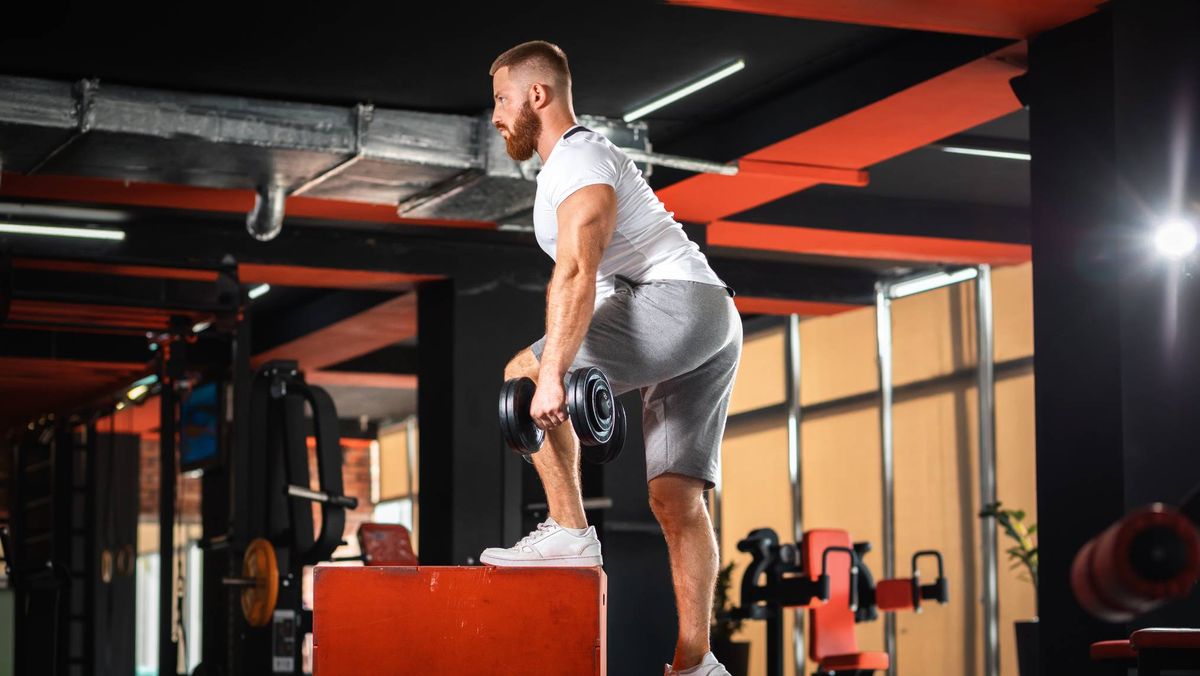
To perform the step-up, stand facing a sturdy bench, box, or step. Place one foot fully on the platform, then drive through that heel to lift your body up until both feet are on the step. Step back down with control and repeat for the desired reps before switching legs. Keep your chest up and avoid pushing off excessively with the trailing leg.
For step height, beginners should start with a low box, roughly ankle to mid-shin height. “You want control, not compensation,” he says. Fitter adults with solid mobility, balance and hip control can work up to knee height.
Advertisement
As for volume, Higgins prescribes 2–3 sets of 8–12 controlled reps per leg. “Tempo matters more than volume,” he says. Drive through the whole foot, stand tall at the top and lower slowly under control.
Higgins confirms that just your bodyweight is sufficient resistance to begin with and, for many people over 50, it’s exactly where they should stay — probably for longer than they’d expect. “Most people over 50 need to relearn movement patterns before adding load,” he says. “Once control, balance and posture improve, adding dumbbells or a weighted vest is a brilliant progression.” The dumbbells can wait. As for frequency? Two to three sessions a week is enough to see real benefit, Higgins says. “Consistency beats intensity every time.”
Precautions
Step-ups are accessible to most people, but Higgins flags a few situations worth considering. Anyone with severe knee osteoarthritis, significant balance issues or acute hip pain should approach the exercise carefully and ideally with professional guidance. “Often it’s not that the exercise is wrong,” he says, “it’s that the height is too ambitious or the body isn’t controlling the movement properly yet.” Low and slow is always the right answer.
What leg-day moves are your go-tos in the gym? Have you tried the step-up yet? Let us know below.
Follow TechRadar on Google News andadd us as a preferred source to get our expert news, reviews, and opinion in your feeds.
HFA urges targeted trade policies to protect the fitness industry.
This week, HFA submitted comments to the Office of the US Trade Representative (USTR) on two important trade policy dockets that could have significant implications for exercise equipment manufacturers, suppliers, and fitness facility operators.
Section 301 Tariff Proceeding USTR sought comment on proposed tariffs from its Section 301 forced labor investigation, including possible product exclusions based on domestic availability and economic impact.
HFA submitted comments that advocated excluding exercise/rehabilitation equipment and critical components, citing irreplaceable global supply chains and the industry’s role in public health, chronic disease prevention, and military readiness.
US- China Board of Trade
Advertisement
USTR proposed a new Board to identify non-sensitive products for reciprocal tariff reductions with China.
In comments submitted to USTR, HFA recommended designating exercise equipment as “non-sensitive” and eligible for negotiation, prioritizing products that boost US manufacturing and affordability, and setting criteria recognizing public health, productivity, and military readiness benefits.
The HFA thanks member operators, manufacturers, and suppliers whose data strengthened these submissions. Your efforts are helping HFA advocate for trade policy that supports the fitness industry.
The payer group said the new Lifestyle Spending Account will pay for the things not currently covered by other flexible spending accounts, such as consumer products to monitor nutrition and manage diabetes. The full list of options is presented in a new webstore.