Fitness
Heart rate zones on Apple Watch and iPhone – 9to5Mac


A handy health and fitness feature with watchOS and iOS is the ability to see your heart rate zones on Apple Watch and iPhone. Read on for what they mean, how to see your max heart rate, manually edit your zones, and more.
Apple Watch and iPhone – with watchOS 9/iOS 16 and later – automatically create your five heart rate zones based on the Heart Rate Reserve method. Max and resting values are updated automatically on the first day of each month.
Here’s how Apple describes the feature:
“Heart Rate Zones are a percentage of your maximum heart rate and are automatically calculated and personalized using your health data. On Apple Watch, Heart Rate Zones are presented in five segments—effort levels from light to increasingly harder. By monitoring your Heart Rate Zone, you can make your workout more efficient and challenge yourself to improve your fitness.”
How to see heart rate zones on Apple Watch and iPhone
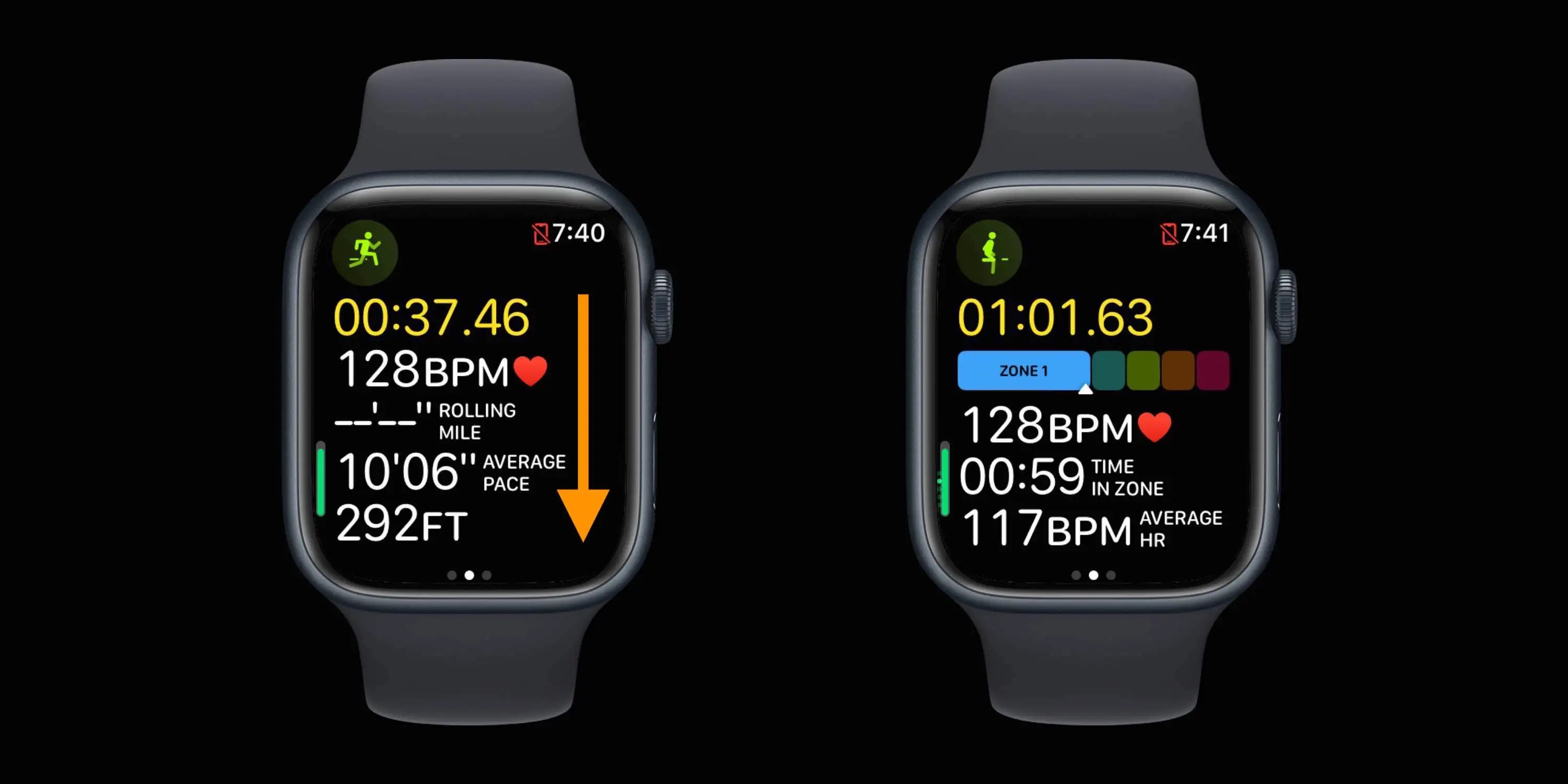
See heart rate zones during a workout
- Make sure you’re running watchOS 9 or later on Apple Watch and also have your birthdate entered in the Health app on iPhone
- Start a cardio-focused workout like a walk, run, or cycling (Apple hasn’t shared exactly which workout types include heart rate zones except for “cardio-focused” ones)
- Swipe down on the first Workout screen to see your heart rate and which zone it’s in
See heart rate zones after a workout
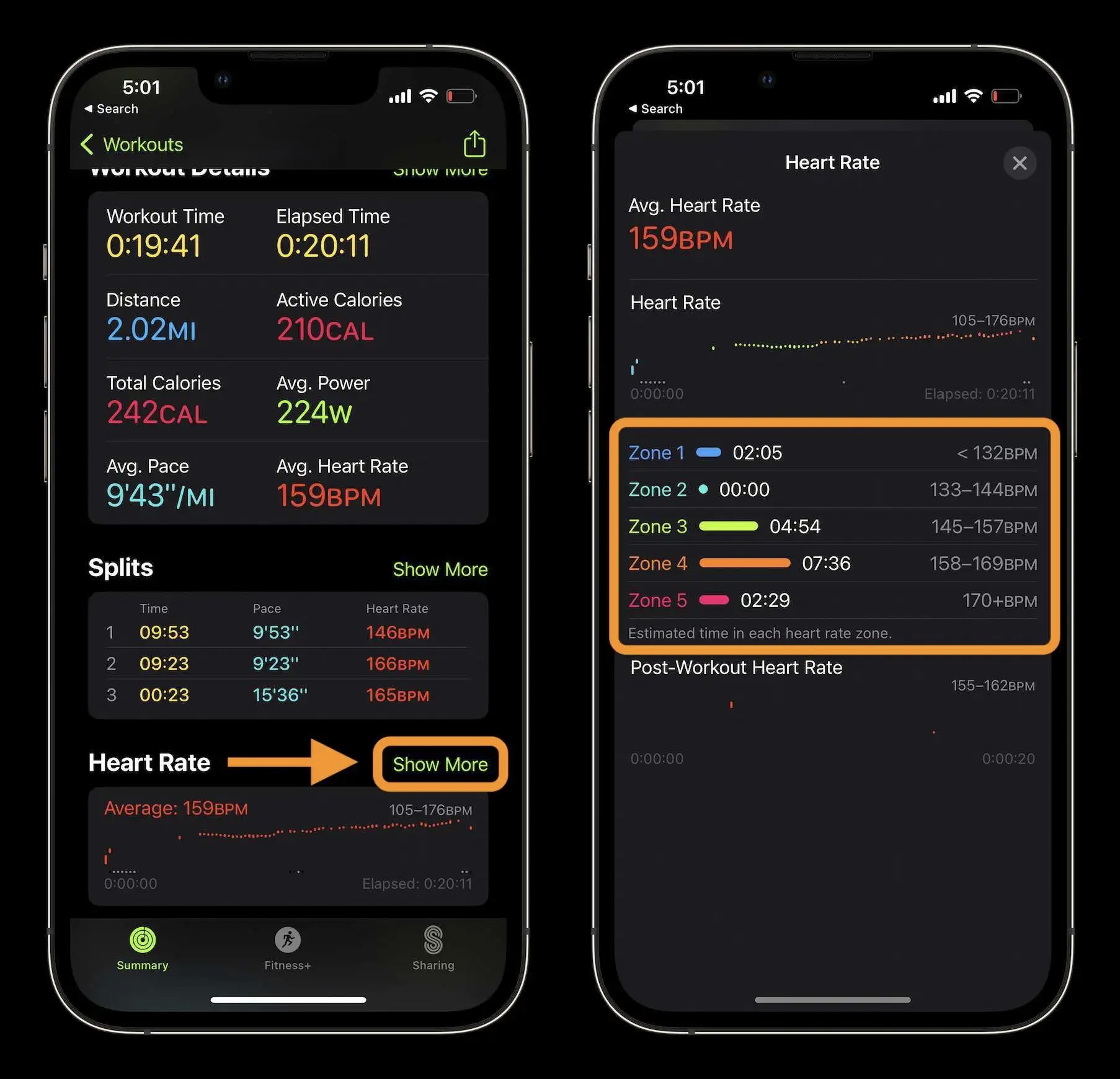
- After a workout, head to the Fitness app on iPhone to see heart rate zone data
- Choose a workout from the main Summary screen or tap the rings or Show More to pick a different date/workout
- Once you’ve picked a workout, swipe down until you see Heart Rate, tap Show More
Now you’ll see the breakdown of how much time you spent in each heart rate zone:
How to manually edit your heart rate zones
While the heart rate zones are automatically added based on your age, height, and weight, you can manually change them (usually for advanced athletes).
- Head to Settings > Workout > Heart Rate Zones on your Apple Watch and choose Manual at the top
- Or on iPhone go to the Apple Watch app > Workout > Heart Rate Zones then choose Manual at the top
How to see your max heart rate?
Going beyond your max heart rate is considered unsafe by medical professionals. To see your recommended maximum:
- Head to Settings > Workout > Heart Rate Zones on your Apple Watch, swipe down to find your max heart rate
- Or on iPhone go to the Apple Watch app > Workout > Heart Rate Zones, swipe down to find your max heart rate
What do heart rate zones mean?
Understanding your heart rate zones can be useful in a variety of ways. But some of the most practical applications are using heart rate training (properly rest or push yourself), targeting fat-burning or carb-burning heart rate zones, and awareness for those who have health conditions.
The Cleveland Clinic has a helpful article on understanding what kind of calories you’re burning in different zones. This won’t map directly to the five heart rate zones with Apple Watch, but is a good starting point.
Use your max heart rate (details on finding above) to figure out the numbers from the below calculations:
- Lower-intensity zone: You’re exercising at 50% to 60% of your max heart rate. At this point, 85% of the calories you burn are fat. The downside? You’re burning fewer calories overall than you would if you were exercising at a higher intensity. You’re generally able to sustain this zone the longest amount of time.
- Temperate zone: You’re exercising at 60% to 70% of your max heart rate. Roughly 65% of the calories you burn are fat.
- Aerobic zone: Working at 70% to 80% of your max heart rate puts you in the aerobic zone. About 45% of the calories you burn are fat. But you’re burning a higher number of overall calories compared to the other heart rate zones. You generally sustain this zone the shortest amount of time.
For heart rate training, the big idea is to “train your aerobic system without overstressing your skeletal and muscular systems, explains personal trainer Erin Carr.” Check out this article from Runner’s World for all the fine details:
Read more 9to5Mac tutorials:
FTC: We use income earning auto affiliate links. More.

Fitness
I’ve seen some bizarre exercises online. If I were an influencer, this is the one workout I’d recommend | Devi Sridhar

Are you still keeping up with your 2026 resolution to exercise more? Or perhaps you’re just trying to survive the winter doldrums, with exercise the last thing on your mind. Whatever it is, social media is alight with fitness influencers showing off all kinds of bizarre and viral exercise trends.
Take squats, a core exercise move. Those don’t seem good enough any more, so now we have Zercher squats (holding a barbell in your elbow crease like a metal baby), squats on vibration plates, squats while throwing a heavy ball and on and on. Some of these exercises may in fact be good, some useless, but because influencers can’t be seen to be doing the same thing every day, the key thing is that they’re novel and can be sold as “the little-known secret exercise that everyone should be doing”.
Then there’s adding a gimmick to an existing exercise. There’s goat yoga, puppy yoga and – my favourite new trend from the US – snake yoga, in which snakes such as pythons slither around the room and on to mats and yogis while they’re in downward dog thinking about spiritual intentions or, more likely, what’s for dinner. The marketing is that being around snakes in yoga can help overcome a fear of snakes while also building flexibility. Cross two things off your to-do list at once!
Here’s my public health take: fear of snakes is rational. About 5.4 million people are bitten by snakes each year. Evolution spent thousands of years instilling that fear in us – for good reason.
Why do bizarre fitness trends go viral, and why do they appeal to something within us? I think it has to do with boredom, the need for novelty and Fomo. Exercise can feel boring: going out running for the same 5k or heading to the gym to the same equipment and space. This is true also for yoga, which can feel slow and lack excitement.
The idea of trying something new is appealing, plus there is a constant push by certain fitness influencers implying that they know something we don’t. Some of them play on health anxiety and a desire to optimise with the “best” exercise to maximise your time and results: how to get a six-pack in two weeks or how to lose 10kg in five days (both pretty much impossible, by the way). Plus they’re telling us to buy a supplement or try a new juice cleanse that will be the missing piece to make us feel better by March.
Fitness trends sell that hope of feeling better. Take Hyrox, a hybrid endurance event where super-fit people pay good money to push sleds, throw wall balls, burpee-jump across the room and run between various stations. It’s impressive to watch and looks great on social media – which feels essential these days – and it’s a clear way to show your friends how fit you are. But it also reflects the push towards extreme, complicated and injury-prone exercise.
I’m going to say something you don’t want to hear, especially if you love Hyrox or snake yoga: none of this is necessary. If your goal is to feel strong, move better, stay pain free and live longer, you need three things: cardio exercises, resistance training and mobility training.
You don’t need weights, reptiles or cameras. It sounds simple, but what makes exercise hard isn’t the actual movement. It’s finding the time and routine to make it sustainable and part of your daily life. Which brings me to the most untrendy thing I can offer you: a 13-minute workout you can do anywhere, with or without weights. This is my default on busy days, and when I’m at home I have an 8kg sandbag on hand to add in.
All you need is a timer on your watch or phone. Start with three minutes of cardio to get warm and your heart rate up, whether it’s jogging on the spot, jumping jacks or just marching. Then it’s three minutes of legs, rotating between five each of narrow squats, broad squats, backward lunges, forward lunges and calf raises. Then on to three minutes of upper body, moving between five each of narrow push-ups, wide push-ups and tricep dips. Time to move on to core with a one-minute plank (either on your hands or forearms) and one minute of glute bridges (lifting your hips off the floor while lying on your back). For the final two minutes, just stretch out, whether that’s standing and reaching for your toes, lying on your back and moving your legs right and left like windshield wipers or sitting cross-legged and folding forward.
That’s it. Do this a couple of times a week if you can. Will you see it go viral on socials? No. Will it get sponsored by a supplement company? No. Will it increase your healthy life expectancy and make you feel happier? Public health evidence suggests yes. The real challenge, it turns out, isn’t finding the latest hack or trend. It’s sticking with a (snake-free) routine, even when the novelty wears off and 2026 resolutions fade from memory.

Walking is brilliant. It’s accessible, affordable and enjoyable, plus it comes with many health benefits, which is why it forms the backbone of most government exercise guidance.
But it is strength that underpins all movement. If you don’t have the strength to get out of your chair and put one foot in front of the other, what good is being told to walk more?
This was the key takeaway from recent research led by Dr Michael LaMonte and his team at the University at Buffalo, which shows the immense value of building skeletal muscle with strength training. It found that, in more than 5,000 women aged 63 to 99, greater strength levels were strongly linked to a lower risk of death from any cause.
Maintaining muscle should be seen as a savvy investment. Muscle allows you to stand, move and remain independent, all while offering further perks that extend far beyond physical function. It powers our breath, regulates blood sugar levels, emits anti-inflammatory myokines and constantly chats with other bodily systems to keep things running smoothly. In short, muscle is the medical marvel you already own.
Here is how to maintain your body’s largest, and in some ways smartest, organ for decades to come.
Why strength training matters
There is a wealth of research on the merits of aerobic exercise, such as walking, running, swimming and cycling. This is a major reason why it dominates government physical activity guidelines. There is far less research into strength training, and much of the data available centres around young, fit men.
By looking at the impacts of strength training in previously understudied demographics, such as women aged 60 and above, studies like this one from the University at Buffalo could change future exercise recommendations for the better.
“When women go through menopause and lose their body’s own secretion of oestrogen, the loss of skeletal muscle mass increases rapidly,” says Dr LaMonte. “We typically see a change in their body composition, where they start losing muscle and holding fat in the belly area, particularly. That’s not healthy.”
Both men and women also tend to become less active as they grow older, which can contribute to sarcopenia – the age-related loss of strength and muscle. Both menopause and sarcopenia are inflammatory processes, Dr LaMonte says.
Read more: Sitting all day wreaks havoc on your hips and spine – here’s how to stop that from happening
This shift impacts fitness. “Muscle strength is fundamental for getting the body from point A to point B, especially when you’re working against gravity.” But it also throws off chemical signalling between skeletal muscle and other systems in the body, such as the heart.
“Fat tissue tends to secrete chemicals called cytokines that are pro-inflammatory,” Dr LaMonte explains. “There’s quite a bit of evidence to show that, when skeletal muscle contracts, it secretes counterbalancing cytokines that are anti-inflammatory.
“This was discovered by a scientist named Bente Pedersen in the 2000s. She published a compelling series of papers showing that these cytokines, which she called myokines, had regulatory functions outside the muscle itself.”
Exactly how skeletal muscle interacts with other crucial systems in our body is unclear, Dr LaMonte says. But it is constantly in deep discussions with them, and it is looking to help out where it can. For this reason, if you can keep your muscles strong and healthy, they can be a powerful force for good.
Read more: Expert warns why this daily habit is shortening your life – even if you exercise

3 simple ways to gauge your strength
Dr LaMonte’s research used a series of simple tests to assess the strength levels of 5,472 women aged 63 and above:
- Grip strength: a dynamometer was used to assess grip strength, with people asked to hold their upper arm at their side, elbow bent at a right angle, then squeeze the machine as hard as possible. This is an indication of upper-body strength.
- Sit-to-stand: people were timed to see how quickly they could stand up from a chair, then sit back down again five times with their arms across their chest. This is an indication of lower body strength.
- Gait speed: a timer was used to see how long it took subjects to walk 2.5m.
Women with greater grip strength – a good signifier of overall strength levels – and faster sit-to-stand times had a “significantly lower death risk over an eight-year follow-up”, the study discovered.
“Gait speed is another one of the most potent predictors of mortality,” Dr LaMonte adds.
“I’d like to see the health care profession embrace functional health as much as they do the things they can prescribe drugs for – because you can’t prescribe a drug for this. It’s a behaviour, and I think that’s why it probably doesn’t get the same kind of attention. Nobody makes money from this, but people do die from it.”
Dr LaMonte also suggests another bonus test anyone can use as a sign they need to work on their strength levels:
- The pickle jar test – this is a proxy for any everyday task. If you notice it starts to feel more difficult, this is a good indication that your fitness has decreased, and it would be beneficial to gain strength and muscle through exercise.
“When you can’t open the pickle jar any more, don’t just assume they’re making the jars harder to open,” Dr LaMonte says. “That’s a good indicator that you might be at a phase of life where your strength levels have changed unknowingly.
“The same applies when you go to pick up a grandchild or climb the stairs, and you find you’re huffing and puffing – it could simply be that you’re getting more out of shape, or in the worst case scenario, it could be indicative of disease.
“Be mindful of your body. It’s going to tell you where you’re at, and we don’t want an injury to be that indicator.”
Read more: Four things you can do to reduce inflammation and cut heart disease risk, according to the experts

How to start strength training at any age
The human body is a representation of the life it has lived, informed by genetics and altered by myriad interventions along the way. A robust life, filled with challenging physical tasks, often builds a robust body. As a result, someone who has always been active will likely find it easier to remain more active as they age.
“I wouldn’t want to convey a message that age becomes a constraint for people doing what they enjoy,” says Dr LaMonte. “I know people in their late, late years who still enjoy going to gyms and lifting weights. It’s effective for their strength goals, and the social aspect keeps them healthy in other ways.”
However, if you are new to strength training and exercise generally, you need to start more conservatively. As with any new skill, there is an obligatory learning curve that allows your mind and body to adapt to the fresh stimulus without being overwhelmed.
“You can use simple bodyweight exercises like press-ups against a wall or sit-to-stands – US adults in their 70s and 80s spend around nine-and-a-half hours each day sitting down, so you could break this up by doing a few sit-to-stands every hour, or each time there is an advert if you are watching television,” Dr LaMonte says.
“Resistance bands are another good option, or even using soup cans or books as a form of resistance provides stimulus to skeletal muscles.”
The common denominator behind these exercises is the act of overcoming resistance. That resistance needs to be slightly challenging, relative to your individual strength levels, to trigger an increase in muscle and strength levels. By consistently doing a task that requires you to be stronger, you are telling your body you want it to adapt to handle it better. If the task feels easy, the body has no reason to make any changes.
“If someone finds that lifting a soup can or book [for example, pressing it overhead 10 times] challenges them, that’s probably the level they should be working at, and they should not be trying to do more,” says Dr LaMonte. As you grow stronger, you can then gradually progress to slightly heavier items to continue to increase your strength levels.
“Older adults in particular should consult with their health care provider about the safety of beginning muscle-strengthening exercises,” Dr LaMonte adds.
In short, building and maintaining strength is important at any age. And if you do fall below this study’s 63-99 demographic, any strength and muscle you can develop now will likely serve you well for the rest of your life.
“We want to live as long as we can healthily, and I think resistance exercises are a part of that,” Dr LaMonte concludes. “When we can no longer get out of the chair and move around, we are in trouble.”
Read more: After 50, you need to train smarter – the eight rules for strength training in midlife, according to experts
Read more: The science-backed two-minute daily workouts for improving heart health

Exercise is part of a healthy lifestyle and its benefits are well known and have been for a long time. What is only recently proven by doctors is just how much exercise makes a difference for one’s longevity.
By now, most people understand that exercise is part of a healthy lifestyle; its benefits are well known and have been for a long time. What is only recently proven by doctors is just how much exercise makes a difference for one’s longevity.
For most people who sit at desks or behind the wheel all day, the problem is often finding time to work out. The good news, according to Dr. Julie Chen, an internal medicine and lifestyle medicine doctor at Kaiser Permanente in Gaithersburg, is that a daily exercise routine can be broken down into brief segments.
“The general recommendation is for 150 minutes of moderate activity per week,” Dr. Chen said. “So that is roughly about 30 minutes a day, five days a week. But the important point is it does not have to all be done at once. You can break it up into shorter segments of exercise and still get the same great benefits.”
And those benefits can be tremendous. Chen said that studies have shown going from no exercise a day to only 15 minutes of total exercise a day can “can actually decrease their risk of death, death from all causes, by about 14%.”
“Any movement is actually better than being sedentary,” she said.
Movement can be divided up into short segments throughout the day instead of in one long, strenuous workout and it can still offer the same reductions in the risk of certain diseases.
Now, you might understand there are benefits of exercising for short periods of time, several times per day; but you might be wondering how you can get in the gym several times a day.
Chen advocates for what she calls “exercise snacks” — “small bursts of physical activity that you can get in, two to three minutes at a time throughout the day.”
For example, taking the stairs or doing squats while putting groceries away, walking around the office on a phone call or planking while your dinner is in the microwave. Chen said try to do whatever it takes to get a few minutes of movement in a few times a day.
Chen is also a big fan of fitness apps, including the ones that come built into our smartphones and watches: “Studies have shown that that is really motivating that you can actually track your progress in your app. You can see your trends.”
“Consistency is a really big goal of this effort, and so if you look at your trends over time, that’s going to be a really rewarding aspect of trying to improve your health,” she added.
Beginning an exercise regimen doesn’t need to be complicated or time-consuming. You don’t need to splurge on workout clothes or a gym membership; you just need a few minutes, several times a day, to start reaping the benefits.
Get breaking news and daily headlines delivered to your email inbox by signing up here.
© 2026 WTOP. All Rights Reserved. This website is not intended for users located within the European Economic Area.

Diabetes surge among Americans could be driven by ‘healthy’ breakfasts, doctor warns

Deion Sanders mourns loss of Colorado quarterback Dominiq Ponder: ‘One of my favorites’

Iran networks suffer losses amid airstrikes, showing digital evolution of conflicts

WGA cancels Los Angeles awards show amid labor strike

After ‘Yellowstone’ and a twist of fate, Luke Grimes rides again as Kayce in ‘Marshals’

Florida High School Football Rankings: Top 25 teams – Oct. 21

Cleary's 21 help Le Moyne down Central Connecticut State 69-64 in OT

How old is Bo Nix? What to know about Oregon quarterback ahead of 2024 NFL Draft

99th annual Pony Swim held in Virginia

Indiana Members Credit Union announced as new anchor tenant at Bottleworks District

Israel FM says Europe too divided, slams Spanish PM

Satellite images provide view inside Iran at war

Video: What the Texas Primary Battle Means for the Midterms

Dems’ potential 2028 hopefuls come out against US strikes on Iran

At least nine killed after Iranian strike on Israel’s Beit Shemesh
-

 World4 days ago
Exclusive: DeepSeek withholds latest AI model from US chipmakers including Nvidia, sources say
-

 Massachusetts4 days ago
Mother and daughter injured in Taunton house explosion
-

 Montana1 week ago
2026 MHSA Montana Wrestling State Championship Brackets And Results – FloWrestling
-

 Denver, CO4 days ago
10 acres charred, 5 injured in Thornton grass fire, evacuation orders lifted
-

 Louisiana7 days ago
Wildfire near Gum Swamp Road in Livingston Parish now under control; more than 200 acres burned
-

 Technology1 week ago
YouTube TV billing scam emails are hitting inboxes
-

 Technology1 week ago
Stellantis is in a crisis of its own making
-

 Politics1 week ago
OpenAI didn’t contact police despite employees flagging mass shooter’s concerning chatbot interactions: REPORT