


Scratch the surface, and you might think women have the upper hand when it comes to longevity. According to data from the Office for National Statistics, here in the UK, we live an average of 3.9 years longer than men.
Look a little closer, however, and there’s a catch. Thanks to a longstanding lack of investment in women’s health research, our underrepresentation in clinical trials and fewer treatment options designed for our bodies, we spend 25% more of our lives in ill health than men.
“For decades, hormonal fluctuations were viewed as a ‘complicating factor’ for data,” explains Elliott Roy-Highley, medical director at preventative health studio, Unbound. “As a result, modern medicine suffers from a massive sex-disaggregated data gap.”
That’s why, for women particularly, the question of longevity is not just one of living longer. Instead, our focus has to shift to ways we can stay healthier whilst we’re living: a concept known as healthspan.
The good news is that improving this metric doesn’t require expensive supplements or complicated therapies (just look at Blue Zone populations if you don’t believe me). Research shows quite clearly that a factor like regular exercise is one of the most powerful forms of health insurance we have.
“A high level of cardiorespiratory fitness reduces the risk of dying from any cause by 53%,” explains Roy-Highley, pointing to a 2024 study in the British Journal of Sports Medicine, “whilst a high level of strength is associated with 31% reduced risk of death from any cause.”
With that in mind, we asked GP and leading longevity doctor, Dr Rhea Kotecha, to share the non-negotiable forms of exercise she believes we should prioritise in order to age well.
For her thoughts, read on. And whilst you’re here, I recommend checking out our guides to the best longevity workouts, how to hack your longevity from home and the daily longevity habits doctors use themselves. We’ve also got a useful guide to musclespan and the habits we can all borrow from the Blue Zones.
I’m A Longevity Doctor – These Are The Six Types Of Exercise Every Woman Should Be Doing For Healthy Ageing
How does exercise affect longevity?
When I posed this question to Dr Kotecha, her response was emphatic. “Exercise,” she says, “is the closest thing we have to a longevity drug.”
It’s a glowing endorsement for the role that movement plays in the ageing process, one repeatedly evidenced by research. “The least fit participants had roughly five times the mortality risk of the fittest,” Dr Kotecha says, referencing a 2018 study of over 122,000 adults. “To put that in perspective, being unfit was a bigger risk than being a smoker.”
But what about the risk of too much exercise? Is there a danger that we could go too far? “In theory, yes, but in practice, rarely,” says Dr Kotecha. “The risks live at the extreme end, where years of relentless overtraining can drive up stress hormones, suppress immunity and, in women, switch off the menstrual cycle and erode bone.”
Though this is critical to be aware of, Dr Kotecha says that it’s far more common for women’s health to be compromised by too little exercise. And, she says, in reality “it’s almost never the exercise itself that harms you, but the absence of recovery.”
Are the longevity benefits of exercise different for men and women?
Due to variations in our biology, muscular and hormonal profiles, it makes sense that exercise would have a different impact on male and female bodies. And in the case of longevity, it turns out things look pretty good for us.
“Essentially, we can do more with less,” says Dr Kotecha, who shares a 2024 study published in the Journal of the American College of Cardiology, which found that women needed to exercise for around 140 minutes a week to reap maximum survival benefits, compared to 300 minutes for men. “What this means is that women get a far better return on investment,” Dr Kotecha explains.
Should your exercise habits change as you age?
It’s not all plain sailing, however. Because as we reach menopause, Dr Kotecha says our biology shifts and this impacts how we need to train. “When oestrogen withdraws, the protection it provides to our bone, muscle and cardiovascular system withdraws with it,” she explains. “This is where training has to step up to fill the gap.”
That doesn’t mean that our exercise routine has to dramatically change in midlife, nor that we have to push our bodies to breaking point. But it does mean that keeping up our fitness in a variety of ways is essential as we age. “What changes across the decades is not which pillars you train, but how you divide the budget between them,” says Dr Kotecha, who says her non-negotiable advice is to remain an all-rounder. “Think of it as a line from performance to preservation. Train now for the answer you want in the future.”
6 types for exercise for staying healthier and living longer, according to top experts:
So, how do we become this exercising all-rounder? According to Dr Kotecha, these six forms of movement are the keys to unlocking healthier ageing.
1. Strength and resistance training
“Muscle is the organ of longevity,” says Dr Kotecha. “It is your metabolic engine, your glucose sink, your fall insurance and, after menopause, one of your only remaining levers on bone health.”
For that reason, she recommends lifting two to three times a week. “You don’t need to live in the gym,” she reassures, citing research which shows the maximum benefit for longevity lands at roughly 30-60 minutes of resistance training a week. “But you do need to lift things which are genuinely heavy, with the last couple of repetitions feeling hard.”
2. Functional Fitness
Functional fitness, which equates to movement patterns that we use in our day-to-day life, should form a core part of your strength training, says Dr Kotecha. “We want to train the body as one connected system, not as a collection of muscles taking turns on machines. We’re looking for the kind of strength that lets you carry the shopping, a toddler and a suitcase up the stairs. These are the tests of strength that really matter.”
Some of her favourite moves include Turkish get-ups and the farmer’s carry. “These moves build grip, core, coordination and real-world strength all at once,” she explains when asked why she loves them.
Watch On
3. Explosive power
“This is the one almost everyone skips,” says Dr Kotecha, who warns that the impact of neglecting to train for power can be detrimental. “As we lose fast-twitch fibres, we lose stability, increasing our risk of falls and fractures, which in turn increase the risk of mortality and a loss of independence in later life.”
The good news, she says, is that explosive power can be done in small doses and ticked off as part of another session. “You only need about five minutes, but those five minutes might buy you decades of staying on your own two feet,” she explains. “Box jumps, jump squats, hops and a few short sprints are all forms of training explosive power.”
4. Zone two cardio
On the other end of the intensity scale is steady, conversational-pace cardio- think brisk walking, easy cycling or light jogging.
“Nobody posts about this kind of fitness, but everybody needs it,” says Dr Kotecha, who recommends between two and a half and four hours a week of this kind of exercise.
5. HIIT
High intensity interval training has been a contentious topic for women’s training over the years, with debates over whether it has a positive or negative effect on our stress levels and hormonal health.
The reality, though, is that it’s not an all-or-nothing approach. “The classic mistake is turning everything into a high-intensity session,” says Dr Kotecha. “But short, hard intervals raise your VO2 max efficiently, and VO2 max is one of the strongest survival predictors we have.”
Her recommendation? One to two sessions a week.
6. Stability and balance
It’s far from the most exciting part of an exercise routine, but Dr Kotecha says stability and balance work is highly underrated. “A few minutes of single-leg work, balance drills and mobility most days is possibly the most important thing you will ever do,” she says. “It could be the difference between a stumble and a fracture.”
Shop MC-UK approved workout kit now:
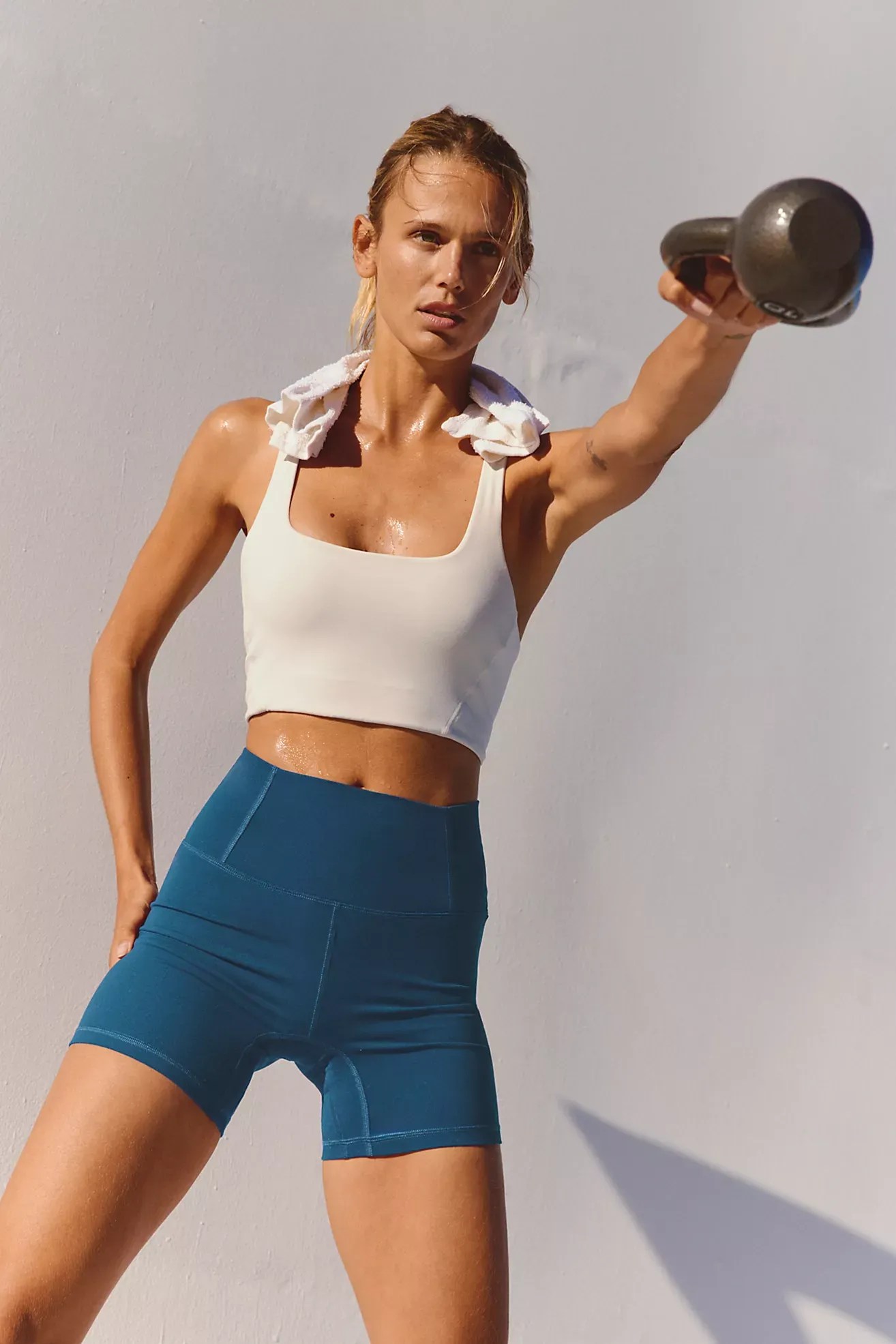
Free People Never Better 5″ Bike Shorts
Finding the right pair of workout shorts is a serious business. But in Free People’s Biker Shorts, I fear I may have found the answer. Buttery soft, zero chafe, no waistband chopping you in half and pockets to store small essentials, I’ve been living in them for the past month.

247 Arena Sunglasses – Papyrus
I never thought I’d be a running sunglasses girl, but even I can’t deny how much I’ve fallen in love with this pair from Represent. Whether they’re keeping my hair back or the sun from my eyes, they’ve become a weekend run essential since the latest heatwave.

Women’s Performance Crop Sailor
If you’re looking for something to bridge the gap between a sports bra and a tank top as the hotter weather (hopefully) arrives, then On’s Performance Crop is a good place to start. With light padding, four-way stretch and a racer-back design, it’s stylish, comfy and supportive – a triple threat if ever we saw one.
Is exercise more important than nutrition for longevity?
It’s tempting to want to rank the things we can do for our health into neatly prioritised boxes. But as Dr Rhea Kotecha, GP and longevity physician, clearly explains, when it comes to nutrition and exercise, one shouldn’t exist without the other.
“The clinical truth is that you cannot outtrain a poor diet and you cannot out-eat a sedentary body,” she says. “How you train and what you eat are the two strongest, most modifiable levers you have on how long and how well you live, and they only reach their full power together. There is no green powder, no collagen sachet and no supplement that substitutes for being strong and aerobically fit. The basics are boring, and they are also undefeated.”


