Finance
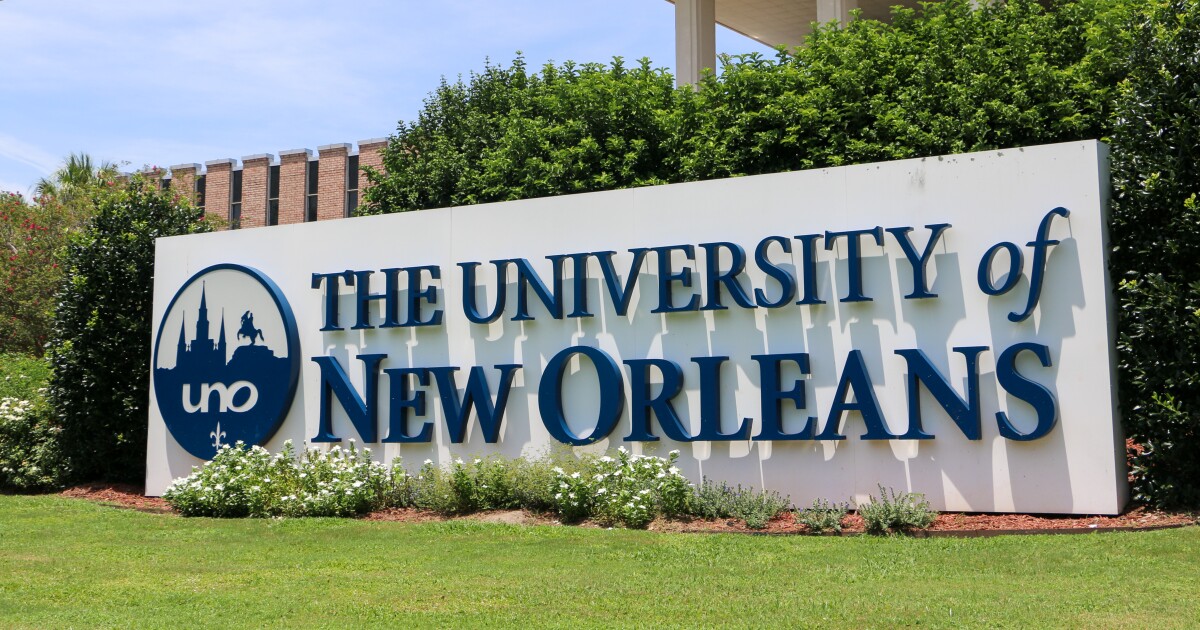
UNO restructures finance team, announces changes to campus
Editor’s note: WWNO is licensed to the University of New Orleans but is funded independently and reports on the university like any other school.
The University of New Orleans is making changes to its financial structure and campus as it prepares to transition back to the LSU System on July 1.
UNO, which officials have already started referring to as LSU New Orleans, has hired Jeanette Weiland as its interim chief administrative officer, a reconfigured role the school’s president says will strengthen its finances.
Weiland previously served as chief business officer of Tulane University’s School of Science & Engineering. She started on a contract basis in January and was hired as an employee on March 1.
In an email to staff this week, President Kathy Johnson said Weiland’s position will span more departments than before, making forecasting and budgeting easier.
“For many years, some of our financial challenges have stemmed from the way separate revenue sources have operated in parallel rather than in alignment,” Johnson said.
The university eliminated its vice president for finance and administration as part of the restructuring, Johnson said, and will hire an interim chief financial officer to work under Weiland.
Arlean Wehle had been serving in both roles, on an interim basis, after Edwin Litolff left for the University of Louisiana at Lafayette last summer. Johnson thanked Wehle for her “tireless work ethic, her steady leadership, and her unwavering commitment to our mission.”
UNO has struggled financially in recent years, which officials have attributed to low enrollment and poor management. The school currently enrolls fewer than 6,000 students, down from more than 17,000 at its peak before Hurricane Katrina.
While faculty and staff have specific concerns about the transition, according to a survey conducted by LSU, more than 60% of students, alumni and faculty support the move.
Officials have promised to revive the university by sharing system resources, eliminating some programs, expanding those it says are unique and successful — like UNO’s naval architecture and marine engineering school — and rebranding the campus as part of the LSU family.
In the same email, Johnson said UNO will lease a building to its neighbor, Benjamin Franklin High School, starting in June, and plans to close its oldest academic building at the end of the semester.
Franklin has been looking for room to expand, rather than cap its enrollment. The school plans to take over the Human Performance Center.
Johnson said the lease will strengthen the existing partnership between the two, “while generating revenue” that UNO needs. Franklin will move out of the classrooms it uses in a campus building that’s farther away, freeing those up.
The terms of the lease with Franklin are still being negotiated, Johnson said in an email to WWNO. It will likely go before the University of Louisiana System board in April, which UNO remains part of until July 1.
The Liberal Arts Building, the facility slated to close, houses the following departments: English, foreign languages, philosophy, history and elements of anthropology.
Johnson said the decision was reached based on UNO’s financial standing and a facility analysis by an outside firm.
“This is not a decision made lightly,” she said in the email. “We simply do not have the resources required to restore it to acceptable standards.”
Departments housed in both impacted buildings will be relocated to other parts of the campus.
Finance
Morgan Stanley sees writing on wall for Citi before major change
Banks have had a stellar first quarter. The major U.S. banks raked in nearly $50 billion in profits in the first three months of the year, The Guardian reported.
That was largely due to Wall Street bank traders, who profited from a volatile stock exchange, Reuters showed.
But even without the extra bump from stock trading, banks are doing well when it comes to interest, the same Reuters article found. And some banks could stand to benefit even more from this one potential rule change.
Morgan Stanley thinks it could have a major impact on Citi in particular.
Upcoming changes for banks
To understand why Morgan Stanley thinks things are going to change at Citi, you need to understand some recent bank rule changes.
Banks make money by lending out money, which usually comes from depositors. But people need access to their money and the right to withdraw whenever they want.
So, banks keep a percentage of all money deposited to make sure they can cover what the average person needs.
But what happens if there is a major demand for withdrawals, as we saw during the financial crisis of 2008?
That’s where capital requirements come in. After the financial crisis, major banks like Citi were required by law to hold a higher percentage of money in order to avoid major bank failures.
For years, banks had to put aside billions of dollars. Money that couldn’t be lent out or even returned to shareholders.
Now, that’s all about to change.
Capital change requirements for major banks
Banks that are considered globally systemically important banking organizations (G-SIBs) have a higher capital buffer than community banks as they usually engage in banking activity that is far more complicated than your average market loan.
The list depends on the size of the bank and its underlying activity, according to the Federal Reserve.
Current global systemically important banks
A proposal from U.S. federal banking regulators could drastically reduce the amount that these large banks have to hold in reserve.
Changes would result in the largest U.S. banks holding an average 4.8% less. While that might seem like a small percentage number, for banks of this size, it equates to billions of dollars, according to a Federal Reserve memo.
The proposed changes were a long time coming, Robert Sarama, a financial services leader at PwC, told TheStreet.
“It’s a bit of a recognition that perhaps the pendulum swung a little too far in the higher capital requirement following the financial crisis, making it harder for banks to participate in some markets,” he said.
Finance
Couple forced to live in caravan buy first home as ‘stars align’ in off-market sale
Natasha Luscri and Luke Miller consider themselves among the lucky ones. The couple recently bought their first home in the northwest suburbs of Melbourne.
It wasn’t something they necessarily expected to be able to do, but some good fortune with an investment in silver bullion and making use of government schemes meant “the stars aligned” to get into the market. Luke used the federal government’s super saver scheme to help build a deposit, and the couple then jumped on the 5 per cent deposit scheme, which they say made all the difference.
“We only started looking because of the government deposit scheme. Basically, we didn’t really think it was possible that we could buy something,” Natasha told Yahoo Finance.
RELATED
Last month they settled on their two bedroom unit, which the pair were able to purchase in an off-market sale – something that is becoming increasingly common in the market at the moment.
Rather perfectly, they got it for about $20-30,000 below market rate, Natasha estimated, which meant they were under the $600,000 limit to avoid paying stamp duty under Victoria’s suite of support measures for first home buyers.
“They wanted to sell it quickly. They had no other offers. So we got it for less than what it would have gone for if it had been on market,” Natasha said.
“We didn’t have a lot of cash sitting in an account … I think we just got lucky and made some smart investment decisions which helped.”
It’s a far cry from when the couple couldn’t find a home due to the rental crisis when they were previously living in Adelaide and had to turn to sub-standard options.
“We’ve managed to go from living in a caravan because we were living in Adelaide and we couldn’t find a rental with our dogs … So we’ve gone from living in a caravan, being kind of tertiary homeless essentially because we couldn’t get a rental, to now having been able to purchase our first home,” Natasha explained.
Rate rises beginning to bite for new homeowners
Natasha, 34, and Luke, 45, are among more than 300,000 Australians who have used the 5 per cent deposit scheme to get into the housing market with a much smaller than usual deposit, according to data from Housing Australia at the end of March. However that’s dating back to 2020 when the program first launched, before it was rebranded and significantly expanded in October last year to scrap income or placement caps, along with allowing for higher property price caps.
Finance
WHO says its finances are stable, but uncertainties loom – Geneva Solutions
A year after the US exit from the global health body, WHO officials say finances are secure, for now. But amid donor cuts, rising inflation, and future economic uncertainties, will funding be sufficient to meet its needs?
Earlier this month, senior officials at the World Health Organization (WHO) told journalists in a newly refurbished pressroom at the agency’s headquarters that its finances were “stable”. Following a year that saw its biggest donor withdraw as a member, forcing it to cut 25 per cent of its staff, its financial chief said that 85 per cent of its 2026 and 2027 budget had been financed.
“While we are looking at resource mobilisation, we’re also looking at tightening our belts,” Raul Thomas, assistant director general for business operations and compliance, explained, admitting that the WHO “will have great difficulty mobilising the last 15 per cent”.
Sitting at the centre of the press podium, surrounded by his deputies, Tedros Adhanom Ghebreyesus, WHO director general, backed up Thomas’s outlook. “We are stable now and moving forward”, since the retreat of the United States from the health body, he said. The Ethiopian noted that the WHO’s financial reform, allowing for incremental increases in state member fees, has been a big plus.
Mandatory contributions have historically accounted for only a quarter of the organisation’s total funding. States have agreed to raise their contributions by 20 per cent twice, in 2023 and in 2025. Further increments are scheduled to be negotiated in 2027, 2029 and 2031 to bring mandatory funding up to par with voluntary donations that the agency relies on. The WHO also reduced its biennial budget for 2026 and 2027 from $5.3 billion to $4.2bn.
“Our financing actually is better,” Tedros emphasised. “Without the reform, it would have been a problem.”
Read more: Nations agree to raise their WHO fees in wake of US retreat
Nonetheless, the director general, now in his final year at the UN agency, warned that member states should not assume that the financial road ahead will be clear. “The future of WHO will also be defined by how successful we are in terms of the assessed contribution increases or the financial reform in general.”
As west retreats, others step in
Suerie Moon, co-director of the Global Health Centre at the Geneva Graduate Institute, explains that every year at the WHO, there’s “a non-stop effort” to ensure funding. She says a continued reliance on non-flexible, voluntary funding earmarked for specific projects, as well as donors withholding contributions – sometimes for political leverage – complicates the organisation’s financial plans. Meanwhile, ongoing cuts and predictions of a global economic downturn stemming from the war in the Middle East may further aggravate the situation, as costs rise and member states focus on national spending needs.
Soaring prices driven by the conflict and supply chain disruptions have already affected the WHO’s procurement of emergency health kits for crises, officials at the global health body said. “We are continuing to negotiate at least from a procurement standpoint on how we can bring down a little bit the prices or reduce the increases, but we are seeing it across the board,” said Thomas.
Altaf Musani, WHO director of health emergencies, meanwhile, said aid cuts have already deprived roughly 53 million people in crisis situations of access to healthcare.
Last month, Thomas told the Association of Accredited Correspondents at the UN at the end of April that the agency is looking at non-traditional, or non-western, donors for funding to close the biennial 15 per cent funding gap. “It’s not that we won’t go to the traditional donors, but we’re expanding that donor base.”
Since the dramatic drop in funding from the US, formerly the WHO’s biggest contributor, Moon highlights that there hadn’t been a “sudden jump by non-traditional states to compensate for the US”. Last May, at the World Health Assembly, China pledged $500 million in voluntary funding until 2030, a sharp rise from the $2.5m it contributed over 2024 and 2025.
The WHO did not respond to questions from Geneva Solutions about how much of the pledged amount had been disbursed. China’s mission in Geneva did not respond to questions raised about the funding.
Other countries, particularly Gulf states, have meanwhile been increasing their voluntary contributions to the organisation in recent years. Similarly to “western liberal democracies have in the past”, Moon explains that they may be seeking “to raise their profile and prioritise health as one of the issues that they would like to be known for”. She noted that the shift in the UN agency’s list of top donors may affect how it manages the money.
‘Sustainable’ spending
Amid these financial uncertainties, WHO executives say the organisation is also reviewing its expenditure through “sustainability plans”. This includes working more closely with collaborating centres, including universities and research institutes that support WHO programmes and are independently funded. On influenza, for example, the WHO works with dozens of national centres around the world, including the Centers for Disease Control and Prevention in the US,
When asked about any plans for further job cuts, Thomas denied that these were part of the WHO’s current strategies, but could not rule them out entirely as a future possibility. Instead, he said, the organisation was “looking at ways to use funding that may have been for activities to cover salaries in the most important areas”.
Meanwhile, WHO data shows that the number of consultants employed by the agency by the end of 2025 decreased by 23 per cent, slightly less than the staff reductions. Global heath reporter Elaine Fletcher explained to Geneva Solutions that consultants continue to represent a significant proportion of the agency’s workforce, at 5,844 – including an overwhelming number hired in Africa and Southeast Asia – compared with regular staff numbering 8,569 in December.
Upcoming donor politics
The upcoming change in leadership will also be a strategic moment for the organisation to boost its coffers. Moon says the race for the top job at the organisation may attract funding from candidates’ home countries, which could be seen as a strategic opportunity.
Given the relatively small size of the WHO budget, compared to some government or agency accounts, “you don’t have to be the richest country in the world to dangle a few 100 million dollars, which could go a long way in their budget,” the expert notes.
The biggest ongoing challenge, however, will be whether major donors will announce further aid cuts. In the medium and longer term, “countries will have to agree on the step up every two years, and there’s always drama around that.”
-
South Dakota7 seconds agoBlack Hills Bottlenecks: Road work update for the week of May 11
-
Tennessee6 minutes agoNew Tennessee law allows K9 officers to be transported by helicopter, ambulance to vet
-
Texas12 minutes agoTexas sues Netflix, alleges platform spied on kids and collected data
-
Utah18 minutes agoTeens airlifted to Utah County hospitals after rollover of at least 50 yards | Gephardt Daily
-
Vermont24 minutes agoCommentary | Afonso-Rojas: Who pays when businesses ignore risks?
-
Virginia30 minutes agoVirginia Supreme Court voids voter-approved redistricting referendum
-
Washington36 minutes ago
19-Year-Old Transgender University of Washington Student Fatally Stabbed
-
Wisconsin42 minutes agoSuspected human bones found in northern Wisconsin