
Connect with us

Finance

Finance Committee Chair Denice Kronau Stepping Down Next Month

Published

on

Finance Committee Chair Denice Kronau Stepping Down Next Month

Nantucket Finance Committee chair Denice Kronau announced Tuesday that she will be stepping down from her seat on the influential town committee next month to focus on the release of her forthcoming book, “The Stars That Guide Us.”

Kronau, who has one year left on her term, was first appointed to the Finance Committee by the Select Board in 2017. She informed the town administration of her intention to resign effective June 30 last week and made a formal announcement at Tuesday’s Finance Committee meeting.

Denice Kronau

“It has been my honor to serve the community for the past eight years,” Kronau wrote to Select Board chair Brooke Mohr.

Kronau’s background as a corporate executive and non-profit board member for more than three decades included leadership positions with several multinational companies, including Siemens, Diageo, Kraft, and Philip Morris.

On the Finance Committee on Nantucket, she most recently made headlines after breaking with the majority of her committee on its initial recommendation to support the $105 million appropriation for the new Our Island Home. She spoke out publicly before the Select Board to explain her dissent and why she opposed the project. After the price tag for the new Our Island Home climbed to $125 million in the month before Town Meeting, a majority of the committee ultimately joined her in opposing the appropriation.

Advertisement

Kronau’s upcoming book is the second in a historical fiction trilogy she is writing that is set on Nantucket.

The Select Board is expected to appoint a candidate to fulfill the final year of Kronau’s term later this year. Three other FinCom members – Stephen Maury, Chris Glowacki, and Jill Vieth – will also be up for reappointment in 2025.

Finance

PERSONAL FINANCE: Finance 101 — the lessons every college-bound kid should learn now

Published

on

PERSONAL FINANCE: Finance 101 — the lessons every college-bound kid should learn  now

Sending a child to college marks an important milestone for families, bringing both new opportunities and natural questions. It’s often the first time students manage money independently while balancing classes, new responsibilities and newfound freedom. This transition also creates a valuable opportunity for parents to guide and teach their children how to build strong financial habits.

While it’s easy to focus on major expenses like tuition and housing, the everyday financial behaviors students develop during this time can shape their future long after graduation. College presents an ideal environment to introduce foundational financial skills in a real-world setting where the stakes are manageable, but the lessons are meaningful. The following areas highlight key lessons parents can help reinforce as their child begins this new chapter.

Understanding cash flow matters more than ever

For many students, college marks the first time money is not simply “there” when they need it. Whether funds come from a checking account, part-time work, or family support, learning how to track income and expenses is essential. Teaching students to understand the difference between fixed costs, like rent or meal plans, and flexible spending, like entertainment or dining out, can help them avoid running short before the semester ends. A simple budget can be a helpful tool that builds awareness and confidence.

Credit is powerful

Credit cards are often heavily marketed to young adults, but few understand how credit really works. College-bound students should recognize that credit is not additional income; interest can accumulate quickly, and payment history plays a critical role. Developing habits like paying balances on time, keeping utilization measured, and regularly reviewing statements can help build strong credit rather than costly missteps. These early behaviors often shape long-term financial health.

Saving is not just for later — it supports flexibility

Students may assume saving can wait until after graduation, but even modest savings during college can serve an important purpose. Emergency expenses, unexpected travel home, or gaps between part-time income can derail finances quickly without a cushion. Understanding the value of saving, even in small amounts, helps students experience firsthand how preparation creates options and reduces stress.

Advertisement

Financial decisions reflect values

College is often when young adults begin defining what matters most to them. Encouraging students to think about how they spend money, and why, can help align spending with personal priorities. Whether it means minimizing debt, prioritizing experiences, or saving for future goals, learning to make intentional choices fosters independence and accountability.

The goal is not perfection, but to equip students with practical tools and a healthy relationship with money as they enter adulthood. For parents, this means maintaining open conversations, setting realistic expectations, and providing ongoing guidance that can help build confidence in financial decision-making. For families navigating this transition, a financial advisor can provide clarity, outline long-term implications, and help balance education goals with future financial independence.

Bronwyn L. Martin is a Financial Advisor and Chartered Financial Consultant with Martin’s Financial Consulting Group, a financial wealth advisory practice of Ameriprise Financial Services LLC. in Kennett Square, Pa. and Havre de Grace, Md. She specializes in fee-based financial planning and asset management strategies and has been in practice for over 25 years. To contact her: www.ameripriseadvisors.com/bronwyn.x.martin.

Advertisement
Continue Reading

Finance

Artificial Intelligence is Reshaping the US Financial Market; EX DeFi Launches AI-Driven Trading Technology

Published

on

Artificial Intelligence is Reshaping the US Financial Market; EX DeFi Launches AI-Driven Trading Technology

New York City, NY, July 11, 2026 (GLOBE NEWSWIRE) — Recently, the US financial market has been undergoing a new round of structural changes. With the continued surge in investment in artificial intelligence (AI), a large amount of international capital is flowing into US technology companies, while the US Treasury market faces pressure from factors such as widening fiscal deficits, increased bond supply, and persistently high long-term yields.

The market generally believes that global capital allocation patterns are changing, and the US financial market is thus entering a new stage of development. For decades, the US current account deficit has primarily relied on overseas official institutions purchasing US Treasury bonds for financing, a mechanism that has long supported the international status of the US dollar.

However, as global central banks gradually diversify their asset allocation, coupled with the continued expansion of the US fiscal deficit, some overseas investors are beginning to reduce their allocation to US Treasury bonds, preferring to invest in growth industries such as artificial intelligence and semiconductors.

AI Drives Financial Market Innovation

Driven by the wave of artificial intelligence, the US technology sector continues to attract international capital inflows. A recent study by Deutsche Bank indicates that in recent years, inflows of foreign capital into the US stock market have continued to grow, while inflows into US Treasury bonds have slowed relatively, creating a significant gap that indicates capital is gradually shifting towards technological innovation.

Advertisement

Meanwhile, US long-term Treasury yields remain high, and the market continues to focus on fiscal financing pressures, interest rate policy, and the future trajectory of the US dollar. Analysts believe that under the new capital flow pattern, the correlation between the technology industry, the stock market, and the US dollar is constantly strengthening, and artificial intelligence is becoming a key factor driving the development of the US financial market.

Against this backdrop, EX DeFi announced the launch of its AI-driven automated trading technology, combining artificial intelligence, big data analytics, and automated execution to provide users with a more intelligent and efficient trading experience.

According to EX DeFi, the system can analyze market prices, transaction data, technical indicators, and other multi-dimensional information in real time, and automatically execute trades based on user-preset strategies, improving market analysis efficiency while helping to optimize strategy execution processes.

Advertisement
Continue Reading

Finance

Trump’s Financial Disclosure Revealed a $1.67 Million Micron Stock Stake | The Motley Fool

Published

on

Trump’s Financial Disclosure Revealed a .67 Million Micron Stock Stake | The Motley Fool

There are plenty of AI stocks whose valuations have surged amid the current AI boom. There are now three companies worth at least $4 trillion, six companies worth at least $2 trillion, and 15 companies worth at least $1 trillion. And of the 15 companies worth at least a trillion, 13 are tech companies.

One of the newest members of the trillion-dollar club is Micron (MU 1.05%), which had a market cap of $1.07 trillion as of the market close on July 8. The stock is up more than 660% in the past 12 months and 200% this year, making investors a lot of money along the way — including President Donald Trump.

Trump’s 2025 financial disclosure showed that he owned between $1.67 million and $6.65 million in Micron stock. Should Trump’s stake in Micron be a sign that investors should follow his lead?

Image source: The Motley Fool.

At the right place at the right time

Trump’s stake in Micron is noteworthy given the company’s $250 million commitment to the president’s “Trump Account.” But when you set that aside, the investment in Micron is a matter of striking while the iron is hot.

Advertisement

Micron is a memory chip maker and has found itself at the right place at the right time during the current AI boom. As AI hyperscalers such as Amazon, Microsoft, and Alphabet have spent billions building out data centers and other AI infrastructure, there has been a shortage of memory hardware that these data centers rely on to operate.

Given the high demand and short supply, Micron has been able to considerably raise prices and improve its profits and margins (though it has been accused of collusion and price-fixing). In the past year, Micron’s revenue has increased by 266%, while its net income has surged by 782%.
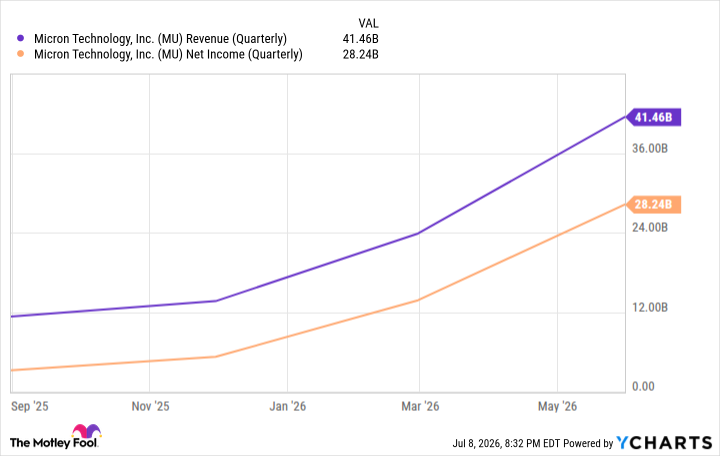
MU Revenue (Quarterly) Chart

MU Revenue (Quarterly) data by YCharts

Unsurprisingly, the unique position Micron has found itself in — both financially and in terms of market position — has attracted many investors hoping to capitalize on it. And based on the president’s latest disclosure, he’s been one of those investors.

Micron Technology Stock Quote

Today’s Change

(-1.05%) $-10.39

Advertisement

Current Price

$981.25

Should you follow Trump’s lead?

You shouldn’t invest in Micron simply because the president did. It’s true his stake in the company means he has a vested interest in making sure the stock does well, but you don’t want to blindly follow his moves simply for that reason.

You should, however, consider investing in Micron because its unique market position is bound to last for the foreseeable future. But even when supply meets demand, and Micron can’t command the premium it’s currently charging, the company will still have long-term agreements in place.

It’s operating in a cyclical industry that’s riding the high end, but it’s still a solid company with good long-term potential. It’s likely to be highly volatile along the way, but I trust its trajectory.

Continue Reading
Advertisement

Trending
