This story contains spoilers from the the season finale of “True Detective: Night Country.”
The darkness has lifted, “True Detective: Night Country” has come to an end, and some of us may never look at an orange in the same way again.
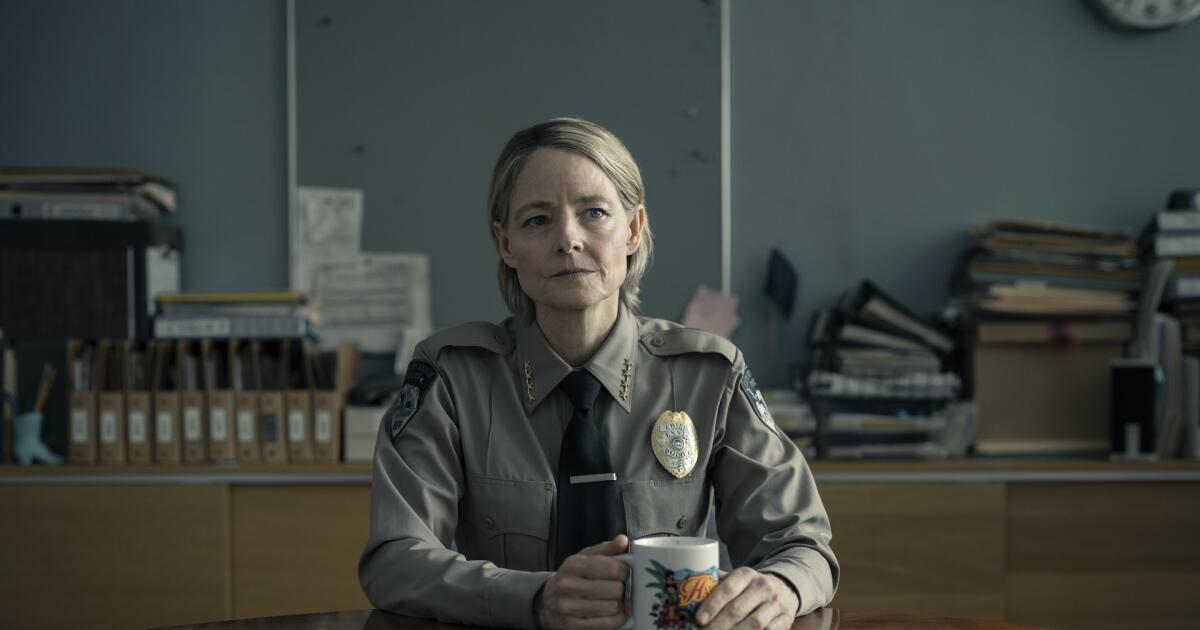
Written and directed by Issa López, the latest incarnation of the anthology mystery series relocated the action to the fictional town of Ennis, Alaska, and follows two women — Liz Danvers (Jodie Foster), the local police chief, and Evangeline Navarro (Kali Reis), a state trooper, as they investigate the mysterious death of a group of scientists at an Arctic research station — all while trying to heal the wounds of their past.
Invoking familiar “True Detective” imagery (creepy swirls) while introducing all new eerie iconography (one-eyed polar bears), “Night Country” put a welcome, feminist spin on the franchise after a four-year hiatus.
Leading into Sunday’s finale, many unanswered questions remained, starting with who — or what — was responsible for turning the Tsalal scientists into a corpsicle, who really killed Annie K., and how her tongue ended up at the research station six years after she died.
Advertisement
Over the course of the New Year’s Eve from hell, Danvers and Navarro make one bombshell discovery after another, learning that: 1. the scientists at Tsalal were pushing the mine to pump out more pollutants because it made it easier for them extract DNA from the ice; 2. Annie found out about it and destroyed their research; 3. the scientists killed her in a collective fit of rage; 4. members of the cleaning crew discovered the ice cave, where they saw the evidence of Annie’s murder; 5. they returned to the research station, forced the scientists out onto the ice in the middle of a storm, made them strip, and left them there in an act of revenge that proved fatal to them all; 6. except Raymond Clark, who hid in the abandoned ice cave for weeks until Danvers and Navarro found and interrogated him; 7. and he wound up becoming a corpsicle, too.
In the finale of “Night Country,” we witness Danvers (Jodie Foster) and Navarro (Kali Reis) uncovering the mystery of what happened to the scientists at the Tsalal research station.
(Michele K. Short / HBO)
Phew. Got all that?
Advertisement
The episode ends on a decidedly ambiguous note, however. An epilogue skips ahead four months to May. Navarro has seemingly vanished and Danvers faces questioning by investigators about the events of the previous December. She is evasive when asked about reported sightings of Navarro — who we see walking onto the ice, alone, then standing on a porch next to Danvers in the parting shot of the season. Is it really her? Or just an apparition? It’s impossible to say. “This is Ennis, “ Danvers tells the investigators. “Nobody ever really leaves.”
Speaking recently by Zoom, López broke down the series finale and was, thankfully, willing to answer more questions than Danvers. This conversation has been edited and condensed for clarity.
It turns out the women of the cleaning crew were responsible for the deaths of the scientists at Tsalal — or at least they are the ones who drove the men out into the cold. Did you always know that would be the outcome?
I knew from the very beginning. Being Mexican and having moved to Los Angeles some 10 years ago, it’s interesting to see how behind every scene, there is someone you would never notice. I’m Mexican, and most people in California are Mexican or Latin American. They’re the person that washes the dishes, the person that cleans the office after you leave. They’re really invisible. However, they’re everywhere, they have access to everything, they know everything. Invisibility is a superpower. It can be terrible. And it can be conducive to horrors like missing and murdered Indigenous women. But at the same time, it can be a superpower. Why not flip that coin and use it for power?
The scientists turn out to be the bad guys in this story. They’re willing to kill Annie and pollute the town in the name of scientific progress. How did you decide to make them the villains?
Advertisement
That’s a tough decision for me. I’m a massive believer in science. If there’s a religion for me, it’s science. The idea that ancient DNA can be used is not impossible, it’s not madness. But it would be very hard to extract. All of that is factual. The pursuit of knowledge or any greater good without a moral compass, I think, is the question of our age, as we look at what’s happening with AI and so many technologies that put the human race in a place that we never imagined. I don’t know if there’s a moral compass behind those. I don’t think we’re growing morally at the speed that we’re growing intellectually. And that’s a very dangerous place to be. If you abandon responsibility for the greater good, it’s very, very dangerous. It’s not about the pursuit of knowledge, it’s absolute self-obsession. It’s egotistical. In the traditional Greek tragedy, the mistake of the hero is always taking endeavors that go beyond the human. When you overstep human capacities, it ends in tragedy. So I just went with the Greeks on this one.
The version of Alaska that a lot of us know through pop culture is this male-dominated frontier with fishermen and ice road truckers. In your version of Alaska, it’s the women who dominate and the men who seem lost. Were you consciously trying to present a different idea of Alaska?
I think that the male and female characters in the series are democratically helpless, in the sense that everyone is lonely — men and women. Everyone is a little terrified of the stuff that they carry inside of them, perhaps with the exception of [Eddie] Qavvik on the male side — that guy’s fine — and Rose on the female side. They have their s— figured out. Everyone else is completely lost and trying to find their own path. It’s the nature of this town at the edge of the world, at the edge of civilization, at the edge of reality.
The Alaska that you were describing is predominantly male in its presentation. And the Alaska that I explored is predominantly female, the characters leading the conflict and the drama and the decisions are female. That comes from my understanding of these communities — Nome and Katovik and Utqiagvik [Alaska] — these communities [can be] 70% [or more] Inuit and particularly Iñupiaq. The strength of the Iñupiaq women is key to their survival. They’re just as much the hunters and fishers. They’re dog-sledding. They’re just indomitable. It’s incredible. Putting that in there felt very necessary.
Issa López, writer, director and showrunner of “True Detective: Night Country.”
Advertisement
(Christina House / Los Angeles Times)
A number of Indigenous women were consultants on the series. What kind of perspective and input did they bring?
I conceived the idea when we were in the lockdown. I couldn’t just pick up and go to Alaska and write it, which is what I wanted to do. I had to do the first passes based only on watching endless hours of “Alaska State Troopers” and “Life Below Zero,” which, by the way, I recommend.
I consumed hours and hours of social media of the people living in these towns. I listened to local radio stations while I was writing the scripts. Once I had an initial pass, we worked together through an association called Illuminative, which is amazing and connected us with two Alaskan producers [who were] very much in contact with the culture. They put together a council of the elder women of the Iñupiaq. When you say “elder,” I always think “ancient,” but there were women of [age] 45 and women of 90. They went through every single page of the scripts. I would mention elk, and they would say, “There’s no elk, not in that region.” [They provided details] like the type of fish, or how would they address someone coming into their house and insulting them.
Advertisement
Then I went to Alaska and I ate the animals that they hunted, we broke bread and I drank the wine that you have to get in the depot. I brought all that into the scripts and then some of the women in the elder council actually appeared in the series. They came with the clothing they made and they cooked the food that we served to the characters in the series. It was just beautiful. They became completely intertwined with the fabric of the series. They’re watching and loving it, which makes me endlessly proud.
I’ve watched the finale twice now. I’m still trying to figure out how literally I should interpret the final shot, with Danvers and Navarro on the porch. I assume you wanted to leave us with a mystery to think about. Tell me about that.
I think that the entire series has two readings. One of them is that everything is connected to the supernatural. The other one is there’s absolutely nothing supernatural happening. The dark brings its own madness and neurosis to some characters. The men walking onto the ice — you can go with they froze to death in a flash freeze and they had paradoxical undressing and delirium because of hypothermia. Or [you can believe] they walked onto the ice, and faced the thing they woke up by being in the wrong place. It’s up to you to decide which one of those readings you are going to embrace.
Navarro asks in the series, “Don’t you ever feel that you just want to go and walk away and never come back?” She talks about getting calls from something that has called the women in her family for generations. She’s terrified. In the climax of Episode 6, shegoes into the darkness on the ice. When she finally surrenders to [the calls], in peace, she receives a piece of herself that she was missing: her name. That part of her is complete.
The part of her that wants to just go away is still there. Danvers says, “If you ever go, please come back.” In the very last part of the episode, we see her at peace. It’s up to her to decide if she goes on a walkabout to find herself and come back, as Danvers asks, or if she goes to be with the other women in peace, and is visiting as an apparition. It’s up to you to decide which one of the two it is. I have my version, but I’m not going to tell you.
Advertisement
“I think that the entire series has two readings. One of them is that everything is connected to the supernatural. The other one is there’s absolutely nothing supernatural happening,” says Issa López.
(Lilja Jons)
Clark says “time is a flat circle,” a callback to what is probably the best known line of dialogue from the original season. How’d you decide to bring that line in the episode? And did you have any anxiety about such a recognizable callback?
Here’s the thing. I never set out [like], “Oh, let’s put everything we can that references Season 1.” I believe in the idea of letting the story speak to you. I decided that Alaska was a super interesting setting for this series. I rewatched Season 1 and I realized Rust Cohle’s father had lived and died in Alaska. It would be crazy to never mention it. It’s the same universe. There is a corporation that is funding the endeavors of a greedy machine that is lying about pollution. In Season 1, there is an evil corporation too — it would be silly to have two different ones. When there is a symbol in my season that signifies the proximity of a different level of reality — the supernatural — and there is a symbol for that in the first season. So why add in a new one? That just makes it not “True Detective.”
Advertisement
The idea in Clark’s crazed mind [is] that Annie’s spirit has always inhabited this cave, because maybe Annie is herself, in a way, whatever was sleeping there. Annie’s friend tells us she dreamed about this spiral when she was in school. Clark [tells Danvers], “She has been there forever, she will be there forever.” it’s just absolutely natural that he says, “Time is a flat circle.” That is a concept that comes from quantum physics. He’s a scientist, so it’s the most organic thing.
The other unresolved mystery is the tongue. How does that fit in?
Same story. If we’re going to go with the supernatural story, Hank is the one that dumps [Annie’s body] and cuts out the tongue. He leaves the tongue there, and the tongue disappears. No one ever finds it until six years later. In the moment that the scientists face their fate, the tongue reappears because it’s the time to tell the story that was silenced before. Was it Annie’s ghost?
If you’re going to go rational, Hank cuts the tongue and leaves it there. And then the body is found, not by Navarro — Navarro is the first cop at the scene — but by the community. In my mind, the women find Annie and they cannot take her body, but they can keep her tongue in a gesture of kindness for their friend. Danvers says it has some unusual cellular damage, it could be from freezing. They keep the tongue, they freeze it and when they go into the research station [to attack the scientists], they leave it there: Full circle. Time to pay. You can decide which one you believe.
Can you talk about how the ice becomes a border between the human and the supernatural, the living and the dead, especially in this last episode?
Advertisement
It’s absolutely at the center of the entire narrative. If you look at the title sequence, it’s all about that; we’re on this road that will expose what’s under the ice. When I picked the setting, [I was interested in] the idea of the things that we freeze inside ourselves, and hide under ice, so we cannot access them. However, the ice breaks, and the things that lie beneath will come to light. The ice won’t last forever. It is a massive metaphor, and it is at the very center of everything we’re saying in this story.
Bounding into cinemas just in time for spring, the latest Pixar animation is a pleasingly charming tale of man vs nature, with a bit of crazy robot tech thrown in.
The star of Hoppers is Mabel Tanaka (voiced by Piper Curda), a young animal-lover leading a one-girl protest over a freeway being built through the tranquil countryside near her hometown of Beaverton.
Because the freeway is the pet project of the town’s popular mayor, Jerry (Jon Hamm), who is vying for re-election, Mabel’s protests fall on deaf ears.
Everything changes when she stumbles upon top-secret research by her biology professor, Dr Sam Fairfax (Kathy Najimy), that allows for the human consciousness to be linked to robotic animals. This lets users get up close and personal with other species.
Advertisement
“This is like Avatar,” Mabel coos, and, in truth, it is. Plugged into a headset, Mabel is reborn inside a robotic beaver. She plans to recruit a real beaver to help populate the glade, which is set to be destroyed by Jerry’s proposed road.
In the summer of 1991, Nirvana filmed the music video for “Smells Like Teen Spirit” on a Culver City sound stage. Kurt Cobain strummed the grunge anthem’s iconic four-chord opening riff on a 1969 Fender Mustang, Lake Placid Blue with a signature racing stripe.
Nearly 35 years later, the six-string relic hung on a gallery wall at Christie’s in Beverly Hills as part of a display of late billionaire businessman Jim Irsay’s world-renowned guitar collection, which heads to auction at Christie’s, New York, beginning Tuesday. Each piece in the Beverly Hills gallery, illuminated by an arched spotlight and flanked by a label chronicling its history, carried the aura of a Renaissance painting.
Share via
Advertisement
Advertisement
Irsay’s billion-dollar guitar arsenal, crowned “The Greatest Guitar Collection on Earth” by Guitar World magazine, is the focal point of the Christie’s auction, which has split approximately 400 objects — about half of which are guitars — into four segments: the “Hall of Fame” group of anchor items, the “Icons of Pop Culture” class of miscellaneous memorabilia, the “Icons of Music” mixed batch of electric and acoustic guitars and an online segment that compiles the remainder of Irsay’s collection. The online sale, featuring various autographed items, smaller instruments and historical documents, features the items at the lowest price points.
A portion of auction proceeds will be donated to charities that Irsay supported during his lifetime.
The instruments of famous musicians have long been coveted collector’s items. But in the case of the Jim Irsay Collection, the handcrafted six-strings have acquired a more ephemeral quality in the eyes of their admirers.
Amelia Walker, the specialist head of private and iconic collections at Christie’s, said at the recent highlight exhibition in L.A. that the auction represents “a real moment where these [objects] are being elevated beyond what we traditionally call memorabilia” into artistic masterpieces.
“They deserve the kind of the pedestal that we give to art as well,” Walker said. “Because they are not only works of art in terms of their creation, but what they have created, what their owners have created with them — it’s the purest form of art.”
Advertisement
Cobain’s Fender was only one of the music history treasures nestled in Christie’s gallery. A few paces away, Jerry Garcia’s “Budman” amplifier, once part of the Grateful Dead’s three-story high “Wall of Sound,” perched atop a podium. Just past it lay the Beatles logo drum head (estimated between $1 million and $2 million) used for the band’s debut appearance on “The Ed Sullivan Show,” which garnered a historic 73 million viewers and catalyzed the British Invasion. Pencil lines were still visible beneath the logo’s signature “drop T.”
Pencil lines are still visible on the drum head Ringo Starr played during the Beatles’ debut appearance on “The Ed Sullivan Show.”
(Christie’s Images LTD, 2026)
It is exceptionally rare for even one such artifact to go to market, let alone a billion-dollar group of them at once, Walker said. But a public sale enabling many to participate and demonstrate the “true market value” of these objects is what Irsay would have wanted, she added.
Dropping tens of millions of dollars on pop culture memorabilia may seem an odd hobby for an NFL general manager, yet Irsay viewed collecting much like he viewed leading the Indianapolis Colts.
Advertisement
Irsay, the youngest NFL general manager in history, said in a 2014 Colts Media interview that watching and emulating the legendary NFL owners who came before him “really taught me to be a steward.”
“Ownership is a great responsibility. You can’t buy respect,” he said. “Respect only comes from you being a steward.”
The first major acquisition in Irsay’s collection came in 2001, with his $2.4-million purchase of the original 120-foot scroll for Jack Kerouac’s 1957 novel, “On the Road.” He loved the book and wanted to preserve it, Walker said. But he also frequently lent it out, just like he regularly toured his guitar collection beginning 20 years later.
Jim Irsay purchased the original 120-foot scroll manuscript of Jack Kerouac’s “On the Road” for $2.4 million in 2001.
(Christie’s Images)
Advertisement
“He said publicly, ‘I’m not the owner of these things. I’m just that current custodian looking after them for future generations,’ ” Walker said. “And I think that’s what true collectors always say.”
At its L.A. highlight exhibition, Irsay’s collection held an air of synchronicity. Paul McCartney’s handwritten lyrics for “Hey Jude” hung just a few steps from a promotional poster — the only one in existence — for the 1959 concert Buddy Holly, Ritchie Valens and J.P. “The Big Bopper” Richardson were en route to perform when their plane crashed. The tragedy spurred Don McLean to write “American Pie,” about “the day the music died.”
Later, the Beatles’ 1966 song “Paperback Writer” played over the speakers near-parallel to the guitars the song was written on.
Irsay’s collection also contains a bit of whimsy, with gems like a prop golden ticket from 1971’s “Willy Wonka & the Chocolate Factory” — estimated between $60,000 and $120,000 — and reading, “In your wildest dreams you could not imagine the marvelous surprises that await you!”
Advertisement
Another fan-favorite is the “Wilson” volleyball from 2000’s “Cast Away,” starring Tom Hanks, estimated between $60,000 and $80,000, Gibson said.
Historically, such objects were often preserved by accident. But as the memorabilia market has ballooned over the last decade or so, Gibson said, “a lot of artists are much more careful about making sure that things don’t get into the wrong hands. After rehearsals, they tidy up after themselves.”
If anything proves the market value of seemingly worthless ephemera, Walker added, it’s fans clawing for printed set lists at the end of a concert.
“They’re desperate for that connection. This is what it’s all about,” the specialist said. It’s what drove Irsay as well, she said: “He wanted to have a connection with these great artists of his generation and also the generation above him. And he wanted to share them with people.”
In Irsay’s home, his favorite guitars weren’t hung like classic paintings. Instead, they were strewn about the rooms he frequented, available for him to play whenever the urge struck him.
Advertisement
Thanks to tune-up efforts from Walker, many of the guitars headed to auction are fully operational in the hopes that their buyers can do the same.
“They’re working instruments. They need to be looked after, to be played,” Walker said. And even though they make for great gallery art, “they’re not just for hanging on the wall.”
“Trying to find your niche as a movie star isn’t easy,” said Frank Scheck in The Hollywood Reporter. Take Glen Powell. A year ago, the Twisters and Anyone but You star was being talked about as possibly the next Tom Cruise. But he “stumbled badly” when he tried to play a macho action hero in November’s remake of The Running Man, and he’s now turned in a second straight box office flop. He took a risk with How to Make a Killing, playing a guy cheated by fate who we’re supposed to root for as he begins murdering off the seven rich relatives standing between him and an enormous inheritance. But c’mon. “Powell is charming, but he’s not that charming.”
The Week
Escape your echo chamber. Get the facts behind the news, plus analysis from multiple perspectives.
Advertisement
SUBSCRIBE & SAVE
Sign up for The Week’s Free Newsletters
From our morning news briefing to a weekly Good News Newsletter, get the best of The Week delivered directly to your inbox.
From our morning news briefing to a weekly Good News Newsletter, get the best of The Week delivered directly to your inbox.
The movie “needed to pick a side,” said Jacob Oller in AV Club. It could have been “a clownish class comedy” or “bitter sociopathic satire,” but it winds up being neither, and “at the center of it all is Powell, making the same face for an hour and 45 minutes, too unflappable to root for, too smug to magnetize as an inhuman American Psycho.” I’m not ready to give up on him, said Nick Schager in the Daily Beast. To me, he and co-star Margaret Qualley, who plays the femme fatale who eggs on the killing spree, come across as “such alluringly nasty delights” that this reworking of the 1949 black comedy Kind Hearts and Coronets “ survives its potentially lethal missteps and works on its own limited terms.” Though its teeth aren’t as sharp as they should be, “it’s smart and spiky enough to leave a pleasurably painful mark.”
‘Pillion’
Directed by Harry Lighton (Not rated)
Advertisement
★★★★
While this gay BDSM rom-com from a rookie director “might sound niche,” said Amy Nicholson in the Los Angeles Times, “free yourself to see it and you’ll discover it’s a universal romance.” Former Harry Potter side figure Harry Melling stars as a shy singleton who’s figuring out what he wants in a relationship when he happens into a submissive-dominant entanglement with a tall, handsome biker played by Alexander Skarsgard. Soon, Melling’s Colin is obeying his lover’s every order, including by shaving himself bald and sleeping like a dog on the floor. But the “kinky-funny” screenplay, which won a prize at Cannes, makes sure we see that Colin is not stuck but growing.
A free daily email with the biggest news stories of the day – and the best features from TheWeek.com
While the movie’s sex scenes are “refreshingly graphic,” they’re “never used or shock value,” said Odie Henderson in The Boston Globe. “The real shock comes from how emotionally involved the characters become within the construct of their kink.” And when Colin brings his new lover home to meet the parents, Skarsgard and Lesley Sharp, as Colin’s suburban London mom, do memorable work because “neither of them approaches the scene in a way you’d expect.” Until the ending, which “feels a little neat,” said Zachary Barnes in The Wall Street Journal, the movie “proceeds with an assurance of tone that’s especially impressive for a first-time filmmaker handling material like this.” Harry Lighton’s debut “could have been simply shocking, revving its engine in sexed-up style. Instead, Pillion purrs.”
‘Midwinter Break’
Directed by Polly Findlay (PG-13)
Advertisement
★★
Lesley Manville and Ciarán Hinds “would be appealing to watch just fumbling for their reading glasses,” said Natalia Winkelman in The New York Times. Unfortunately, this “staid” drama about an aging Irish couple puts that claim to the test. A “slow-moving film with a sappy score and mellow mood,” Midwinter Break opens with Manville’s Stella surprising Hinds’ Gerry by arranging a spur-of-the-moment trip to Amsterdam. Alas, “precious little conflict occurs until long afterward.”
But while Polly Findlay’s adaptation of a Bernard MacLaverty novel is a “delicate” film, said Lindsey Bahr in the Associated Press, its impact can be profound “if you can get on its level.” Stella, a devout Catholic, has an ulterior motive for dragging Gerry abroad, and when she nervously proposes how she’d like to live more purposefully in retirement, “it feels earth-shattering.” This is a couple accustomed to leaving much unsaid, including how the violence of the Troubles led them to flee Belfast years earlier for Scotland. Manville and Hinds give the movie everything they’ve got, said Caryn James in The Hollywood Reporter. In a scene in which Stella pours out her heart to a stranger, “Manville delivers one of her most magnificent performances, which is saying a lot.” Alas, the script lets them down, “not because it needs more action but because this ordinary couple’s problems seem so unsurprising, their inner lives so veiled.”