Entertainment
Upheaval wrestles with tradition in Korean art of the 1960s and ’70s at the Hammer Museum

Seoul is the latest major city to establish itself as a significant international hub for new art. With that distinction comes the expected propagation of ambitious museum exhibitions seeking to articulate, illuminate and cogitate over its local history of modern art, which is little known.
“Only the Young: Experimental Art in Korea, 1960s-1970s” is the latest. It follows “The Space Between: The Modern in Korean Art,” which a year ago covered 1897 to 1965 at the Los Angeles County Museum of Art.
“Only the Young,” organized last year by the Solomon R. Guggenheim Museum in New York, working with Korea’s National Museum of Modern and Contemporary Art, is at the UCLA Hammer Museum in Westwood through May 12. It’s the first show of its kind in North America. With 29 artists and nine artist groups, the exhibition is anchored by varieties of Conceptual art, which became the leading form internationally in the decades under review. The result is work that feels at once recognizable and unfamiliar, which sometimes makes for a bit of a tough haul, if also a nicely curious experience.
The history of the participating Korean museum suggests some of what you’ll find explored in the show. The institution, founded in 1969, smack in the middle of the exhibition timeline, has now branched out into four satellites — Gwacheon, Deoksugung, Cheongju and Seoul, most of them in and around the nation’s capital. Those sites represent shifting centers of power, influence and reigning cultural philosophy within the country, beginning with the isolationist Joseon dynasty that ruled for half a millennium, before the tumultuous modern era.
Of the 29 artists, all but two, Jung Kangja and Lee Hyangmi, are men. That’s one indication of the deep social conservatism of an era of rebuilding after the Korean War, which was led by strongman Park Chung Hee. His tenure — Park took power in a 1961 military coup and was assassinated while still in office in 1979 — brackets the show’s “experimental” era.
A timeline of Korean performance art leads to Song Burnsoo’s “Take Cover I-V,” five silkscreen images.
(Christopher Knight / Los Angeles Times)
Jung’s participation in a satirical 1968 performance stands out. In a happening that parodied academic female nudes painted by men, her male colleagues, Chung Chanseung and Kang Kukjin, attached transparent balloons to her semi-naked body. The balloons then were popped, one by one, to fully expose the 26-year-old artist.
A hit with their avant-garde coterie, partly for its virtually unprecedented feminist insistence on a living, breathing woman’s centrality to the project, the event didn’t go down well everywhere, including in a scandalized Korean popular press. (Police were also on hand to observe.) Two years later, annoyed authorities shuttered a survey exhibition of Jung’s work.
Jung, Chung and Kang had all been students in the department of Western painting at Seoul’s Hongik University. That such a department existed shows where certain official Asian ambitions lay: The Western establishment was the standard for what “modern” meant. Many young Korean artists worked in groups, affiliated formally or loosely, which may suggest just how minimized experimentation was. (There’s strength in numbers.) Amid churning local political controversies around national identity, the students surely were looking to developments in Europe and the United States for artistic inspiration, with contemporary art magazines as a guide.
At the Hammer, “Transparent Balloons and Nude” is represented by a slightly blurry photograph, displayed with other still and video images of performance art in a helpful timeline that spreads across a wall. The performance indicates obvious debts to slightly earlier Western works.
Among them are Yves Klein’s 1960 performance in Paris, “Anthropometry of the Blue Period,” in which nude women were slathered in blue paint and then imprinted their bodies on canvas; and Yoko Ono’s 1964 “Cut Piece,” first performed in Tokyo and then London and New York (at Carnegie Hall, no less), where she sat alone on a stage while members of the audience were invited to come up and cut off pieces of her clothing. Neither of these cutting-edge Western precedents required police to be in attendance, which yields dramatic — and courageous — resonance for the Koreans’ performance.
Park Hyunki, “Untitled (TV Stone Tower),” 1982, mixed media.
(Hammer Museum)
L.A. is home to the largest Korean diaspora, but the country’s history, which may or may not be familiar to Hammer visitors, illuminates what artists were up to. It was not always to profound effect. For instance, Andy Warhol is an obvious marker for Song Burnsoo’s “Take Cover I-V,” five silkscreen images that repeat a gas-masked face, its sequence of solid colors representing coded government alarms related to threats from North Korea. The work’s Pop social commentary is pretty thin.
More intriguing is Park Hyunki’s “Untitled (TV Stone Tower),” which inserts a television monitor within a short stack of hefty stones, surrounded by additional scattered rocks. (Here the show fudges a bit, since the work is dated 1982.) In this Brancusi-inflected “endless column,” commercially produced and ephemeral mass imagery is juxtaposed with an actual, if abbreviated, mass drawn from nature, creating an oddly poignant sense of loss. The effect is only enhanced by learning from the show’s excellent catalog that Park’s composition refers to traditional Korean doltap, stone piles erected at temples to drive away evil spirits.
Two of the show’s simplest works are among its most hauntingly beautiful. Lee Seung-taek’s “Tied Ceramic” and Ha Chong-Hyun’s “Work 73-13” both date from the early 1970s, a time of serious national distress that included ramifications from participation in the Vietnam War.
“Tied Ceramic” leaves the tracks of a rope that, before firing in a kiln, were wound around a white porcelain moon jar, an exquisite traditional form highly revered during the premodern Joseon dynasty. The wrapping marks, cut into the clay like a memory made concrete, oscillate between signs of painful bondage and a warm embrace, a tension both social and artistic in 1970s Korean culture.
Lee Seung-taek, “Tied Ceramic,” 1975, porcelain.
(Christopher Knight / Los Angeles Times)
“Work 73-13” is a large, earthy, monochrome abstraction, its mottled muddy color achieved by pushing brown oil paint through rough jute from behind. Almost 4 feet tall and nearly 8 feet wide, the plane is wrapped in a strict grid of barbed wire. The aesthetic effect is of nature, tradition, human effort and modernity imprisoned but unstoppable. It will all ooze out.
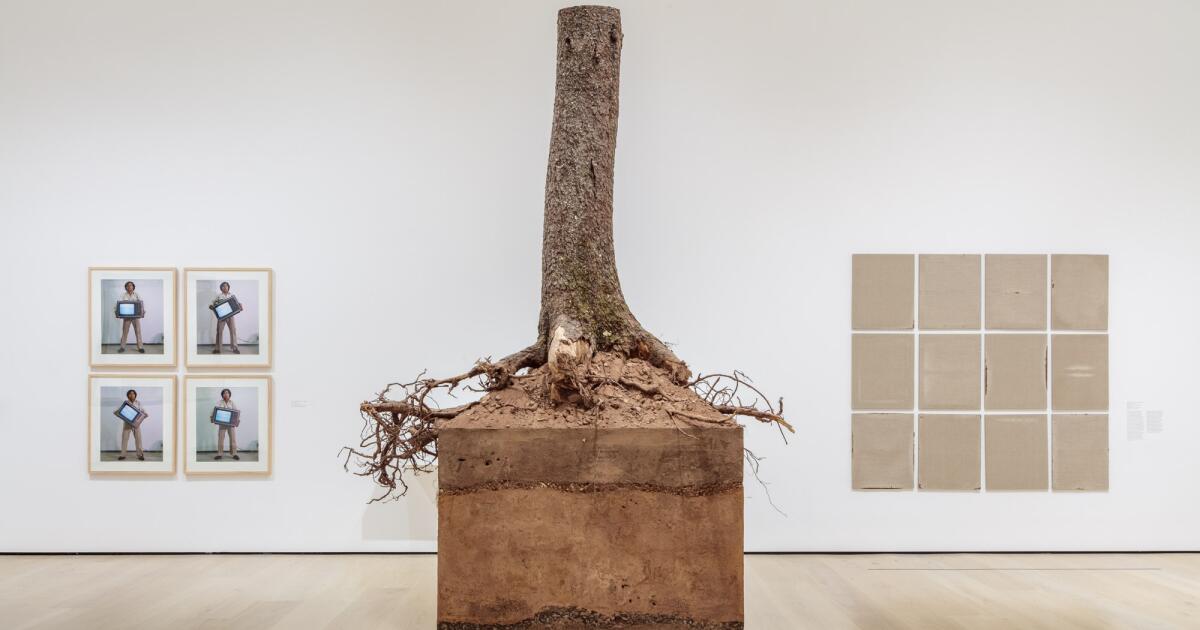
A kind of exclamation point marks the final room, where a tall, severed tree stump rises from a big, precisely carved cube made of soil, gravel and concrete. Lee Kun-Yong’s sculpture “Corporal Term,” which sits atop a wooden pallet, is remade whenever it is shown, its natural elements scavenged from local sources. (A Hammer label is careful to note that this particular tangled stump was found as is; no trees were harmed to make the art.) The title “Corporal Term” describes the bodily lifespan of the sculpture, the human effort to fabricate the form, the viewer’s experience of it — even, perhaps, the long arc of Korean history that has brought the object here. The work is a lovely meditation on mortality and endurance.
Kim Kulim, who worked in Los Angeles in the 1990s, emerges from “Only the Young” as an essential artist for the experimental activity that erupted in 1960s Korea. At the show’s entrance, his painting “Death of the Sun II” (1964) is a scarred, all-black panel, made from paint covered with a petroleum-doused vinyl sheet that was set on fire and then smothered. The battered panel — painting as performance art — takes a cue from Shōzō Shimamoto, Saburō Murakami and other Gutai aesthetics of 1950s Japan, which emerged from the apocalyptic ruins of Hiroshima and Nagasaki.
Ha Chong-Hyun, “Work 73-13,” 1973, mixed media.
(Ariel Ione Williams)
“Death of the Sun II” metaphorically destroys both the revered Korean tradition of black ink painting and modern Western abstraction, whose epitome was said to be the structural void represented by the all-black paintings of 1950s American artists Robert Rauschenberg, Ad Reinhardt, Mark Rothko and Frank Stella. As the show unfolds, Kim turns up in several disparate guises — making films, producing happenings, wiring a big electrified panel of dancing lights — leaving one to wonder what a full solo retrospective might reveal.
Conceptual art was both an extension and a critique of modernism. A common though mistaken assumption is that varieties of Conceptual art erupted in New York and eventually spread out to cover the art globe, as Abstract Expressionist, Pop, Minimal and street art are often erroneously claimed to have done. Rather than representing a cultural center and its periphery, however, the artistic shift in the 20th century’s second half had multiple points of origin all over the globe. Seoul and its environs formed one of them. “Only the Young” does an admirable job of presenting the Korean dialect of Conceptual art’s emergent international language.
‘Only the Young: Experimental Art in Korea, 1960s-1970s’
Where: UCLA Hammer Museum, 10899 Wilshire Blvd., Westwood
When: Through May 12. 11 a.m. to 6 p.m. Tuesdays to Sundays, 11 a.m. to 8 p.m. Fridays; closed Mondays
Admission: Free
Info: hammer.ucla.edu, (310) 443-7000


RICHMOND, Va. (WRIC) — In this episode of 8News Reel Talk, Julia Broberg sits down with Hekla Petursson and Catori Ryan to talk about “Toy Story 5.”
The hosts gave their reviews and provided the following star ratings:
Catori: ★★★★
Hekla: ★★★★★
Julia: ★★★★.2
To watch more livestreams and digital video content, head to the WRIC+ Originals page. You can also watch full on-demand videos on your smart TV using the WRIC+ app.

Passing “Go” has become especially lucrative for mobile game publisher Scopely.
The Culver City-based Scopely launched “Monopoly Go!” in 2023, betting fans of the classic board game would flock to a mobile version aimed at casual gamers.
By 2025, “Monopoly Go!” had accrued $6 billion in lifetime in-app purchase revenue, becoming the fastest free mobile game to do so, according to app analytics firm Sensor Tower.
This summer, the app is expected to reach $8 billion in lifetime revenue, the company says, solidifying “Monopoly Go!” as Scopely’s biggest game and far surpassing the company’s popular “Pokémon Go.” The company declined to disclose its total profits.
Scopely Co-Chief Executive Javier Ferreira.
As overall downloads in the mobile game market have stagnated and in-app purchases and retention become the main drivers of growth, Scopely has hit on an age-old Hollywood strategy — using known franchises and intellectual property to bring out fans.
“These are incredibly durable and long-lasting games that have really passionate communities and fandom around them,” said Javier Ferreira, co-chief executive of Scopely. “We’re in the business of building people’s favorite thing, and that’s a difficult thing to do. The power of [intellectual property] is that, in some cases, that is already their favorite thing.”
The company’s journey toward “Monopoly Go!” began in 2014, when Scopely formed a partnership with Rhode Island-based toymaker Hasbro. Its first collaboration was a Yahtzee mobile dice game that ultimately drew millions of players worldwide (though it was especially popular in the U.S.) and generated more than $1 billion in lifetime revenue.
After that, Scopely approached Hasbro about taking on the “crown jewel” of its board game empire — Monopoly.
Monopoly’s massive global popularity was an obvious draw. But adapting an hours-long real estate transaction game for a casual, mobile audience proved challenging.
Development of what would become “Monopoly Go!” ultimately took seven years, two of which were spent trying to make movement around the board more fun. In that time, the company scrapped two versions of the game; one deemed too competitive, and one that was too complex, Ferreira said.
Developers wanted to capture the “roller coaster feel” of the board game’s highs and lows, while also having simple rules and ensuring a strong social element, he said.
“We couldn’t just copy,” Ferreira said. “We had to reinvent it and re-imagine it, and that’s a complicated, creative endeavor.”
Today, “Monopoly Go!” brings in more than $2 billion in annual revenue and has been downloaded across the globe more than 300 million times.
Now with “Pokémon Go,” which the company owns after acquiring maker Niantic’s game business last year, “Scopely has gone from a successful publisher to one of the defining companies in mobile gaming,” Randy Nelson, head of insights at Appfigures, a mobile app analytics firm.
“The company cracked the code on licensed games years ago,” he wrote in an email. “Its biggest hits work because they’re great games first and recognizable brands second.”
Though the company’s overall game downloads have slowed, its gross revenue has largely increased every year since 2020, according to Appfigures data.
Shortly after Scopely released “Monopoly Go!,” the company was acquired by Savvy Games Group, which is owned by the Saudi Public Investment Fund, for $4.9 billion.
In a statement about the deal, Savvy Games Group Chief Executive Brian Ward touted the success of “Monopoly Go!” as “indicative of Scopely’s ongoing position at the forefront of the global games sector.”
Representatives of the Saudi investment fund are part of Savvy Game Group’s board and do sometimes give some feedback on company initiatives, though Ferreira said the company has remained “very independent.”
The proposed acquisition of gaming giant Electronic Arts by the Saudi Public Investment Fund is not expected to affect Scopely since EA largely focuses on high-budget console and computer games, he said.
As Scopely, now 3,000 employees strong, looks to the future, it has embarked on a number of entertainment partnerships with studios to add franchises such as “The Simpsons,” “Hello Kitty” and Marvel to its mobile game ecosystem.
“They give us access to these universes that millions of people love and are really invested in,” Ferreira said. “We see this as a very strategic part of our business.”

Rose of Nevada is a genuinely poetic movie that pushes the boundaries of the Groundhog Day-style time-travel narrative while carving out an identity completely its own. Rather than relying on the familiar mechanics that audiences have come to expect from the genre, the film approaches the concept through a more reflective and emotional lens. The result is a movie that feels thoughtful, ambitious, and surprisingly moving.
It makes a huge on-screen presence felt through its cast, particularly George MacKay and Callum Turner, who both deliver performances that elevate the material beyond a simple science-fiction premise. Combined with breathtaking visuals and a strong directorial vision, Rose of Nevada becomes something far more memorable than many of its genre contemporaries.
George MacKay continues to prove why he is one of the most compelling actors working today. Following his acclaimed work in 1917, he once again demonstrates an ability to carry a film through sheer presence and emotional authenticity.
Every scene feels grounded because of his performance, even when the story ventures into more abstract territory. Alongside him, Callum Turner delivers what could easily be viewed as a breakout performance. The chemistry between the two leads helps anchor the film, allowing audiences to connect with the characters even as the narrative challenges conventional storytelling expectations.
One of the film’s greatest strengths is its visual presentation. The cinematography is nothing short of earth-shattering. Nearly every frame looks like a carefully crafted painting, capturing both the beauty and mystery of the world these characters inhabit. There is a dreamlike quality to the imagery that perfectly complements the film’s themes of time, memory, and destiny.
The camera lingers on landscapes just long enough to allow viewers to soak in their beauty without ever slowing the pace. It’s the kind of cinematography that demands to be appreciated on the largest screen possible.
Director Mark Jenkin continues to establish himself as one of the most distinctive voices in modern British cinema. Following the atmospheric and haunting Enys Men, Jenkin once again crafts a story that feels deeply connected to folklore and place.
The British backdrop becomes a character in itself, with rugged coastlines, open landscapes, and isolated locations contributing to the film’s unique atmosphere. His direction never feels showy or excessive; instead, he trusts the audience to absorb the experience and interpret its deeper meanings.
What makes Rose of Nevada especially fascinating is how it recalls classic time-travel films without simply copying them. There are moments that evoke the spirit of The Final Countdown, particularly in the sense of wonder and uncertainty surrounding the temporal elements.
Yet the film remains firmly rooted in its own identity, focusing more on emotion and introspection than spectacle. It invites viewers to engage with its ideas rather than simply consume them.
This is also one of those rare films that benefits from reflection after the credits roll. It is not a movie designed to provide easy answers. Instead, it lingers in the mind, encouraging discussion and interpretation. The more time you spend thinking about it, the more rewarding it becomes. Much like a fine wine, Rose of Nevada continues to improve with age, revealing new layers and details upon reflection.
Overall, Rose of Nevada is a beautiful, ambitious, and visually stunning piece of filmmaking that deserves to be experienced on the big screen. Powered by exceptional performances, remarkable cinematography, and confident direction, it stands as one of the more unique takes on time travel in recent memory.
Overall Grade: 4/5 Stars
-

 Fitness2 minutes ago
How Kaye Adams’ varied exercise routine keeps her fit at 63 – and why she swapped HIIT for walking
-

 Movie Reviews10 minutes ago
8News Reel Talk: ‘Toy Story 5’ movie review
-

 World20 minutes ago
Strong Earthquake Rocks Venezuela Capital
-

 Health50 minutes ago
Does Berberine Aid Weight Loss? The Best Time To Take It To Boost Results
-
 Lifestyle1 hour ago
John Cena wanted to step away from the WWE ring before he became ‘too slow for the show’ : Wild Card with Rachel Martin
-

 Technology1 hour ago
Here’s a bunch of Prime Day deals on keyboards, mice, and other peripherals we like
-

 World1 hour ago
Israel slams UN report as ‘political blood libel’ for alleging deliberate targeting of Palestinian children
-

 Politics1 hour ago
Biden judge rejects Trump’s sanctuary cities lawsuit, says even a win wouldn’t solve DOJ’s problem

