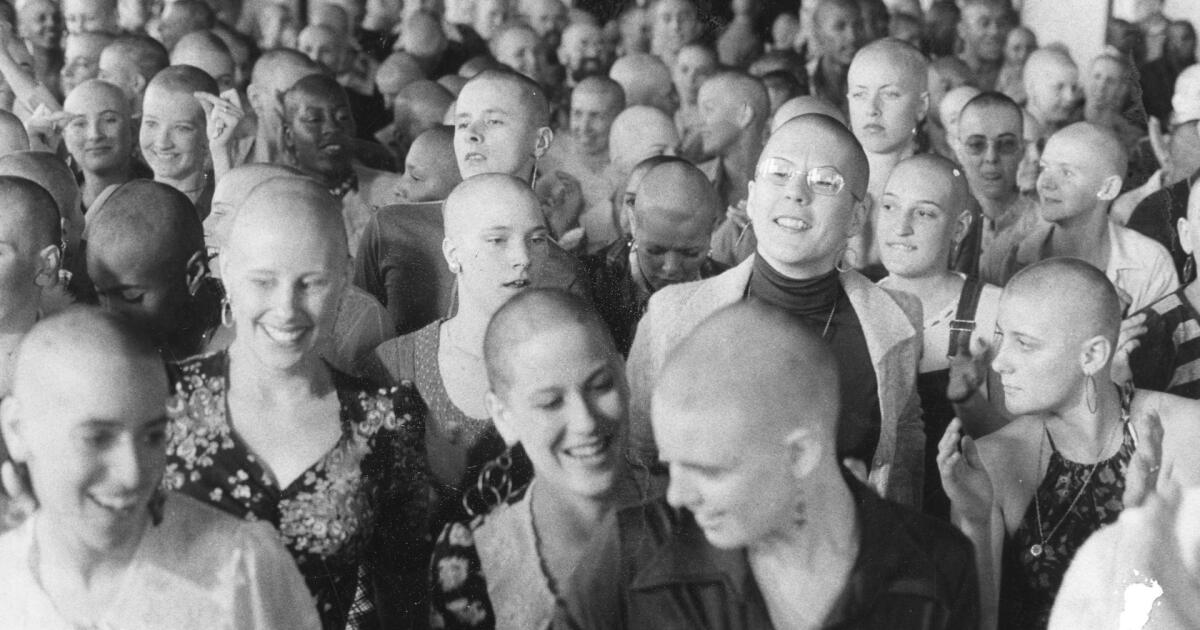
In the late 1950s, Charles “Chuck” Dederich started a drug rehabilitation program out of a storefront in Santa Monica. A recovering alcoholic who’d gotten sober through Alcoholics Anonymous, Dederich offered free treatment to self-described “dope fiends” desperate to kick their deadly habit and go cold turkey.
Over the next decade and a half, the group, named Synanon, expanded across the country and evolved into a self-help movement with thousands of members, including many who were not addicts but were simply drawn to its idealistic vision — no drugs, alcohol, or violence — and its primary ritual, an intensely confrontational form of group therapy known as “The Game.”
Yet by the late 1970s, Synanon had strayed dramatically from its original mission, devolving into a dangerous quasi-religious paramilitary organization whose devotees, beholden to Dederich’s increasingly erratic whims, were willing to undergo forced vasectomies, relinquish control over their own children and even attempt to murder a prominent critic by planting a rattlesnake in his mailbox.
The dark saga of Synanon is now the subject of a four-part documentary “The Synanon Fix,” concluding Monday on HBO. Directed and executive produced by Rory Kennedy, the series traces the group’s utopian origins and gradual descent into violence and manipulation. Arriving at a moment when the public’s interest in cults and high-control groups seems almost insatiable, “The Synanon Fix” offers a particularly grim, resonant twist on the familiar tale of the California dream gone awry.
The story “had this really dramatic, almost Shakespearean arc to it,” said writer and executive producer Mark Bailey, in a video chat with Kennedy from their home in California (the couple are filmmaking partners and have also been married since 1999). “The intentions and accomplishments for the first decade or so were really amazing. But where it ended up was really dark and destructive.”
Advertisement
Kennedy, who has made more than a dozen documentaries including “Ghosts of Abu Ghraib” and “Downfall: The Case Against Boeing,” said she was not particularly interested in “quote-unquote cult stories,” but was struck by the drama of Synanon’s 180-degree transformation. “In the beginning the pillars of Synanon were no drugs, no alcohol and no violence. By the end, they had bought more firearms than anybody in the history of California and had an open bar in the facility.”
Not only was the story dramatic, but it contained lessons about the dangers of blindly following a charismatic leader — a topic that feels politically relevant in 2024. Dederich was just such a figure, someone who built a community and inspired intense loyalty from his followers. “Because they’re tethered to him, where he goes, they go. And that’s the danger — as he starts becoming less stable, whether it’s from his alcoholism or mental illness, he takes Synanon with it,” Bailey said. “That felt, to us, like an important thing to say right now.” (Along with many members of her famous family, Kennedy, whose brother Robert F. Kennedy Jr. is running for president as an independent, endorsed President Biden last week.)
Kennedy and Bailey first learned about Synanon about a decade ago while reading “Straight Life,” an autobiography by jazz musician Art Pepper and his wife, Laurie, who met while getting clean in Synanon. “I had never heard of Synanon, but it’s right there on the beach, these folks with shaved heads, playing ‘The Game,’ which sounds like this pretty radical therapeutic treatment,” Bailey said. “I was instantly like, ‘Wow, what was this? And why have I never heard about it?’”
Charles “Chuck” Dederich, founder of Synanon.
(HBO)
Advertisement
The documentary is woven together using extensive archival material — including news reports and visceral footage of members playing “The Game,” in which participants were aggressively pushed to be brutally honest about themselves and each other. It also features audio recordings of Dederich lecturing his followers over “the Wire,” the group’s internal broadcasting system, as well as first-person accounts from roughly 20 former members and interviews with journalists including Narda Zacchino, who wrote about Synanon for The Times.
Some former members were initially wary of sitting for interviews, Kennedy said, because “everybody was aware that there was a way to tell this story that’s pretty sensationalist.” But as she gradually won them over, more people decided to participate in the documentary — including Dederich’s daughter, Jady Dederich Montgomery.
After years of wrangling, the filmmakers were also able to secure access to Synanon’s archives, which included thousands of photos and “a treasure trove of extraordinary footage,” according to Kennedy. Because this happened just weeks before they were set to lock picture, they had to ask HBO for several more months and more money to recut the documentary. “To their credit, they agreed,” said Kennedy.
Interviewing people who spent years in Synanon playing “The Game” was both fascinating and challenging, she said.
Advertisement
“On average for documentaries, which I’ve now been doing for 25 years, the interviews are maybe two to three hours long. None of these were less than seven hours. Some of them went for nine hours, in like a sitting.” At times, Kennedy felt she was playing “The Game” with her subjects. “They would talk back to me more about how they were feeling about the interview as the interview was happening.”
Kennedy takes a straightforward approach in “The Synanon Fix,” allowing the story to unfold chronologically and spending time explaining the group’s origins before diving into the rattlesnakes and mate-swapping.
“This was a community that was taking a big swing at something that was really ahead of its time, in many ways, in terms of how it was treating drug addicts, who had been a very ostracized community,” said Kennedy. “They either went to jail, or they went to a mental hospital, or they died.”
Viewers learn how Synanon, which eventually moved into the historic Hotel Casa Del Mar in Santa Monica, began to attract a wider array of followers with the rise of the counterculture in the late 1960s. “Lifestylers,” as they were known, were people who joined Synanon because they were seeking a sense of purpose and belonging, not to treat their addiction. They saw the group as “a cure for loneliness and alienation,” said Bailey, and “The Game” as a way to heighten connection and sense of community. Some also donated large sums of money and professional services to the organization.
Throughout the ‘70s Dederich became increasingly dictatorial, making bizarre demands of his followers that had little to do with the group’s original mission. He required members to shave their heads and follow stringent diets and exercise regimens. Men were pressured into getting vasectomies and women into having abortions. After his wife died and he remarried, Dederich urged married couples to divorce and take new partners assigned to them. Eventually, Dederich fell off the wagon and rolled back the group’s ban on alcohol. Children were separated from their parents and had to shave their heads and play “The Game” just like adults, even if they lacked the ability to understand it. Some children allegedly were beaten and forced to do grueling labor.
Advertisement
Throughout the decade, Synanon faced mounting criticism including charges of kidnapping and child abuse, but its members grew ever more militant, stockpiling weapons and forming a militia called the Imperial Marines. The group made national headlines in 1978 when a lawyer named Paul Morantz, who had won a $300,000 settlement from Synanon, nearly died from a rattlesnake bite after Synanon zealots planted the animal in his mailbox.
The incident marked a breaking point for some adherents, but not all.
One of the more striking aspects of the series is how many former members still seem to believe in the Synanon cause — and remain grateful to Dederich, who died more than 25 years ago, for saving their lives.
Rory Kennedy, one of the filmmakers of HBO’s “The Synanon Fix.”
(Jon Kopaloff / Getty for HBO)
Advertisement
The series’ central question is “Did the cure become a cult?,” and the filmmakers don’t entirely agree on the answer.
Bailey is not fully convinced Synanon fits the definition of a cult, if only because “there is something that feels too random and disorganized in what it was trying to do,” he said.
Kennedy is more confident in using the term. “I talked to enough people who felt like they compromised their moral compass to follow an idea that drove them in directions that they didn’t feel they should have gone in. That’s a defining quality of a cult,” she said, gently needling her husband for his more ambivalent take. “If you were there, you would have stuck with it to the end, clearly,” she said, laughing. “Sucker is what you are.”
Regardless of how they classify the group, the filmmakers see “The Synanon Fix” as a quintessentially Californian story about the kinds of spiritual seekers who’ve been drawn to the state for generations.
“You think of the people who move West as already kind of having searching in their DNA,” said Bailey. “We came out here about 14 years ago, but both of us were born and raised on the East Coast. And it was really something to get used to how you are allowed to just follow your own weird jam and everybody’s like, ‘Oh, that’s great.’”
A still from ‘Song Sung Blue’.
| Photo Credit: Focus Features/YouTube
There is something unputdownable about Mike Sardina (Hugh Jackman) from the first moment one sees him at an Alcoholics Anonymous meeting celebrating his 20th sober birthday. He encourages the group to sing the famous Neil Diamond number, ‘Song Sung Blue,’ with him, and we are carried along on a wave of his enthusiasm.
Song Sung Blue (English)
Director: Craig Brewer
Cast: Hugh Jackman, Kate Hudson, Michael Imperioli, Ella Anderson, Mustafa Shakir, Fisher Stevens, Jim Belushi
Runtime: 132 minutes
Advertisement
Storyline: Mike and Claire find and rescue each other from the slings and arrows of mediocrity when they form a Neil Diamond tribute band
We learn that Mike is a music impersonator who refuses to come on stage as anyone but himself, Lightning, at the Wisconsin State Fair. At the fair, he meets Claire (Kate Hudson), who is performing as Patsy Cline. Sparks fly between the two, and Claire suggests Mike perform a Neil Diamond tribute.
Claire and Mike start a relationship and a Neil Diamond tribute band, called Lightning and Thunder. They marry and after some initial hesitation, Claire’s children from her first marriage, Rachel (Ella Anderson) and Dayna (Hudson Hensley), and Mike’s daughter from an earlier marriage, Angelina (King Princess), become friends.
Members from Mike’s old band join the group, including Mark Shurilla (Michael Imperioli), a Buddy Holly impersonator and Sex Machine (Mustafa Shakir), who sings as James Brown. His dentist/manager, Dave Watson (Fisher Stevens), believes in him, even fixing his tooth with a little lightning bolt!
The tribute band meets with success, including opening for Pearl Jam, with the front man for the grunge band, Eddie Vedder (John Beckwith), joining Lightning and Thunder for a rendition of ‘Forever in Blue Jeans’ at the 1995 Pearl Jam concert in Milwaukee.
There is heartbreak, anger, addiction, and the rise again before the final tragedy. Song Sung Blue, based on Greg Kohs’ eponymous documentary, is a gentle look into a musician’s life. When Mike says, “I’m not a songwriter. I’m not a sex symbol. But I am an entertainer,” he shows that dreams do not have to die. Mike and Claire reveal that even if you do not conquer the world like a rock god, you can achieve success doing what makes you happy.
Advertisement
ALSO READ: ‘Run Away’ series review: Perfect pulp to kick off the New Year
Song Sung Blue is a validation for all the regular folk with modest dreams, but dreams nevertheless. As the poet said, “there’s no success like failure, and failure’s no success at all.” Hudson and Jackman power through the songs and tears like champs, leaving us laughing, tapping our feet, and wiping away the errant tears all at once.
The period detail is spot on (never mind the distracting wigs). The chance to hear a generous catalogue of Diamond’s music in arena-quality sound is not to be missed, in a movie that offers a satisfying catharsis. Music is most definitely the food of love, so may we all please have a second and third helping?
Stephen A. Smith is arguably the most-well known sports commentator in the country. But the outspoken ESPN commentator’s perspective outside the sports arena has landed him in a firestorm.
The furor is due to his pointed comments defending an Immigration and Customs Enforcement agent who fatally shot a Minneapolis woman driving away from him.
Just hours after the shooting on Wednesday, Smith said on his SiriusXM “Straight Shooter” talk show that although the killing of Renee Nicole Good was “completely unnecessary,” he added that the agent “from a lawful perspective” was “completely justified” in firing his gun at her.
He also noted, “From a humanitarian perspective, however, why did he have to do that?”
Smith’s comments about the agent being in harm’s way echoed the views of Deputy of Homeland Security Secretary Kristi Noem, who said Good engaged in an “act of domestic terrorism” by attacking officers and attempting to run them over with her vehicle.
Advertisement
However, videos showing the incident from different angles indicate that the agent was not standing directly in front of Good’s vehicle when he opened fire on her. Local officials contend that Good posed no danger to ICE officers. A video posted by partisan media outlet Alpha News showed Good talking to agents before the shooting, saying, “I’m not mad at you.”
The shooting has sparked major protests and accusations from local officials that the presence of ICE has been disruptive and escalated violence. Minneapolis Mayor Jacob Frye condemned ICE, telling agents to “get the f— out of our city.”
The incident, in turn, has put a harsher spotlight on Smith, raising questions on whether he was reckless or irresponsible in offering his views on Good’s shooting when he had no direct knowledge of what had transpired.
An angered Smith appeared on his “Straight Shooter” show on YouTube on Friday, saying the full context of his comments had not been conveyed in media reports, specifically calling out the New York Post and media personality Keith Olbermann, while saying that people were trying to get him fired.
He also doubled down on his contention that Good provoked the situation that led to her death, saying the ICE agent was in front of Good’s car and would have been run over had he not stepped out of the way.
Advertisement
“In the moment when you are dealing with law enforcement officials, you obey their orders so you can get home safely,” he said. “Renee Good did not do that.”
When reached for comment about his statements, a representative for Smith said his response was in Friday’s show.
It’s not the first time Smith, who has suggested he’s interesting in going into politics, has sparked outside the sports universe. He and journalist Joy Reid publicly quarreled following her exit last year from MSNBC.
He also faced backlash from Black media personalities and others when he accused Democratic Rep. Jasmine Crockett of Texas of using “street verbiage” in her frequent criticisms of President Trump.
“The way that Jasmine Crockett chooses to express herself … Aren’t you there to try and get stuff done instead of just being an impediment? ‘I’m just going to go off about Trump, cuss him out every chance I get, say the most derogatory things imaginable, and that’s my day’s work?’ That ain’t work! Work is, this is the man in power. I know what his agenda is. Maybe I try to work with this man. I might get something out of it for my constituents.’ ”
In 1977, a man named Tony Kiritsis fell behind on mortgage payments for an Indianapolis, Indiana, property that he hoped to develop into an affordable shopping center for independent merchants. He asked his mortgage broker for more time, but was denied. This enraged him because he suspected that the broker and his father, who owned the company, were conspiring to defraud him by letting the property go into foreclosure and acquire it for much less than market value. He showed up at the offices of the mortgage company, Meridian, for a scheduled appointment regarding the debt in the broker’s office, where he took the broker, Richard O. Hall, hostage, and demanded $130,000 to settle the debt, plus a public apology from the company. He carried a long cardboard box containing a shotgun with a so-called dead man’s wire, which he affixed to Hall as a precaution against police interference: if either of them were shot, tackled, or even caused to stumble, the wire would pull the trigger, blowing Hall’s head off.
That’s only the beginning of an astonishing story that has inspired many retellings, including a memoir by Hall, a 2018 documentary (whose producers were consultants on this movie) and a podcast drama starring Jon Hamm as Tony Kiritsis. And now it’s the best current movie you likely haven’t heard about—a drama from director Gus Van Sant (“Good Will Hunting”), starring Bill Skarsgård as Tony Kiritsis and Dacre Montgomery as Richard Hall. It’s unabashedly inspired by the best crime dramas from the 1970s, including “Dog Day Afternoon,” “The Sugarland Express,” “Network,” and “Badlands,” and can stand proudly alongside them.
From the opening sequence, which scores the high-strung Tony’s pre-crime prep with Deodato’s immortally groovy disco version of “Thus Spake Zarathustra” played on the radio by one of Tony’s local heroes, the philosophical DJ Fred Temple (Colman Domingo); through the expansive middle section, which establishes Tony as part of a thriving community that will see him as their representative in the one-sided struggle between labor and capital; through the ending and postscript, which leave you unsure how to feel about what you’ve seen but eager to discuss it with others, “Dead Man’s Wire” is a nostalgia trip of the best kind. Rather than superficially imitate the style of a specific type of ’70s drama, Van Sant and his collaborators connect with the essence of what made them powerful and memorable: their connection to issues that weighed on viewers’ minds fifty years ago and that have grown heavier since.
Tony is far from a criminal genius or a potential folk hero, but thinks he’s both. The shotgun box with a weird bulge, barely held together with packing tape, is a correlative of the mentality of the man who carries it. His home is filled with counterculture-adjacent books, but he’s a slob who loudly gripes during a brief car ride that his “shorts have been ridin’ up since Market Street,” and has a vanity license plate that reads “TOPLESS.” His eloquence runs the gamut from Everyman acuity to self-canceling nonsense slathered in profanity . He accurately sums up the mortgage company’s practices as “a private equity trap” (a phrase that looks ahead to the 2008 financial collapse, which was sparked by predatory lending on subprime mortgages) and hopes that his extreme actions will generate some “some goddamn catharsis” for himself and his fellow citizens, and “some genuine guilt” among Indianapolis’ lending class.
He’s also intoxicated by his sudden local fame. The hostage situation migrates from the mortgage company to Tony’s shabby apartment complex, which is quickly surrounded by beat cops, tactical officers, and reporters (including Myha’La as Linda Page, a twenty-something, Black local TV correspondent looking to move up. Tony also forces his way into the life of his idol Temple, who tapes a phone conversation with him, previews it for police, and grudgingly accepts their or-else request to continue the dialog and plays their regular talks on his morning show.
Advertisement
Despite these inroads, Tony is unable to prevent his inner petty schmuck from emerging and undermining his message, such as it is. He vacillates between treating Hall as a useless representative of the financial elite (when the elder Hall finally agrees to speak with Tony via phone from a tropical vacation, Tony sneers to Hall the younger, “Your daddy’s on the line—he wants to know when you’ll be home for supper!”) and connecting with him on a human level. When he’s not bombastic, he’s needy and fawning. “I like you!” he keeps telling people he just met, but Fred most of all—as if a Black man who’d built a comfortable life for himself and his wife in 1977 Indiana could say no when an overwhelmingly white police force asked him to become Tony’s fake-confidant; and as if it matters whether a hostage-taking gunman feels warmly towards him.
Ultimately, though, making perfect sense and effecting lasting change are no higher on Tony’s agenda than they were for the protagonists of “Dog Day Afternoon” and “Network.” Like them, these are unhinged audience surrogates whose media stardom turned them into human megaphones for anger at the miserable state of things, and the indifference of institutions that caused or worsened it. These include local law enforcement, which—to paraphrase hapless bank robber Sonny Wirtzik taunting cops in “Dog Day Afternoon”—wanna kill Tony so bad that they can taste it. The discussions between Indianapolis police and the FBI (represented by Neil Mulac’s Agent Patrick Mullaney, a straight-outta-Quantico robot) are all about how to set up and take the kill shot.
The aforementioned phone call leads to a gut-wrenching moment that echoes the then-recent kidnapping of John Paul Getty III, when hostage-takers called their victim’s wealthy grandfather to arrange ransom payment, and got nickel-and-dimed as if they were trying to sell him a used car. The elder Hall is played by “Dog Day Afternoon” star Al Pacino, inspired casting that not only officially connects Tony with Wirtzik but proves that, at 85, Pacino can still bring the heat. The character’s presence creeps into the rest of the story like a toxic fog, even when he’s not the subject of conversation.
With his frizzy grey toupee, self-satisfied Midwest twang, and punchable smirk, Pacino is skin-crawlingly perfect as an old man who built a fortune on being good at one thing, but thinks that makes him a fountain of wisdom on all things, including the conduct of Real Men in a land of women and sissies. After watching TV coverage of Tony getting emotional while keeping his shotgun on Richard, Jr., he beams with pride that Tony shed tears but his own son didn’t. (Kelly Lynch, who costarred in another classic Van Sant film about American losers, “Drugstore Cowboy,” plays Richard, Sr.’s trophy wife, who is appalled at being confronted with irrefutable evidence of her husband’s monstrousness, but still won’t say a word against him.)
Van Sant was 25 during the real-life incidents that inspired this movie. That may partly account for the physical realism of the production, which doesn’t feel created but merely observed, in the manner of ’70s movies whose authenticity was strengthened by letting the main characters’ dialogue overlap and compete with ambient sounds; shooting in existing locations when possible, and dressing the actors in clothes that looked as if they’d been hanging in regular folks’ closets for years. Peggy Schnitzer did the costumes, Stefan Dechant the production design, and Arnaud Poiter the cinematography, all of which figuratively wear bell-bottom pants and platform shoes; the soundscape was overseen by Leslie Schatz, who keeps the environments believably dense and filled with incidental sounds while making sure the important stuff can be understood. It should also be mentioned that the film’s blueprint is an original script by a first-timer, Adam Kolodny, with a bona-fide working class worldview; he wrote it while working as a custodian at the Los Angeles Zoo.
Advertisement
More impressive than the film’s behind-the-scenes pedigree is its vision of another time that unexpectedly comes to seem not too different from this one. It is both a lovingly constructed time machine highlighting details that now seem as antiquated as lithography and buckboard wagons (the film deserves a special Oscar just for its phones) and a wide-ranging consideration of indestructible realities of life in the United States, which are highlighted in such a way that you notice them without feeling as if the movie pointed at them.
For instance, consider Tony’s infatuation with Fred Temple, which peaks when Tony honors his hero by demonstrating his “soul dancing” for his hostage, is a pre-Internet version of what we would now call a “parasocial relationship.” An awareness of racial dynamics is baked into this, and into the film as a whole. Domingo’s performance as Temple captures the tightrope walk that Black celebrities have to pull off, reassuring their most excitable white fans that they understand and care about them without cosigning condescension or behavior that could escalate into harassment. Consider, too, the matter-of-fact presentation of how easy it is for violence-prone people to buddy up to law enforcement officers, especially when they inhabit the same spaces. When Indianapolis police detective Will Grable (Cary Elwes) approaches Tony on a public street soon after the kidnapping, Tony’s face brightens as he exclaims, “Hi Mike! Nice to see you!”
And then, of course, there’s the economic and political framework, which is built with a firm yet delicate hand, and compassion for the vibrant messiness of life. “Dead Man’s Wire” depicts an analog era in which crises like this one were treated as important local matters that involved local people, businesses, and government agents, rather than fuel for a global agitprop industry posing as a news media, and a parasitic army of self-proclaimed influencers reycling the work of other influencers for clout. Van Sant’s movie continually insists on the uniqueness and value of every life shown onscreen, however briefly glimpsed, from the many unnamed citizens who are shown silently watching news coverage of the crisis while working their day jobs, to Fred’s right hand at the radio station, an Asian-American stoner dude (Vinh Nguyen) with a closet-sized office who talent-scouts unknown bands while exhaling cumulus clouds of pot smoke.
All this is drawn together by Van Sant and editor Saar Klein in pop music-driven montages that show how every member of the community depicted in this story is connected, even if they don’t know it or refuse to admit it. As John Donne put it, “No man is an island/Entire of itself/Each is a piece of the continent/A part of the main.” The struggle of the individual is summed up in one of Fred’s hypnotic radio monologues: “Let’s remember to become the ocean, not disappear into it.”