Entertainment
The Black Keys on the L.A. hangout that led to their funky new album

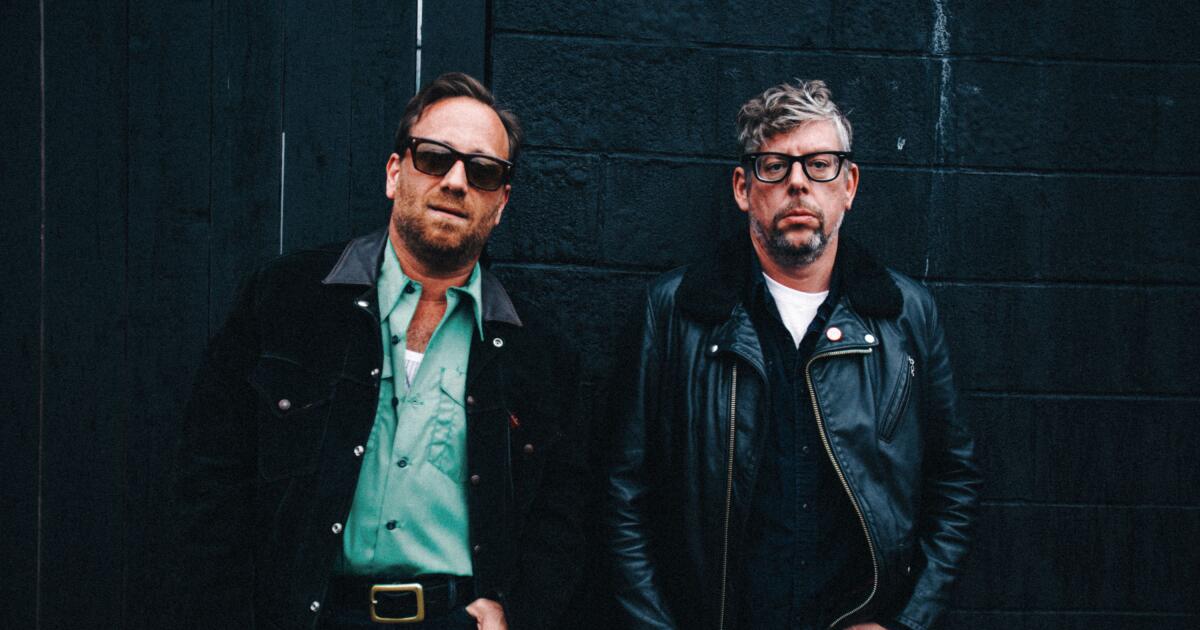
Twenty-four hours or so before the release of their new album, Dan Auerbach and Patrick Carney of the Black Keys are sipping old fashioneds at the Chateau Marmont as they reminisce about the days when the two of them ran a lawn-mowing business with one lawnmower between them.
“And one weed whacker,” Carney says.
“One lawnmower and one weed whacker,” Auerbach confirms. “And one gas canister. All in the same minivan we used for gigs. So all of our s— smelled like gasoline and grass clippings all the time.”
This was in the early 2000s, when they formed this once-scuzzy blues-rock duo in their shared hometown of Akron, Ohio — Auerbach on guitar and vocals, Carney on drums — and immediately began playing every deserted bar they could.
Two decades later, the Black Keys’ lives are very different, with four Grammy Awards, a pair of double-platinum albums and, thanks to Carney’s colorful marriage to singer-songwriter Michelle Branch, a level of tabloid scrutiny the members never even thought to dread back in Akron. (More on that marriage in a minute.)
On this recent evening, Carney, 43, and Auerbach, 44, have returned to the Chateau after a day of hand shaking and meeting taking while in town from Nashville, where they both live, to promote their latest LP, which somehow has only now used the title “Ohio Players.” Earlier they had lunch at the Beverly Hills Hotel with their manager of 2½ years, Irving Azoff, whose other famous clients include the Eagles, U2 and Jon Bon Jovi.
“We’d never been there in all our years of coming to L.A.,” Carney says. “That exterior is amazing, and everything else was terrible. But I think that sums up Beverly Hills.” He looks around the dimly lighted lounge. “This is more our steez. The thing about the Chateau is that it’s so classy but the rooms kind of look exactly like an apartment I had in Akron.”
Indeed, for all their success — at one point, Carney mentions that pandemic shutdowns wiped out $20 million of Black Keys concert income in 2020 — there’s something about the band’s current situation that evokes the Black Keys’ busy first chapter, when they dropped four studio albums in just over four years. Having seriously burned out on the road, the duo went dormant in August 2015 and didn’t play a show again until September 2019; since reuniting, they’ve been on a creative tear, releasing another four LPs, including “Ohio Players,” their 12th overall.
Says Dan the Automator, the veteran hip-hop producer who was among the band’s many collaborators on the new album: “They’re cranking together right now.”
The novelty this time is that they seem to be enjoying it. The Black Keys’ liveliest effort since 2011’s hook-jammed “El Camino” (which drew a Grammy nomination for album of the year), “Ohio Players” is a loose and funky party record with catchy choruses and chewy grooves and guest appearances by the likes of Beck, Juicy J and Oasis’ Noel Gallagher. The album’s freewheeling vibe — think Beck’s “Odelay” meets the soundtrack of “Rushmore” — was inspired in part by the band’s so-called record hangs in which Carney and Auerbach haul their collection of vintage 45s to a bar and DJ late into the night; to make the album, they ventured from Nashville, where they typically record at Auerbach’s Easy Eye Sound Studio, to work in rooms in London and Los Angeles.
“Honestly, we weren’t doing anything financially smart if we were trying to make money,” Carney says, recalling long stays at the Chateau and what he called its London equivalent, the Chiltern Firehouse. “But it wasn’t about that. It was about trying to maximize the experience.”
They so maximized it that “Ohio Players” almost ended up a double album, according to Carney, at least until he and Auerbach thought better of that idea. “There’s been a couple bands that have released very long albums recently that are complete garbage,” he says. “I’m not gonna name names, but there was one that had like 40 f— songs. Dan and I realized we didn’t want anything to do with making a pile of s—.”
Though the Black Keys broke out as a scrappy two-piece, they went into “Ohio Players” eager to “flex our Rolodex,” as Carney puts it. “There’s a lot of features in rap, but in rock these days there’s very little of it,” the drummer says — a shift from the late ’60s, he adds, when “Clapton would jump on a Beatles record or whatever.” For Auerbach, the collaborations — other musicians on the record include rapper Lil Noid, Leon Michels on saxophone and multi-instrumentalist Greg Kurstin — were a way to add fresh wrinkles to the band’s established sound just as a new documentary heralds the approach of legacy-act status.
“I think it was important to us to release a new album at the same time as the movie,” Auerbach says of director Jeff Dupre’s “This Is a Film About the Black Keys,” which premiered at last month’s South by Southwest festival in Austin. “But also, we wouldn’t have been able to do this kind of collaborating when we started, or even 10 years ago,” the singer adds. “It’s really only now that Pat and I are confident enough to sit in a room and let something unfold without getting in the way.”
At the top of their wish list of accomplices, both men say, was Beck, who ended up performing on half of “Ohio Players’” 14 tracks, including the swaggering “Beautiful People (Stay High)” and “Paper Crown,” a fuzzy rap-rock-soul mash-up that also features a verse by Juicy J of Memphis’ pioneering Three 6 Mafia. Carney remembers wearing out a copy of “Odelay” as a teenager while on a family road trip from Akron to Washington, D.C.; Auerbach singles out “One Foot in the Grave,” Beck’s 1994 album of lo-fi folk songs, as a formative influence. “The way he bridged the gap as this guy who was on MTV but who was playing these Mississippi John Hurt-style songs — I was just like, Oh s—, I understand this,” Auerbach says of Beck, whom the Black Keys have known since he invited the band on the road as an opening act in 2003.
Almost as crucial as hooking up with Beck was doing it in L.A., which Carney describes as “a place that’s very conducive to creativity for us.” He lived with Branch in Toluca Lake for about a year when they got together around 2015, and he quickly “fell in love with the Valley”; these days he’s partial to the scene in West Hollywood, which offers “a culture we don’t have in Nashville,” he says. “When we’re home, I’m just watching football with my friends. But when we’re here, we’re, like, rubbing shoulders with Jason Momoa.”
The cover of the Black Keys’ “Ohio Players.”
(Easy Eye Sound / Nonesuch Records)
The Black Keys initially set up at North Hollywood’s historic Valentine Recording Studios, where Bing Crosby and the Beach Boys once worked. “That was great because it feels like you’re in your grandparents’ basement,” Carney says. “But they were adamant that there was to be no weed smoking in the control room, which was a deal breaker.” They eventually relocated to Hollywood’s Sunset Sound, a familiar setting after the six weeks they spent there making 2014’s “Turn Blue” with producer Danger Mouse.
To get Gallagher in the mix, the Black Keys agreed to go to the Oasis guitarist in London — “which was a big deal,” Carney says, “because I hadn’t gotten Dan to leave the country since 2015.” Auerbach was playing in Paris with his side project the Arcs the night of that year’s horrific terrorist attack that killed 90 people at an Eagles of Death Metal concert at the Bataclan theater. “Definitely made me a little leery of wanting to travel for a while,” Auerbach says now. “Subconsciously, I knew we had to get back, so I thought this was a great way to do it without the pressure of a tour.”
With Gallagher, the band wrote three songs in three days, including “On the Game,” a stately ballad with Beatlesque guitars that feels lush yet proudly hand-played. Carney says it’s that slightly sloppy quality that attracts listeners to the Black Keys’ music — and not just to theirs. “I think that’s why Mac DeMarco is so popular,” he says of the scruffy indie-rock crooner. “You can smell the realness. Or this new Waxahatchee record. I don’t hear big hits but I hear something you can really get a hold of.” He laughs. “A lot of that kind of stuff misses the mark because it just takes one person in the room who wants to straighten something out to ruin it.”
One of “Ohio Players’” appealing kinks comes in “Candy and Her Friends,” where a crisp psych-rock tune suddenly slows to a half-time lurch with the entrance of Lil Noid, an underground Memphis rapper whose mid-’90s “Paranoid Funk” cassette has been a favorite of Auerbach’s since he discovered it on YouTube. “We were listening to it in the car one night in L.A. on the way back to the Chateau,” Auerbach says. “And then we were just like, ‘I wonder what Lil Noid is up to?’ We looked him up and he was in Memphis, just down the road from us in Nashville. So we invited him to the studio.”
“Dan is a genuine lover of hip-hop,” says Dan the Automator, who’s known for his work with Kool Keith, Prince Paul and Del the Funky Homosapien, among other acts. “I mean, he’s into some regional stuff that I’m not even really up on.”
Auerbach equates the rawness of “Paranoid Funk” to that of records by Hasil Adkins, the rockabilly oddball who garnered a cult following in the ’80s and ’90s. “Pure folk art,” he calls the kind of music he’s drawn to. But of course, it’s been years since the Black Keys themselves could be considered anything close to outsiders. The night after our drinks, the band celebrates the release of “Ohio Players” (whose cover photo was shot in a bowling alley) with an invite-only gig at Highland Park Bowl filled with contest winners and music-industry types; also there dancing near the makeshift stage is Branch, with whom Carney reconciled after a messy 2022 incident in which she accused the drummer of cheating on her — in a tweet, no less — then was arrested on a domestic assault charge for slapping Carney.
Is the price of having a hit—
“We haven’t had one,” Carney interrupts back at the Chateau, which is certainly untrue given that five of the band’s songs have topped Billboard’s alternative airplay chart. So is the price of having a hit that you have to accept becoming a celebrity of some sort, with all the attention on your private life that that role entails?
“People are interested in stuff where they don’t know what’s going on,” Carney says. “And I get where the intrigue comes from. The thing is, being in a marriage is hard. I was actually just talking to my therapist about this. I was like, ‘Here’s the truth about marriage: I don’t know one that I can use as a reference that’s not unconventional or a little bit f— up.’ So whatever this is supposed to be, it’s gonna have to be its own model.”
As Carney speaks, Auerbach nods with what looks like recognition. His ex-wife is interviewed in the Black Keys doc and speaks frankly about his shortcomings as a partner. “Squirmworthy” is the word he uses to describe the experience of watching the film. “I’m glad I don’t have to watch it again,” he says. Then again, the movie recounts one of Auerbach’s most cherished experiences, when he traveled as an 18-year-old to rural Mississippi and jammed with another pure folk artist: the bluesman T-Model Ford. There’s a picture from that day that shows Auerbach, a high school sports star from a solidly middle-class upbringing, sitting in the scrubby yard outside Ford’s double-wide trailer home.
Asked how the encounter shaped his youthful conception of the musician’s existence, he says, “I didn’t see any of it like that. I didn’t think about quality of life. I just thought, I’m sitting across from the coolest person I’ve ever met, and he loves my playing. Nothing else mattered.”
And now? What would the Black Keys say if someone could guarantee they could make whatever music they wanted for the rest of their lives but only if they traded the rock star trappings for Ford’s more meager circumstances?
“Depends,” Auerbach says. “Where’s that double-wide at?”



“So it’s like Avatar?” one character quips in Disney and Pixar’s “Hoppers,” bluntly translating the film’s high-concept premise for the sugar-fueled kids in the audience. And yes, the comparison is apt. The story follows a nature-obsessed teenage girl who manages to quite literally “hop” her consciousness into the body of a robotic beaver in order to spark an animal rebellion against a greedy mayor determined to bulldoze their forest for a freeway.
It’s a clever hook. The kind of big, elastic idea Pixar used to make look effortless. “Hoppers” does not reach the rarified air of “Up,” “Wall-E,” or “Inside Out,” but after a stretch of uneven originals like “Turning Red” and “Luca,” and outright misfires such as “Elemental” and “Elio,” this feels like a genuine course correction. The environmental messaging is clear without being preachy, the animals are irresistibly anthropomorphized, and the studio’s once-signature emotional sincerity is back in sturdy form.
Pixar can afford to gamble on originals when it has a guaranteed cash cow like this summer’s “Toy Story 5” waiting in the wings, but “Hoppers” earns its place in the catalogue. Director Daniel Chong crafts a warm, heartfelt film that occasionally strains under the weight of its own ambition, yet remains grounded by character and theme. Its meditation on conservation and animal displacement feels timely in a way that never tips into after-school-special territory.
We meet Mabel, voiced with bright conviction by Piper Curda, as a child liberating her classroom pets and returning them to the wild. Her moral compass is shaped by her grandmother, voiced by Karen Huie, who imparts wisdom about nature’s sanctity. True to both Pixar tradition and the broader Disney playbook, this beacon of guidance does not survive past the opening act. Loss, after all, is Pixar’s favorite inciting incident.
Years later, Mabel is still fighting the good fight, squaring off against the smarmy Mayor Jerry, voiced with slick menace by Jon Hamm. He plans to flatten the glade where Mabel and her grandmother once found solace. Mabel’s resistance feels noble but futile. The animals have already mysteriously vanished, the machinery is coming, and her last-ditch plan involves luring a beaver back to the abandoned forest in hopes of jumpstarting the ecosystem.
That’s when the film gleefully pivots into mad-scientist territory. At Beaverton University, Mabel discovers her professor, voiced by Kathy Najimy, has developed a device that can project human consciousness into synthetic animals. The process, dubbed “hopping,” allows Mabel to inhabit a robotic beaver and infiltrate the forest from within. It’s an inspired escalation that keeps the film buoyant even when the plotting grows predictable.
Her new posse includes King George, a lovably beaver voiced by Bobby Moynihan with distinct Bing Bong energy; a sharp-tongued bear voiced by Melissa Villaseñor; a regal bird king voiced by the late Isiah Whitlock Jr.; and a fish queen voiced by Ego Nwodim. As is often the case with Pixar, even in its lesser efforts, the world-building is meticulous. The animal hierarchy, complete with titles like “paw of the king,” is layered with jokes that play for kids while slyly winking at adults.
The plot ultimately follows a familiar template. Scrappy underdog rallies community. Corporate villain twirls metaphorical mustache. Emotional third-act sacrifice looms. At times, you can feel the machinery working a little too cleanly. Pixar, and Disney at large, has grown increasingly reliant on sequels and established IP, and “Hoppers” does not radically reinvent the wheel. In an animated landscape where films like “K-Pop: Demon Hunters,” “Across the Spider-Verse,” and “Goat” are pushing stylistic and narrative boundaries, being safe and sturdy may not always be enough.
And yet, there is something refreshing about a Pixar original that remembers how to tug at the heart without squeezing it dry. “Hoppers” is playful, peppered with cheeky needle drops, and builds to a sweet emotional catharsis that may or may not have left this critic a little misty-eyed. It feels earnest and engaged.
“Hoppers” may not be top-tier Pixar. But it is a welcome return to form, a reminder that the studio still knows how to marry big ideas with a bigger heart.
HOPPERS opens in theaters Friday, March 6th.
Entertainment
How a mural of Altadena became a symbol of resilience for one small store, through fire and flood

Every time Adriana Molina drives up Lake Avenue to her retro-style women’s clothing shop Sidecca in Altadena, she sees the new outdoor mural she commissioned for the store by muralist and illustrator Annie Bolding. It gives her hope.
“I’m here to stay, and this mural solidified my decision to reopen my business,” said Molina on a recent winter day, sitting next to Bolding inside the boutique. “I grew up in Altadena. The community has motivated me this whole time, and I want them to drive by this mural and smile.”
“ALTADENA.” The word — in big white letters, set against layers of blue — appears toward the top of the mural, on the store’s brick wall facing Lake. Above are the San Gabriel Mountains, painted a deep brown, California poppies and Mariposa Street and Lake Avenue street signs. Below are green grass, a monarch butterfly and Altadena’s Christmas Tree Lane. A bright blue house is on a multicolored striped path in the middle of the mural. Next to it, on a hiking trail, a sign says, “Welcome Home Altadena… With Love, Sidecca.”
For Molina and Bolding, the mural is a personal ode to the Eaton fire-ravaged community — art as a message of optimism and healing.
A car passes by the new Altadena mural on the side of Sidecca apparel shop, which commissioned the piece after fire and floods devastated the community.
(Genaro Molina / Los Angeles Times)
When the fire tore through Altadena in January 2025, Sidecca and a few other stores on the north side of Mariposa Street’s bustling Mariposa Junction survived, while the other half-block of businesses burned to the ground. The fire leveled Bolding’s parents’ house off Lake and the home of one of Molina’s close relatives.
Molina staged pop-ups and sold merchandise online during months of remediation, and officially reopened Sidecca’s doors in November as part of Mariposa Junction’s larger comeback. Then the store suffered another blow: flooding and damage during rainstorms in late December. While Molina prepped to temporarily close her store yet again for renovations, Bolding began work on the mural. She started painting on the one-year anniversary of the fire and finished eight days later.
“On the day I started it, it was so cold and windy, and I was scared being up on the ladder,” said Bolding. “But getting to talk to community members while I was painting was very special. People were excited and honking as they drove by. That night, I drove up to the lot where my parents’ place was, and I stood there and all the feelings flooded back.”
The mural’s origin story is that of two creative women bound by strength and a desire to give back.
Molina, who has worked in the fashion industry for more than 30 years, opened Sidecca’s Altadena spot in 2023, after closing its longtime Pasadena location. Voted Pasadena’s best women’s clothing store five times by Pasadena Weekly, Sidecca sells fun vintage-inspired merchandise and clothes, from ‘50s style dresses to snazzy magnets, tote bags and sunglasses. A big rainbow zips across the top of one of the store’s walls.

A display in Sidecca in 2023, two years before the Eaton fire devastated Altadena.
(Alejandro R. Jimenez)
“A few months after Sidecca opened in Altadena, my mom walked in and saw how colorful it was, and said, ‘This reminds me of my daughter,’ ” Bolding said. “With zero hesitation, my mom said to Adriana, ‘Here’s her Instagram. This is my daughter’s stuff.’ ”
Bolding, who goes by Disco Day Designs, calls herself “a joyful creator who loves to intentionally transform spaces.” Known for the bright murals she creates for brands and shops, Bolding gained attention on social media for a trash bin she painted with palm trees and stripes. She brought it to the 2024 Coachella Valley Music and Arts Festival as part of a contest organized by the festival’s sustainability partner, Global Inheritance.
“I fixated on the trash can,” said Molina. “I looked at Annie’s murals and was like, ‘Oh, she has to do something in here for us.’ ”
“Game recognizes game,” added Bolding, smiling.
Molina wanted to rebrand Sidecca with a new logo, bags and art, and connected with Bolding about that and a possible mural inside the store. “I wanted ‘Sidecca’ painted across a wall as an acronym that stands for style, individuality, diversity, expression, community, culture and art,” she said. “That’s who we are.”
Then came Jan. 7, 2025.
The store was closed all day for a holiday lunch. Then the winds picked up and the flames roared. Molina, who lives with her husband and two children on the Altadena-Pasadena, evacuated with her family to Long Beach and came back days later. She knew the store was OK because she’d seen it — intact — on the news.
“As soon as we could come up to the shop, we went,” Molina said. “There were ashes all over.”
Bolding and her husband were in Palm Springs fixing up an AirBnb they cohost when Bolding got a call from her mom about the fire in Altadena. She urged her mom, dad and younger brother to evacuate. After they did, their home burned down. Her parents now live in a Pasadena apartment.
When Molina started selling Altadena-themed merch on Sidecca’s website, Bolding donated three designs, including one with lively retro daisies. In July, she wrote an email to Molina reviving the idea of a mural, but outside versus inside, as an ode to Altadena.
“It felt like anything I could do to bring joy, let’s go,” said Molina. “And I really wanted a little house in there, and for it to say, ‘Welcome home.’ ”
The mural would be Bolding’s first public piece of art on a main street.
“Lake always felt like the road going home,” she said. “That rainbow road in the mural, leading to the mountains, is so symbolic. Very ‘Wizard of Oz.’ The mountains, their silhouette, have always felt majestic, safe, and why it was so heartbreaking anytime to see them burn. To me, they feel like mother.”

Muralist Annie Bolding stands in front of her new Altadena mural on the side of the Sidecca apparel shop. The work is Bolding’s first piece of public art on a main street.
(Genaro Molina / Los Angeles Times)
Bolding’s joyful daisies decorated the Sidecca tote bag given to customers at November’s reopening, just before December’s intense rainstorms. Water gushed through Sidecca’s ceiling. Molina and her employee Manisa Ianakiev were overwhelmed.
“We were like, ‘Is this really happening?’ ” said Molina. “Then people started bringing tools and towels. It was an example of community.”
Bolding planned to start painting the mural Jan. 4, during the Altadena Forever Run, but rain swept through. After Molina’s landlord installed a plywood base, Bolding started on the mural several days later.
Since then, the shop’s ceiling has been replaced, and Molina is working on trying to replace the floor — while continuing to stage pop-ups and sell merchandise online — before fully reopening the bricks-and-mortar boutique this spring.
“People say, ‘Every time I go into your store, I just get happy. I’m in a better mood,’ ” said Molina. “I get that all the time. And what Annie has done, this mural, is beautiful. It makes me happy.”

Just when you think Pixar’s petting-zoo cute new movie “Hoppers” is flagrantly ripping off James Cameron, the characters come clean.
movie review
HOPPERS
Running time: 105 minutes. Rated PG (action/peril, some scary images and mild language). In theaters March 6.
“You guys, this is like ‘Avatar’!,” squeals 19-year-old Mabel (Piper Curda), the studio’s rare college-age heroine.
Shoots back her nutty professor, Dr. Fairfax (Kathy Kajimy): “This is nothing like ‘Avatar!’”
Sorry, Doc, it definitely is. And that’s fine. Placing the smart sci-fi story atop an animated family film feels right for Pixar, which has long fused the technological, the fantastical and the natural into a warm signature blend. Also, come on, “Avatar” is “Dances With Wolves” via “E.T.”
What separates “Hoppers” from the pack of recent Pix flix, which have been wholesome as a church bake sale, is its comic irreverence.
Director Daniel Chong’s original movie is terribly funny, and often in an unfamiliar, warped way for the cerebral and mushy studio. For example, I’ve never witnessed so many speaking characters be killed off in a Pixar movie — and laughed heartily at their offings to boot.
What’s the parallel to Pandora? Mabel, a budding environmental activist, has stumbled on a secret laboratory where her kooky teachers can beam their minds into realistic robot animals in order to study them. They call the devices “hoppers.”
Bold and fiery Mabel — PETA, but palatable — sees an opportunity.
The mayor of Beaverton, Jerry (Jon Hamm), plans to destroy her beloved local pond that’s teeming with wildlife to build an expressway. And the only thing stopping the egomaniacal pol — a more upbeat version of President Business from “The Lego Movie” — is the water’s critters, who have all mysteriously disappeared.
So, Mabel avatars into beaver-bot, and sets off in search of the lost creatures to discover why they’ve left.
From there, the movie written by Jesse Andrews (“Luca”) toys with “Toy Story.” Here’s what mischief fuzzy mammals, birds, reptiles and insects get up to when humans aren’t snooping around. Dance aerobics, it turns out.
Per the usual, “Hoppers” goes deep inside their intricate society. The beasts have a formal political system of antagonistic “Game of Thrones”-like royal houses. The most menacing are the Insect Queen (Meryl Streep — I’d call her a chameleon, but she’s playing a bug), a staunch monarch butterfly and her conniving caterpillar kid (Dave Franco). They’re scheming for power.
Perfectly content with his station is Mabel’s new best furry friend King George (Bobby Moynihan), a gullible beaver who ascended to the throne unexpectedly. He happily enforces “pond rules,” such as, “When you gotta eat, eat.”
That means predators have free rein to nosh on prey, and everybody’s cool with it. Because of bone-dry deliveries, like exhausted office drones, the four-legged cast members are hilarious as they go about their Animal Planet activities.
No surprise — talking lizards, sharks, bears, geese and frogs are the real stars here. They far outshine Mabel, even when she dons beaver attire. Much like a 19-year-old in a job interview, she doesn’t leave much of an impression.
Yes, the teen has a heartfelt motivation: The embattled pond was her late grandma’s favorite place. Mabel promised her that she’d protect it.
But in personality she doesn’t rank as one of Pixar’s most engaging leads, perhaps because she’s past voting age. Mabel is nestled in a nebulous phase between teenage rebellion and adulthood that’s pretty blasé, even if a touch of tension comes from her hiding her Homo sapien identity from her new diminutive pals. When animated, kids make better adventurers, plain and simple.
“Hoppers” continues Pixar’s run of humble, charming originals (“Luca,” “Elio”) in between billion-dollar-grossing, idea-starved sequels (“Inside Out 2,” probably “Toy Story 5”). The Disney-owned studio’s days of irrepressible innovation and unmatched imagination are well behind it. No one’s awed by anything anymore. “Coco,” almost 10 years ago, was their last new property to wow on the scale of peak Pixar.
Look, the new movie is likable and has a brain, heart and ample laughs. That’s more than I can say for most family fare. “A Minecraft Movie” made me wanna hop right out of the theater.

Police search for suspect, accomplice after teen injured in shooting outside Detroit school gym

Celebrated San Francisco historic landmark, the Huntington Hotel officially reopens

GOP candidates for Texas House face off in Collin County, Park Cities, North Dallas

First Alert: Mix of snow and rain today, then looking ahead to warmer weather

Former Avs defenseman launches beer brand in Denver

Florida High School Football Rankings: Top 25 teams – Oct. 21

Cleary's 21 help Le Moyne down Central Connecticut State 69-64 in OT

How old is Bo Nix? What to know about Oregon quarterback ahead of 2024 NFL Draft

99th annual Pony Swim held in Virginia

Indiana Members Credit Union announced as new anchor tenant at Bottleworks District

Fraud-plagued Minnesota sues Trump admin for withholding $243M in Medicaid payments

Is Iran expanding attacks to target energy and civilian sites in the Gulf?

Trump claims US stockpiles mean wars can be fought ‘forever’; Kristi Noem testifies before Congress – US politics live

War in the Middle East: Iran’s broad retaliation in the Gulf • FRANCE 24 English

Melania Trump presides at UN Security Council meeting • FRANCE 24 English
-

 World6 days ago
Exclusive: DeepSeek withholds latest AI model from US chipmakers including Nvidia, sources say
-

 Massachusetts6 days ago
Mother and daughter injured in Taunton house explosion
-

 Denver, CO6 days ago
10 acres charred, 5 injured in Thornton grass fire, evacuation orders lifted
-

 Louisiana1 week ago
Wildfire near Gum Swamp Road in Livingston Parish now under control; more than 200 acres burned
-

 Oregon4 days ago
2026 OSAA Oregon Wrestling State Championship Results And Brackets – FloWrestling
-

 Florida3 days ago
Florida man rescued after being stuck in shoulder-deep mud for days
-

 Technology1 week ago
Arturia’s FX Collection 6 adds two new effects and a $99 intro version
-

 News1 week ago
Video: How Lunar New Year Traditions Take Root Across America