Entertainment
Sterling K. Brown and James Marsden say ‘Paradise’ brings twists and existential questions


Can “This Is Us” collaborators Dan Fogelman and Sterling K. Brown reunite without making viewers cry?
It’s possible in the new TV world of Fogelman’s creation, Hulu’s “Paradise,” which stars Brown as CIA agent Xavier Collins, who is suspected of killing the president, Cal Bradford, played by James Marsden.
But did he? Or is someone else responsible? And is that the only question we should be focused on?
For six seasons, Fogelman’s “This Is Us” had viewers on their emotional toes with the time-jumping drama that told the sentimental story of a family across decades, infusing it with twists and turns uncommon to the genre but inherent to life. With “Paradise,” Fogelman puts his affinity for twists and turns to use, this time in a political conspiracy thriller. There may be less tears, but a death hangs over this series, too. In true Fogelman fashion, though, the final moments of the pilot reveal there’s also something bigger at play: This story is set inside an underground community funded by a tech billionaire, played by Julianne Nicholson, after a massive catastrophe threatens the extinction of the human race.
“Ironically, it’s a show that’s pretty void of politics completely, even though it’s about a president and it also — I don’t think it necessarily lectures on things like climate change — it’s just you watch a series of events unfold,” Fogelman says. “I’m not smart enough to write anything with an agenda. I just write. But clearly, there are things in the ether and there are things in the air right now that are underneath the show.”
And the questions that drive the season, according to Fogelman, won’t overstay their welcome.
“I wanted to serve a complete meal to people that watch a show in the first season,” Fogelman said. “A big challenge we had during ‘This Is Us’ was it was not a murder mystery, but it had this one mystery that was propulsive — it took us 14 episodes to answer it. With the time it’s taken to get things back on the air, and also just what the conception of the show is, I felt it was important that by the end of the first season, all eight episodes, you should have every question you’ve asked answered.”
Three of the season’s eight episodes are now streaming. During a recent sit-down in Los Angeles, Brown and Marsden spoke about the show’s big twist, how they would respond to crisis their characters confront, and backside acting.
James Marsden, left, as President Cal Bradford and Sterling K. Brown as CIA agent Xavier Collins in Hulu’s “Paradise.”
(Brian Roedel/Disney)
Dan typically keeps things close to the vest when it comes to his twists and reveals. How much did you know about that final twist at the end of the pilot?
Brown: He didn’t tell me anything. He just wants you to read it. And this is something that he does in general. He doesn’t really tend to pitch things out because I don’t think he wants anybody’s notes. He just wants to present them [with the script] and say, “This is what the show is gonna be. If you like it, great. If you don’t, I’ll go somewhere else.” So I read it and really just enjoying the world of it — very similar to how I was enjoying “This Is Us” — then you get to the end of it, and your mind just goes [eyes grow wide]. I couldn’t believe he did it to me again. I did not see it coming. Kudos to him for always finding a way to make something rich that much richer.
Marsden: His [Dan’s] interest and curiosity about the human experience, and the range of experience we can have, and the confusion with emotions and relationships and the complexities of relationships, is this real fertile ground for him. No matter how ornate and spectacular or destructive or whatever the circumstances are within the plot, the core of that in a Dan show is the humans, it’s the relationships and how they’re affected by all of that.
At the end of the first episode, Sterling, your character is told some top secret security news, which is that the world is nearing the extinction of the human race. Can you keep that secret, Sterling?
Brown: I would be worried how people would react. I would probably be prone to tell people who I knew would be like, “OK, I’m gonna tell you something that’s gonna be crazy, but I need you to use this information for your benefit without sort of freaking out.” There would probably be some people that I would share it with, but it would be a very small group because that’s an enormous responsibility. And if you would have just blasted it out, it probably wouldn’t have been the reaction that you want from the world at large either. It’s a very difficult predicament to hold that.
Marsden: Yeah, I would have real regret if I didn’t and it negatively affected the people I care about. But I guess what we get into in the show a little bit is like, “OK, well, if you can keep this secret, then it will benefit you? Is that even fair?” My instinct would be that: I’m telling you this, but if the response to this is a panic or telling the wrong person, we’re gonna be f— even quicker.
Brown: You could have had to take me out, bro. If I didn’t feel well with this information, you might have been like, “All right, he’s off the [CIA] detail.”
Marsden: Are we looking at this like it’s terminal? Like, there’s no Paradise hope? I think I would probably not say.

Sterling K. Brown stars in the new Hulu series, “Paradise,” as a CIA agent suspected of killing the president.
(Christina House/Los Angeles Times)
It’s almost too timely to ask this question in light of recent events, but how do you think you’d react in a moment like that? The fear, figuring out what you would take with you if faced with it.
Brown: It’s interesting because the [Los Angeles] fires just transpired … so my heart goes out to everybody who’s dealing with that. I had a few friends lose their homes. You know about the folks from “This Is Us,” [former co-star Milo Ventimiglia lost his home, and Mandy Moore’s sustained damage in the fires earlier this month] but a buddy of mine from Stanford who’s a lawyer, his home of about 12 years burned to the ground. I was actually out of the country shooting [a project]. We have this Marco Polo group thread and I was like, “Dude, what is the process like of deciding what you take? What are the things that you absolutely want to hold on to?” He’s like, “Dude, I left thinking that I was going to go back to the house. I didn’t even have a chance to really get all the stuff that I wanted.” So my wife and I started this conversation: What would I take? And she started getting mad at me about the things that I decided to take. And I was like, “There’d be a few mementos, but I really need my workout clothes because I need to work out the next day.” And she’s like, “You can go buy some more.” That’s where my head went. But it is a moment of analytical paralysis because it’s so big to consume. I guess you have to give yourself a thought experiment or otherwise you’re just frozen in that.
Marsden: I was out driving and as I was driving back to my house — there in the Hollywood Hills was the Sunset fire, so we evacuated as well; obviously nothing near [as bad as] Palisades and Altadena, but I remember being washed over with a sort of worrisome calm. It was like, “OK, you’re down here, you’re not up there.” I hate to say this because people lost their houses and things and valuables and children’s photos. But for me, it was like, “My kids are safe, my family is safe. I’m OK. There are others in way worse positions than I right now and I’m gonna be all right.” I didn’t feel compelled to race up there and try to get things out. Maybe that’s shock or some sort defense mechanism, or shutting down.
James, you have played a real president before, John F. Kennedy — so, you had something to emulate and build from in playing that. What were the conversations like with Dan as he talked about the kind of leader Cal would be, especially in a moment of crisis like this?
Marsden: He did bring up Kennedy a couple of times in the context of [how] the man was a great communicator, he was the smartest guy in the room, but he knew to surround himself with other very exceptional individuals. But ultimately he would put that through his decoder and his processor and do what was right for the people. I think Cal’s similar in that way. We never were trying to recreate. It wasn’t like a blueprint from a U.S. president we were taking, but it was more about who is this person as a human being. I found it really interesting that Dan told me that he [Cal] has the job, but he doesn’t really want the job. He’s here because he’s been conditioned to become that by his family. That was a really interesting template to dive off of creatively as a character because OK, what makes this guy tick? What interests him? What sort of regrets does he have about mistakes he’s made in his life, and how can he figure out a way of fulfilling the promises that maybe he hasn’t really been so great at holding true to. There was real great evolution of the character through the show, and that was exciting to me, that it was a person, it wasn’t a president.
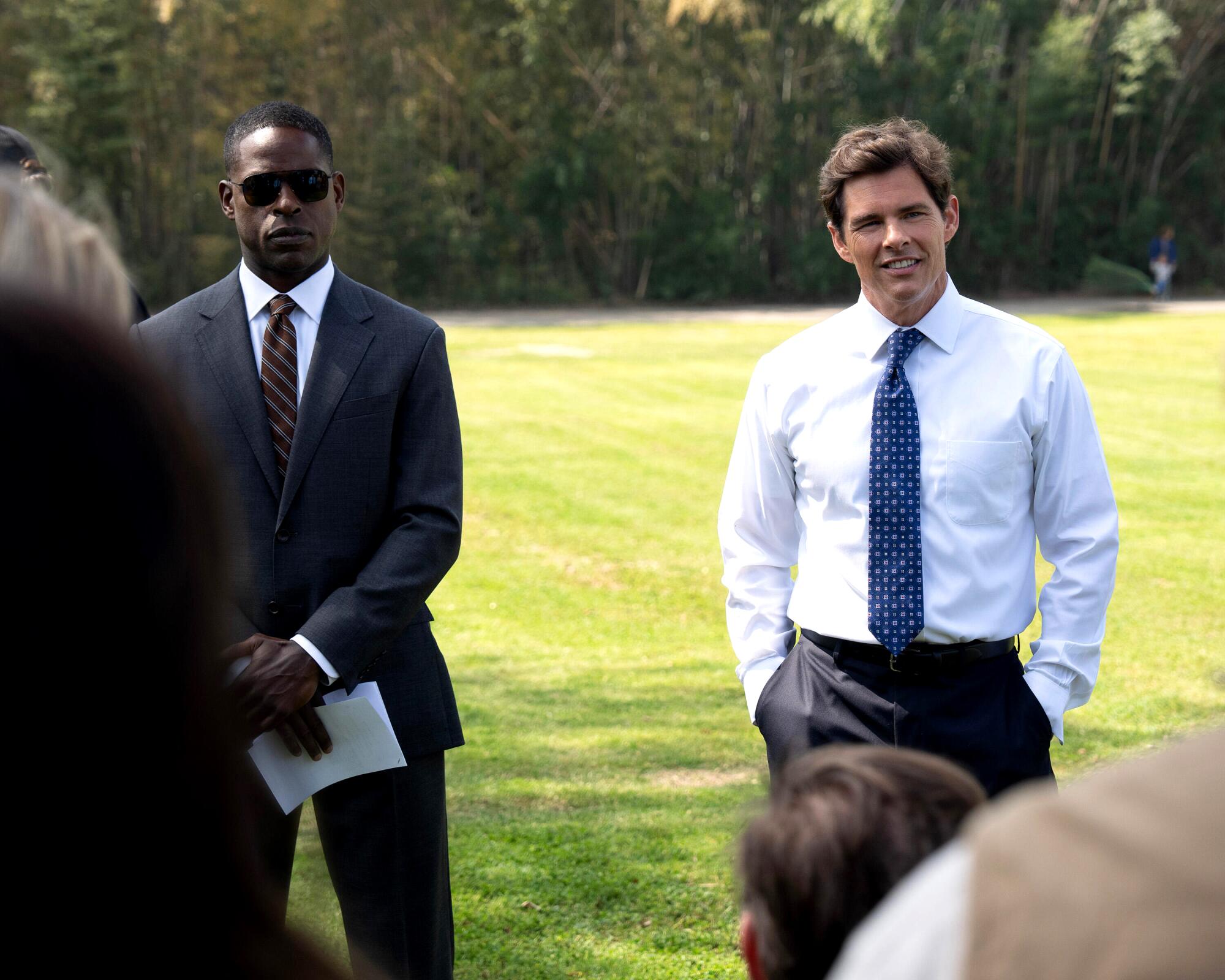
Sterling K. Brown and James Marsden in Hulu’s “Paradise.” “There was real great evolution of the character through the show, and that was exciting to me, that it was a person, it wasn’t a president,” Marsden says.
(Ser Baffo/Disney)
I know this idea has been percolating with Dan for about a decade and the show doesn’t necessarily intend to touch on the political points of the current moment. But time has caught up — whether it’s concerns with the climate right now or what’s unfolding on the political stage.
Brown: Yeah, it’s hard not to notice. I do think the show asks a very interesting question regarding who holds real power. What is the nature of that real power? The strange bedfellows of capitalism and politics, and should they necessarily be so closely intertwined with one another? Do we need a little bit more separation? I think the show, or at least I argue that the answer to that is, yes. I was listening to something on my IG [Instagram] the other day [that said something like] the 400 wealthiest white people had the collective income of all the Black people in America; the collective 1000 richest white people in America have the collective resources of all African Americans and Latinos in America. And I’m like, “Wow” [eyes grow wide]. So, is government for the people or is government for the people that are able to fund the campaign? I think the show tangentially touches on that little bit. In terms of climate, I think the show is saying, “You gotta take care of this planet, man.” We cannot be cavalier. We’ve got a lot of people giving us a lot of warnings of what is going to happen if we don’t change.
Marsden: It’s harrowing. Nobody wants this to be the case. And what do we do? And how do we separate the facts when there’s so much misinformation? Is this a reality that we’re going to have to accept at some point or is it not?
So, you’re told that there’s an underground community happening in Colorado and you’ve been selected. Are you likely to go or would you be like, ”I don’t want to be underground.” And what necessities or essentials do you want there with you?
Marsden: Your people. If you can’t have your people, I’m staying.
Brown: I agree with that. If it’s a matter of life or death, I’m going if I can take my people with me. If I’m going to be alone by myself, without my kids and my wife, I’d rather be with my kids and my wife, and we’ll all go to heaven.
Marsden: I feel like, if this would have happened, it’d have to be a very quick lottery. As much as your survival instinct kicks in, and you want to go and have all your people in — and then you’re there, watching the rest of the world perish. I would be feeling so guilty and terrible, but also happy that you have your people.

James Marsden plays the president in a pre- and post-apocalyptic U.S. in Hulu’s “Paradise.”
(Christina House/Los Angeles Times)
And the chili cheese fries, which are apparently a must in this makeshift world.
Brown: That are not made with real milk. The lack of animal product is tough, but we can’t be releasing methane up in a cave. It’s not a good look.
Sterling, the third episode’s final moments has a reveal of a different sort for you: your backside in the shower scene. I wondered what both your reactions were in reading that in the script. Was that a twist you expected?
Marsden: I’m an admirer of the human physique, male or female. Thank God it’s him.
Brown: [laughs]
Marsden: And I thought I was in shape!
Brown: You are in shape. You’re in great shape. I focus on the posterior chain. It’s important to me. A lot of power lays in the back.
Marsden: What is the posterior chain?
Brown: Posterior chain is everything up and down the backside of your body and the posterior.
Marsden: I have a posterior ch—. Not a fully developed chain.
Brown: James’ [character] is dead. But if James is free, and as I go to the writers room, if there’s a possible flashback, hopefully we can get him back for Season 2 if and when we get picked up to work for that butt shot.
Marsden: I could work this thing out for 20 years and I would never look like this man.



Entertainment
After ‘Yellowstone’ and a twist of fate, Luke Grimes rides again as Kayce in ‘Marshals’

This story contains spoilers for the pilot of “Marshals.”
When the curtain came down on “Yellowstone” last year, Kayce Dutton had finally found his happily-ever-after.
The youngest son of wealthy rancher John Dutton (Kevin Costner) had secured a modest cabin in a mountainous region where he could reside in secluded peace with his beloved wife, Monica (Kelsey Asbille), and son, Tate (Brecken Merrill), far from the turbulent dysfunction of his family.
“Kayce found his little peace of heaven, getting everything he ever wanted and fought for,” said Luke Grimes, who plays the soft-spoken Dutton in “Yellowstone.”
Grimes reprises the role in CBS’ “Marshals,” which premiered Sunday. But in the new series, Kayce’s serenity has been brutally shattered, forcing him to find a new path forward after an unimaginable tragedy.
The drama is the first of several planned spinoffs of “Yellowstone,” which became TV’s hottest scripted series during its five-season run. And while some familiar faces return and events unfold against the magnificent backdrop of towering mountains and lush greenery, “Marshals” is definitely not “Yellowstone” 2.0.
Luke Grimes as Kayce Dutton in “Marshals,” which combines the gritty Western flavor of “Yellowstone” with the procedural genre.
(Sonja Flemming / CBS )
In “Marshals,” Kayce joins an elite squad of U.S. Marshals headed by his Navy SEAL teammate Pete Calvin (Logan Marshall-Green). The drama combines two distinct brands — the gritty Western flavor of “Yellowstone” with the procedural genre, a flagship of CBS’ prime-time slate.
During an interview at an exclusive club in downtown Los Angeles, Grimes expressed excitement about dusting off his cowboy hat and boots, though he admitted to having initial concerns about whether the project was a fit.
“I had never watched a procedural before, so I had to do some homework on what that was,” Grimes said hours before the gala premiere of “Marshals” at the Autry Museum of the American West in Griffith Park. “And I just couldn’t wrap my head around it at first. In the finale, Kayce had ridden off into the sunset. So I thought, ‘Let him be, let him go.’ ”
Those doubts eventually ebbed away.
“To be honest, there was a part of me that didn’t want to let Kayce go just yet,” Grimes said. “Saying goodbye to him was really hard, so the opportunity to keep this going was something I couldn’t pass up. We get to show his backstory and also this other side of him that we didn’t see in ‘Yellowstone.’ ”
But this Kayce is a man in crisis. “Yellowstone” devotees will likely be shocked by the “elephant in the room” — the revelation in the pilot episode that Monica has died of cancer. The couple’s sexy and loving chemistry was a key element in the series while also establishing Grimes as a heartthrob.
“I think fans will be upset — and they should be,” Grimes said as he looked downward. “Kayce is very upset. It’s the worst thing that could have happened to him. But as much as I’m really upset not to work with Kelsey, it’s a good idea for the show.”
He added, “His dream life is no longer available to him. Now the only thing he has is his son, who is not so sure he wants the same life as Kayce. A big part of the season is Kayce learning how to manage all these new things — new job, being a single father.”

“His dream life is no longer available to him. Now the only thing he has is his son, who is not so sure he wants the same life as Kayce,” said Luke Grimes about his character Kayce.
(Jay L. Clendenin / For The Times)
Executive producer and showrunner Spencer Hudnut (CBS’ “SEAL Team”) acknowledged in a separate interview that viewers may be stunned by the tragedy. “Real life intervenes for Kayce. Unfortunately it happens to so many of us.”
But he stressed that although Monica is physically gone, her presence will be heavily felt this season.
“She is guiding Kayce, and their relationship is moving forward,” Hudnut said. “His dealing with his inability to confront his grief is a big part of the season. It became clear that something horrible had to happen to put Kayce on a different path.”
As the development evolved, Grimes embraced the procedural concept: “This is a very different show and structure. This is an action show, very fast paced. I meet a lot of fans who say they really want to see Kayce go full Navy SEAL.”
Alumni from “Yellowstone” returning in “Marshals” include Gil Birmingham as tribal Chairman Thomas Rainwater and Mo Brings Plenty as his confidante Mo.
“Yellowstone” co-creator Taylor Sheridan, who had already spearheaded the prequels “1883” and “1923,” will further expand the “Yellowstone” universe later this month with “The Madison,” starring Michelle Pfeiffer and Kurt Russell, about a New York City family living in Montana’s Madison River territory. Later this year, Kelly Reilly and Cole Hauser will star in “Dutton Ranch,” reprising their respective “Yellowstone” roles as John Dutton’s volcanic daughter Beth Dutton and her husband, boss ranch hand Rip Wheeler.
Hudnut said fans of “Yellowstone” will recognize themes that were central to that series: “The cost and consequences of violence, man versus nature, man versus man.”
“We’re trying to tap into what people loved about ‘Yellowstone’ but to tell the story in a different framework,” he said. “The procedural brand is obviously very successful for CBS. And nothing has been bigger than ‘Yellowstone.’ So the challenge is, how do you marry those things?”
Taking on the lead role prompted Grimes to reflect on how “Yellowstone” transformed his life after co-starring roles in films like “American Sniper” and “Fifty Shades of Grey” and playing a vampire in the TV series “True Blood.”
“‘Yellowstone’ changed my life in many, many ways,” he said. “The biggest change is that I now live where we shot the show in Montana. The first time I went there, I would have never thought I would ever live there.
“I would come back to the city after shooting. But a little bit more each year, I felt more out of place here, and more peace and at home there. I’m a big nature person — I never was a big city person, but I had to be here to do what I wanted. But after the third season, my wife and I decided to move there. We wanted to start a family.”
The topic of a Kayce spinoff kept coming up during the filming of the finale, but “meanwhile we were having a baby, so that was the biggest thing on my plate.”

“‘Yellowstone’ changed my life in many, many ways,” said Luke Grimes.
(Jay L. Clendenin/For The Times)
Grimes was also dealing with the off-screen drama that impacted production due to logistical and creative differences between Costner and Sheridan. Costner, who was the show’s biggest attraction, exited after filming the first part of the final season. His character was killed off.
Asked about the backstage tension, Grimes said, “I just tried to do my job to the best of my ability, and not get caught up in all that. It was sort of frustrating, but I felt lucky to have a job.”
He recalled getting a call from Sheridan about the plans for a spinoff: “He said, ‘I think you should talk to the guy who is going to be the showrunner. I’m not telling you to do it, and I’m not telling you not to do it. But Spencer is great and he has some good ideas.’ ”
Hudnut said Kayce “was always my favorite character. Also, Luke is not Kayce. Kayce is an amazing character, but Luke is really thoughtful and smart. He is a true artist and has an artist’s soul, while Kayce is kicking down doors and terrorizing people. And Luke has such a great presence. He can do so much with just a look to the camera. He is a true leading man.”
In addition to starring in “Marshals,” Grimes is also an executive producer. He pitched the opening sequence — a flashback showing Kayce in the battlefield. He also performs the song that plays over the final scene, in which he visits his wife’s grave. The ballad is from Grimes’ self-titled country album which was released last year.
“Luke’s creative fingerprints are all over the pilot,” Hudnut said.
Grimes said he does not feel pressure about being the first follow-up from “Yellowstone” to premiere.
“We’re not trying to make the same show, so no matter what happens, its a win-win,” he said. “I had a blast doing it.”

I am a sucker for all those straight-to-video slasher movies from the 90’s; there was just a certain point where you knew the acting was terrible, however, it made you fall in love. I can definitely remember scanning the video store sections for all the different horror movies I could. All those movies had laughable names and boom mics accidentally getting in the frame. Trucker seems like a child of all those old dreams, because it is.
Let’s get into the review.
Synopsis
When a group of reckless teens cause an accident swroe to never speak of it. The father is reescued by a strange man. from the wreckage and nursed back to health by a mysterious old man. When the group agrees to visit the accident scene, they meet their match from a strange masked trucker and all his toys with revenge on his mind.
Roll on 18 Wheleer
Trucker is what you would imagine: a movie about a psychotic trucker chasing you. We have seen it many, many times. What makes the film so different is its homage to bad movies but good ideas. I don’t mean in a negative way. When you think of a slasher movie, it’s not very complicated; as a matter of fact, it takes five minutes to piece the film together. This is so simple and childlike, and I absolutely love it. Trucker gave us something a little different, not too gory, bad CGI fire, I mean, this is all we old schlock horror fans want. Trucker is the type of film that you expect from a Tubi Original, on speed. However, I would take this over any Tubi Original.
I found some parts that were definitely a shout-out to the slasher humor from all those movies. Another good point that made the film shine was the sets. I guess what I can say is the film is everything Joy Ride should have been. While most modern slashers are trying to recreate the 1980s, the film stands out with its love for those unloved 1990’s horror films. While most see Joyride, you are extremely mistaken, my friend; you will enjoy this film much more.

In The End
In the end, I enjoyed the entire film. At first, I saw it listed as an action thriller; I was pleasantly surprised, and Trucker pulled at my heart strings, enveloping me in its comfort from a long-forgotten time in horror. It’s a nostalgic blast for me, thinking back to that time, my friends, my youth, and finding my new home. Horror fans are split down the middle: from serial-killer clowns (my side) to elevated horror, where an artist paints a forty-thousand-year-old demon that chases them around an upper-class studio apartment. I say that a lot, but it’s the best way to describe some things.
The entire movie had me cheering while all the people I hated suffered dire consequences for their actions. It’s the same old story done in a way that we rabid fans could drool over, and it worked. In all the bad in the world today, and my only hope for the future is the soon-to-end Terrifier franchise. However, the direction was a recipe to succeed with 40+ year old horror fans like me. I see the film as a hope for tomorrow, leading us into a new era.
Trucker is set to release on March 10th, 2026
Entertainment
Review: In ‘American Classic,’ Kevin Kline and Laura Linney deliver a love letter to theater

The lovely, funny “American Classic,” premiering Sunday on MGM+, is a love letter to theater, community and community theater. Kevin Kline plays Richard Bean, a narcissistic stage actor. He’s famous enough to be opening on Broadway in “King Lear,” but he has to be pushed onstage and is forgetting lines. After he drunkenly assails a hostile New York Times critic — caught on video, of course — he’s suspended from the play, and his agent (Tony Shalhoub) advises him to get out of town and lay low until the heat’s off, as they used to say in the gangster movies.
Learning that his mother (Jane Alexander, acting royalty, in film clips) has died, Richard heads back to his small Pennsylvania hometown, where his family — all actors, like the Barrymores, but no longer acting — owns a once-celebrated theater. To Richard’s horror, it has, for want of income, become a dinner theater, hosting touring productions of “Nunsense” and “Forever Plaid” instead of the great stage works on which he cut his teeth.
Brother Jon (Jon Tenney), running the kitchen at the theater, is married to Kristen (Laura Linney), Richard’s onetime acting partner, who dated him before her marriage; now she’s the mayor. Their teenage daughter, Miranda (Nell Verlaque) — a name from Shakespeare — does want to act and move to New York, as her mother had before her, but is afraid to tell her parents. Richard’s father, Linus (Len Cariou), is suffering from dementia, though not to the point he won’t actively contribute to the action; every day he comes out again as gay.
Across the eight-episode series, things move from the ridiculous to the sublime. Richard’s attempt to stage his mother’s funeral, with her coffin being lowered from the ceiling, while “Also sprach Zarathustra” plays and smoke billows toward the audience, fortunately comes to naught; but he announces at the ceremony that he’ll direct a production of Thornton Wilder’s 1938 play “Our Town” at the theater, to “restore the soul of this town.” (His big idea is to ignore Wilder’s stage directions, which ask for no curtain, no set and few props, with a “realistic version,” featuring a working soda fountain, rain effects and a horse.) Fate will have other plans for this, and not to give away what in any case should be obvious, the title of the play will also become its ethos, with a cast of amateurs, including Miranda’s jealous boyfriend, Randall (Ajay Friese), and ordinary people standing in for the ordinary people of Wilder’s Grover’s Corners.
The series has a comfortable, cushiony feeling; it’s the sort of show that could have been made as a film in the 1990s, and in which Kline could have starred as easily in his 40s as in his 70s; it has the same relation to reality as “Dave,” in which he played a good-hearted ordinary Joe who takes the place of a lookalike U.S. president. The town is essentially a sunny place, full of mostly sunny people, to all appearances, a typical comedy hamlet. But we’re told it’s distressed, and Mayor Kristen is in transactional cahoots with developer Connor Boyle (Billy Carter), who wants clearance to build a casino on the site of a landmark hotel. (Much of the plot is driven by money — needing it, trading for it, leaving it, losing it.) He also wants his heavily accented, bombshell Russian girlfriend, Nadia (Elise Kibler), to have a part in “Our Town.”
As in the great Canadian comedy “Slings & Arrows,” set at a Shakespeare Festival outside of Toronto, themes and moments and speeches from the play being performed are echoed in the lives of the performers, while the viewer experiences the double magic of watching a fine actor playing an actor playing a part. Kline, of course, is himself an American classic, with a long stage and screen career that encompasses classical drama, romantic and musical comedy and cartoon voiceovers; the series makes room for Richard to perform soliloquies from “Hamlet” and “Henry V,” parts Klein has played onstage. He brings out the sweetness latent in Richard. Linney, who played against her sweetheart image in “Ozark,” is happily back on less deadly ground (though she’s tense and drinks a little). Tenney, who was sweet and funny on “The Closer,” and who we don’t see enough of these days, is sweeter and funnier here, and gets to sing. (All the Beans will sing, except for Linus.)
As a comedy, it is often predicable — you know that things will work out, and some major plot points are as good as inevitable — but it’s the good sort of predictability, where you get what you came for, where you hear the words you want to hear, ones you could never have written yourself. “American Classic” is not out to challenge your world view in any way but wants only to confirm your feelings and in doing so amplify them. Shock effects are fine in their place — and to be sure there are major twists in the plot — but there is a certain release when the thing you’re ready to have happen, happens, whether it brings laughter or tears. Either is welcome.

‘Wait Wait’ for February 28. 2026: Live in Bloomington with Lilly King!

This Windows gaming handheld has a screen that folds in half

Tel Aviv analyst shelters from 30 missile sirens in 48 hours, says Iran ‘won’t recover’

House Republicans push Johnson to go to war with Senate over SAVE Act

Diabetes surge among Americans could be driven by ‘healthy’ breakfasts, doctor warns

Florida High School Football Rankings: Top 25 teams – Oct. 21

Cleary's 21 help Le Moyne down Central Connecticut State 69-64 in OT

How old is Bo Nix? What to know about Oregon quarterback ahead of 2024 NFL Draft

99th annual Pony Swim held in Virginia

Indiana Members Credit Union announced as new anchor tenant at Bottleworks District
House Republicans push Johnson to go to war with Senate over SAVE Act

Israel FM says Europe too divided, slams Spanish PM

Satellite images provide view inside Iran at war

Video: What the Texas Primary Battle Means for the Midterms

Dems’ potential 2028 hopefuls come out against US strikes on Iran
-

 World4 days ago
Exclusive: DeepSeek withholds latest AI model from US chipmakers including Nvidia, sources say
-

 Massachusetts4 days ago
Mother and daughter injured in Taunton house explosion
-

 Montana1 week ago
2026 MHSA Montana Wrestling State Championship Brackets And Results – FloWrestling
-

 Denver, CO4 days ago
10 acres charred, 5 injured in Thornton grass fire, evacuation orders lifted
-

 Louisiana7 days ago
Wildfire near Gum Swamp Road in Livingston Parish now under control; more than 200 acres burned
-

 Technology1 week ago
YouTube TV billing scam emails are hitting inboxes
-

 Technology1 week ago
Stellantis is in a crisis of its own making
-

 Politics1 week ago
OpenAI didn’t contact police despite employees flagging mass shooter’s concerning chatbot interactions: REPORT