Entertainment
Review: ‘The Little Sister’ finds a young Muslim woman taking risks to show her true self

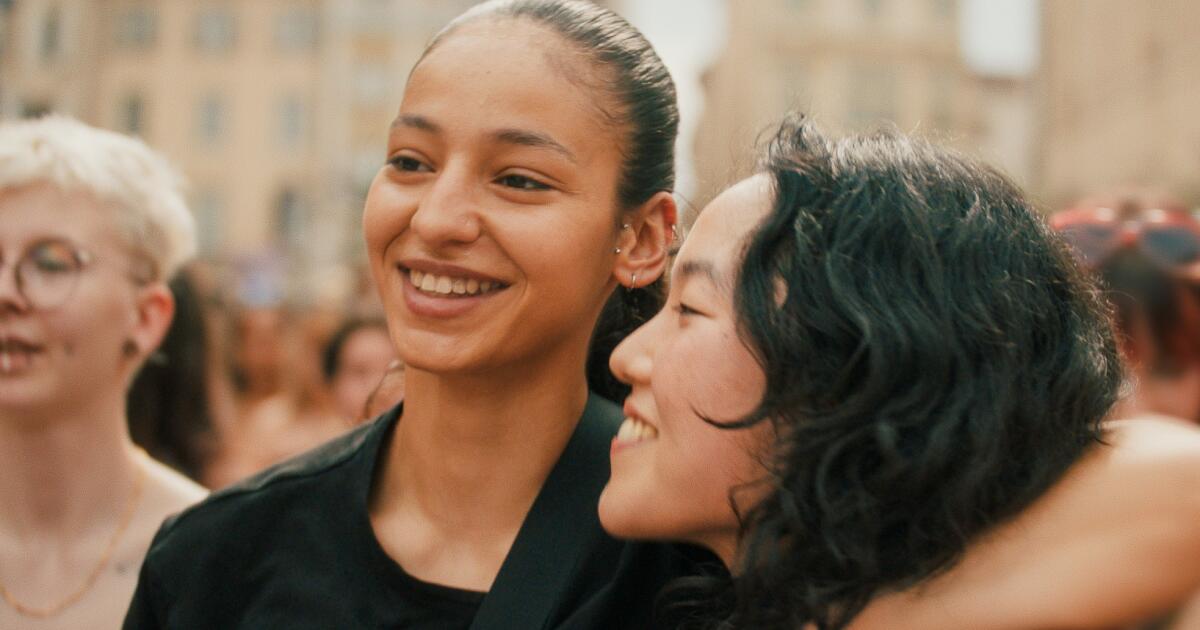
In “The Little Sister,” a teenager tries to hide in plain sight. Although everyone comments on her beauty, 17-year-old Fatima prefers to tie her hair back in a ponytail, her bright eyes buried underneath a black ball cap, her body concealed in unflattering tracksuits. As played by first-timer Nadia Melliti, who won the actress award at last year’s Cannes Film Festival, Fatima is encased in a kind of armor, an outward manifestation of her hesitancy to share her sexual orientation with a world she knows will judge her. This graceful film chronicles the process by which Fatima gradually sheds that reserve.
Adapted from Fatima Daas’ 2020 novel “The Last One,” a work of autofiction detailing the French author’s own coming out, “The Little Sister” takes place over five seasons, observing Fatima as she completes grade school and begins attending university. An adept athlete with a tomboyish demeanor, Fatima disappears inside a friend group consisting of immature teen boys who treat her like one of the guys, including her in their raunchy sex talk. Fatima has a boyfriend, Adel (Ahmed Kheloufi), but the relationship feels vestigial, with him constantly complaining that she should dress more feminine. Just as upsetting to Adel: When he tells Fatima that he loves her, she doesn’t respond in kind.
This is the third feature from French actor and director Hafsia Herzi, who herself made an acting splash in 2007’s “The Secret of the Grain.” For “The Little Sister,” Herzi takes a cue from Daas’ book, mapping Fatima’s inner journey as a modest series of tentative steps forward and anxious steps back. Fatima has reason to be skittish. The youngest of three daughters in a loving French-Algerian Muslim family, she conceals any hint of her sexuality from her mother, father and sisters, anticipating their disapproval. Many queer coming-of-age movies position the character’s awakening as an act of defiance. For Fatima, a practicing Muslim who adores her parents, the stakes feel even higher. Melliti’s performance is one of silent suffering, illustrating Fatima’s deference to her family.
But as much as she smothers her desires, others can sense them. An altercation between her friends and a gay male classmate gets heated once the classmate accuses her of being closeted, which she vehemently (and violently) denies. Soon after, Fatima secretly joins a dating app, hoping to understand her queerness. Her first date, in which she uses a fake name, focuses on learning terminology such as scissoring, and she approaches each new encounter like a fact-finding mission. Melliti keeps the shy teenager’s reactions neutral, Fatima’s stoicism a strategy to prevent exposing her inexperience.
That’s when she meets Ji-Na (Park Ji-min, the free spirit of “Return to Seoul”), a physician’s assistant who practically glows in her presence, overwhelming Fatima’s cautious nature. Ji-Na and Fatima’s love story — its blossoming, its unraveling, its possible resuscitation — forms the heart of “The Little Sister,” which also received the Queer Palm at Cannes. Melliti and Park exude a frisky, lusty chemistry, but it’s a film as much about self-love, as Fatima seeks to become comfortable in her own skin. Ji-Na is open and confident while Fatima remains closed off, her shame about her sexuality deeply culturally ingrained. When our main character starts lowering her defenses, however, that’s when she’s hit by a jolt that sends her spiraling.
Herzi’s slender, unassuming drama contains few emotional crescendos or grand insights, although this is the rare French film to center on a Muslim lesbian as its protagonist. “The Little Sister” grows even more intriguing once the love affair runs aground, forcing Fatima to flounder in her heartache. Her odyssey will lead to threesomes and lonely nights, but also difficult questions regarding how her faith and family may leave her perpetually adrift.
“The Little Sister” leaves much unspoken, which is fitting for a protagonist who rarely expresses herself in clear terms. Even during a touching scene near the finale, as Fatima sits at the dinner table weeping, upset over the end of a relationship, she and her mother (Amina Ben Mohamed) engage in a nimble dance: Fatima doesn’t feel safe explaining precisely why she’s crying, while her supportive mom chooses her words carefully, perhaps knowing more about her daughter than she dares say aloud. But despite the character’s rocky path to sexual awakening, Herzi navigates toward a hopeful conclusion that doesn’t peddle phony uplift. Fatima still faces a community that won’t embrace her true self. But maybe, at last, she’s willing to be seen.
‘The Little Sister’
In French, with subtitles
Not rated
Running time: 1 hour, 48 minutes
Playing: Opens Friday, June 12 at Laemmle Glendale



Emily Blunt stars as a TV meteorologist who discovers she can read minds in Disclosure Day.
Niko Tavernise/Universal Pictures
hide caption
toggle caption
Niko Tavernise/Universal Pictures
Earlier this year, former President Obama made waves in an interview when he said that he believed aliens were real, though he hadn’t seen any evidence of them during his time in office. President Trump accused Obama of revealing “classified information,” but then said that he would direct government agencies to release a number of images showing alien and extraterrestrial activity. The Pentagon rolled out those photos last month, but they were largely deemed fuzzy and inconclusive.
All this might sound like free publicity for Steven Spielberg’s new thriller, Disclosure Day, which is about a massive U.S. conspiracy to hide the fact that aliens have been visiting Earth for decades. If anything, though, the movie’s pleasures feel more retro than timely. It harks back to Spielberg’s greatest alien-themed hits, like Close Encounters of the Third Kind, E.T. and War of the Worlds. But it also feels like a throwback to the ’90s and early 2000s — the era of conspiracy-minded sci-fi series like The X-Files and M. Night Shyamalan’s eerie crop-circle thriller, Signs.

Disclosure Day stars Josh O’Connor as Daniel Kellner, a cybersecurity expert who decides to blow the whistle on his employer, Wardex. That’s a powerful agency, operating outside the boundaries of the government, that, for decades, has suppressed evidence of alien visits to Earth. Daniel has stolen video footage of these creatures, and he feels duty-bound to disclose it to the public — and to expose the sinister Wardex for having captured, detained and even tortured its share of aliens.
Meanwhile, in Kansas City, Mo., something strange happens when a TV meteorologist named Margaret Fairchild, played by Emily Blunt, tries to deliver her morning weather report. She freezes up on the air and begins making strange, guttural clicking noises, speaking what appears to be a kind of alien language. Around this time, Margaret also finds that she can read the minds of the people around her — a gift that comes in handy once she, too, goes on the run, with Wardex agents in pursuit.
Although Margaret and Daniel don’t know each other, they share a mysterious connection. Noah Scanlon, the head of Wardex, played by an unusually terrifying Colin Firth, is determined to stop them before they can make contact.
One of Scanlon’s deadliest weapons is a form of mind-control technology that he uses to try to get Daniel’s girlfriend, Jane, played by a very good Eve Hewson, to betray him. Whatever aliens might be capable of doing to us, the movie suggests, we have far more to fear from some of our fellow humans.

The mind-control bit is one of the movie’s cleverest sequences; a scene in which Margaret stages an almost Houdini-level escape is another. At 79, Spielberg is still the nimble filmmaker who delights in treating cinema as a magic trick. He’s also as skilled with actors as ever. Firth injects a palpable sense of anguish into the role of the movie’s big villain, and O’Connor brings an Everyman likability to his truth-telling tech whiz. But the most dazzlingly inventive work comes from Blunt.
Often a tough, sardonic screen presence, as in The Devil Wears Prada 2, Blunt gets to flex her proven action and comedy muscles in a more earnest emotional register. Like Richard Dreyfuss’ obsessed alien seeker in Close Encounters, Margaret is the kind of madly eccentric character Spielberg instinctively gravitates toward — someone who has little idea where she’s headed, but is convinced, rightly, that the truth really is out there.
There are other memorable characters, too. Colman Domingo gives a warm turn as a fellow whistleblower, who steers the operation from afar. And Elizabeth Marvel delivers a fine performance as a Catholic nun who, in one of the film’s more thoughtful asides, claims that the existence of aliens doesn’t threaten her belief in God. If anything, she says, it affirms that God, like the universe he created, is far bigger and more complex than humans like to acknowledge.
That’s a profoundly beautiful idea, though I wish Disclosure Day itself were a more complex movie. Spielberg’s storytelling is often described as overly sentimental, which isn’t always fair; his previous work, the semi-autobiographical The Fabelmans, was one of the most genuinely moving films of his career.
But sentimentality does ultimately overwhelm Disclosure Day, especially in the big finale, when the movie strains to bring its characters and indeed all of humanity together. Having shown us some of the terrible things powerful people are capable of, Spielberg makes a third-act lurch toward catharsis, as though desperate to suggest we aren’t beyond redemption as a species. Like the existence of alien life, our essential goodness is easy enough to believe in, but a lot harder to prove.

Movie Reviews
‘Hollywood Does Abortion’ Review: Politics and Pop Culture Intersect in a Doc That’s Broad in Scope but Sharp in Insight

Speaking about the abortion storylines of the 2010s, a media researcher remarks on how “divorced” Hollywood seemed from the “political reality” of the era.
On our shows, from Parenthood to Private Practice to Better Things, characters were freely exercising their right to choose, with support from sympathetic loved ones and reassuring medical professionals. Meanwhile, out in the real world, the rising Tea Party were passing a “tidal wave” of ever-tightening restrictions, turning those same scenes into increasingly inaccessible fantasies.
Hollywood Does Abortion
The Bottom Line A galvanizing start to a long-overdue conversation.
Venue: Tribeca Festival (Spotlight Documentary)
Directors: Barbara Attie, Janet Goldwater, Mike Attie
Screenwriter: Jamie Boyle
1 hour 36 minutes
Hollywood Does Abortion, premiering at Tribeca, aims to close that gap. Combining news footage, expert interviews and a dizzying array of film and TV clips, the documentary makes the case for the inextricable relationship between pop culture and politics, each side shaping the other. If it necessarily prioritizes breadth over depth, its sharp insights make for a galvanizing start to a long-overdue conversation.
It helps that despite the often dispiriting subject matter, Hollywood Does Abortion, directed by Janet Goldwater, Barbara Attie and Mike Attie, is a surprisingly easy watch. The pacing is brisk but never hurried, and its leaps between eras or topics never feels difficult to follow, thanks to writer-editor Jamie Boyle’s well-organized narrative flow. Statistics are trotted out judiciously to make a clear statement, rather than thrown at us willy-nilly.
The talking heads include academics and activists as well as creatives like Crazy Ex-Girlfriend creator Rachel Bloom and Dirty Dancing writer Eleanor Bernstein, and the film allows both their expert knowledge and their personal perspectives to shine through. (In a pointed touch, nearly all of them are women.) In one minute, they might be thoughtfully pushing back against former President Bill Clinton’s “safe, legal and rare” line, which stigmatized the choice even as it argued for the right to make it. In another, they might be laughing at their own irritated responses to a particularly irresponsible bit of storytelling.
If abortion is often regarded as a topic so complex and controversial that even the most powerful institutions and ambitious politicians are loath to go near it, Hollywood Does Abortion makes a point of presenting it as digestible and approachable.
Covering half a century’s worth of storytelling about reproductive rights — from a Maude episode that aired shortly before Roe v. Wade to Blonde, which released shortly after its overturn in 2022, and beyond — it lays out in clear and cogent detail how real-world conversations are reflected in our pop culture. Which, in turn, has the power to influence public thinking and even actual legislation around certain issues, à la the Will & Grace effect.
Like how Dirty Dancing taught the generation who came up after Roe what they stood to lose if those rights were repealed, by smuggling a back-alley abortion storyline into an irresistible teen romance. Or, on the flip side, how a particularly nasty episode of Law & Order inspired by George Tiller helped to justify his murder in retrospect, by turning the fictionalized version of him into the specter of every fervent pro-lifer’s nightmares.
And even within its limited run time, the film allows for nuance: The same Dirty Dancing clips that served as a necessary reminder of an uglier past resurface in another segment discussing how the frequent depiction of abortion as physically and emotionally traumatic helped portray it as something evil.
Hollywood Does Abortion’s biggest issue, insofar as it can even be fairly described as one, is simply the overabundance of worthy topics. The filmmakers are admirable in their ambition, touching on everything from the way male characters are depicted in these storylines (often furious at not having been allowed more say) to which types of stories remain underrepresented (basically anything that isn’t about a pretty young white woman getting a medical procedure) to Hollywood’s favorite wishy-washy plot cheats (like Cristina’s ectopic pregnancy on Grey’s Anatomy, the result of ABC refusing to let Shonda Rimes depict her going through with an abortion).
However, the doc’s wide-ranging view also means touching on things is all it has time to do. Though entire essays can and have been written about some of the individual storylines mentioned here (indeed, Slate critic Dana Stevens, who wrote one about Knocked Up’s “shmashmortion” approach, gets to reiterate some of her points here), the vast majority of referenced shows and movies appear only as out-of-context clips, and even the ones subject to more thorough discussion are allowed just a few minutes at most.
But such restraint is more a virtue than a drawback of the movie, which works precisely because it’s so judicious about recognizing what fits into its scope and what doesn’t. It’s plugged in enough to bring up, say, trad wife content on TikTok — a very modern form of pop culture — but smart enough to recognize that it’s another discussion for another day. It shows enough clips of conservative commentators spewing hateful rhetoric or prominent politicians like J.D. Vance demanding “more babies” to provoke justified fury, but leaves the hardcore history lessons for other books or docs to handle.
Very consciously, Hollywood Does Abortion positions itself as part of a larger discussion rather than its entirety. And while it can be devastatingly candid about the terror of the times we live in, it offers itself up as a call to fight rather than a concession of defeat.
Entertainment
Todd and Julie Chrisley sue law firm for $25 million, say legal flub led to conviction

Embattled reality TV personalities Todd and Julie Chrisley are suing an Atlanta law firm and one of its attorneys, alleging that legal mistakes led to the couple’s conviction.
The lawsuit, filed June 5 in U.S. District Court for the Northern District of Georgia, alleges that Atlanta-based Balch & Bingham LLP and attorney Chris Anulewicz “put their own interests ahead of their clients’ lives” by taking on the couple’s case and appointing Anulewicz as the lead, which they say meant “money, publicity, and the kind of high-profile notoriety that brings in business.”
According to the Chrisleys, Anulewicz “had no meaningful criminal defense experience,” and “Balch knew this — or should have.” They also claim that while representing them, Anulewicz steered them into a $75,000 investment in his brother-in-law’s food truck business.
The lawsuit claims that the couple’s conviction and subsequent federal prison sentence were the result of an “unlawful, warrantless search of the Chrisleys’ warehouse” by the Georgia Department of Revenue, and that Anulewicz missed a deadline to suppress derivative evidence that was ultimately used as the foundation of the prosecution’s case.
“That illegal search launched the entire federal case,” reads the lawsuit. “The district court agreed the search was illegal and suppressed the physical documents. But Anulewicz — operating without supervision from Balch — never moved to suppress the derivative evidence: the emails, bank records, and financial documents that federal agents obtained because of what they learned from the illegal search.”
The couple is seeking $25 million in damages, claiming that because their team didn’t have the documents suppressed, they were convicted on every count.
“They served time in federal prison,” reads the suit. “They were separated from each other and from their children. They lost their television show and endorsement deals, costing them more than $25 million in income. Their reputations were destroyed. They have spent millions more in appeals and post-conviction proceedings, all of it an attempt to undo harm that a single timely motion would have prevented.”
In 2022, an Atlanta court found the “Chrisley Knows Best” couple guilty on charges of conspiracy to commit bank fraud, bank fraud, conspiracy to defraud the United States and tax fraud. Julie Chrisley was also charged with wire fraud and obstruction of justice.
Todd Chrisley received a 12-year sentence, along with 16 months’ probation, while his wife was sentenced to seven years in prison and 16 months’ probation.
In 2024, the Chrisleys’ daughter, Savannah, appealed to President Trump to free her mom and dad. During the Republican National Convention, she gave a speech about the “rogue prosecutors” who locked up her parents.
Last year, Trump granted the reality stars a full pardon.
Jay V. Surgent, an attorney who represents Todd and Julie Chrisley, said in a statement to The Times that the reality stars “have correctly been pardoned by President Trump.” He alleged that Georgia officials violated the “Chrisley Knows Best” stars’ constitutional rights due to their notoriety and criticized local authorities’ “improper seizure of evidence.”
Times staff writer Alexandra Del Rosario contributed to this report.
-

 Ohio3 minutes ago
Why is Ohio is seeing so much rain, severe weather? El Niño one reason
-

 Oklahoma6 minutes ago
Star-studded cast announced for Will Rogers-inspired Oklahoma film
-

 Oregon11 minutes ago
Farm groups oppose Oregon recycling fees with ‘no public oversight’ | Capital Press
-

 Pennsylvania18 minutes ago
Pa. Senate votes down proposal to create independent cannabis regulatory board
-

 Rhode Island21 minutes ago
Grow Smart Rhode Island leader reflects on decades of change in Rhode Island development – The Boston Globe
-
South-Carolina26 minutes ago
Miss Charleston Lindsay Jones set to compete for Miss South Carolina title June 16-20
-

 South Dakota33 minutes ago
South Dakota motorcyclist killed in Highway 450 crash near Gillette
-

 Tennessee36 minutes ago
Norfolk Southern derailment, fire in Tennessee leads to evacuations

