Entertainment
Review: ‘Power Ballad’ is a one-scene wonder with a terrific start and a sloppy second act

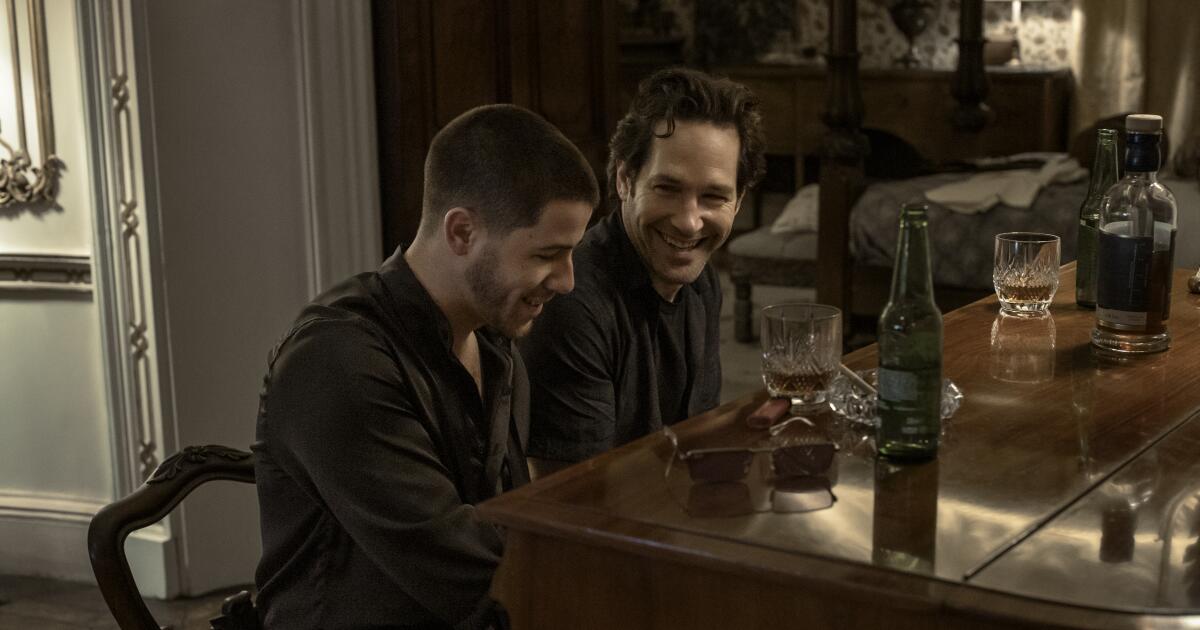
“Power Ballad” is a cynical, sloppy comedy about a wedding singer (Paul Rudd) and a pop titan (Nick Jonas) who drunkenly tinker with an unfinished song, then squabble over who gets custody when it becomes a hit.
Disharmony is a new chord for filmmaker John Carney, who has specialized in films about collaboration since his 2007 art house hit “Once.” From the snotty ’80s synth music of “Sing Street” to the acoustic heartbreak of “Begin Again,” Carney loves to hear how a rough idea evolves into a polished track. Lately, he’s been trying to find new approaches to his formula. His 2023 “Flora and Son” was about a surly single mother who picks up a guitar and discovers that her life doesn’t change that much. I loved that one because it said we’re all entitled to noodle without having to make much fuss about it.
The problem with “Power Ballad” is that it’s all rough ideas itself. Like an album that kicks off with its single, it starts with a jazzy sequence of song creation that’s one of the best versions of the scene Carney has ever done. A faded teen icon, Danny (Jonas, gamely sending up his history as one of the platinum-selling Jonas Brothers), explains how to write a PG-rated hit to Paul Rudd’s cover band frontman Rick, who immediately tries to improvise lyrics with the word “titties.” (Or as he warbles it, “tit-taaays!”). It’s perfect casting — Rudd’s singing voice keeps up with his comic chops.
Fifteen years ago, Rudd’s Rick fancied himself an up-and-coming American rock god until his grunge act went on a transatlantic tour and he fell in love with an Irish girl, Rachel (Marcella Plunkett), and had a daughter named Aja, a feisty teen played by the scene-stealing Beth Fallon. Settling into a life of anonymity in the Dublin suburbs, Rick now has his wedding band Bride & Groove, which allows him brief flashes of cool — or at least the chance to strut into gigs wearing tight black jeans. His bandmates are pretty funny but so underwritten that one even gives a big speech about how he’s more than just a bit player in Rick’s life.
Straight away we’re suspicious that Carney and co-screenwriter Peter McDonald stashed this story in a drawer ages ago and didn’t bother to dust it off. If Rick quit his serious group during the Obama era, why does he consider himself a peer of Eddie Vedder? The character is written to be in his late 30s, but acts decades older than that, posturing like he’s one of the last ambassadors of authentic rock and roll while ripping through a setlist that’s mostly Hall & Oates. (Shouldn’t he at least be jamming the Killers’ indie-sleaze wedding staple “Mr. Brightside” that sends bridesmaids shrieking onto the dance floor like a maenad cult?)
At one soiree, Rick is asked to pass the mic to Danny, a boy-band celebrity struggling to make the leap to a solo artist. Rick has already mocked him earlier that day as “the death of the music industry,” but Danny proves to be a true performer with enough star power to electrify Rick, who starts copying his gestures, clapping alongside him and having a blast. Their chemistry carries over into an all-night jam session in which Danny and Rick share spliffs, whiskey and scraps of songs that they haven’t managed to perfect.
For a thrilling moment, the movie is a platonic rom-com about two dissatisfied artists coming together from opposite directions: Danny crumpling under mass scrutiny, Rick weary of obscurity. Danny is desperate to get back to playing Madison Square Garden; Rick has long since abandoned his dream of playing there even once. Having seen a movie or two before in my life, I assumed that “Power Ballad” would climax at that stadium with Danny and Rick harmonizing for a crowd of 15,000. Corny, sure, but satisfying.
But this banger of a bonding session is a one-night stand. In a shallow heel turn, Danny poaches one of Rick’s unfinished songs and blows it up into a chart-topper. It’s a major betrayal for Rick and a bummer for the audience, who never get to see the two make music together again. Instead, Jonas’ Danny becomes a callow Hollywood creep just like his manager, a menacing slickster named Mac Darling (Jack Reynor), who seems hip until he tries to explain an internet meme and it becomes obvious that Carney doesn’t understand what a meme is.
Meanwhile, Rick suffers a meltdown, haunted by the hit he can’t escape. The stolen track chases him everywhere: on the radio, overheard at the mall, even at his own gigs where newlyweds cluelessly ask him to play “their” special song. We’re forced to hear endless snippets of it, too, although the full lyrics are saved for the end when we discover that one of songwriters clumsily shoved in the word “albatross.”
“Power Ballad” nods toward a dozen interesting themes, none of which it bothers to explore. It could be about what turns a pretty melody into a mega-smash, about the value of songwriting versus charisma, about timid artists who hoard their best material and showboats obligated to satisfy their promotional teams, or even about how a song ultimately belongs less to its creator than its fans. It also flirts with being about how both men write for female approval — girls are Danny’s fanbase and Rick’s family is his entire world — only to have their women think most of their songs are pandering and dull.
“What are you interested in?” Rick finally huffs to his daughter.
“Revenge,” she says.
Well, Carney’s made a movie about darkness and it’s a total bummer. In a brutal little detail, he contrasts Danny’s bikini groupies with the women in Rick’s crowd, who clomp toward him with toilet paper stuck to their shoes.
“Power Ballad” postures like a sincere drama but has the set pieces of a giant slapstick farce. Rudd seems to have been told he’s in one, playing Rick’s humiliation so large that he looks unhinged, his face covered in cuts and bruises of his own doing that, distractingly, never seem to heal.
The result is punishing — and tone deaf.
‘Power Ballad’
Rated: R, for language throughout and some drug use
Running time: 1 hour, 38 minutes
Playing: Opening Friday, May 29, in limited release


New Year’s Absolution, 2024
Directed by Nick Leisure.
Starring Michael Copon, Joel Brady, Josh Gilmer, Rafael Siegel, Shala White, Victoria Brandart, Siddalee Diaz and Lamondo Hill II.
SYNOPSIS:
Four longtime friends reunite for their traditional New Year’s Eve party. But things start to go awry with the arrival of a mysterious resolution: Kill Someone.

The amateur production values of New Year’s Absolution leak off the screen from the opening frame, as a cheap-looking title card appears over stock drone footage, followed by the actors’ names in a bold yellow font, dancing on and off the screen with only the flashiest of iMovie transitions. It’s effective, in letting you know exactly what kind of ride you’re in for.
We get the first sense of this film’s ‘humour’ as we meet Stuart and Travis, a couple played by Rafael Siegel and Lamondo Hill II. As Travis drives toward the home of Damon (Joel Brady), who’s hosting this year’s annual New Years’ Eve party, director Nick Leisure attempts to shock us with a rude joke, as Stuart bends down towards Travis’ crotch, a visual that would almost work if Travis didn’t have a small dog sitting on his lap. Turns out Stuart was just reaching down to pick up his phone. Hilarious.

Stuart and Damon are both members of ‘the five of ’99’, a friend group who met in 1999, of which only four remain (watch for the shocking revelation to this mystery). Damon is more concerned with arranging the coasters, and bickering with his wife Clare (Shala White) over the canapés, than making sure his friends have a good time. Don’t worry, Damon, we’re not having any fun either.
As everyone starts trickling in, the lack of chemistry between the cast members becomes increasingly apparent. ‘Lifelong friends’ Stuart and Damon interact like coworkers at an after-hours event, while ‘best friends’ Travis and Clare stand around rehearsing dialogue. This involves a lot of bitching about the others, especially the next arrivals Jacob (Josh Gilmer), an off-duty cop, and his wife Misty (Victoria Brandart). They are both vain and image-obsessed, showing off their bodies while the others snigger behind their backs about how fat they used to be.

The last to arrive are narcissistic surgeon Roy (Michael Copon), and his new girlfriend Kira (Siddalee Diaz), a shallow parody of Gen Z shallowness, whose entire character is constructed around her social media presence, and who physically cannot stand being separated from her phone. That’s the caliber of subtle social satire you can expect here.
What with the vanity, body shaming, and some casual racism and homophobia, it becomes clear that these are not nice people. There’s an obscenity to their wealth; Stuart blew 50k on a vintage car that can’t drive in the rain, and Damon forked out for a pool that he’s never swam in. Yet Leisure fails to make any kind of satirical point about the superficiality on display, because his approach to filmmaking lacks any depth of its own.

Damon’s hesitancy to get into his own pool is a key point, as his friends jokingly threaten to throw him in, and Stuart later threatens to drown him if he harms his dog Cookie, whom Damon fears will crap on his precious floors. It’s not much, but it’s nice to get some foreshadowing in a plot that’s mostly lacking in structure or craft.
Said plot eventually coughs and sputters to life when Jacob picks his new year’s resolution out of a ceremonial hat, and reads – kill someone. You might expect the group to laugh this off, but Jacob flips out, and deeper, sinister connotations are revealed. Jacob, who has been doing coke with Roy all night, then draws a loaded firearm in his drug-fueled haze, which he accidentally fires, injuring a member of the party.

This leads to some impromptu bathtub surgery from the coked-up doctor, that further highlights the film’s disconnection from reality. None of the characters react in a normal way to this development, continuing the party as if there isn’t a dude with a gunshot wound in the tub.This could’ve been an interesting satirical point about the hollowness of the upper class, except so little has been established about these characters and their relationships, that it just comes across as lazy writing.
However, it’s after this point that the film finally begins to find some (admittedly ironic) entertainment value, as the plot descends into a chain reaction of over-the-top carnage, with each character blaming another for the night’s misfortunes, and perpetuating them in grisly fashion. It’s in this last half hour that Nick Leisure’s vision of a bloody dark comedy begins to come through, and the kills are as exaggerated as they are unexpected, sparing no amount of fake blood. That said, it’s too little too late, as we’ve already wasted an hour watching these unbearable characters exchange dialogue that’s in turn laughable and dull.

New Year’s Absolution is a tonally confused, poorly put-together piece of work that is unclear in its goals, and fails to achieve them. Director Nick Leisure seems to be going for a broad black comedy, but the only laughs I found were from the piss-poor acting, ridiculous deaths, dumb editing gimmicks, and the autogenerated subtitles while rewatching the surgery scene – “It’s bleeding!” “Boobs tend to do that.”
It’s supposedly a horror/thriller, but it’s not scary or thrilling, because there’s no singular antagonistic force, and the deaths are too random, while the characters are so flat and unlikable that we neither feel nor fear for them. Though it’s possible Leisure is going for some kind of ‘eat the rich’ social satire, his approach is too bland for this to come through, and we don’t get any grounded perspective outside of these awful characters.
One question remains, however – who wrote the resolution? Don’t know. Don’t care.
Flickering Myth Rating – Film: ★ / Movie: ★
Dan Carville
https://www.youtube.com/watch?v=embed/playlist

Thinking back on the last two years of his life full of album releases, filming schedules and tour dates, Finn Wolfhard requires squint-inducing concentration to keep it all straight.
“Jesus, a lot has happened,” he says, looking surprised. That’s an understatement.
In that time, the 23-year-old not only finished filming the Netflix hit show “Stranger Things,” which catapulted him to global stardom, and promoted the final season upon its premiere. He also released his feature film directorial debut (“Hell of a Summer,” co-directed with Billy Bryk, which hit theaters in April 2025). Then, he starred in another movie (A24’s creature feature “The Legend of Ochi”), directed a posthumous George Harrison stop-motion music video, wrote, recorded and put out his first solo album (“Happy Birthday”), and embarked on a 22-date tour before recording a new album.
On a video call from his family home in Vancouver, Canada, where he lives with his parents and older brother, he’s chatting about the release of that record, the eclectic, guitar-driven “Fire From the Hip,” which dropped Friday.
“I think it’s a nice day?” he offers when I ask what’s happening in Vancouver. “I don’t know. I’ve been in my basement studio all day, so I don’t … I think it’s nice.”
He’s been down in the basement doing press calls like this, he explains, undoubtedly a familiar routine after so many years in the limelight. He wears a baseball cap and an oversize brown sweater, tugging on the sleeves while he ponders.
Even if Wolfhard is exhausted by the press marathon, he doesn’t show it. He’s excited for the chance to be known on his own terms. He never fails to express gratitude for the projects that afforded him recognition and opportunity, but he’s ready to “take control of the narrative.”
“I spent my whole childhood standing on marks that other people told me to stand on and saying lines that other people told me to say,” he says. “Why wouldn’t I want to make my own stuff?”
Being in control also means being the face of the operation. Before “Happy Birthday” and “Fire From the Hip,” Wolfhard released a total of two records and an EP, plus a whole bunch of singles, with his previous bands, Calpurnia and the Aubreys. Being in a band was a natural fit for Wolfhard, who thrives in an ensemble where he can “hide behind the band name.”
Touring last year was his first time seeing his own name on the marquee.
“It’s just straight up me, and if I suck, I suck,” he laughs. “It’s not like I can be like, ‘Oh, man, we’re having disagreements in the band.’ It’s like, no, that’s you. So there was a little more pressure early on.”
Finn Wolfhard released “Fire From the Hip” on Friday.
(Victoria Stevens)
Stepping into the spotlight required Wolfhard, who admits he shies away from conflict, to own both the pressure and the power of being the one audiences came to hear.
When he got sick and had to cancel a show in Portland, Ore., he remembers feeling crushingly sad “letting down” his fans and bandmates — who, of course, assured him it was outside of his control and urged him not to be so hard on himself.
Wolfhard introduced many of the songs that ended up becoming “Fire From the Hip” to his bandmates while they were still on tour, and he says playing them live “cultivated the spirit” of the eventual recordings. Despite his collaborative ethos, there was a moment during the process where he had to learn how to put his foot down in real time.
“I remember suggesting something and people being like, ‘Ah, I don’t know if I want to do that.’ And I was like, ‘No, you don’t get to do that to me. It’s my record,’” he remembers. “It was very innocent — I don’t think there was much ego on either side. But I think I maybe set up too collaborative of an experience that day.”
“I think I sometimes make it feel like a democracy, which it is in a lot of ways,” he adds. “But also, in the end, it is up to me.”
That thought is echoed in the album’s cover art, an image of two miniature Finn Wolfhards facing off, donning colonial garb and brandishing weapons. It’s meant to represent dueling impulses inside of him, he explains.
Wolfhard, a true-blue music nerd, has been described online as an archetypical example of the “child of a Gen X cool dad,” in the same vein as Olivia Rodrigo. (His dad, a former screenwriter turned lawyer and Indigenous rights researcher, does sound cool, but it was his mom who first introduced him to the Beatles. His parents apparently met over a Stone Roses record.)
That sensibility is evident in his musical influences — “I wanted everything [on drums] to sound like the first two Wilco records,” he says — and in his approach to recording. “Happy Birthday” was recorded almost entirely on four-track cassette tapes, while “Fire From the Hip” uses 24-track reel-to-reel.
The album runs the gamut from its cheeky, surf-rock opener “I’ll Let You Finish” (yes, that is a reference to Kanye West’s infamous speech at the 2009 VMAs) to more ’90s alt-inspired tunes to a surprising dose of straightforward country-folk.

Lyrically, Wolfhard divides his songs into two categories: the “very personal” and the story songs written around books he was reading (“Knockemstiff” by Donald Ray Pollock) or quotes that made him laugh. The personal themes he explores are exactly what you would expect from an early-20s rocker raised in the public eye — namely, relationship expectations and existential fears about the future.
On the nostalgic piano ballad “Good Morning,” he imagines what it might be like to settle down somewhere “with a dog and a wife.”
“I haven’t lived that part of my life yet,” he says now. “So I can really easily get lost in thinking about what that looks like.”
When it comes to sharing his music, especially the more vulnerable tracks, Wolfhard knows his “Stranger Things” fame is the elephant in the room. Anything he sings can and might be used against him in the court of public opinion.
“I could either kind of say nothing and be totally private, because it is scary knowing that everything I say, at least one person will take it a certain way that I wouldn’t want them to. But I just don’t have the control,” he says.
“So if I don’t have the control, then there’s nothing really that I can do, other than try to be as truthful and passionate and well-meaning as I possibly can, you know?”
The double-edged sword of fandom hasn’t stopped Wolfhard or his musically-inclined “Stranger Things” co-stars from pursuing this path. Fellow Hawkins alums Joe Keery (who releases music under the moniker Djo) and Maya Hawke are indie darlings in their own right, and Wolfhard has previously referred to Keery as a mentor. None of them face the unique challenge of relatability in quite the same way, however.
“I’m aware that my specific problems are maybe not as relatable because of how specific of a life I have,” he said. “The only thing I can hope for is that some other person out there listens to it and relates to the same things that I do.”
Sometimes an air of wistfulness accompanies these admissions. When asked about how he feels about Los Angeles, he tells me that it’s complicated: “I think if I wasn’t a young actor, it would be a very different situation.” His favorite parts of the city are its repertory cinemas and lush neighborhoods like Mount Washington, where his godfather resides, because they look the most like Vancouver.
That said, he’s not through with Hollywood. He’ll be back in L.A. for an Oct. 13 show at the Fonda Theatre, and acting and directing are still on the agenda. He would like his next film project — other than the Matt Johnson and Bong Joon Ho projects he’s already committed to, of course — to be something more “personal.”
For now, though, the focus is music. Wolfhard launches a new tour this month, and he’s most looking forward to “doing dumb s—” with his friends.
He tells a quick story to illustrate: When he and the band last toured in Glasgow, Scotland, he was trying to leave the venue without being noticed. (“I have a hard time dealing with fan interaction,” he says.)
“We kind of made it into this joke thing, knowing it wouldn’t work, where me and Rand, my guitarist, were like, ‘let’s switch clothes.’ Rand pretended to be me and I pretended to be Rand,” he says. Miraculously, it worked up until the “very last second” before they stepped on the bus.
“I couldn’t help myself,” he says: He instinctively made eye contact with someone in the crowd. “They did a double take, like, ‘Wait, what?’”
It sounds like a scene straight out of “A Hard Day’s Night” — or maybe inspiration for his next film.
“I’m pretty in my head about things and want them to be a certain way,” he says. “The thing that I have to remind myself all the time is that, like, dude, you’re with your friends, you’re playing music — it’s the best.”
Movie Reviews
‘Fruit Gathering’ Review: A Factory Worker Falls for Her Female Colleague in a Delicate Burmese Debut

Caught between rural roots and urban opportunities, familial duty, friendship and forbidden carnal desire, young San Kyi (Nandar Myat Aung) struggles to find her place in Fruit Gathering, a sensitive Myanmar-Czechia-France co-production that just won Karlovy Vary’s top prize.
That’s an impressive achievement for Burmese writer-director Aung Phyoe, making his feature debut after several shorts. His flair for blending realist drama with more poetic, painterly imagery makes for a dreamy, hypnotic viewing experience, eased along by a confident, open-hearted performance from Nandar Myat Aung in the lead role. Fruit Gathering will be ripe for picking at further festivals, especially ones specializing in Asian and/or LGBTQ+ fare, possibly followed by niche distribution.
Fruit Gathering
The Bottom Line Juicy but not too sweet.
Venue: Karlovy Vary Film Festival
Cast: Nandar Myat Aung, Nandar Myint Lwin, Tin Tin Ei, Thida Soe Khant, Wutt Yeet Kyaw, Htet Aung Lynn, Khet Suu Myat, Min Nyo, Zun Pwint Phyu
Director/screenwriter: Aung Phyoe
1 hour 37 minutes
Self-transplanted with her mother (Tin Tin Ei) and grandmother from the countryside to industry-rich Yangon, San Kyi has so far managed to resist the pressure from her mom to get married or pursue a career in something upmarket like tech. Instead, eager for a job that doesn’t demand too much thinking, San Kyi works in a massive clothing factory, sewing seams all day in a ferociously noisy, scrap-strewn environment where the supervisor gets snotty if she takes a bathroom break without seeking permission first.
Incidentally, while the factory hardly looks inviting, the conditions don’t seem to be too bad compared to those seen in older documentaries about East and South Asian sweatshops. They’re comparable to what’s on display in, say, Chinese director Wang Bing’s doc Youth but without the company-owned residential housing. At least the workers are allowed to submit petitions circulated by labor organizers requesting better pay and more safety measures, although tellingly San Kyi refuses to sign lest she might get fired for it. A union leader (Wutt Yee Kyaw) pours scorn on her for not showing more solidarity with her colleagues.
Later, after she’s injured herself by a sewing accident, San Kyi will rethink her position on workers’ rights, but industrial relations in the textile industry are not the film’s main focus. It’s all background color, as much a part of the vivid landscape as the interludes where we see San Kyi back home visiting the mango farms and spirit-dance ceremonies of her agrarian childhood.
At least it’s at this factory that San Kyi meets Theint Theint Oo (Nandar Myint Lwin), a young co-worker around the same age as San Kyi with a radiant smile and street sense to burn. The two young women start out just hanging together during their lunch breaks but soon grow inseparable. The script suggests early on that Theint Theint may be the kind of pal who always forgets to bring enough cash for dinner. A darker interpretation might posit that she sees San Kyi as little more than a mark, but the truth probably falls somewhere in a grayer area.
Either way, by the time San Kyi is buying nearly identical blouses for the two of them to wear on strolls around town, it’s pretty clear that she’s smitten with Theint Theint. The latter is ambiguously flirtatious and keen to have languid girls’ night sleepovers in the same bed, but also open about the fact that she’s got a man in the background, who is conveniently always away working in another country. Afraid of losing her new limerent object of desire, San Kyi entertains the thought of going abroad with Theint Theint to work as housekeepers or factory workers in somewhere affluent like Singapore or Malaysia.
Clearly, things are heading for a smash up when San Kyi lends Theint Theint a substantial amount of money. Somehow the tension is heightened by the fact that Theint Theint gets closer to San Kyi’s family, even accepting a job offer that comes through the local guy whom San Kyi’s mom was trying to set San Kyi up with as a potential husband. It all serves to underscore how narrowly female relationships are usually defined in highly traditional, painfully patriarchal Myanmar society. The intense feeling between these two young women could never be openly romantic, although no one bats an eye when they walk hand and hand through the streets, much the way Queen Victoria is said to have refused to sign legislation banning lesbianism because she wouldn’t acknowledge such a thing even existed.
Aung Phyoe suggests the messy, uncontrollable nature of desire via some slightly heavy-handed imagery of flooded apartments and generally juicy, watery, somewhat soluble imagery. But the story surprisingly shifts tack halfway through and becomes less interested in the two women’s relationship and more in San Kyi’s personal development, especially after some hard knocks change how she sees the world.
Every so often, the camera will linger on a tiny detail like a vase that has some emotional significance, or the light coming in a window. There’s a tiny hint that these cinematic still life pictures are being seen through San Kyi’s eyes, like scenes in a book told through limited third-person point of view. Indeed, there’s a faintly literary quality to the filmmaking, as if inspired by romance and high-brow fiction, but Aung Phyoe’s touch is feathery soft, as gentle as the soft thud of a mango falling from a tree.
-

 Los Angeles, Ca1 hour ago
Stabbing at Chino Hills liquor store ends in attempted murder arrest
-

 Detroit, MI2 hours ago
A small group of citizens rally for mental health coverage in Detroit
-

 San Francisco, CA2 hours ago
1 dead, 2 missing after boat capsizes near Alcatraz in San Francisco Bay
-

 Dallas, TX2 hours ago
Death penalty off the table for man accused of beheading Dallas motel manager, prosecutors say
-

 Boston, MA2 hours ago
Chickadee, the popular Mediterranean restaurant in Seaport, is shutting down – The Boston Globe
-

 Denver, CO2 hours ago
Denver Nuggets 7-Year NBA Veteran Gets Honest On Peyton Watson
-

 Seattle, WA2 hours ago
Top 25 Seattle Seahawks Going into 2026 NFL Season: #17 Grey Zabel
-

 San Diego, CA3 hours ago
Tijuana earns spot in Little League World Series, hoping third time’s a charm

