Entertainment
Review: In Denmark's 'The Promised Land,' the virtues of an old-school western still blaze

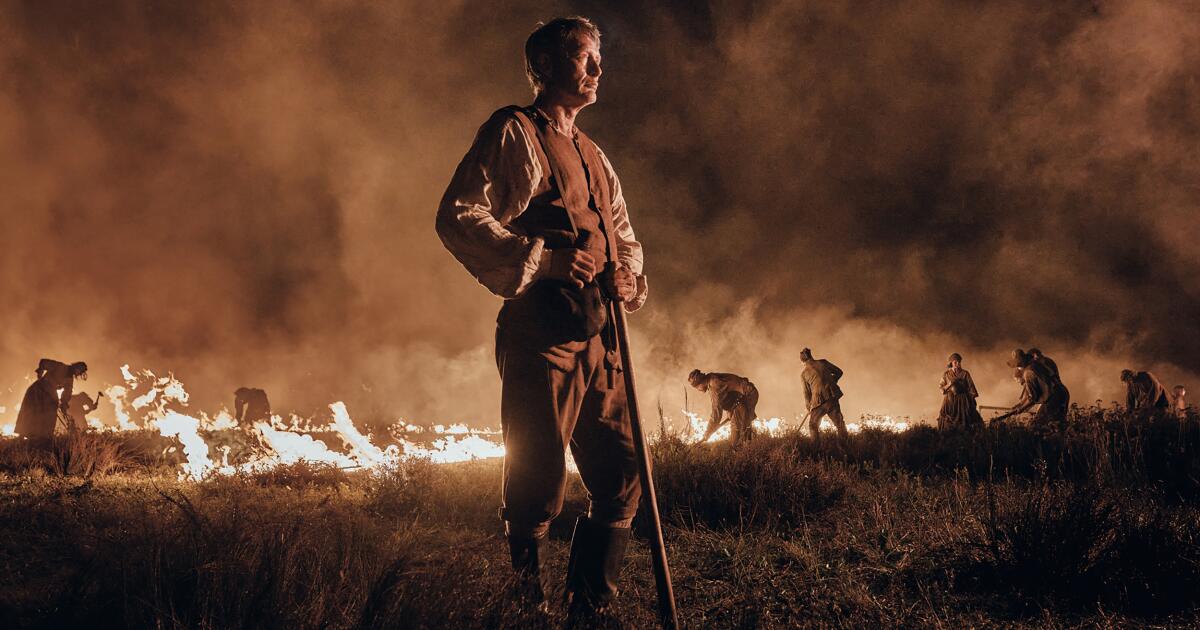
Nikolaj Arcel’s “The Promised Land” is aptly titled. Adapted from the 2020 novel “The Captain and Ann Barbara,” by Ida Jessen, the land itself — the untamed heath of Jutland, the peninsula that makes up the continental portion of Denmark — proves to be both setting and character: as mercurial, tormented and blood-stained as anyone in this tale.
In 1755, the heath is empty, save for bands of outlaws and low-lying foliage, until a retired army captain, Ludvig Kahlen (Mads Mikkelsen) leaves the poor house with a secret shipment from Germany and a plan. He convinces the Royal Treasury to let him cultivate the territory at his own expense, appeasing the whims of King Frederick V and earning himself a noble title in exchange.
Ultimately, Ludvig’s is the story of a homesteader and Arcel treats it with the iconography and grandeur of a classic western, Scandinavian style. The film is a tapestry of misty vistas pierced only by lantern light as Ludvig battles the unforgiving earth in every condition, day and night, the planes of Mikkelsen’s distinctive face set against the sky.
If only the soil was his only antagonist. Ludvig has planted his settlement on a stretch of acreage that a nearby landowner and local judge, Frederik de Schinkel (Simon Bennebjerg), fancies his own. The only laborers Ludvig manages to keep are a couple of runaway tenant farmers, Johannes (Morten Hee Andersen) and Ann Barbara (Amanda Collin), whom Frederik also fancies his own. And Frederik is a jealous, controlling and vengeful megalomaniac, who sets about destroying Ludvig’s dreams at any cost, simply because of where they are on the map.
Melina Hagberg and Mads Mikkelsen in the movie “The Promised Land.”
(Henrik Ohsten / Zentropa)
After a foray into Hollywood with the 2017 Stephen King adaptation “The Dark Tower,” writer-director Arcel is back in his wheelhouse of Danish historical dramas, reuniting with Mikkelsen, who starred in his 2012 film “A Royal Affair,” and with his co-writer Anders Thomas Jensen, with whom he wrote “Riders of Justice.” Arcel’s films don’t revise Danish history so much as expand upon it, upturning previously held assumptions and examining the corruption of powerful men, with a socially progressive, even feminist bent.
Arcel makes this kind of large-scale period filmmaking look effortless, these detailed dramas of serious emotion and sociopolitical issues woven with humor, romance and sensuality. He approaches aristocracy with a certain level of absurdism, showing men in power as ridiculous and pathetic. Bennebjerg takes well to this, playing the psychopathic sadist Frederik in an almost comedic vein.
We laugh at him, especially when he continually corrects everyone to include the “de” in his last name, added as a vanity to seem more aristocratic. But we also see Frederik’s enormous cruelty, as he lashes out in a murderous rage whenever he feels impotent or frustrated, taking it out on innocents. Frederik is a very bad man and witnessing what he has coming to him is deeply satisfying, the lines of good and evil clearly drawn as they usually are in this kind of throwback storytelling.
“The Promised Land” is also the story of an unlikely family, a slowly developing theme that reveals itself over the course of the film’s runtime. It is a found family, made up of Ludvig, the steely Ann Barbara and a young Romani girl, Anmai Mus (Melina Hagberg), whose mischief and humor bring a lightness to the remote house on the heath. However, she is the focus of racism and discrimination by the German settlers who arrive there, and Ludvig almost loses the women who, though not a part of his plan, make his life complete.
This is the finest work of Arcel’s collaboration with longtime cinematographer Rasmus Videbæk. They craft this Nordic western epic with an eerie beauty and an eye toward the kind of startling violence that can erupt unexpectedly in lawless frontiers. Blood flows darkly and scenes are lighted by flame: a raging fire on the field as Ludvig and his outlaw workers burn the heather; blazing candelabras illuminating an intimidating manor dinner; feeble lamplight beating back the foggy night as Ludvig battles the dirt with his bare hands. Aerial shots capture the texture and topography of the landscape.
Mikkelsen commands quiet attention with his signature stoicism at the center. His Ludvig is orbited by the flamboyantly evil Frederik, the wounded yet powerful Ann Barbara and the charmingly potty-mouthed Anmai Mus. But Mikkelsen has a stunning ability to express deep wells of emotion with only his eyes; much is communicated in glances and meaningful looks. Without a single word, he makes his final decision about his land and his fate upon it, though his feelings couldn’t be more clear.
“The Promised Land” is the kind of sweeping big-screen epic that will make you say, “They don’t make them like this anymore.” Thank goodness Nikolaj Arcel still does.
Katie Walsh is a Tribune News Service film critic.
‘The Promised Land’
In Danish, Swedish, German and Norwegian, with English subtitles
Rating: R, for bloody violence, language, some sexuality and brief nudity
Running time: 2 hours, 7 minutes
Playing: In limited release Friday, Feb. 2


RICHMOND, Va. (WRIC) — In this episode of 8News Reel Talk, Julia Broberg sits down with Hekla Petursson and Catori Ryan to talk about “Toy Story 5.”
The hosts gave their reviews and provided the following star ratings:
Catori: ★★★★
Hekla: ★★★★★
Julia: ★★★★.2
To watch more livestreams and digital video content, head to the WRIC+ Originals page. You can also watch full on-demand videos on your smart TV using the WRIC+ app.

Passing “Go” has become especially lucrative for mobile game publisher Scopely.
The Culver City-based Scopely launched “Monopoly Go!” in 2023, betting fans of the classic board game would flock to a mobile version aimed at casual gamers.
By 2025, “Monopoly Go!” had accrued $6 billion in lifetime in-app purchase revenue, becoming the fastest free mobile game to do so, according to app analytics firm Sensor Tower.
This summer, the app is expected to reach $8 billion in lifetime revenue, the company says, solidifying “Monopoly Go!” as Scopely’s biggest game and far surpassing the company’s popular “Pokémon Go.” The company declined to disclose its total profits.
Scopely Co-Chief Executive Javier Ferreira.
As overall downloads in the mobile game market have stagnated and in-app purchases and retention become the main drivers of growth, Scopely has hit on an age-old Hollywood strategy — using known franchises and intellectual property to bring out fans.
“These are incredibly durable and long-lasting games that have really passionate communities and fandom around them,” said Javier Ferreira, co-chief executive of Scopely. “We’re in the business of building people’s favorite thing, and that’s a difficult thing to do. The power of [intellectual property] is that, in some cases, that is already their favorite thing.”
The company’s journey toward “Monopoly Go!” began in 2014, when Scopely formed a partnership with Rhode Island-based toymaker Hasbro. Its first collaboration was a Yahtzee mobile dice game that ultimately drew millions of players worldwide (though it was especially popular in the U.S.) and generated more than $1 billion in lifetime revenue.
After that, Scopely approached Hasbro about taking on the “crown jewel” of its board game empire — Monopoly.
Monopoly’s massive global popularity was an obvious draw. But adapting an hours-long real estate transaction game for a casual, mobile audience proved challenging.
Development of what would become “Monopoly Go!” ultimately took seven years, two of which were spent trying to make movement around the board more fun. In that time, the company scrapped two versions of the game; one deemed too competitive, and one that was too complex, Ferreira said.
Developers wanted to capture the “roller coaster feel” of the board game’s highs and lows, while also having simple rules and ensuring a strong social element, he said.
“We couldn’t just copy,” Ferreira said. “We had to reinvent it and re-imagine it, and that’s a complicated, creative endeavor.”
Today, “Monopoly Go!” brings in more than $2 billion in annual revenue and has been downloaded across the globe more than 300 million times.
Now with “Pokémon Go,” which the company owns after acquiring maker Niantic’s game business last year, “Scopely has gone from a successful publisher to one of the defining companies in mobile gaming,” Randy Nelson, head of insights at Appfigures, a mobile app analytics firm.
“The company cracked the code on licensed games years ago,” he wrote in an email. “Its biggest hits work because they’re great games first and recognizable brands second.”
Though the company’s overall game downloads have slowed, its gross revenue has largely increased every year since 2020, according to Appfigures data.
Shortly after Scopely released “Monopoly Go!,” the company was acquired by Savvy Games Group, which is owned by the Saudi Public Investment Fund, for $4.9 billion.
In a statement about the deal, Savvy Games Group Chief Executive Brian Ward touted the success of “Monopoly Go!” as “indicative of Scopely’s ongoing position at the forefront of the global games sector.”
Representatives of the Saudi investment fund are part of Savvy Game Group’s board and do sometimes give some feedback on company initiatives, though Ferreira said the company has remained “very independent.”
The proposed acquisition of gaming giant Electronic Arts by the Saudi Public Investment Fund is not expected to affect Scopely since EA largely focuses on high-budget console and computer games, he said.
As Scopely, now 3,000 employees strong, looks to the future, it has embarked on a number of entertainment partnerships with studios to add franchises such as “The Simpsons,” “Hello Kitty” and Marvel to its mobile game ecosystem.
“They give us access to these universes that millions of people love and are really invested in,” Ferreira said. “We see this as a very strategic part of our business.”

Rose of Nevada is a genuinely poetic movie that pushes the boundaries of the Groundhog Day-style time-travel narrative while carving out an identity completely its own. Rather than relying on the familiar mechanics that audiences have come to expect from the genre, the film approaches the concept through a more reflective and emotional lens. The result is a movie that feels thoughtful, ambitious, and surprisingly moving.
It makes a huge on-screen presence felt through its cast, particularly George MacKay and Callum Turner, who both deliver performances that elevate the material beyond a simple science-fiction premise. Combined with breathtaking visuals and a strong directorial vision, Rose of Nevada becomes something far more memorable than many of its genre contemporaries.
George MacKay continues to prove why he is one of the most compelling actors working today. Following his acclaimed work in 1917, he once again demonstrates an ability to carry a film through sheer presence and emotional authenticity.
Every scene feels grounded because of his performance, even when the story ventures into more abstract territory. Alongside him, Callum Turner delivers what could easily be viewed as a breakout performance. The chemistry between the two leads helps anchor the film, allowing audiences to connect with the characters even as the narrative challenges conventional storytelling expectations.
One of the film’s greatest strengths is its visual presentation. The cinematography is nothing short of earth-shattering. Nearly every frame looks like a carefully crafted painting, capturing both the beauty and mystery of the world these characters inhabit. There is a dreamlike quality to the imagery that perfectly complements the film’s themes of time, memory, and destiny.
The camera lingers on landscapes just long enough to allow viewers to soak in their beauty without ever slowing the pace. It’s the kind of cinematography that demands to be appreciated on the largest screen possible.
Director Mark Jenkin continues to establish himself as one of the most distinctive voices in modern British cinema. Following the atmospheric and haunting Enys Men, Jenkin once again crafts a story that feels deeply connected to folklore and place.
The British backdrop becomes a character in itself, with rugged coastlines, open landscapes, and isolated locations contributing to the film’s unique atmosphere. His direction never feels showy or excessive; instead, he trusts the audience to absorb the experience and interpret its deeper meanings.
What makes Rose of Nevada especially fascinating is how it recalls classic time-travel films without simply copying them. There are moments that evoke the spirit of The Final Countdown, particularly in the sense of wonder and uncertainty surrounding the temporal elements.
Yet the film remains firmly rooted in its own identity, focusing more on emotion and introspection than spectacle. It invites viewers to engage with its ideas rather than simply consume them.
This is also one of those rare films that benefits from reflection after the credits roll. It is not a movie designed to provide easy answers. Instead, it lingers in the mind, encouraging discussion and interpretation. The more time you spend thinking about it, the more rewarding it becomes. Much like a fine wine, Rose of Nevada continues to improve with age, revealing new layers and details upon reflection.
Overall, Rose of Nevada is a beautiful, ambitious, and visually stunning piece of filmmaking that deserves to be experienced on the big screen. Powered by exceptional performances, remarkable cinematography, and confident direction, it stands as one of the more unique takes on time travel in recent memory.
Overall Grade: 4/5 Stars
-

 Maine33 seconds ago
Person hospitalized after shed fire in Harpswell
-

 Maryland3 minutes ago
Navy ship USS Marinette arrives in Maryland for Sail250:
-

 Michigan9 minutes ago
Michigan president has strong words for college sports after Dusty May exit
-

 Massachusetts16 minutes ago
Mass. lawmakers prioritizing 100 high-risk locations to implement wrong-way driving prevention measures – Boston News, Weather, Sports | WHDH 7News
-

 Minnesota18 minutes ago
Rationalizing Charlotte’s Shocking Decision to Trade LaMelo Ball to Minnesota
-

 Mississippi23 minutes ago
Mississippi Legislature will talk school choice, redistricting in 2027
-

 Missouri31 minutes ago
Missouri Highway Patrol investigating KCPD officer involved shooting
-
Montana34 minutes ago
Montana DEQ works toward impairment designation for Big Hole River


