
Connect with us

Entertainment

Review: A family’s past and present intermingle in Germany’s eerie, elliptical ‘Sound of Falling’

Published

on

Review: A family’s past and present intermingle in Germany’s eerie, elliptical ‘Sound of Falling’

There are ghosts inhabiting “Sound of Falling” — you just need to know where to look for them. German director Mascha Schilinski’s astonishing second feature could scarcely be more ambitious as it offers an impressionistic portrait of four young women who take turns residing in the same house over roughly 110 years.

But where other movies are overly precious while collecting the invisible string that binds characters from different time periods, “Sound of Falling” is stark and unsentimental. Covering the early 20th century through the present, gliding back and forth between eras with the deftest touch, the film views the living as merely the latest iteration of a fragile species that has been constantly struggling against unseen forces that drag it down, generation after generation. So many of the movie’s characters are long dead, their hopes and dreams now erased, while we strut and fret our hour upon the stage.

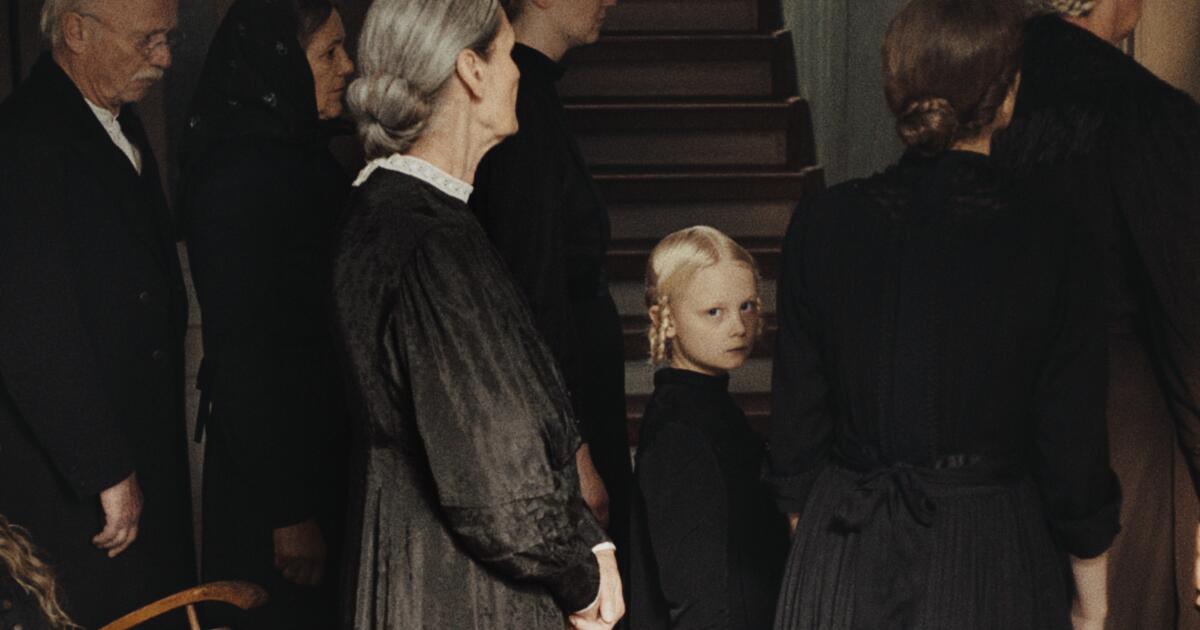
Winning the Jury Prize at last year’s Cannes, “Sound of Falling” introduces us to Alma (Hanna Heckt), a child living on her family farm in northern Germany around 1910; adolescent Erika (Lea Drinda), who occupies the house in the 1940s; flirty 1980s teen Angelika (Lena Urzendowsky); and Lenka (Laeni Geiseler), a shy tween hanging out with her mother and sister in the 21st century. Schilinski doesn’t hold the viewer’s hand, providing no title cards to indicate which time period we’re visiting. “Sound of Falling” doesn’t even start chronologically, opening with Erika as she silently adores her sleeping, bedridden uncle Fritz (Martin Rother), an amputee whose hairy chest and sweat-filled bellybutton entrance her. The reason for Fritz’s injury will eventually be revealed, but not immediately — Schilinski will not be rushed as her epic tale slowly unfolds.

In a sweepingly offhand way, “Sound of Falling” is a canny exploration of how sexism and repression echo across the ages. The unconscionable treatment of maids in Alma’s era finds uncomfortable parallels in the 1980s, when Angelika is both appalled and intrigued by the leering looks of her uncle Uwe (Konstantin Lindhorst). But Schilinski never underlines her points: Events occur not because the plot twists are attached to a larger thematic idea but, rather, because these women’s lives are crushingly commonplace for their time periods. It is only by seeing them in concert that we fully understand the whole symphony.

Much like the exceptional recent dramas “Aftersun” and “Nickel Boys,” “Sound of Falling” plays as an act of re-created memory. But while all three dreamlike films expertly mimic the imperfect act of remembering, Schilinski’s makes the past seem irretrievable — a ghost whose presence we can feel but not touch. “Sound of Falling” presents Alma’s and Erika’s agrarian segments as dusty museum pieces, with even the 1980s and 21st century portions coming across as hazy snapshots. The rueful voice-over from myriad characters is spoken in the past tense, the onscreen moments (even the present-day scenes) seemingly being recollected long after. And Fabian Gamper’s spectral cinematography sometimes incorporates POV shots that produce the sensation that we, the viewer, are physically touring these long-abandoned rooms. When the characters occasionally look at the camera, the effect is chilling, briefly but powerfully bridging the distance between then and now, them and us.

Advertisement

Audiences will gradually realize that there are familial connections between these women, although those specifics are best left discovered within “Sound of Falling’s” temporal drift. Family is central to Schilinski’s work. (Literally: She and Gamper are married, recently welcoming their first child.) Thus far, though, her films express misgivings about the virtue of those bonds. Her 2017 debut, “Dark Blue Girl,” concerned a young girl scheming to keep her separated parents from getting back together. In “Sound of Falling,” incest rears its ugly head, as does suicidal ideation and a relentless desire to escape. The four young women never meet, yet they share a sense of despair. Alma’s confusion at the secretive manner in which adults behave is no different than Lenka’s insecurity a century later as she befriends a girl (Ninel Geiger) who seems far older and wiser. What if Alma and Lenka could talk, “Sound of Falling” asks. What would they say to one another?

Such questions are central to this elusive marvel, which invites the viewer to complete the drawing that Schilinski evocatively sketches. Images and ideas repeat over time periods: buzzing flies, the taking of photos, the haunting use of Anna von Hausswolff’s 2015 ballad “Stranger.” The song’s lyrics don’t directly correspond to the beauty and pain contained in “Sound of Falling” — it’s just one more layer of enigma in a movie that doesn’t answer all its riddles. But these lines are a useful guide to appreciating its ghostly spell: “There is something moving against me / It’s not in line with what I know / Changing the heart, changing the spirit / Changing my path, changing my soul.” To see this film is to be transformed.

‘Sound of Falling’

In German, with subtitles

Not rated

Advertisement

Running time: 2 hours, 29 minutes

Playing: Opens Friday, Jan. 23 at Laemmle Royal

Advertisement

Movie Reviews

Review | Hoppers: Pixar’s new animation is a hilarious, heartfelt animal Avatar

Published

on

Review | Hoppers: Pixar’s new animation is a hilarious, heartfelt animal Avatar

4/5 stars

Bounding into cinemas just in time for spring, the latest Pixar animation is a pleasingly charming tale of man vs nature, with a bit of crazy robot tech thrown in.

The star of Hoppers is Mabel Tanaka (voiced by Piper Curda), a young animal-lover leading a one-girl protest over a freeway being built through the tranquil countryside near her hometown of Beaverton.

Because the freeway is the pet project of the town’s popular mayor, Jerry (Jon Hamm), who is vying for re-election, Mabel’s protests fall on deaf ears.

Everything changes when she stumbles upon top-secret research by her biology professor, Dr Sam Fairfax (Kathy Najimy), that allows for the human consciousness to be linked to robotic animals. This lets users get up close and personal with other species.

Advertisement
“This is like Avatar,” Mabel coos, and, in truth, it is. Plugged into a headset, Mabel is reborn inside a robotic beaver. She plans to recruit a real beaver to help populate the glade, which is set to be destroyed by Jerry’s proposed road.
Continue Reading

Entertainment

Kurt Cobain’s Fender, Beatles drum head among $1-billion collection going to auction

Published

on

Kurt Cobain’s Fender, Beatles drum head among -billion collection going to auction

In the summer of 1991, Nirvana filmed the music video for “Smells Like Teen Spirit” on a Culver City sound stage. Kurt Cobain strummed the grunge anthem’s iconic four-chord opening riff on a 1969 Fender Mustang, Lake Placid Blue with a signature racing stripe.

Nearly 35 years later, the six-string relic hung on a gallery wall at Christie’s in Beverly Hills as part of a display of late billionaire businessman Jim Irsay’s world-renowned guitar collection, which heads to auction at Christie’s, New York, beginning Tuesday. Each piece in the Beverly Hills gallery, illuminated by an arched spotlight and flanked by a label chronicling its history, carried the aura of a Renaissance painting.

  • Share via

    Advertisement

Advertisement

Irsay’s billion-dollar guitar arsenal, crowned “The Greatest Guitar Collection on Earth” by Guitar World magazine, is the focal point of the Christie’s auction, which has split approximately 400 objects — about half of which are guitars — into four segments: the “Hall of Fame” group of anchor items, the “Icons of Pop Culture” class of miscellaneous memorabilia, the “Icons of Music” mixed batch of electric and acoustic guitars and an online segment that compiles the remainder of Irsay’s collection. The online sale, featuring various autographed items, smaller instruments and historical documents, features the items at the lowest price points.

A portion of auction proceeds will be donated to charities that Irsay supported during his lifetime.

The instruments of famous musicians have long been coveted collector’s items. But in the case of the Jim Irsay Collection, the handcrafted six-strings have acquired a more ephemeral quality in the eyes of their admirers.

Amelia Walker, the specialist head of private and iconic collections at Christie’s, said at the recent highlight exhibition in L.A. that the auction represents “a real moment where these [objects] are being elevated beyond what we traditionally call memorabilia” into artistic masterpieces.

“They deserve the kind of the pedestal that we give to art as well,” Walker said. “Because they are not only works of art in terms of their creation, but what they have created, what their owners have created with them — it’s the purest form of art.”

Advertisement

Cobain’s Fender was only one of the music history treasures nestled in Christie’s gallery. A few paces away, Jerry Garcia’s “Budman” amplifier, once part of the Grateful Dead’s three-story high “Wall of Sound,” perched atop a podium. Just past it lay the Beatles logo drum head (estimated between $1 million and $2 million) used for the band’s debut appearance on “The Ed Sullivan Show,” which garnered a historic 73 million viewers and catalyzed the British Invasion. Pencil lines were still visible beneath the logo’s signature “drop T.”

A drum head.

Pencil lines are still visible on the drum head Ringo Starr played during the Beatles’ debut appearance on “The Ed Sullivan Show.”

(Christie’s Images LTD, 2026)

It is exceptionally rare for even one such artifact to go to market, let alone a billion-dollar group of them at once, Walker said. But a public sale enabling many to participate and demonstrate the “true market value” of these objects is what Irsay would have wanted, she added.

Dropping tens of millions of dollars on pop culture memorabilia may seem an odd hobby for an NFL general manager, yet Irsay viewed collecting much like he viewed leading the Indianapolis Colts.

Advertisement

Irsay, the youngest NFL general manager in history, said in a 2014 Colts Media interview that watching and emulating the legendary NFL owners who came before him “really taught me to be a steward.”

“Ownership is a great responsibility. You can’t buy respect,” he said. “Respect only comes from you being a steward.”

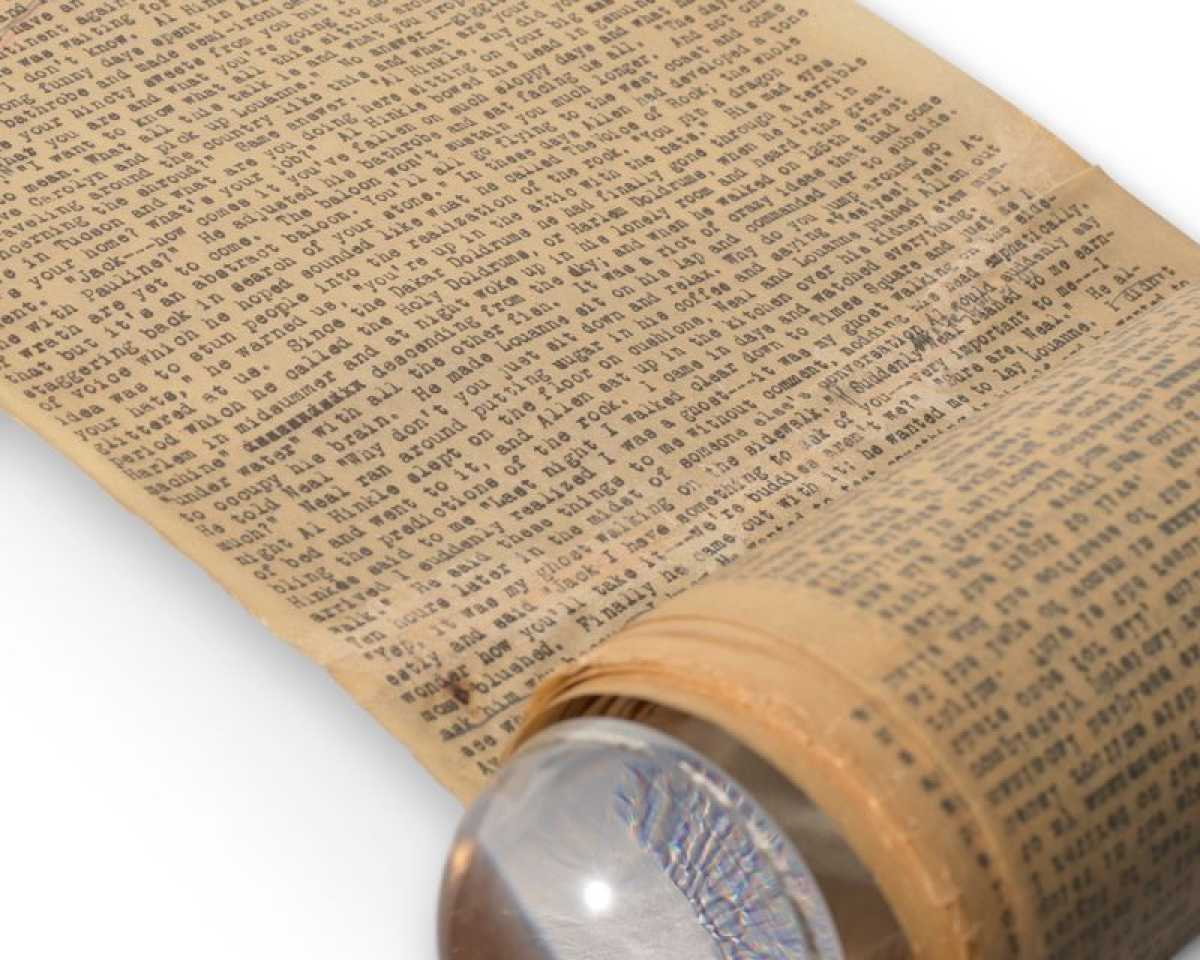
The first major acquisition in Irsay’s collection came in 2001, with his $2.4-million purchase of the original 120-foot scroll for Jack Kerouac’s 1957 novel, “On the Road.” He loved the book and wanted to preserve it, Walker said. But he also frequently lent it out, just like he regularly toured his guitar collection beginning 20 years later.

A scroll of writing.

Jim Irsay purchased the original 120-foot scroll manuscript of Jack Kerouac’s “On the Road” for $2.4 million in 2001.

(Christie’s Images)

Advertisement

“He said publicly, ‘I’m not the owner of these things. I’m just that current custodian looking after them for future generations,’ ” Walker said. “And I think that’s what true collectors always say.”

At its L.A. highlight exhibition, Irsay’s collection held an air of synchronicity. Paul McCartney’s handwritten lyrics for “Hey Jude” hung just a few steps from a promotional poster — the only one in existence — for the 1959 concert Buddy Holly, Ritchie Valens and J.P. “The Big Bopper” Richardson were en route to perform when their plane crashed. The tragedy spurred Don McLean to write “American Pie,” about “the day the music died.”

Holly was McCartney’s “great inspiration,” Christie’s specialist Zita Gibson said. “So everything connects.”

Later, the Beatles’ 1966 song “Paperback Writer” played over the speakers near-parallel to the guitars the song was written on.

Irsay’s collection also contains a bit of whimsy, with gems like a prop golden ticket from 1971’s “Willy Wonka & the Chocolate Factory” — estimated between $60,000 and $120,000 — and reading, “In your wildest dreams you could not imagine the marvelous surprises that await you!”

Advertisement

Another fan-favorite is the “Wilson” volleyball from 2000’s “Cast Away,” starring Tom Hanks, estimated between $60,000 and $80,000, Gibson said.

Historically, such objects were often preserved by accident. But as the memorabilia market has ballooned over the last decade or so, Gibson said, “a lot of artists are much more careful about making sure that things don’t get into the wrong hands. After rehearsals, they tidy up after themselves.”

If anything proves the market value of seemingly worthless ephemera, Walker added, it’s fans clawing for printed set lists at the end of a concert.

“They’re desperate for that connection. This is what it’s all about,” the specialist said. It’s what drove Irsay as well, she said: “He wanted to have a connection with these great artists of his generation and also the generation above him. And he wanted to share them with people.”

In Irsay’s home, his favorite guitars weren’t hung like classic paintings. Instead, they were strewn about the rooms he frequented, available for him to play whenever the urge struck him.

Advertisement

Thanks to tune-up efforts from Walker, many of the guitars headed to auction are fully operational in the hopes that their buyers can do the same.

“They’re working instruments. They need to be looked after, to be played,” Walker said. And even though they make for great gallery art, “they’re not just for hanging on the wall.”

Continue Reading

Movie Reviews

Film reviews: ‘How to Make a Killing,’ ‘Pillion,’ and ‘Midwinter Break’

Published

on

Film reviews: ‘How to Make a Killing,’ ‘Pillion,’ and ‘Midwinter Break’

‘How to Make a Killing’

Directed by John Patton Ford (R)

★★

Continue Reading

Trending
