Entertainment
Prince William makes a surprise BAFTA TV Awards appearance after recent return to public duties

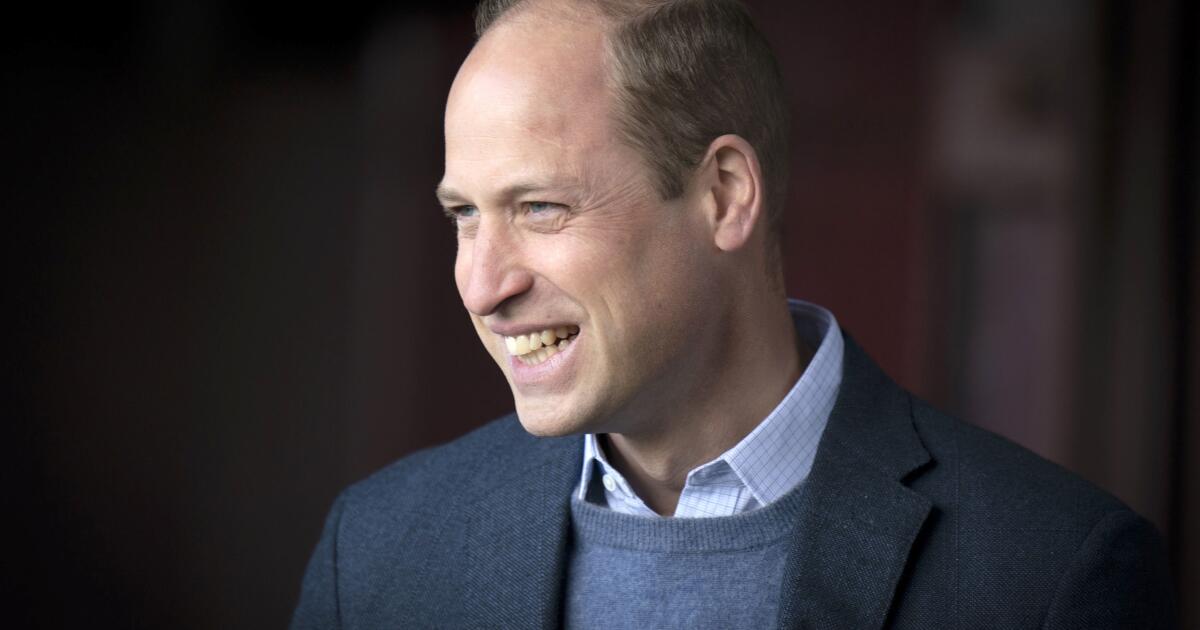
Prince William made a surprise video appearance at the BAFTA TV Awards over the weekend to praise Floella Benjamin, a baroness, for her work with children.
The prince praised Benjamin for her philanthropy, which “supported a great number of charitable organizations [and] tirelessly campaigned for social justice,” according to U.K. outlet the Express.
The baroness, who w as a presenter on British children’s shows such as “Play School,” “Play Away,” “Jamboree” and “Fast Forward,” was receiving the prestigious BAFTA Fellowship, a lifetime achievement award for dedication to the arts.
Appearing in a prerecorded video posted by Hello!, Prince William commended her for her “groundbreaking work with children and young people” as well as her “long-standing commitment” to television broadcasting.
“You remind us of the power of empathy, compassion and action to effect positive change, and I would like to take this opportunity to say thank you,” the prince said. “I’m thrilled that you are receiving the BAFTA Fellowship this evening, and I send my heartfelt congratulations.”
Benjamin was overwhelmed by the praise. “I’ve just been floating ever since,” she told U.K. news service PA Media. “I just can’t believe this wonderful accolade is happening to me.”
William also praised Benjamin for her lifelong commitment to philanthropy: The baroness is vice president of Action for Children and Barnardo’s, both of which work with vulnerable children in the U.K. She’s also a member of the National Society for the Prevention of Cruelty to Children‘s Hall of Fame.
“Beyond the screen arts, Baroness Benjamin has steadfastly advocated for children’s education and welfare, supported a great number of charitable organizations, tirelessly campaigned for social justice — and as a member of the Windrush generation (of immigrants from British colonies) — she has given voice to those who faced discrimination upon arrival in the U.K.,” the prince said.
William appeared without his wife, who is still undergoing treatment for cancer. He returned to public duties in late April after taking time off to help care for her.


So I took my Dad to go and see the new Supergirl movie – and we both loved it;
Kara Zor-El, aka Supergirl, joins forces with an unlikely companion on an interstellar journey of vengeance and justice when an unexpected adversary strikes too close to home.
And when we left the cinema, I broke the News to him that critics had absolutely panned it and predicted it was on its way to being a box office flop;
And my Dad joined me in being totally and utterly baffled by this response, and wondering if we’d just seen a totally different film to the seeming majority of reviewers!?
Oddly enough, a few reviewers banged the same drum asking if Supergirl had come out just as audiences were putting away childish things, like Superheroes;
To that last point; sure Scorsese hates superhero movies, but he also endorses the use of AI in filmmaking calling it “creatively freeing” – so I dunno, if a douche canoe declares superhero movies aren’t “real cinema” but seems totally fine letting broligarchy robots become filmmakers using stolen artwork, does anyone care? No. No we do not.
And mind you too – everyone is excited for the new Spider-Man: Brand New Day (including me, and my Dad) and not decrying it’s come out just as Superheroes are dying. So once again; this seems an odd argument to make.
And then lots also took the opinion that it missed the feminist mark;
I mean … sigh – there’s no real valid points to them, and when Coleman Spilde decries the “infantilisation” of Superigrl in one paragraph (WHAT?!) and then – with a straight-face – writes;
As always, I return to a perfect example: 2004’s “Catwoman.” That film was ingeniously enterprising, weird, stylish, sexy, and most importantly, totally singular. Moreover, it was entirely separate from the character’s source comics, with no mention of Batman to be found. Although “Catwoman” didn’t quite recoup its budget in theaters and was largely reviled among audiences and critics, it looks and feels a hell of a lot more thrilling 22 years on than anything DC Studios has cooked up in the time since.
I’m sorry but I can’t take you seriously. Sit down.
ALSO: the reviewers pointing to a slumped box office as proof that Supergirl is dud are being disingenuous, but few are willing to admit it;
Waner Bros. and DC’s “Supergirl” did the best of the newcomers on Friday, landing in second place with $18 million domestically from 3,602 theaters. Through the weekend, it should collect about $50 million. For context, James Gunn’s “Superman,” which cost $225 million, debuted to $125 million last summer and ended its run with $618 million. “Supergirl” was a bit cheaper to produce at $170 million, but will still need to stick around in theaters to justify the pricetag.
So here’s the truth; Supergirl has a fairly gritty storyline – we follow newcomer, young girl Ruth (Eve Ridley) who witnesses the murder of her parents and sibling at the hands of patriarchal space pirates – the Brigands – and specifically their leader Krem (Matthias Schoenaerts) who struck the killing blows against her kin. Her father was a master sword-maker, so when Ruth is the only one left alive she vows to take her father’s last remaining sword and use it to seek vengeance and kill Krem. She goes seeking a champion to help her in this goal.

But what Ruth stumbles across in the Red Sun galaxy is a bar-hopping Supergirl (played brilliantly by Aussie Milly Alcock) – who is seeking the neutralisation of the red sun to allow her to exist in a boozey state of forgetting … she has her canine companion Crypto, her cousin Kal-El back on the rejuvenating yellow-sunned earth (who she is avoiding) but not much else until Ruth and her problems stumble into her life.
When Crypto’s life is endangered by one and the same Krem, Supergirl reluctantly joins the fight – and along the way discovers that the Brigands trade in kidnapped girls from across the galaxy, to continue populating their all-male line.
Ah.
Suddenly the throughly disinterested Supergirl is drawn into a Shakespearean web of Ruth’s revenge plot, her own desperate three-day bid to save Crypto, and breaking up an inter-galactic slave trade smuggling ring.
It’s definitely got darkness at its centre. And decent enough story-echoes to two more films from established franchises that put female leads front-and-centre in their new outings, and saw great success. Namely; Rogue One which has the avenge-my-family subplot similar to Ruth’s, and Mad Max; Fury Road for the rescued brides of pirate psychopaths plot.

Along the way Supergirl and Ruth bump into Lobo (Jason Momoa) who is seeking his own bounty from one of the heads of the Brigands. He’s not so interested in helping Ruth and Supergirl in their loftier ambitions, but proves a useful hammer when their fights align;
![Film/TV] New LOBO Character Poster for SUPERGIRL : r/DCcomics](https://i0.wp.com/substackcdn.com/image/fetch/$s_!vAcc!,w_1456,c_limit,f_auto,q_auto:good,fl_progressive:steep/https%3A%2F%2Fsubstack-post-media.s3.amazonaws.com%2Fpublic%2Fimages%2F39e348f6-fa86-46af-a788-9f7299e9b9be_1080x1440.jpeg?ssl=1 "Film/TV] New LOBO Character Poster for SUPERGIRL : r/DCcomics")
Overall I found the plot to be quite moving and decently big enough in scope. It’s hard to watch and not see connections to the here and now – that no matter the planet or galaxy, women and girls are traded and abused at the hands of men;
Why shouldn’t Supergirl but a version of this story front and centre?
James Gunn’s 2025 Superman raised similar lines of enquiry about the echoes to modern conflicts to be found in its fiction;
That last one undoubtedly hits closest to the truth – but it’s still an interesting practice on how Art is Indeed Political, and amazingly when you give audiences colonial war-mongers as villains they’re going to see parallels to real-world apartheid and genocidal states, whether studios wanted them to or not.
I am not the biggest Superman fan, truth be told. But I did really enjoy David Corenswet’s 2025 take (and far more than all of the Zack Snyder’s poorly written nonsense … I mean; MARTHA!! – really? Dud).
Superman has always been a little too cheery and optimistic for me. I far more gravitate to Batman (millionaire he may be, eat them!) and Chris Nolan’s films remain the definitive superhero franchise for me – especially because they lean into violence and a more Jekyll-Hyde struggle.
I am probably also more of a Marvel gal (X-Men and Kitty Pryde being my definitive favourites of all time!) and again – I think there’s more complexity and shades of light and dark to be found there, that I am more drawn to. I am a millennial child raised on the X-Men cartoon and The Dark Phoenix Saga in particular, really shaped my comic-book/superhero arc outlook.
So I was pleasantly surprised to find more grit and dark in this 2026 Supergirl, and new dimensions to the character whom I’d last encountered in the squeakier CW universe (which only tangentially touched on domestic violence against women, when its star –Melissa Benoist – admitted to her own experiences in an abusive relationship, with a fellow actor on the CW show).
Superman is a tale of immigration, and always has been – Superman is a refugee;
Critically though; Superman migrated to America and found asylum with the Kent family, as a baby. He has little to no memory of Krypton, only the acquired memories of his parent’s imperfect messages in his Fortress of Solitude.
Supergirl is not the same – as she explains in the film; “Krypton did not die in a day, the Gods are not that kind.” She was born eight years after Krypton’s core could not sustain the planet anymore. Her uncle and Kal-El’s father sent Superman away immediately as the planet started to disintegrate, but Supergirl’s own father was instrumental in creating a forcefield around the city to sustain it while the rest of the planet fell away. Supergirl was born in a domed and doomed piece of the Krypton planet, and it was only in her teenage years when her father admitted this bandaid-on-a-bullet-wound was unsustainable, that he sent her away to Earth, to follow her cousin to safety and a new life. In this, there’s of course allusions to climate catastrophe that any viewer can – and should – relate to, living on a similarly dying planet.
Supergirl did not want to leave though, because that dying planet was all she had ever known. It was home. Imperfect as it was.

She is the embodiment of a different refugee and migration story. She is closer to the Warsan Shire poem;
you have to understand,
that no one puts their children in a boat
unless the water is safer than the land
That’s Supergirl’s experience.
She does not integrate into Earth as seamlessly as Kal-El. She is not the perfect refugee, desperate to assimilate.
How interesting, that we’re having these ridiculous conversations in Australian politics – prompted by that feckless and cruel bootlicker, Pauline Hanson – about migrants assimilating. A deadening and dulling of their culture to a ‘mono’ smooth-brained nothingness of acquiescence to an ill-defined “Australian” identity.

I found Supergirl’s struggles refreshing, in this light. She is not the perfect immigrant – there is no such thing. She struggles with Superman’s goodness and wholesome Kansas-boy persona, his Clark Kent assimilation that she cannot relate to or emulate. She carries the death and destruction she witnessed on Krypton with her, the grief for what she left behind – all that she had ever known. It has shaped her in a way that Superman wasn’t similarly moulded, and so she feels alone and lonely. One of two surviving Kryptonians and one of them has no memory of what they even survived.
This is fascinating to me, and brilliantly wrought in the film.
Especially for how Supergirl sees in Ruth a similar yearning for a place that no longer exists, and she can never go back to … a place before her family was murdered. Ruth is hellbent on vengeance to try and cure her of her grief, but Supergirl knows all too well that nothing can change the past.
I loved it.
My Dad loved it.
Milly Alcock was brilliant – snarky and ragged, but a girl willing to go to great lengths for her dog (hard relate).
Maybe the character of Krem was rendered in costume and design a little too Mad Max, and lost some of the comic-book commentary around him just being an ordinary-looking guy bordering on dastardly dashing pirate; maybe keeping him looking so norm-core would’ve added to commentary on bad men looking completely ordinary as opposed to the villainous ball-bearings-embedded-in-his-forehead version of the film? But I’m honestly not that mad at it.
I thought it was suitably dark in places, funny in others, with tough but necassary commentary on the safety of women in every galaxy. A film for young girls to come to and appreciate, but equally millennial me and my younger boomer dad also got a lot out of it.
5/5, frankly – and now I am keen for a Superman and Supergirl pair-up movie, as these two refugees swap light and dark and learn to live in the imperfect complexity of their migrant stories.

A Hollywood portrayal of OpenAI Chief Executive Sam Altman portrayed by actor Andrew Garfield will be released later this year, after Amazon MGM Studios dropped the movie.
“Artificial,” which chronicles Altman‘s 2023 ouster from OpenAI and his reinstatement as CEO, was acquired by Neon, the studio announced Tuesday.
“The acquisition underscores Neon’s commitment to partnering with visionary filmmakers, and bringing ambitious cinema to audiences around the world,” the studio said in a statement. “Artificial will compete in this year’s Oscar race.”
The film has a critical take on artificial intelligence, according to three sources briefed on it who declined to be named. That portrayal caused Amazon to want to distance itself from the film, given the company’s $50 billion investment in OpenAI, two of the sources said.
Amazon declined to comment on the claims. In a statement, the company said it has “the utmost respect and admiration” for the movie’s director Luca Guadagnino. “We believe that ‘Artificial’ will be better served if it were released by a different studio and are working closely with the filmmaking team to find the film a new home,” Amazon said.
The deal was negotiated by Neon, CAA Media Finance and Amazon. CAA and Amazon declined to comment. A Neon spokesperson did not immediately respond to questions regarding the financial terms of the deal.
Puck News first reported Amazon dropping the movie.
Other studios, including Netflix, A24 and Focus Features, screened “Artificial.” Netflix and Focus passed on the film.
Amazon’s decision to drop the film comes at a time when Hollywood is grappling with the growth of artificial intelligence. Some creatives are concerned that the technology could displace jobs; others worry that their likenesses are being used to train AI models without their permission or compensation.
Meanwhile, many AI companies are eager to work with studios, saying their AI tools can help speed processes and reduce costs.
To foster more nuanced discussions about artificial intelligence, Google is collaborating with talent management firm Range Media Partners to develop films that present a less dystopian view of the technology.
Amazon passing on the film raises questions about whether tech company-backed studios would be willing to release movies that are critical of innovations in which they have a stake. It could create a chilling effect, said Robert Thompson, director of Syracuse University’s Bleier Center for Television and Popular Culture.
“The chilling effect could not only be on films critical of AI, they could be on films critical of all kinds of things that these companies have their tentacles in,” Thompson said.
Stories about tech company founders can be attractive to audiences, most notably with the 2010 film “The Social Network” about the founding of Facebook. That film earned $225 million worldwide at the box office, according to Paul Dergarabedian, head of marketplace trends at Rentrak. “The Social Network” came out a time when many people were talking about Facebook and had big talent behind it, including director David Fincher, Dergarabedian said.
“Neon is a perfect custodian for this film, and they will shepherd it to the big screen, I think very effectively,” he said. “They’re very filmmaker-centric … I think they found the perfect home with Neon.”
“Artificial” features major talent, with actor Monica Barbaro portraying former OpenAI Chief Technology Officer Mira Murati, and Ike Barinholtz as Elon Musk. Other actors include Jason Schwartzman and Billie Lourd.
Director Guadagnino has worked on films including “Challengers” and “Call Me By Your Name.”
Staff writer Samantha Masunaga contributed to this report.

While a bit hollow as a character study, painting with broad thematic brushstrokes that often keep its hero at a distance, Young Washington is a compelling historical drama, with a grandiose scope that is rare in Hollywood, and an inspirational story befitting of America at its best.
About the Film
It’s trendy for Hollywood to disparage the United States with films that highlight how the country has fallen short of its lofty ideals (and the beauty of American liberty is that such critical self-reflection is possible). Last year’s One Battle After Another was the darling of the Academy Awards with such a tale. But this Independence Day, and in celebration of 250 years as a nation, audiences can be reminded that (like the men who founded it) America may be imperfect, but the American spirit is a noble and beautiful thing worth fighting for. Young Washington is the origin story, not just of one of those brave Founding Fathers, but of the patriotic spirit and noble values they inspired. While a bit hollow as a character study, painting with broad thematic brushstrokes that often keep its hero at a distance, Young Washington is a compelling historical drama, with a grandiose scope that is rare in Hollywood, and an inspirational story befitting of America at its best.
Director Jon Erwin (House of David, I Can Only Imagine) again proves to be one of the best all-around storytelling talents in Hollywood right now, faith-based or otherwise. Produced and distributed by Angel and Wonder Project, the film is among the most ambitious projects to emerge from the new wave of faith-based entertainment, even if Young Washington isn’t explicitly “faith-based” in a rigid sense. When I interviewed screenwriter Diederik Hoogstraten, he aptly referred to the storytelling approach as “values based.” It may not be a gospel-preaching cinematic tract (and it’s the better for it), but Christians will find plenty to affirm and celebrate here.
If we do count the film among the “faith-based” genre family, then it’s easily a peak achievement. It’s a visually beautiful and well-crafted film. For as good as the modern faith-based genre has become, few movies have warranted a theatrical viewing, being built more on wholesome narrative than visual spectacle. In contrast, seeing Washington gallop on a horse as cannon fire and the pandemonium of battle rages all around him is a full-blown cinematic experience that has rarely been achieved in the genre – other than perhaps Erwin’s own The House of David.
Young Washington is solid from start to finish, but it never fully soars. The film is more interesting than engrossing; good in most areas, but never quite great at any one of them. The clearest comparable, due to the subject matter, is perhaps Mel Gibson’s The Patriot (2000). Historical inaccuracies aside, that film packed a cinematic punch of action, spectacle, and emotional storytelling. Young Washington offers the first two but lacks the third. It’s a story that appeals more to the head than the heart, historically informative, but not making me feel much toward the story.
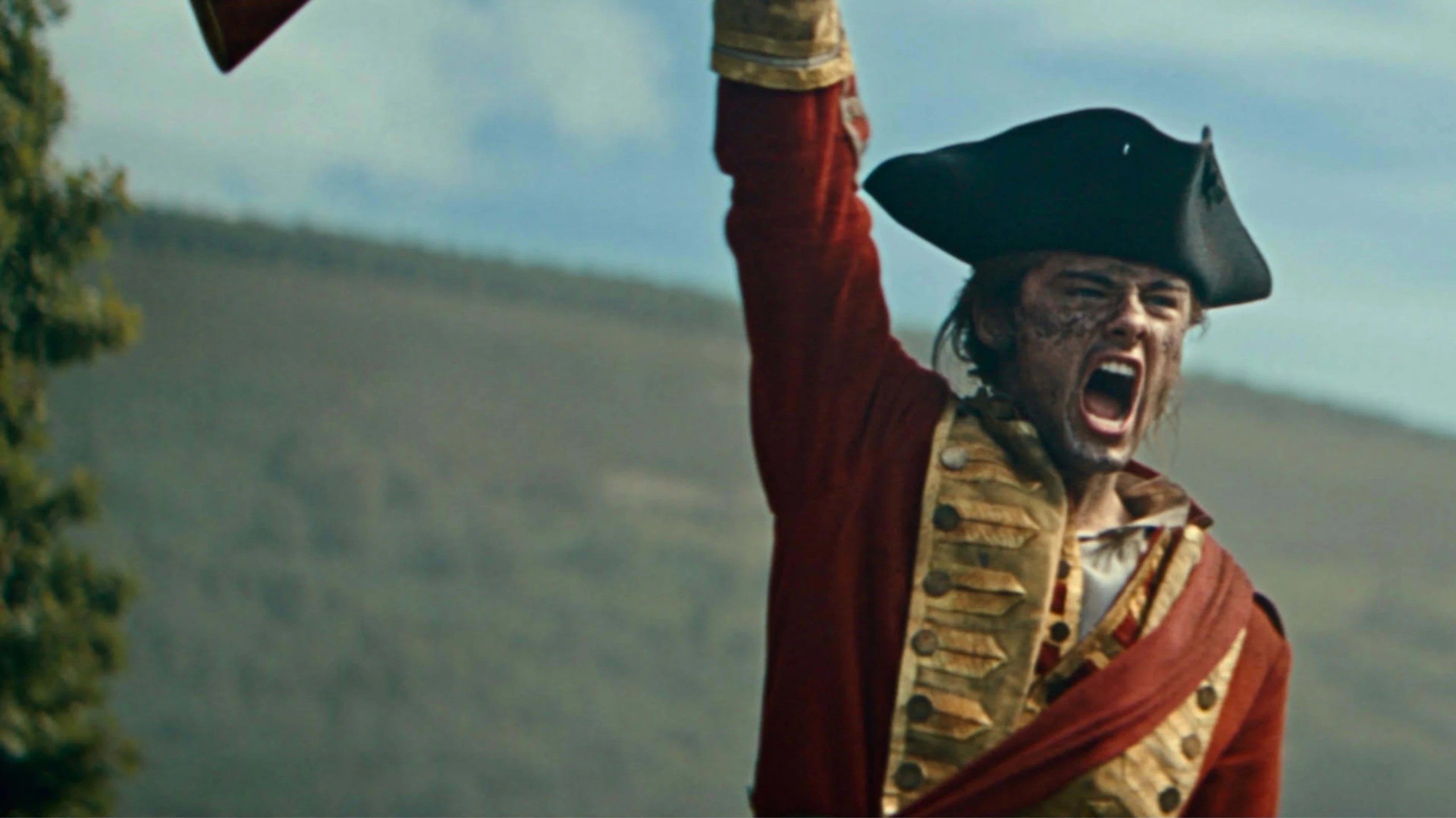
The creative decision to focus the story on a limited, formulative period of Washington’s early life shapes the film in significant ways. Many biopics fall into the trap of dutifully checking boxes, adapting a Wikipedia page more than unfolding a character journey. There’s still some of that with Young Washington, but the limited parameters lend the film a greater sense of focus and an opportunity to breathe. It feels like a story about something more than just putting historical events onto the movie screen.
At the same time, the film also feels like “part one” of a larger story, or a prequel for a film that doesn’t yet exist. The story seems constantly building toward something but then ends on the cusp of reaching it. Perhaps a future sequel is in the cards (although Middle Aged Washington doesn’t have the same ring to it), but the climactic pay off feels lacking. Interestingly, while the movie remains largely historically accurate (as far I can tell), the climactic final battle is more positively framed as a sort of inspirational victory, even when the historical battle was a crushing defeat. It’s perhaps an attempt to manufacture a thrilling third act resolution for a historical figure who was still only in the “first act” of his life. The decision mostly works, and that final battle is the film’s greatest triumph, but the story overall, as told, feels incomplete.

Also notable is that despite the intentionally patriotic release date, and centering on George Washington—arguably the American hero—the “Young” part of the film’s title means that the story pre-dates the revolutionary war. It sees Washington spend the duration of the runtime as a proud officer in the British army. Not quite the patriotic celebration the marketing has promised. Beyond existing knowledge of the historical significance of the protagonist, there is no real “America” at all, beyond a focus on his Virginian regiment, and some hints at the “American Spirit” that would one day define the nation (see themes below).
The fact that it has taken until the end of this review to discuss the character of George Washington himself is also telling. Unfortunately, he is the least interesting part of the film. The fault is not with actor William Franklyn-Miller, who does an admirable job. The problem is with the characterization. Washington has understandable motivations and inner conflict, but they are approached more from the perspective of an outside observer, rather than getting into his own headspace (we are told about struggles but rarely feel his turmoil). The film doesn’t probe deep enough into the root causes of these struggles, or the causes of his insecurity and drive for greatness. I left the film having learned about the events his early life, but without a better understanding of him as a man.
In the end, Young Washington boasts enough entertainment and quality filmmaking to please audiences. It’s a high floor, low ceiling type of film. There are no moments where the film fails to deliver consistent quality, but it just never seems able to achieve anything more. It’s good, but not great, which is something rarely said of George Washington himself. Still, I enjoyed it, and in retrospect, its legacy may be more for how it paved the way for the genre to enter a brighter future. Come to think of it, that sounds befitting of George Washington after all.
On the Surface
For Consideration
On the Surface—(Profanity, Sexual content, violence, etc.).
Language: There are three minor profanities (“d—” x2, “b—ard” x1).
Violence: There is plenty of wartime action, including men shot with rifles and cannon fire, although the action remains relatively bloodless. The most extreme violence comes when a man is hacked with an axe, although it is more implied than depicted on screen.
Sexuality: None.
Beneath The Surface
Engage The Film
The Makings of a Leader
George Washington was a larger-than-life person. By the end of the film, he is depicted as a near mythic figure (although, the scenes are adapted from details provided by several Pulitzer Prize winning biographies, so sometimes real life really is a Hollywood story). But one of the film’s central ambitions, and one emphasized in my interview with the screenwriter, is to humanize that mythical figure.

Early in the film, he is not necessarily even very likeable at times. He is stubborn, and his deep insecurities manifest as the appearance of pride and arrogance. His poor choices and refusal to heed wise counsel, such as the defeat at Fort Necessity, lead to serious consequences. Many biopics are hagiographical (such as the recent Michael), but Young Washington demonstrates the biblical truth that all men have sinned and fallen short of God’s standard (Romans 3:23). It answers the age-old question by suggesting that great leaders are not born great, they must become great.
In an early scene, George and his mother argue about their unfavorable circumstances. George’s mother wishes for her deceased husband back, but says, “Providence denied me this.” George responds, “Then providence is cruel!” His mother eventually counters, “God raises what is well grounded.” That exchange represents the heart of the film. We cannot control our circumstances, but we can shape our character (and allow God to shape it) to respond to them. As one character says, “Failure is the tutor sent by God.” Washington lacks the status and social advantages of others, and at first, he attempts to take it into his own hands to rise to prominence. Ultimately, after great failure, he learns that it is through humility and service that he can be used to do great deeds (Matthew 20:16). Interestingly, at the end of the film, even the pagan Indian tribes recognize God’s anointing on Washington’s life.

-

 Texas2 minutes ago
Phoenix Merchant Partners and Texas Capital Alternative Asset Management Form Strategic Relationship
-

 Utah5 minutes ago
Therapy dogs offer a welcome break for firefighters battling Utah’s Iron, Cherry fires
-

 Vermont10 minutes ago
She moved from Paris to Vermont and found her ‘dream job’ opening a bakery – The Boston Globe
-

 Virginia17 minutes ago
Reopening date set for Virginia Creeper Trail after months of work
-

 Washington20 minutes ago
Colorado Democrats punish Washington ties in primaries
-

 Wisconsin25 minutes ago
Missing Wisconsin teen Joniah Walker found safe 4 years after disappearing from home
-

 West Virginia32 minutes ago
Transmission line proposals raise ratepayer cost concerns in West Virginia
-

 Wyoming35 minutes ago
Wyoming Department of Health warns of scam callers using official phone number

