Entertainment
Meet the Netflix executive responsible for your recommendations


LOS GATOS, Calif. — There’s no red carpet for people who make sure Netflix provides an appealing user experience; no Emmy or Oscar for an app that gives you the right recommendations for what to watch next.
But those functions, when working correctly, are an advantage for Netflix in the streaming wars. Chief Product Officer Eunice Kim is the executive in charge of overseeing much of what makes Netflix tick — such as incorporating new features into the streaming service including live events, ads and mobile games.
Her team analyzes consumer behavior on Netflix to determine which shows and movies could excite viewers next on the streaming service and makes sure that the viewing experience is smooth. As such, she’s among the most important Netflix executives you’ve probably never heard of. That comes with the territory of being the person making sure Netflix is a seamless product, one of the most underappreciated aspects of the streaming wars.
“We make it look easy, but it’s not actually that easy under the hood,” said Kim. “If we’re doing our jobs, we shouldn’t be talking about the product all that much, but it should be working for people.”
Kim, who was promoted to the role in October, joined Netflix in early 2021. She previously served in product management roles at Google Play and YouTube. She grew up in Fremont, Calif., where her dad launched a startup out of their garage and she soldered motherboards. When she’s not looking at screens, she enjoys gardening.
She spoke with The Times in an interview at Netflix’s Los Gatos headquarters. This conversation has been edited for length and clarity.
How do you see the Netflix product experience evolving as the company adds different types of content, like games or live events?
These new content types require us to really evolve the experience that lives today. We like to joke that our current homepage experience on TV is about 10 years old. That doesn’t mean we haven’t done tremendous amounts of work to improve it over time. But at its core, it’s remained the same and it really was built and designed for a streaming video-on-demand service. Every facet of how we’ve arranged everything anticipates an on-demand video experience.
LOS GATOS, CA – JAN 11: Eunice Kim, Netflix’s Chief Product Officer, is photographed at the Netflix offices in Los Gatos, CA on January 11, 2024.
(Benjamin Heath / For The Times)
Live TV is like, “Hey, everyone gather on the couch now and watch it now,” right? So the signals we send to people [to tell users] now’s the time to gather are super important. In games as well, the content engagement and pattern is very different. You can play the same game for a few years, if you’re really into it.
You’ve said Netflix users on average watch six genres. How do you anticipate what people are feeling like watching?
We want to pay attention a little bit more closely in real time to the way that you’re browsing the service, so that we can interpret that a little bit faster. For example, you dwelled a little bit on this trailer — that’s maybe of interest. We’re really just trying to make sure that timeliness is built a little bit more deeply into the way that we understand your needs.
To some extent, familiarity breeds interest. Like the first time you see something, you may or may not be paying attention, then you hear about it through word-of-mouth, maybe there’s an L.A. Times critic’s review that you saw, you see a TikTok video on that title, there’s the billboard that’s on Sunset Boulevard. So it may be all of those things lead up to some degree of interest for a title.
Let’s use an example to explain how the recommendations work. Like, say, the sci-fi movie “Rebel Moon.”
The very simple signals for us are that you are watching more content and that you’re showing us that you enjoy it, meaning that you finish the whole movie or you give it a thumbs up at the end. When we think about the categories that help us decide what we like, there are a couple of things we look for, including your past viewing behavior. Is “Rebel Moon” similar to other kinds of content that you watch on the service? Or you watched the trailer twice, or you added it to your list or you opened the email about “Rebel Moon.”
And then there’s what tells us how we know that “Rebel Moon” is a sci-fi movie. It sounds very basic, but when you have thousands of titles on the service, how do we classify that? Sci-fi is a broad category. “Dune” is a very different flavor from “Rebel Moon.” So the precision of our understanding of the content at what we call the metadata level also helps us understand the content similarities.
How does user behavior and data affect what trailers or promotion we see for Netflix content?
The way we present each title can be slightly different for each person. We might be playing up the angle about the race car drivers being part of a live event like “The Netflix Cup,” or the golf players being part of it because we think you’re going to recognize the face because we know that you watched “Formula 1: Drive to Survive.” Of course, not everyone who watches Netflix will be interested in a given event. We want to make sure we reach the right people. If we’ve never seen any indication that you have any interest in sports, it’s unlikely that we would put that in front of you.
How many different trailers are there for each show or movie?
For our bigger titles, we might have up to six on average.
There was a technical issue with the reality dating show “Love Is Blind’s” live reunion in April, which was one of Netflix’s early efforts in live programming. How has Netflix improved its livestreaming capabilities since then?
That was definitely a humbling moment for us. We definitely took stock and asked ourselves, what can we do better? We’ve really mainly just been focused on improving our technical capabilities and our operations behind this and are super excited about the way that we were able to pull off “The Netflix Cup” and more recent live events that we’ve had on the service. So we’re feeling pretty good, that we’ve learned from that and evolved from it.
In any complex technical system, there can be any number of things that go wrong, right? There’s never a world in products and tech where there are no mistakes. That’s just not possible. So really the name of the game is how quickly did you catch your mistakes and fix them? That’s half the battle in our world.
How is Netflix working to improve the experience for gamers? For example, on the mobile app, gamers still need to download the games via the Apple and Google app stores first, rather than have it be instantly playable on the Netflix app.
Downloading from the app stores is something we do because those are the policies that we abide by in partnership with Google and Apple. We try to make that discovery as simple and seamless as possible. I think about one feature we’re particularly proud of that made this easier for our members. If you’re on your iPhone and you find a game, we have what we call a “bottom sheet experience.” [It] just kind of slides up, and you can just press “install,” and that installs without landing you in the app store. That had a really nice bump in impact in terms of making that experience easier for our members.
Netflix has expanded the number of games it offers. Are games driving engagement?
We’re at almost 90 games right now. We’ve been very pleased with the progress we’ve made and met the goals that we had for 2023 around engagement.
How did you get interested in this type of work?
My dad did a classic hardware startup out of his garage. So from a young age, I learned how to solder motherboards and inventory microchips and would write marketing materials for COMDEX, which was the big computer trade show back then.
Discussions about technology and reading sci-fi were part of my family upbringing. It was ironic that I ran away to the East Coast for college to be a writer because I was just so tired of the tech-speak, but it drew me back because there’s something really profound about the way that technology can enable our lives and bring us joy. It can also bring us misery if we’re not careful. I think finding that right balance is super important.



Watch Psycho Killer on VOD now
Psycho Killer was directed by Gavin Polone, who has produced a lot of amazing genre movies. These include Stephen King‘s Secret Window (2004), Cold Storage, and Zombieland: Double Tap, while also having produced projects in various other genres. As a director, this is his feature film debut, and I’m sorry to say I think this is the main issue of the finished product.
I say this because the screenplay was written by Andrew Kevin Walker, who also wrote Se7en. Much of what I liked initially about Psycho Killer feels like classic Andrew Kevin Walker, so I’m hesitant to truly believe the story is bad. After all, the iconic Seven could also have been a very strange experience if not directed by David Fincher.
For the record, Seven is far from the only successful script by Andrew Kevin Walker. He also wrote Brainscan (1994), Hideaway (1995), 8MM (1999), Sleepy Hollow (1999), The Wolfman (2010), Windfall (2022), and The Killer (2023). In other words, he is very far from being a one-hit wonder.
I don’t want to recommend that you skip this movie, because the first half of Psycho Killer shows what a brilliant serial killer horror slasher this could have been. So watch it, and try to prepare yourself for an ending that does not live up to that strong opening.
Psycho Killer is out on digital from April 7, 2026.
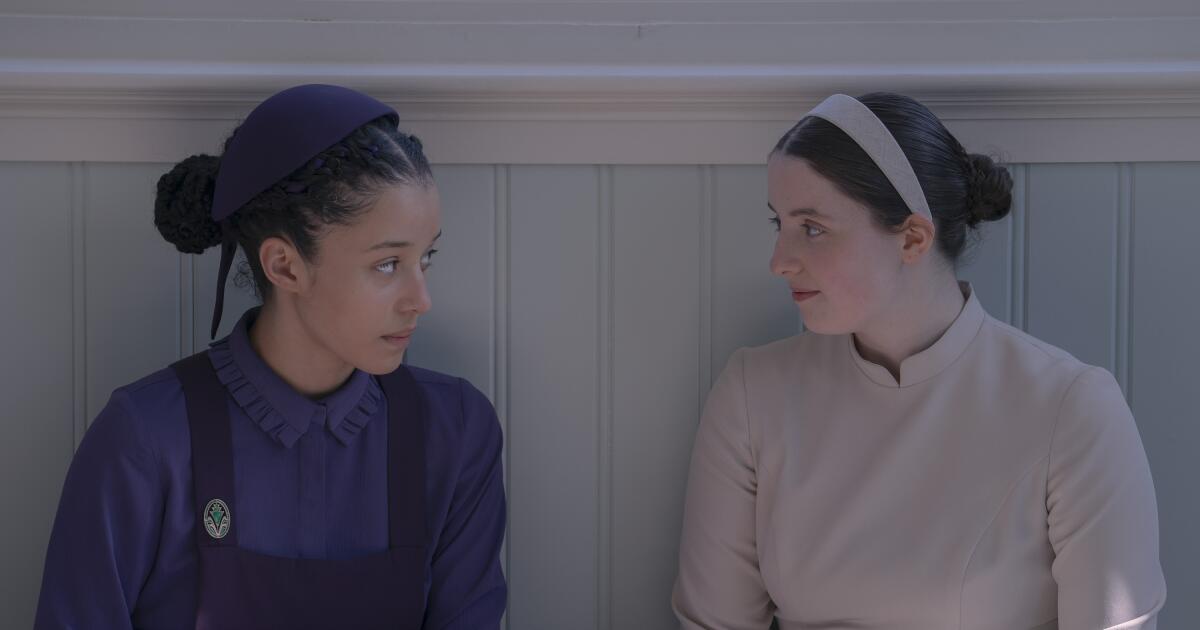
When the Hulu adaptation of Margaret Atwood’s “The Handmaid’s Tale” premiered during the early months of the first Trump presidency, it was seen by many as a timely prophecy — the crimson cloaks and white bonnets of the story’s eponymous sex slaves became a symbol of protest against a president who, though not a religious man himself, embraced many policies supported by the far-right Christian minority, especially those regarding the reproductive and civil rights of women.
This was not the plan, of course, or at least not as regards the Trump factor. The book was written in 1985, the show greenlit long before Trump became president, which only proves the grim resilience of Atwood’s themes. So it shouldn’t be surprising that the sequel series, “The Testaments,” also has name-specific cultural resonance. Plum-cloaked in a YA-leaning, high school drama that owes as much to “Pretty Little Liars” or “Gossip Girl” as it does to “The Handmaid’s Tale,” “The Testaments” gives us an apocryphal version of the Epstein files.
Based on Atwood’s 2019 Booker Prize-winning novel, “The Testaments” takes place some years after the final events of “The Handmaid’s Tale” series and revolves around Ardua Hall where Aunt Lydia (Ann Dowd), having regained her Gileadean status, oversees the instruction of young women as they prepare to take up their lives as obedient wives and, Under His Eye, fruitful mothers.
Agnes (Chase Infiniti) is our initial central character and narrator. Though we know from her backward-looking tone that change is coming, her initial main worries are her mean stepmother and when (or if) she will finally begin to menstruate. She and her friends — Becka (Mattea Conforti), Shunammite (Rowan Blanchard) and Hulda (Isolde Ardies) — have all graduated from the “Pinks” (little girls) to the “Plums” (young women) but only Becka has achieved the “blessing” of menarche, which means she can now be chosen by an unmarried (or widowed) Commander or other man of lesser rank.
This particular form of reaping occurs midway through the season at a dance where all the eligible girls meet with all manner of young bachelors, only to discover that the oldest and most powerful members of the elite get first choice. Watching as the men joke among themselves before staking their claims, it is difficult not to think of Jeffrey Epstein parceling out young women to his powerful male friends (albeit not for marriage).
Though touched on throughout “The Handmaid’s Tale,” the horrifying connection between status and the systematic procurement of women is the sinister force that drives “The Testaments.” A global infertility crisis may have been the catalyzing force for Gilead’s rise but this “privilege” of power is not about repopulation; Agnes and the Plums are simply victims of sexual grooming taken to its pathological conclusion.
Becka is the only one who is less than thrilled by her “prospects” — everyone else, including Agnes, can hardly wait to be married off and, with any luck, quickly become pregnant (not that they know anything about sex, forced by the state or otherwise).
Having been raised in a beautiful home with no material wants, Agnes knows little about the outside world. Like most women in Gilead, she is not allowed to read or write, and she and her friends coolly accept public executions, torture and other means of corporal punishment as the inevitable consequence of breaking any of the many rules drilled into them. They accept that their bodies are instruments of the devil designed to compel men to commit lustful acts and that they are responsible for ensuring that this does not happen.
Ann Dowd reprises her role as Aunt Lydia in “The Testaments.”
(Russ Martin / Disney)
But girls will be girls and even under the stern eye of Aunt Vidala (Mabel Li) and the more kindly countenance of Aunt Estee (Eva Foote), they tease each other and romp together, compare hairstyles and trade snarky comments about the Aunts as they dream of a happy ending.
In its own way, that’s even more chilling and resonant than the horrors of “The Handmaid’s Tale.” Enslavement will always require some level of violence, but violence tends to spark rebellion — indoctrination is always more effective. Training people to believe they are fated, or even happy, to live without freedom, rights or real choice is the only way a totalitarian society can survive.
Showing this is far less exciting than the images of grown women being killed or stripped of their rights as presented in “The Handmaid’s Tale” (though “The Testaments” does offer a few very chilling flashbacks). But as social commentary, it’s difficult to beat the sight of young women, recognizable in so many ways as modern teens, complying with their own enslavement, out of ignorance and, as events proceed, the gut-wrenching fear of what the truth might mean.
Gilead’s future hangs on whether the Plums remain ignorant and compliant, as does the story of “The Testaments.” Agnes may not share Becka’s unhappiness with forced marriage, but she is soon given other things to worry about, including a growing attraction to one of the Eyes who guards her and a request to mentor one of the school’s new “Pearl Girls.” These young female missionaries, dressed in white, have been sent into Canada to draw girls to Gilead’s cause. Among the recruits is Daisy (Lucy Halliday), who Aunt Lydia puts under Agnes’ care.
Shunammite, the sharpest-tongued of Agnes’ friends, is convinced Daisy is a spy. Daisy, whose backstory includes, in the first episode, a brief glimpse of Elisabeth Moss’ June, certainly upsets things, most often by reacting to Gilead’s penchant for public atrocities the way a non-sociopath outsider would.
Over the course of the season (upon which many, many plot-point embargoes have been placed), Agnes and Daisy form a bond that threatens Agnes’ worldview, as well as her friend group. The novel “The Testaments” is a much larger and more complex book than “The Handmaid’s Tale.” Each are presented as historical records of a government long gone, but where Bruce Miller, who adapted both, had to first spin a series out of “The Handmaid’s Tale’s” relatively short and fairly elliptical story, he has much more to work with here.
He does so carefully, and perhaps a tad too slowly. Much of the first season is spent getting to know the girls, especially Agnes (whose pre-Gilead identity is obvious to anyone who read or watched “The Handmaid’s Tale.”) Coming off her Oscar-nominated performance in “One Battle After Another,” Infiniti masterfully conjures the rigorous placidity of a young woman so accustomed to holding herself in check she has a hard time recognizing the difference between her mask and her real self.
Her friends share the same disability, though to greater and lesser degrees. As their characters, Conforti, Blanchard and Ardies, deftly carve out discrete personalities beneath their plum-colored homogeneity, each playing a role that is, in turn, playing a role while also remaining desperately human.
Halliday as Daisy is the rawest nerve among them, but all the main characters, including the Aunts, are people trapped inside uniforms and all allow their intelligence to shine through state-imposed ignorance, embodying both the tense acceptance of indoctrination and the disorientation that strikes when it begins to crack.
Dowd, of course, is next level. Compressing and occasionally revealing all that she has been through in “The Handmaid’s Tale” and before, what she manages to make Aunt Lydia is both Dorian Gray and his portrait. What exactly Aunt Lydia is doing by handing Daisy into Agnes’ care is not made clear but she is obviously doing something.
Both “The Handmaid’s Tale” and “The Testaments” were written as historic documents gathered from a fallen regime; it doesn’t break any embargo to say that at some point Gilead will fall. Whether that fall begins, or occurs within, the action of “The Testaments” remains to be seen.
But we all know what happened to Epstein in the end.

On August 13, 1982, Universal released teen comedy Fast Times at Ridgemont High in theaters, marking the directorial debut of Amy Heckerling from a screenplay by Cameron Crowe. The film, featuring a breakout performance from Sean Penn, would go on to become a cult classic. The Hollywood Reporter’s original review is below:
Fast Times at Ridgemont High has it all Pac-Man, pizza, cruising, cursing, rockin’, rollin’ enough to keep even the most “totally awesome” teen tuned in all the way. And, given the recent success of almost every zany adolescent film, Fast Times should easily pull in its share of youngsters. What separates this Universal release from the pack, however, is its warmth. It may be a film about kids, but it’s for adults who have not forgotten what it’s like to be a kid.
Fast Times follows six teenagers through one year at Ridgemont High, clocking every escapade, from ordering a pizza for arrival during U.S. History to boyfriends and unwanted pregnancies. Screenwriter Cameron Crowe has adapted his bestselling book quite well, keeping a very personal perspective (Crowe actually went back to high school before writing the book, posing as a student for a year as research). Amy Heckerling, in her feature debut, has proven herself to be a truly gifted director, able to tickle the ribs with one hand while the other tugs at the heartstrings.
Although the high school setting might at first brand Fast Times as another Porky’s spin-off, the film stands on its own. If comparisons are to be made, they might better link Fast Times with the intimate portrayal of ’50s teens in American Graffiti. Both Graffiti and Times delve beneath the surface of their characters, showing in the process that teenagers haven’t changed all that much. They just quit cruising the main drag with Elvis. Now they “check out” the mall to the beat of the Go Go’s.
The cast approaches the picture with a delightfully devil-may-care sincerity, playing off of one another with a simple ease. It is these characterizations, as written by Crowe and under the skillful eye of Heckerling, that give the film its charm. The most flamboyant in his characterization is Sean Penn as Spicoli, the bleached-out surfer with the permanently blood-shot eyes and a half-smile pinned to his cheeks. Penn provides the wilder moments at Ridgemont High, and to his credit, never dropped the reality of his character in going for a madcap laugh.
Judge Reinhold’s Brad also adds consistent comic edge to the picture with his sad eyes and fast food attitude. Robert Romanus, as Damone, would scalp Ozzy Osbourne tickets to his grandmother, and yet deftly treads the tightrope between cockiness and desperation. Phoebe Cates play the nymphette Linda to the hilt, showing only now and again the lost little girl inside. Jennifer Jason Leigh, as the freshman with a lot to learn, proaches her Stacy with the most even of keels. Her performance, although quite natural, tends toward the monochromatic. Brian Hecker, as the would-be beau, has little to do other than proffer an embarrassed smile. Veteran actor Ray Walston, as the history teacher, plays a sour-pussed straight man to the constant shenanigans of Spicoli.
Music plays an important role in Fast Times, offering an ambience that varies from “Oingo Boingo” to Jackson Browne. Although the likes of the Go Go’s and the Cars are present at times, the soundtrack as a whole seems too staid to provide a backdrop for ’80s kids kicking around in the heyday of punk. Other technical credits include the fine work of Dan Lomin whose art direction gives the Sherman Oaks Galleria an intimacy it has never known. — Gina Friedlande, originally published on Aug. 11, 1982.

California Supreme Court halts GOP sheriff’s voter fraud investigation

K-9 sniffs out undeclared fruit trees in arriving luggage at Detroit Metro Airport

49ers and Dexter Lawrence: A complex opportunity

Dallas Cowboys Star Labeled Trade Candidate and Named Ideal Fit for Chargers

How to Watch Miami Baseball Series Against Wake Forest

Florida High School Football Rankings: Top 25 teams – Oct. 21

How old is Bo Nix? What to know about Oregon quarterback ahead of 2024 NFL Draft

Cleary's 21 help Le Moyne down Central Connecticut State 69-64 in OT

99th annual Pony Swim held in Virginia

Indiana Members Credit Union announced as new anchor tenant at Bottleworks District
California Supreme Court halts GOP sheriff’s voter fraud investigation

AOC doubles down on call for Trump’s ouster even after ceasefire announcement

EU made ‘no diplomatic effort’ to end Iran war, says MEP Botenga

U.S. and Iran agree to 2-week ceasefire

Democrat swing candidate called Biden’s border handling ‘a huge misstep’ after backing his approach as mayor
-

 Atlanta, GA4 days ago
1 teenage girl killed, another injured in shooting at Piedmont Park, police say
-

 Movie Reviews6 days ago
Vaazha 2 first half review: Hashir anchors a lively, chaos-filled teen tale
-

 Culture1 week ago
Do You Know Where These Famous Authors Are Buried?
-

 Georgia1 day ago
Georgia House Special Runoff Election 2026 Live Results
-

 Pennsylvania2 days ago
Parents charged after toddler injured by wolf at Pennsylvania zoo
-
 Entertainment7 days ago
Inside Ye’s first comeback show at SoFi Stadium
-
 Milwaukee, WI2 days ago
Potawatomi Casino Hotel evacuated after fire breaks out in rooftop HVAC system
-

 Indianapolis, IN6 days ago
Fighting Illini begin Final Four preparations in Indianapolis