Entertainment
L.A. Times Book Prize winners named in a ceremony filled with support for USC valedictorian Asna Tabassum

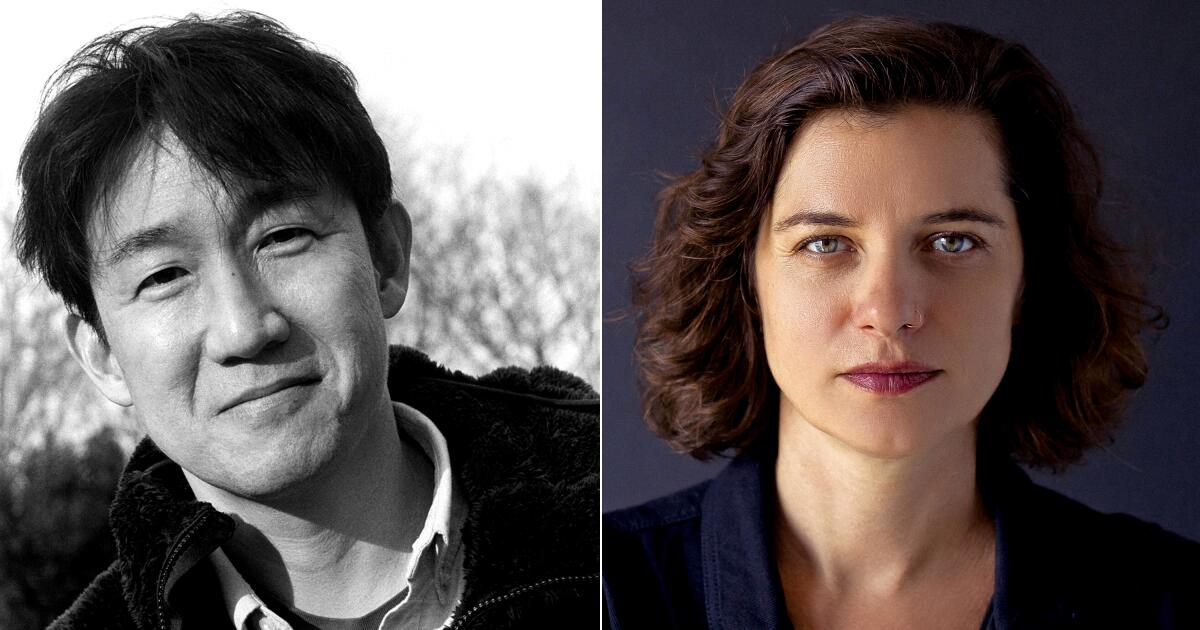
The spotlight shined on great literature Friday night at the 44th Los Angeles Times Book Prizes ceremony at USC’s Bovard Auditorium, where 13 winners took the stage to celebrate their honors and, in some cases, call attention to the free speech controversy unfolding on campus.
A political undercurrent ran through the night’s speeches following the university’s cancellation of a commencement speech by pro-Palestinian valedictorian Asna Tabassum. Emily Carroll, who won the Book Prizes’ graphic novel/comic category, ended her speech by calling on USC to restore Tabassum’s appearance, “so that she may inspire her community of peers with, as she’s put it, her ‘message of hope.’ Also, I would like to express my own solidarity with Asna and also my solidarity with Palestine.”
Applause drowned out Carroll’s words at times. Later, Tananarive Due, who won for science fiction, fantasy and speculative fiction, used her speech to add: “As we face the horrors in our in our cities, in Gaza and elsewhere, and witness true-life racism, homophobia, Islamophobia and antisemitism, let us honor the courage of young people.” They, Due said, have been the drivers of change throughout history.
Upon accepting the award for the current interest category, Roxanna Asgarian added her support for Tabassum. “She earned her right to speak,” Asgarian said. “Let her speak.” Amber McBride, who won for young adult literature concluded her speech by saying, “Free Palestine.”
The focus for the rest of the evening were the books themselves — more than 60 finalists plus three special honors. Jane Smiley accepted the Robert Kirsch Award for lifetime achievement, which pays tribute to a writer with a substantial connection to the American West. The L.A.-born author, who won the Pulitzer Prize for fiction in 1992 for her novel “A Thousand Acres,” gave a brief, heartfelt speech, noting, “I love to write novels, I love to go for walks and look around. And I think the greatest pleasure of the novelist’s life is curiosity.”
Claire Dederer received the Christopher Isherwood Prize for Autobiographical Prose for “Monsters: A Fan’s Dilemma.”
“‘Monsters,’ a book-length expansion of an essay on the problematic relationship between masculinity and fame, considers how we come to love art made by less than perfect humans,” read the selection committee’s praise. “Dederer engages the essayist form at its best and the result is both critical, literary and provocative.”
“These are really, really dark days,” said Dederer, accepting the award. “And I’m so grateful for this bright moment.”
The final special honor went to Access Books, which received the Innovator’s Award for its work renovating school libraries to enhance access to books and literary resources for underserved students and communities.
This year’s Book Prizes featured a new category:achievement in audiobook production. That award, which honors performance, production and innovation in storytelling — given in collaboration with Audible — went to Dion Graham and Elishia Merricks for “Thank You (Falettinme Be Mice Elf Agin): A Memoir.” The judges noted Graham’s “transcendent” narration of musician Sly Stone’s “percussive and almost musical writing” in his memoir.
Ed Park’s novel “Same Bed Different Dreams” took the fiction prize. The selection committee singled it out for being “as playful as it is moving, as serious as it is otherworldly and as funny as it is intellectually stimulating.”
The Art Seidenbaum Award for First Fiction went to Shannon Sanders’ debut, “Company: Stories,” which features 13 stories that follow the lives of a multi-generational Black family from the 1960s to the 2000s in cities including Atlantic City, N.J., New York and Washington, D.C. “The prose is magnificent, mature and breathtakingly precise, and the collection resounds with a sensitivity and wisdom rarely seen in a debut,” noted the judges.
Gregg Hecimovich won for biography with “The Life and Times of Hannah Crafts: The True Story of The Bondwoman’s Narrative,” about a slave who escaped from a Southern plantation and spent the rest of her life evading capture. The book was chosen out of more than 100 entries, with the selection committee writing, “Through Hecimovich’s painstaking historical detective work and keen literary analysis, the reader is rewarded with a captivating and vivid portrait of a life once stolen by enslavers and long robbed of recognition. This is at once a startling and original work.”
Carroll won for “A Guest in the House,” an adult horror story about a woman who marries a dentist and discovers there is a mystery to be solved when it comes to the death of his former wife. “A fleshy, sensuous journey that pushes the limits of the medium in ways that only Carroll can. A skin-crawling gem, not to be missed,” wrote the selection committee.
Joya Chatterji took home the prize for history with “Shadows at Noon: The South Asian Twentieth Century,” which limns the region’s trajectory from British colony to three complex, independent nations.
The mystery/thriller award went to Ivy Pochoda for “Sing Her Down.” The unique nail-biter takes place in the shadows of L.A.’s homeless camps, run-down motels and dark alleys, following women who have turned — for various reasons — to a life of crime. The judges, including Alex Segura, Wanda Morris and mystery fiction critic Oline Cogdill, wrote, “Pochoda brilliantly explores her characters and this setting, while sifting through myriad literary tropes, including allusions to Macbeth, mythology, even a bit of a Greek chorus.”
Airea D. Matthews’ “Bread and Circus” was honored in the poetry category. Matthews is an associate professor of creative writing and the co-director of the creative writing program at Bryn Mawr College. She was named the 2022-23 poet laureate of Philadelphia.
The prize for science fiction fiction was given to Due for “The Reformatory.” The book is part horror, part historical fiction in its examination of life under Jim Crow law in the South.
Eugenia Cheng’s “Is Math Real? How Simple Questions Lead Us to Mathematics’ Deepest Truths” nabbed the prize for science & technology, with the judges writing, “Beginning with a dedication to readers who think math isn’t for them, Cheng shows us that not only is math for all of us, but so is the act of searching for meaning in shapes, patterns and symbols that simultaneously seem like they have nothing to do with us and also everything to do with who we are as a species.”
Cheng uttered perhaps the most helpful line to all the writers in the room, noting to applause, “If you have ever been made to feel bad at math, you didn’t fail math, math failed you.”
The story of a 12-year-old blue-skinned girl called Inmate Eleven who is being groomed to be a partner to a white-skinned teen clone, and future president of Bible Boot, is the plot of McBride’s “Gone Wolf,” which won for young adult literature. “McBride mixes American history with speculative fiction to dissect melancholia and political anxiety for young people who are living through uncertain times — in the future and today,” wrote the judges.
The full list of finalists and winners is below.
Achievement in Audiobook Production
Maria Bamford, narrator, “Sure, I’ll Join Your Cult: A Memoir of Mental Illness and the Quest to Belong Anywhere”
Sophia Bush, narrator, “Wild and Precious: A Celebration of Mary Oliver”
Helena de Groot, lead producer, “Wild and Precious: A Celebration of Mary Oliver”
Dion Graham, narrator, “Thank You (Falettinme Be Mice Elf Agin): A Memoir”
Kerri Kolen, executive producer, “Wild and Precious: A Celebration of Mary Oliver”
Helen Laser, narrator, “Yellowface”
Adam Lazarre-White, narrator, “All the Sinners Bleed”
Elishia Merricks, producer, “Thank You (Falettinme Be Mice Elf Agin): A Memoir”
Elishia Merricks, producer, “All the Sinners Bleed”
Suzanne Franco Mitchell, director/producer, “Yellowface”
The Art Seidenbaum Award for First Fiction
Stephen Buoro, “The Five Sorrowful Mysteries of Andy Africa: A Novel”
Sheena Patel, “I’m a Fan: A Novel”
Shannon Sanders, “Company: Stories”
James Frankie Thomas, “Idlewild: A Novel”
Ghassan Zeineddine, “Dearborn”
Biography
Leah Redmond Chang, “Young Queens: Three Renaissance Women and the Price of Power”
Gregg Hecimovich, “The Life and Times of Hannah Crafts: The True Story of The Bondwoman’s Narrative”
Jonny Steinberg, “Winnie and Nelson: Portrait of a Marriage”
Elizabeth R. Varon, “Longstreet: The Confederate General Who Defied the South”
David Waldstreicher, “The Odyssey of Phillis Wheatley: A Poet’s Journeys Through American Slavery and Independence”
The Christopher Isherwood Prize for Autobiographical Prose
Claire Dederer, “Monsters: A Fan’s Dilemma”
Current Interest
Bettina L. Love, “Punished for Dreaming: How School Reform Harms Black Children and How We Heal”
Roxanna Asgarian, “We Were Once A Family: A Story of Love, Death, and Child Removal in America”
Zusha Elinson, “American Gun: The True Story of the AR-15”
Cameron McWhirter, “American Gun: The True Story of the AR-15”
Christina Sharpe, “Ordinary Notes”
Raja Shehadeh, “We Could Have Been Friends, My Father and I: A Palestinian Memoir”
Fiction
Susie Boyt, “Loved and Missed”
Yiyun Li, “Wednesday’s Child: Stories”
Elizabeth McKenzie, “The Dog of the North: A Novel”
Ed Park, “Same Bed Different Dreams: A Novel”
Justin Torres, “Blackouts: A Novel”
Graphic Novel/Comics
Derek M. Ballard, “Cartoonshow”
Matías Bergara, “CODA”
Emily Carroll, “A Guest in the House”
Sammy Harkham, “Blood of the Virgin”
Chantal Montellier, “Social Fiction”
Simon Spurrier, “CODA”
History
Ned Blackhawk, “The Rediscovery of America: Native Peoples and the Unmaking of U.S. History”
Joya Chatterji, “Shadows at Noon: The South Asian Twentieth Century”
Malcolm Harris, “Palo Alto: A History of California, Capitalism, and the World”
Blair L.M. Kelley, “Black Folk: The Roots of the Black Working Class”
Nikki M. Taylor, “Brooding Over Bloody Revenge: Enslaved Women’s Lethal Resistance”
Innovator’s Award
Access Books
Mystery/Thriller
Lou Berney, “Dark Ride: A Thriller”
S. A. Cosby, “All the Sinners Bleed: A Novel”
Jordan Harper, “Everybody Knows: A Novel”
Cheryl A. Head, “Time’s Undoing: A Novel”
Ivy Pochoda, “Sing Her Down: A Novel”
Poetry
K. Iver, “Short Film Starring My Beloved’s Red Bronco”
Airea D. Matthews, “Bread and Circus: Poems”
Maggie Millner, “Couplets: A Love Story”
Jenny Molberg, “The Court of No Record: Poems”
Simon Shieh, “Master: Poems”
Robert Kirsch Award
Jane Smiley
Science & Technology
Eugenia Cheng, “Is Math Real? How Simple Questions Lead Us to Mathematics’ Deepest Truths”
Jeff Goodell, “The Heat Will Kill You First: Life and Death on a Scorched Planet”
Jaime Green, “The Possibility of Life: Science, Imagination, and Our Quest for Kinship in the Cosmos”
Caspar Henderson, “A Book of Noises: Notes on the Auraculous”
Zach Weinersmith, “A City on Mars: Can We Settle Space, Should We Settle Space, and Have We Really Thought This Through?”
Kelly Weinersmith, “A City on Mars: Can We Settle Space, Should We Settle Space, and Have We Really Thought This Through?”
Science Fiction, Fantasy & Speculative Fiction
Tananarive Due, “The Reformatory: A Novel”
Daniel Kraus, “Whalefall”
Victor LaValle, “Lone Women: A Novel”
V. E. Schwab, “The Fragile Threads of Power”
E. Lily Yu, “Jewel Box: Stories”
Young Adult Literature
Jennifer Baker, “Forgive Me Not”
Olivia A. Cole, “Dear Medusa”
Kim Johnson, “Invisible Son”
Amber McBride, “Gone Wolf”
Sarah Myer, “Monstrous: A Transracial Adoption Story”



PopHorror had the chance to check out Anacoreta (2022) ahead of its streaming release! Does this meta-horror flick provide interesting story telling or is it a confusing mess.
Let’s have a look…
Synopsis
A group of friends heads to a secluded woodland cabin for a weekend getaway, planning to film an experimental horror movie. As the shoot progresses, the project begins to fall apart—until a real and terrifying presence emerges from the darkness.
Anacoreta is directed by Jeremy Schuetze. It was written by Jeremy Schuetze and Matt Visser. The film stars Antonia Thomas (Bagman 2024), Jesse Stanley (Raf 2019), Jeremy Schuetze (Jennifer’s Body 2009), and Matt Visser (A Lot Like Christmas 2021)
My Thoughts
Antonia Thomas delivered an outstanding performance as the female lead in Anacoreta. It was remarkable to watch her convey such a wide range of emotions with authenticity and depth. I was continually impressed by her ability to switch seamlessly between different dialects. I absolutely loved her delivery of the dialogue of telling The Scorpion and the Frog fable.
Anacoreta employs a distinctive, meta-horror style of storytelling. The narrative follows a group of friends creating a “scripted reality” horror film, and as the plot unfolds, the boundary between their staged production and their actual lives becomes increasingly blurred. This was interesting, but at the same time frustrating as a viewer.

Check out Anacoreta on Prime Video and let us know your thoughts!

Todd Meadows, a crewmember on one of the fishing vessels featured on the long-running reality series “Deadliest Catch,” has died. He was 25.
Rick Shelford, the captain of the Aleutian Lady, announced in a Monday post on Facebook and Instagram that Meadows died Feb. 25. He called it “the most tragic day in the history of the Aleutian Lady on the Bering Sea.”
“We lost our brother,” Shelford wrote in his lengthy tribute. “Todd was the newest member of our crew, he quickly became family. His love for fishing and his strong work ethic earned everyone’s respect right away. His smile was contagious, and the sound of his laughter coming up the wheelhouse stairs or over the deck hailer is something we will carry with us always.
“He worked hard, loved deeply, and brought joy to those around him,” he added. “Todd will forever be part of this boat, this crew, and this brotherhood. Though we lost him far too soon, his legacy will live on through his children and in every memory we carry of him.”
A fundraiser set up in Meadows’ name described the deckhand from Montesano, Wash., as a father to “three amazing little boys” who died “while doing what he loved — crabbing out on Alaskan waters.”
According to the Associated Press, Meadows died after he was reported to have fallen overboard around 170 miles north of Dutch Harbor, Alaska.
“He was recovered unresponsive by the crew approximately ten minutes later,” Chief Petty Officer Travis Magee, a spokesperson with the Coast Guard’s Arctic District, told the AP. The Coast Guard is investigating the incident.
Meadows was a first-year cast member of “Deadliest Catch,” the Discovery Channel reality series that follows crab fishermen navigating the perilous winds and waves of the Bering Sea during the Alaskan king crab and snow crab fishing seasons. The show debuted in 2005. No episodes from Meadows’ season has aired.
Deadline reported that the show was in production on its 22nd season when the incident occurred, with the Shelford-led Aleutian Lady being the last of the vessels still out at sea at the time. Production has subsequently concluded, per the outlet.
“We are deeply saddened by the tragic passing of Todd Meadows,” a Discovery Channel spokesperson said in a statement that has been widely circulated. “This is a devastating loss, and our hearts are with his loved ones, his crewmates, and the entire fishing community during this incredibly difficult time.”
Meadows is the latest among “Deadliest Catch” cast members who have died. Previous deaths include Phil Harris, a captain of one of the ships featured on the show, who died after suffering a stroke while filming the show’s sixth season in 2010. Todd Kochutin, a crew member of the Patricia Lee, died in 2021 from injuries he sustained while aboard the fishing vessel, according to an obituary. Other cast members have died from substance abuse or natural causes.

“So it’s like Avatar?” one character quips in Disney and Pixar’s “Hoppers,” bluntly translating the film’s high-concept premise for the sugar-fueled kids in the audience. And yes, the comparison is apt. The story follows a nature-obsessed teenage girl who manages to quite literally “hop” her consciousness into the body of a robotic beaver in order to spark an animal rebellion against a greedy mayor determined to bulldoze their forest for a freeway.
It’s a clever hook. The kind of big, elastic idea Pixar used to make look effortless. “Hoppers” does not reach the rarified air of “Up,” “Wall-E,” or “Inside Out,” but after a stretch of uneven originals like “Turning Red” and “Luca,” and outright misfires such as “Elemental” and “Elio,” this feels like a genuine course correction. The environmental messaging is clear without being preachy, the animals are irresistibly anthropomorphized, and the studio’s once-signature emotional sincerity is back in sturdy form.
Pixar can afford to gamble on originals when it has a guaranteed cash cow like this summer’s “Toy Story 5” waiting in the wings, but “Hoppers” earns its place in the catalogue. Director Daniel Chong crafts a warm, heartfelt film that occasionally strains under the weight of its own ambition, yet remains grounded by character and theme. Its meditation on conservation and animal displacement feels timely in a way that never tips into after-school-special territory.
We meet Mabel, voiced with bright conviction by Piper Curda, as a child liberating her classroom pets and returning them to the wild. Her moral compass is shaped by her grandmother, voiced by Karen Huie, who imparts wisdom about nature’s sanctity. True to both Pixar tradition and the broader Disney playbook, this beacon of guidance does not survive past the opening act. Loss, after all, is Pixar’s favorite inciting incident.
Years later, Mabel is still fighting the good fight, squaring off against the smarmy Mayor Jerry, voiced with slick menace by Jon Hamm. He plans to flatten the glade where Mabel and her grandmother once found solace. Mabel’s resistance feels noble but futile. The animals have already mysteriously vanished, the machinery is coming, and her last-ditch plan involves luring a beaver back to the abandoned forest in hopes of jumpstarting the ecosystem.
That’s when the film gleefully pivots into mad-scientist territory. At Beaverton University, Mabel discovers her professor, voiced by Kathy Najimy, has developed a device that can project human consciousness into synthetic animals. The process, dubbed “hopping,” allows Mabel to inhabit a robotic beaver and infiltrate the forest from within. It’s an inspired escalation that keeps the film buoyant even when the plotting grows predictable.
Her new posse includes King George, a lovably beaver voiced by Bobby Moynihan with distinct Bing Bong energy; a sharp-tongued bear voiced by Melissa Villaseñor; a regal bird king voiced by the late Isiah Whitlock Jr.; and a fish queen voiced by Ego Nwodim. As is often the case with Pixar, even in its lesser efforts, the world-building is meticulous. The animal hierarchy, complete with titles like “paw of the king,” is layered with jokes that play for kids while slyly winking at adults.
The plot ultimately follows a familiar template. Scrappy underdog rallies community. Corporate villain twirls metaphorical mustache. Emotional third-act sacrifice looms. At times, you can feel the machinery working a little too cleanly. Pixar, and Disney at large, has grown increasingly reliant on sequels and established IP, and “Hoppers” does not radically reinvent the wheel. In an animated landscape where films like “K-Pop: Demon Hunters,” “Across the Spider-Verse,” and “Goat” are pushing stylistic and narrative boundaries, being safe and sturdy may not always be enough.
And yet, there is something refreshing about a Pixar original that remembers how to tug at the heart without squeezing it dry. “Hoppers” is playful, peppered with cheeky needle drops, and builds to a sweet emotional catharsis that may or may not have left this critic a little misty-eyed. It feels earnest and engaged.
“Hoppers” may not be top-tier Pixar. But it is a welcome return to form, a reminder that the studio still knows how to marry big ideas with a bigger heart.
HOPPERS opens in theaters Friday, March 6th.

Detroit Pistons’ loss to Cavs shows weaknesses before playoffs

Floats for San Francisco Chinese New Year Parade get finishing touches

Hip-hop hitmaker Cardi B coming to AAC in Dallas

Shooting in northwest Miami-Dade leaves man in critical condition, sheriff’s office says

Charlotte plays Boston on 5-game win streak

Florida High School Football Rankings: Top 25 teams – Oct. 21

Cleary's 21 help Le Moyne down Central Connecticut State 69-64 in OT

How old is Bo Nix? What to know about Oregon quarterback ahead of 2024 NFL Draft

99th annual Pony Swim held in Virginia

Indiana Members Credit Union announced as new anchor tenant at Bottleworks District

Video: Senators Question Kristi Noem on ICE Immigration Tactics

Combustible Republican Senate primary in Texas heading into overtime

Hungarian veto proves EU needs less unanimity, says new Dutch PM

Pregnant migrant girls are being sent to a Texas shelter flagged as medically risky

Fraud-plagued Minnesota sues Trump admin for withholding $243M in Medicaid payments
-

 World6 days ago
Exclusive: DeepSeek withholds latest AI model from US chipmakers including Nvidia, sources say
-

 Massachusetts7 days ago
Mother and daughter injured in Taunton house explosion
-

 Denver, CO7 days ago
10 acres charred, 5 injured in Thornton grass fire, evacuation orders lifted
-

 Louisiana1 week ago
Wildfire near Gum Swamp Road in Livingston Parish now under control; more than 200 acres burned
-

 Oregon5 days ago
2026 OSAA Oregon Wrestling State Championship Results And Brackets – FloWrestling
-

 Florida3 days ago
Florida man rescued after being stuck in shoulder-deep mud for days
-

 Maryland3 days ago
AM showers Sunday in Maryland
-

 Culture1 week ago
Try This Quiz on Thrilling Books That Became Popular Movies