Entertainment
L.A. lost Yuval Sharon to Detroit. Here's what we're missing — and what we might win back

Detroit —
Ten years after founding the Industry, America’s most mind-changing opera company, Yuval Sharon in 2020 improbably accepted the role of artistic director of Michigan Opera Theatre. He now divides his time between sustaining the Industry in L.A. and disrupting opera in Detroit, where he changed the formerly conventional company’s name to Detroit Opera. But that’s not all that he divides.
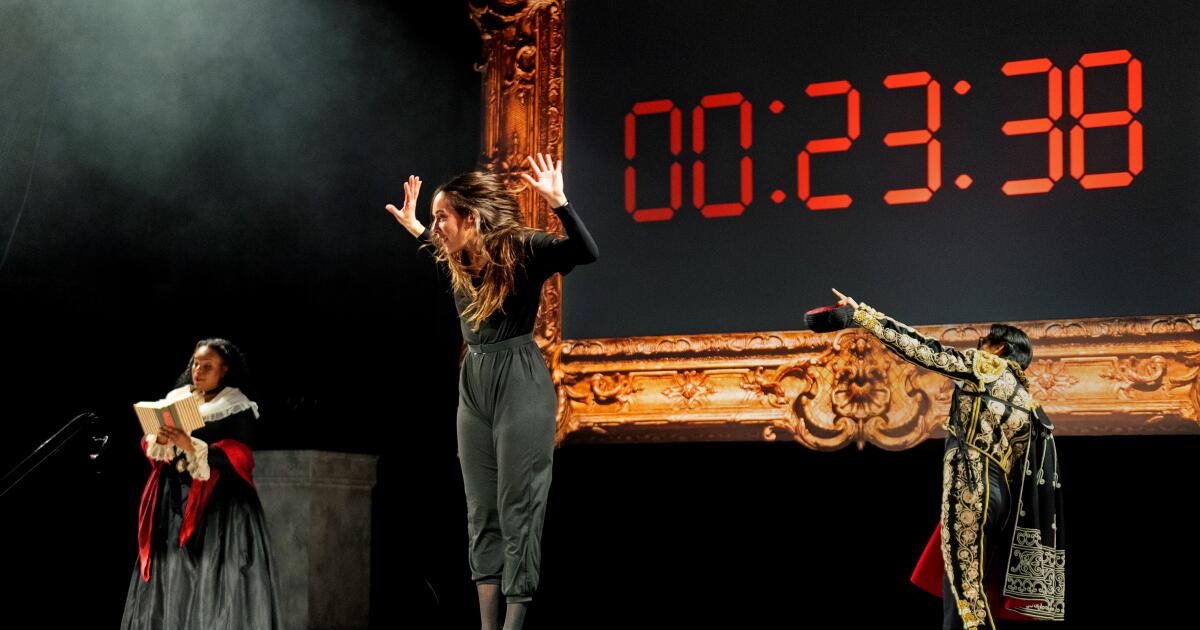
Detroit still gets traditional opera in its traditional opera house, although imaginatively spruced up, like the time Sharon staged Puccini’s “La Bohème” backward (Acts 4, 3, 2 and 1 in that order). But he also takes opera entirely out of its comfort zone. This month Sharon chose the lovely but underused 400-seat Gem Theatre, around the corner from the grander Detroit Opera House, for a sensational new production of John Cage’s “Europeras 3 & 4,” an unpredictable cornucopia of run-of-the-mill opera refashioned through chance operations into an outright operatic circus.
A few days later, Sharon announced his next Industry innovation, “The Comet/Poppea,” slated for June at the Museum of Contemporary Art’s Geffen Contemporary in L.A. Here Sharon will adapt Cage’s “Europera” principle — the allowance for all aspects of opera to unpredictably collide — with an epoch mashup juxtaposing scenes from Monteverdi’s 1643 “The Coronation of Poppea” with those from a newly commissioned experimental opera by George Lewis based on a 1920 science fiction short story by W.E.B. Du Bois.
Sharon has, in fact, been slowly taking up a Cagean operatic challenge. A dozen years ago, he startlingly staged a quasi-operatic interpretation of Cage’s 1970 “Song Books,” an almost-anything-goes theatrical endorsement of Thoreau’s call for anarchy that included the great opera star Jessye Norman. It was part of a San Francisco Symphony concert in which conductor Michael Tilson Thomas’ job was to make a smoothie.
In 2018, during Sharon’s three-year stint as artist-collaborator at the Los Angeles Philharmonic, Sharon combined the orchestra’s resources with those of the Industry to mount Cage’s “Europeras 1 & 2,” originally written for Frankfurt Opera in 1987 and meant to deconstruct the full resources of a big opera company. To make it local, Sharon produced his “Europeras 1 & 2” on a Sony Pictures soundstage in Culver City, taking advantage of props and costumes from classic films.
Cage followed “Europeras 1 & 2” with a a pair of chamber operas for an avant-garde theater festival in London. Long Beach Opera is the only company in America to have attempted “Europeras 3 & 4.” A yet smaller-scaled fifth “Europera,” which is well suited for college music departments, gets around more and has been done several times since 2011 at Loyola Marymount University, making the Greater L.A. area the only place in the world where all five “Europeras” have been performed.
The “Europera” essence is the paying attention to what is, rather than belaboring relationships. Cage did not reimagine the past but simply accepted the fact that we are surrounded by old things and old music. There is nothing unusual about hearing an aria in your car and passing a building from another era. Does anyone think it odd to be sitting on a modern sofa while listening to a turntable housed in a 19th century hutch?
In all the “Europeras,” props, costumes, arias and movement, as well as entrances and exits, happen in arbitrary fashion. Singers are on their own. They sing whatever arias they like in the public domain, without regard to anything else around them. The audience is on its own as well. You pick out what you want to hear, see what catches your eye, focus your attention at will. “Europera” is your opera.
“Europera 3” employs six solo singers, two pianists playing tidbits from Liszt opera arrangements and a dozen 78-rpm turntables. “Europera 4” reduces the numbers to a mere pair of singers, a single piano and an antique record player. Sharon raided Detroit Opera’s storage rooms for costumes and props. He scoured local stores for old 78-rpm opera discs and borrowed a Victrola from a patron. The backdrop was a large projection of a digital clock.
Chaos was not the result. Instead, a listener was invited to home in on a forest of opera, noticing this or that — maybe you recognize it, maybe you don’t. But like nature, everything felt like it had a purpose, multiplicity a matter for celebration. The devotion of the six singers mesmerized.
For “Europera 4,” Sharon impressively enticed two stars, mezzo-soprano Susan Graham and bass-baritone Davóne Tines. Each has a stunning, polished stage presence and knows it. Cage might have preferred less showiness, but here they felt bigger than life, capable of moving a listener to tears.
The “Europeras” needed nothing more, but Sharon is a maximalist and pleasingly welcomed into the mix two dancers. Their presence became a reminder of just how much cooperation is needed. “Europeras” are an exercise in social interaction — all elements animate and inanimate, visual and aural, coexisting, each remaining true.
I attended a Friday night performance, the first of three. Sharon attracted the audience every American opera company lusts after, filling the Gem with what appeared to be an eager and open-minded mix of well-dressed opera patrons, new-music fans and curiosity seekers, along with a contingent of out-of-towners not wanting to miss history in the making. Both “Europeras” received excited standing ovations.
“Europeras” work as well as they do because Cage ingeniously set up strategies that focus our attention on the unexpected. Detroit’s “Europeras” worked as well as they did thanks to Sharon’s genius. He is famously the strategizing mastermind of “Hopscotch,” the 2015 opera staged around downtown L.A. with the audience riding in limos.
So maybe there was some cosmic sense to it all. That same Friday night while “Europeras 3 & 4” were being performed, Lewis, the composer of the upcoming “Comet,” was leading a public discussion with Christian Wolff on the latter’s 90th birthday at Judson Memorial Church in New York. Over more than seven decades, Wolff has been one of the most extraordinary strategist-composers in history. The teenage Wolff astonished Cage when he first studied with him in the early 1950s, becoming the youngest and now final surviving member of Cage’s legendary New York School of composers.
The following evening at Judson an arresting New York ensemble, String Noise, presented a birthday marathon concert at Judson in tribute to Wolff, who, along with being an immutable experimentalist, is a noted classical scholar who had a career as a professor at Harvard University and Dartmouth. His father, Kurt Wolff, was a famed publisher who worked with Kafka, Jung and a great many others.
Along with younger musicians who have avidly and brilliantly taken up Wolff’s music, the marathon included older Wolff colleagues, such as composer David Behrman, who performed on a laptop an incandescent electronic piece, “CW90,” written for the occasion.
Wolff’s music does not, for the most part, look back. It explores possibilities and does so with such rigor and invention that Cage often said he learned more from Wolff than Wolff did from him. The marathon covered the full range, beginning with the first piece Wolff showed Cage, “Duo for Violins,” from 1950. It explores a combination of three pitches. The material for Wolff’s newest score, “What If?,” which had its premiere at the concert, consists of 97 “mostly quite short items for use by from 2 to around 20 performers.” It is up to them to determine what, with whom and when.
Wolff has devoted his life to a study of the ancients. His musical heritage is unequaled by any composer today, in his connection to both the old and the new. And all of that has made him the living, questing embodiment of the musical question: What if? You never know what you’ll get, but I’ve never heard it fail to be arresting at the very least, At their best, Wolff’s what-ifs can be enlightening both sonically and, in the interaction of performers, socially.
In 1997, New York University, a Washington Square neighbor to Judson, published Stuart D. Hobbs’ “The End of the American Avant Garde” as the 37th volume in its “The American Social Experience Series.” The New York School shows up on page 165.
But what if just the opposite of this heedless obituary for the avant-garde is true? What if we are entering a new era led by the likes of Sharon? What if we can utilize history not with the superficial irony of postmodernism but allow the past to be the past — something that is part of us but not holding us back? What if we follow the example of Christian Wolff? That extraordinary weekend suggested we should.
In the meantime, stay tuned for “The Comet/Poppea.” And check out the website of Issue Project Room, the presenter of the Wolff 90th-birthday celebration. Recordings of the conversation with Lewis and the historic marathon concert will be made available once edited.


RICHMOND, Va. (WRIC) — In this episode of 8News Reel Talk, Julia Broberg sits down with Hekla Petursson and Catori Ryan to talk about “Toy Story 5.”
The hosts gave their reviews and provided the following star ratings:
Catori: ★★★★
Hekla: ★★★★★
Julia: ★★★★.2
To watch more livestreams and digital video content, head to the WRIC+ Originals page. You can also watch full on-demand videos on your smart TV using the WRIC+ app.

Passing “Go” has become especially lucrative for mobile game publisher Scopely.
The Culver City-based Scopely launched “Monopoly Go!” in 2023, betting fans of the classic board game would flock to a mobile version aimed at casual gamers.
By 2025, “Monopoly Go!” had accrued $6 billion in lifetime in-app purchase revenue, becoming the fastest free mobile game to do so, according to app analytics firm Sensor Tower.
This summer, the app is expected to reach $8 billion in lifetime revenue, the company says, solidifying “Monopoly Go!” as Scopely’s biggest game and far surpassing the company’s popular “Pokémon Go.” The company declined to disclose its total profits.
Scopely Co-Chief Executive Javier Ferreira.
As overall downloads in the mobile game market have stagnated and in-app purchases and retention become the main drivers of growth, Scopely has hit on an age-old Hollywood strategy — using known franchises and intellectual property to bring out fans.
“These are incredibly durable and long-lasting games that have really passionate communities and fandom around them,” said Javier Ferreira, co-chief executive of Scopely. “We’re in the business of building people’s favorite thing, and that’s a difficult thing to do. The power of [intellectual property] is that, in some cases, that is already their favorite thing.”
The company’s journey toward “Monopoly Go!” began in 2014, when Scopely formed a partnership with Rhode Island-based toymaker Hasbro. Its first collaboration was a Yahtzee mobile dice game that ultimately drew millions of players worldwide (though it was especially popular in the U.S.) and generated more than $1 billion in lifetime revenue.
After that, Scopely approached Hasbro about taking on the “crown jewel” of its board game empire — Monopoly.
Monopoly’s massive global popularity was an obvious draw. But adapting an hours-long real estate transaction game for a casual, mobile audience proved challenging.
Development of what would become “Monopoly Go!” ultimately took seven years, two of which were spent trying to make movement around the board more fun. In that time, the company scrapped two versions of the game; one deemed too competitive, and one that was too complex, Ferreira said.
Developers wanted to capture the “roller coaster feel” of the board game’s highs and lows, while also having simple rules and ensuring a strong social element, he said.
“We couldn’t just copy,” Ferreira said. “We had to reinvent it and re-imagine it, and that’s a complicated, creative endeavor.”
Today, “Monopoly Go!” brings in more than $2 billion in annual revenue and has been downloaded across the globe more than 300 million times.
Now with “Pokémon Go,” which the company owns after acquiring maker Niantic’s game business last year, “Scopely has gone from a successful publisher to one of the defining companies in mobile gaming,” Randy Nelson, head of insights at Appfigures, a mobile app analytics firm.
“The company cracked the code on licensed games years ago,” he wrote in an email. “Its biggest hits work because they’re great games first and recognizable brands second.”
Though the company’s overall game downloads have slowed, its gross revenue has largely increased every year since 2020, according to Appfigures data.
Shortly after Scopely released “Monopoly Go!,” the company was acquired by Savvy Games Group, which is owned by the Saudi Public Investment Fund, for $4.9 billion.
In a statement about the deal, Savvy Games Group Chief Executive Brian Ward touted the success of “Monopoly Go!” as “indicative of Scopely’s ongoing position at the forefront of the global games sector.”
Representatives of the Saudi investment fund are part of Savvy Game Group’s board and do sometimes give some feedback on company initiatives, though Ferreira said the company has remained “very independent.”
The proposed acquisition of gaming giant Electronic Arts by the Saudi Public Investment Fund is not expected to affect Scopely since EA largely focuses on high-budget console and computer games, he said.
As Scopely, now 3,000 employees strong, looks to the future, it has embarked on a number of entertainment partnerships with studios to add franchises such as “The Simpsons,” “Hello Kitty” and Marvel to its mobile game ecosystem.
“They give us access to these universes that millions of people love and are really invested in,” Ferreira said. “We see this as a very strategic part of our business.”

Rose of Nevada is a genuinely poetic movie that pushes the boundaries of the Groundhog Day-style time-travel narrative while carving out an identity completely its own. Rather than relying on the familiar mechanics that audiences have come to expect from the genre, the film approaches the concept through a more reflective and emotional lens. The result is a movie that feels thoughtful, ambitious, and surprisingly moving.
It makes a huge on-screen presence felt through its cast, particularly George MacKay and Callum Turner, who both deliver performances that elevate the material beyond a simple science-fiction premise. Combined with breathtaking visuals and a strong directorial vision, Rose of Nevada becomes something far more memorable than many of its genre contemporaries.
George MacKay continues to prove why he is one of the most compelling actors working today. Following his acclaimed work in 1917, he once again demonstrates an ability to carry a film through sheer presence and emotional authenticity.
Every scene feels grounded because of his performance, even when the story ventures into more abstract territory. Alongside him, Callum Turner delivers what could easily be viewed as a breakout performance. The chemistry between the two leads helps anchor the film, allowing audiences to connect with the characters even as the narrative challenges conventional storytelling expectations.
One of the film’s greatest strengths is its visual presentation. The cinematography is nothing short of earth-shattering. Nearly every frame looks like a carefully crafted painting, capturing both the beauty and mystery of the world these characters inhabit. There is a dreamlike quality to the imagery that perfectly complements the film’s themes of time, memory, and destiny.
The camera lingers on landscapes just long enough to allow viewers to soak in their beauty without ever slowing the pace. It’s the kind of cinematography that demands to be appreciated on the largest screen possible.
Director Mark Jenkin continues to establish himself as one of the most distinctive voices in modern British cinema. Following the atmospheric and haunting Enys Men, Jenkin once again crafts a story that feels deeply connected to folklore and place.
The British backdrop becomes a character in itself, with rugged coastlines, open landscapes, and isolated locations contributing to the film’s unique atmosphere. His direction never feels showy or excessive; instead, he trusts the audience to absorb the experience and interpret its deeper meanings.
What makes Rose of Nevada especially fascinating is how it recalls classic time-travel films without simply copying them. There are moments that evoke the spirit of The Final Countdown, particularly in the sense of wonder and uncertainty surrounding the temporal elements.
Yet the film remains firmly rooted in its own identity, focusing more on emotion and introspection than spectacle. It invites viewers to engage with its ideas rather than simply consume them.
This is also one of those rare films that benefits from reflection after the credits roll. It is not a movie designed to provide easy answers. Instead, it lingers in the mind, encouraging discussion and interpretation. The more time you spend thinking about it, the more rewarding it becomes. Much like a fine wine, Rose of Nevada continues to improve with age, revealing new layers and details upon reflection.
Overall, Rose of Nevada is a beautiful, ambitious, and visually stunning piece of filmmaking that deserves to be experienced on the big screen. Powered by exceptional performances, remarkable cinematography, and confident direction, it stands as one of the more unique takes on time travel in recent memory.
Overall Grade: 4/5 Stars
-

 Los Angeles, Ca1 hour ago
Jury says it is deadlocked in trial of man accused in Palisades Fire
-

 Detroit, MI2 hours ago
Scene active as police shoot, kill man on Detroit’s west side
-

 San Francisco, CA2 hours ago
Civil grand jury report warns of wildfire risk at SF’s Glen Canyon Park
-

 Dallas, TX2 hours ago
Ivory Coast advances at World Cup, how to buy Ivory Coast tickets
-

 Miami, FL2 hours ago
Men used fake credentials to enter Brazil vs. Scotland match at Miami Stadium, deputies say
-

 Boston, MA2 hours ago
3 arrested after trying to break into downtown building, Boston police say – The Boston Globe
-

 Denver, CO2 hours ago
RTD to bring back BroncosRide bus service after 5-year suspension
-

 Seattle, WA2 hours ago
FOLLOWUP: Sound Transit Board finalizes $400+ million spending installment for West Seattle light rail

