Entertainment
L.A. jazz pianist and 'Compared to What' singer Les McCann dies at 88

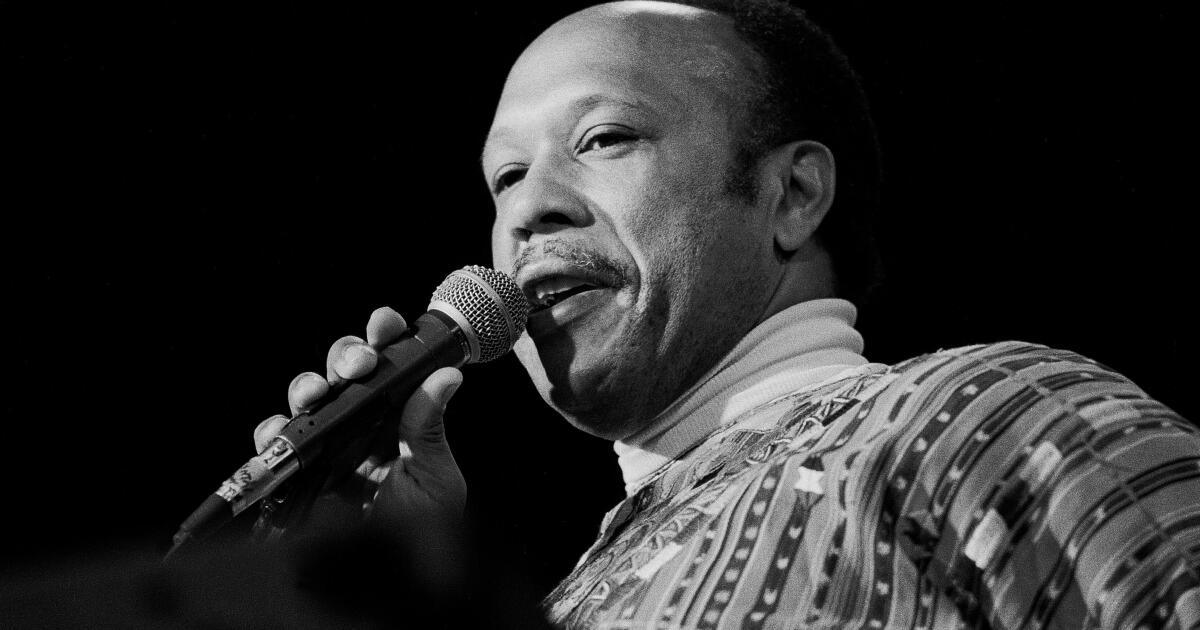
Jazz pianist and singer Les McCann, best known for his raucous live single “Compared to What” from the 1969 Montreux Jazz Festival and later sampled heavily by hip-hop artists, died Friday at a Los Angeles-area hospital, according to his longtime manager and producer Alan Abrahams.
McCann, 88, had been living in a Van Nuys nursing facility and was hospitalized with pneumonia, said Abrahams, who declined to identify the hospital. McCann had been a longtime Van Nuys resident, Abrahams said.
“He was one of the most influential pianists and singers of all time,” said Abrahams, who called McCann an architect of soul jazz. “When he played live, all over the world, people would be enthralled, because he never played it safe. He always took it to the edge and succeeded at it and took the audience with him. For younger people, they’re not making any more Les McCanns.”
McCann’s music has been sampled by Notorious B.I.G., Pete Rock and C.L. Smooth, Warren G., Slick Rick, Dr. Dre, Mobb Deep, A Tribe Called Quest, De La Soul and Naughty by Nature, according to his website.
McCann relished his role as a live performer. “Well, some musicians only want to do it with the music,” McCann told The Times in 1992. “I like to be funny. I like to mess with people, shake ‘em up a little bit. So I do outrageous things sometimes. I know who I am, and people who know me wish I would do more outrageous things — like I do at home. They say, ‘What’s wrong with you? You’re so conservative on the bandstand.’
“That’s all I need, to go into my routine. My routine is love, and that’s what I am. I’m a channel of love. I accept my role.”
McCann during the opening of the 40th Montreux Jazz Festival in 2006.
(Martial Trezzini / Keystone via AP)
Les McCann was born Sept. 23, 1935, in Lexington, Ky., Abrahams said. A largely self-taught musician, McCann joined the Navy in the 1950s and was stationed in California, where he patronized San Francisco’s jazz clubs, encountered trumpeter Miles Davis’ music and was strongly influenced by pianist Erroll Garner, according to his biography from the Kentucky Music Hall of Fame. In 1956, he won a Navy talent contest as a singer and appeared on the “Ed Sullivan Show,” according to the 2007 book “The Biographical Encyclopedia of Jazz.”
He moved to Los Angeles after being discharged, where he formed the Les McCann Ltd. trio and was signed by the L.A.-based Pacific Jazz label.
A prolific performer and collaborator, it was McCann’s appearance at the 1969 Montreux Jazz Festival in Switzerland with saxophonist Eddie Harris, and the ensuing live album “Swiss Movement,” that secured McCann’s international notoriety and his place in the jazz canon. In the hit single “Compared to What,” a rollicking protest anthem against President Nixon and the Vietnam War, McCann sings, “The President, he’s got his war / Folks don’t know just what it’s for / Nobody gives us rhyme or reason / Have one doubt, they call it treason.”
The album was a crossover hit. “The witty, laid-back social commentary McCann delivered on the album’s signature tune, ‘Compared to What,’ appealed to both middle-age ex-beatniks and their rock-loving, hippie-era offspring,” The Times recounted in 1992, as “Swiss Movement” remained a steady seller.
One of McCann’s other major contributions to music happened offstage, at a Washington, D.C., nightclub, where he discovered up-and-coming singer Roberta Flack and introduced her to his producer.
McCann, who recorded dozens of other albums and pioneered the use of electronic keyboards in jazz, also explored creative forms beyond music.
“I would love to have a whole lot of money. Who wouldn’t? But I love what I do. I love the other things I do. I play tennis, paint. A new thing I’m just starting is making giant prints of photographs I’ve taken of jazz musicians,” McCann told The Times in 1992. “I’ve read a lot, studied all the religions … My guru is me, the only one I know I can fully trust to be honest with me is me. I love myself beyond all others, and by doing that, I can love everyone else. I see myself as a channel of love.”
In 1995, McCann was slowed by a stroke while in tour in Zelle, Germany, that left him partially paralyzed, though he was able to continue performing afterward, focusing more on vocals.
“He was bold and a pioneer on so many levels,” Abrahams said, noting that the sampling of McCann’s music had extended his influence across generations. “The rap and hip-hop artists all knew, because they would do the deep dive into their parents’ LP bins.”



Movie Reviews
‘They Will Kill You’ Review: Zazie Beetz Kicks Ass in a Giddy, Gory Eat-the-Rich Actioner

At the end of it all, a flabbergasted detective asks a survivor what’s just occurred. The victim, battered and exhausted and covered in blood, grunts out just two words: “Rich people.”
That’s about the extent of the social commentary on offer from They Will Kill You, a new action-horror-comedy set in a Manhattan luxury building whose Satan-worshipping tenants engage in ritualistic killings of their mostly poor and marginalized staff. But it’s all the excuse writer-director Kirill Sokolov (Why Don’t You Just Die!) and his co-writer Alex Litvak need to unleash great big arterial sprays with gonzo style, to enjoyably giddy, if ultimately insubstantial, effect.
They Will Kill You
The Bottom Line Not a lot of brains, but plenty of splattered guts.
Release date: Friday, March 27
Cast: Zazie Beetz, Myha’la, Paterson Joseph, Tom Felton, Heather Graham, Patricia Arquette
Director: Kirill Sokolov
Screenwriters: Kirill Sokolov, Alex Litvak
Rated R,
1 hour 34 minutes
Arriving just one week after Ready or Not 2: Here I Come hit theaters — and having first debuted at SXSW just a few days after Ready or Not 2: Here I Come did — They Will Kill You will inevitably draw comparisons. It’s impossible to argue they aren’t fair.
Both films are about ordinary women brought into a tightly guarded enclave of the one percent, where they’re to be hunted for sacrifice by entitled sociopaths who’ve struck a literal deal with the Devil. Both films saddle their heroines with estranged younger sisters who harbor lingering resentment about having been abandoned by their big sisters in their youth, but now must make up with them in order to survive. Both films devolve into frenetic yet stylish melees deploying all manner of unusual weaponry before, finally, confronting the supernatural head-on.
But any assumption that they’re the same movie will be wiped out the moment the satin-cloaked Satanists of They Will Kill You corner Asia (Zazie Beetz), the newest maid at the exclusive Virgil apartments, in a closet — only for her to come out literally swinging with a sword, slicing one of their heads clean off to uncork the first of what will be many, many geysers of blood to come.
Asia, we learn through one of several flashbacks, is no oblivious victim but an “avenger,” as her boss (Patricia Arquette‘s Lily) puts it, with an irritated sigh suggesting she isn’t the first. Asia has come here under false pretenses with the intention of rescuing her sister, Maria (Myha’la), another recently hired maid. She’s thus armed to the teeth with blades and guns and ammo, though perhaps nothing is deadlier than her fighting spirit, honed over years of prison brawls. The residents of the Virgil, for their part, are more than ready to defend what’s theirs, with one major supernatural asset up their capacious sleeves that gives them the upper hand.
The simplicity of the plot — the only way out is a fire escape at the top of the building, forcing Asia to fight her way up its nine floors, á la The Raid: Redemption or Dredd — gives Sokolov a relatively blank canvas across which to splatter a grand and gory pastiche of seemingly everything he has ever found cool, from video games to animé to John Wick to Sergio Leone and Quentin Tarantino. If he’s yet to coalesce all those influences into his own distinctive style, he wields them with gleeful enthusiasm. He dials the violence up to Looney Tunes silliness while Beetz infuses it all with an effortless cool, giving Asia an athleticism that makes her a pleasure to watch and a defiance that makes her a joy to root for.
Asia never swings an axe when she can swing a flaming axe so that she can set her enemies on fire even as she hacks off their limbs. Furniture getting hurled through the air is captured in slow-motion, all the better to admire when it shatters on someone. Gunshots are punctuated by flurries of mattress stuffing falling through the air like snow. And I haven’t even revealed the big twist that accounts for the film’s most eye-poppingly gruesome sights; those, I’ll leave you to goggle at in the theater for yourself.
But even with that endless appetite for mayhem — and even with a trim 94-minute run time — there’s a point at which They Will Kill You starts to leave intriguing ideas on the table in favor of repeating itself. Take the layout of the building. We’re told each floor is themed after a different deadly sin, but aside from a brief glimpse of a writhing orgy on the “fuck floor” (Lust, obviously) and a set piece in an empty kitchen (Gluttony, presumably), we don’t get to see any of the others. Instead, we spend much of that time crawling around dark underground tunnels and climbing up nondescript shafts. It seems a missed opportunity to set the Virgil apart from any of a million hallways we’ve seen action stars punch their way through before.
Then there are the characters. They Will Kill You barely bothers fleshing out its robed and masked masses of villains; the ones played by Heather Graham and Tom Felton are distinguishable only because they’re played by Heather Graham and Tom Felton. But it has not much more interest in key characters like Maria, whose motives shift with the needs of the plot. Or Lily and her husband Roy (Paterson Joseph), about whom I could tell you almost nothing beyond that Arquette seems to have decided halfway through the shoot to adopt a “local newscaster on St. Paddy’s day”-level Irish accent, and Joseph to pick up a gently Southern one.
Even its haves-versus-have-nots posturing turns out to be less about exploring social injustice than allowing us to root for ultra-violence guilt-free, secure in the knowledge that these rich actually are not like the rest of us because they are much, much, much worse.
But perhaps it’s for the best. For all the weapons in Asia’s arsenal, thoughtfulness or emotionality or complexity are nowhere among them. They Will Kill You is simply not equipped to serve up a nuanced exploration of class division, or a poignant drama of sisterly devotion, or what have you. What it is armed for is violence — lots and lots and lots of violence, so brutally nasty it comes all the way back around to childishly funny. That, it is happy to dish out in spades, with enough gusto to sate even the most bloodthirsty filmgoer.

Dash Crofts, who as half of the duo Seals & Crofts scored a string of easygoing Top 10 hits in the 1970s — including “Summer Breeze,” “Diamond Girl” and “Get Closer” — died Wednesday in a hospital in Austin, Texas. He was 87.
His daughter Lua Crofts Faragher told the New York Times the cause of death was heart failure.
With his partner Jim Seals (who died in 2022), Crofts helped define the era’s soft-rock sound, layering lush harmony vocals over strummy guitars and soulful, lightly jazzy grooves; the style, which emerged in the wake of the cultural and political turmoil of the late ’60s, offered comforting thoughts of romance and friendship and made stars of other acts such as America, Bread and James Taylor. Years after their heyday, Seals & Crofts would be regarded as purveyors of what came to be known as yacht rock.
Jim Seals, left, with Dudley Moore and Dash Crofts in Los Angeles in 1980.
(Ron Galella / Ron Galella Collection / Getty Images)
The duo’s biggest hit was 1972’s “Summer Breeze,” which described a peaceful Friday night at home:
See the smile awaiting in the kitchen
Food cooking and the plates for two
Feel the arms that reach out to hold me
In the evening, when the day is through
With its image of a gentle breeze “blowing through the jasmine in my mind,” the song, which was nominated for a Grammy Award, reached No. 6 on Billboard’s Hot 100 and drove the band’s album by the same name to double-platinum sales; on Spotify, “Summer Breeze” — later featured in movies and TV shows including “Dazed and Confused” and “Freaks and Geeks” — has been streamed more than 320 million times. In 1973, the Isley Brothers remade the song on their “3 + 3” LP; two decades after that, the gothic metal band Type O Negative recorded a sludgy, slowed-down rendition.
Darrell George Crofts was born Aug. 14, 1938, in Cisco, Texas, where his father was a cattle rancher. (His mother gave him the nickname Dash and gave his twin sister, Dorothy, the nickname Dot.) After meeting as teenagers, he and Seals moved to California together in the late ’50s to pursue music and soon joined the Champs, who’d just topped the Hot 100 with the mostly instrumental hit “Tequila.”
Seals and Crofts played with the Champs — Glen Campbell was another member of the group — until the mid-’60s; they released their first album as Seals & Crofts in 1969, by which time they’d become involved in the Baha’i faith.
In 1974, on the heels of the Supreme Court’s Roe vs. Wade decision, the duo released “Unborn Child,” an antiabortion song that drew widespread condemnation. Seals said in an interview with The Times in 1991 that “Unborn Child” was “really just asking a question: What about the child? We were trying to say, ‘This is an important issue,’ that life is precious and that we don’t know enough about these things yet to make a judgment.” He added that if he and Crofts had known the song “was going to cause such disunity, we might have thought twice about doing it.”
Seals & Crofts broke up around 1980 but later reunited to perform on the road; they put out an album called “Traces” in 2004. In addition to his daughter Lua, Crofts’ survivors include his wife, Louise; another daughter, Amelia Crofts Starkweather; and a son, Faizi.
Movie Reviews
‘Alpha’ Movie Review: Julia Ducournau’s Misguided AIDS Allegory Is an Underbaked Misfire – WEHO TIMES West Hollywood News, Nightlife and Events


A surprise resignation could open the door for an independent to win a Montana Senate seat

Metro Detroit weather forecast, March 26, 2026 — 11 p.m. Update

Man convicted in the deadly 2021 assault of a Thai grandfather in San Francisco avoids prison

Dallas Mayor Eric Johnson is confident about cost estimates to repair, rehab City Hall and insists the process has been transparent

Miami Gardens community rallies to help retired teacher rebuild after a fire tore through his home

Florida High School Football Rankings: Top 25 teams – Oct. 21

How old is Bo Nix? What to know about Oregon quarterback ahead of 2024 NFL Draft

Cleary's 21 help Le Moyne down Central Connecticut State 69-64 in OT

99th annual Pony Swim held in Virginia

Indiana Members Credit Union announced as new anchor tenant at Bottleworks District
A surprise resignation could open the door for an independent to win a Montana Senate seat

Video: Savannah Guthrie Says She Believes Her Mother Was Taken for Ransom

Stefanik grills University of Michigan leader on lack of audit after string of Chinese national arrests

Photos: More than one million displaced by Israel’s evacuations in Lebanon

DHS shutdown live updates as Senate holds test vote on funding bill
-

 Detroit, MI1 week ago
Drummer Brian Pastoria, longtime Detroit music advocate, dies at 68
-

 Science1 week ago
How a Melting Glacier in Antarctica Could Affect Tens of Millions Around the Globe
-

 Movie Reviews1 week ago
‘Youth’ Twitter review: Ken Karunaas impresses audiences; Suraj Venjaramoodu adds charm; music wins praise | – The Times of India
-
 Science1 week ago
I had to man up and get a mammogram
-

 Sports5 days ago
IOC addresses execution of 19-year-old Iranian wrestler Saleh Mohammadi
-

 New Mexico4 days ago
Clovis shooting leaves one dead, four injured
-

 Texas7 days ago
How to buy Houston vs. Texas A&M 2026 March Madness tickets
-

 Tennessee3 days ago
Tennessee Police Investigating Alleged Assault Involving ‘Reacher’ Star Alan Ritchson