
Connect with us

Entertainment

Katherine Min was ahead of her time. Four years after her death, her second novel proves it

Published

on

Katherine Min was ahead of her time. Four years after her death, her second novel proves it

On the Shelf

The Fetishist

By Katherine Min
G.P. Putnam’s Sons: 304 pages, $28

If you buy books linked on our site, The Times may earn a commission from Bookshop.org, whose fees support independent bookstores.

Advertisement

This is the story of a fabulous book that almost never was. A lush and vicious novel with the pacing and urgency of a thriller, “The Fetishist” revolves around desire and revenge, focusing on the abduction of a classical musician with a history of predatory behavior by the punk-rocker daughter of his former paramour, who had killed herself after being spurned by him. It’s the second novel by Katherine Min and it arrives nearly four years after her death.

Min was a connector, a writer and professor who built communities through residencies, conferences and classrooms. This explains why her posthumous publication will be marked by a substantial book tour (including a Los Angeles stop Jan. 23) shepherded by a legion of friends and former students and helmed by her daughter, Kayla Min Andrews, who recovered the file that became “The Fetishist.”

While I was neither Min’s peer nor her student, I was a devoted reader of her work. In August 2006, I met Min at the MacDowell Colony shortly before the publication of her debut novel, “Secondhand World,” at Knopf, where I was then an editorial assistant. Her enthusiastic and unguarded demeanor was refreshing, and I loved her intense but tender novel. Her reading at the KGB Bar in Manhattan that fall struck me as an auspicious launch. Sadly, it was her last book tour.

“Secondhand World” was a coming-of-age novel, set in upstate New York in the 1970s, with autobiographical elements of the immigrant experience. But it was also a propulsive, remarkably literary work that burned with complicated longing. Knopf senior editor Victoria Wilson bought the novel for “the virtue and power of its writing.”

Advertisement

In the early aughts, books that captured the Korean American experience were not so prevalent, much less wildly feted (this was before Min Jin Lee’s “Pachinko” and Michelle Zauner’s “Crying in H Mart”). One fan of “Secondhand World,” Putnam publisher Sally Kim, kept it on a small section of her bookshelf devoted to (the precious few) Korean American novels. She would end up editing “The Fetishist,” but at the time, Min’s debut didn’t find a wide audience.

Speaking over the phone 18 years later, Wilson remembers Min’s intensity, commitment and seemingly limitless promise. Knopf had a crowded list that fall — the season of “The Emperor’s Children,” “Half of a Yellow Sun” and other breakthroughs — but Wilson and others worked hard to bring attention to Min. Publicist Tessa Shanks recalls “cooking up a scheme” with Min to stretch the touring budget toward as many cities as possible. “I believe Vicky was a little taken aback by our excitement for what was a relatively small book,” says Shanks.

“Secondhand World” created a path for Min to become a tenured professor at University of North Carolina in Asheville. It received praise and a nomination for a PEN/Bingham award. Min continued to write at artists’ residencies, working on what would become “The Fetishist.” But when she was diagnosed with Stage 4 breast cancer in early 2014, she shut the door on fiction.

Instead, Min shifted to nonfiction. “It was like a switch was pulled,” remembers her friend, writer Marie Myung-Ok Lee. Min “felt an urgent need to write essays, particularly on her new perspective on life having cancer.” While Lee is pleased by the publication of “The Fetishist,” she also hopes these essays will be published as a collection. “Even through all her treatments and their side effects … she was always writing. That was her way of being.”

Min brought the same commitment to this work as to her fiction. “She wasn’t willing to compromise the urgency at their core in order to receive faint praise or recognition,” remembers another friend, writer and translator Geoffrey Brock. When a “well-known journal” proposed “some wrongheaded cuts,” she withdrew the piece and sent it to Brock at the Arkansas International, where he ran it intact. (“An orange I can manage,” runs the darkly funny opening. “This sumo orange, with its pocky skin and bulbous shnozz.”)

Advertisement

“If there was any silver lining to the way she went out,” says Brock, “it was that she did so with that kind of confidence … intact, despite those publishing realities that must have made it hard to maintain.”

The year Min died, her family created a fellowship in her name at MacDowell, where she was an artist-in-residence eight times, which would provide opportunities for Asian American writers. This did much to preserve her memory, but what about her unpublished work?

Kayla Min Andrews helped bring out “The Fetishist,” the second novel by her late mother, Katherine Min, and worked to complete it.

(Bryan Tarnowski/Bryan Tarnowski)

Advertisement

Initially, the family hoped Min’s essays could be published as a collection. To that end, Kayla Min Andrews approached her mother’s friend, the writer Cathy Park Hong. Hong connected Andrews with P.J. Mark, Hong’s literary agent.

Reached by email, Mark recalls thinking the collection could work — if introduced and properly framed by her contemporaries. But he asked Andrews about any additional material. She mentioned that Min had shared individual chapters from her novel-in-progress before her diagnosis. “I had a sense of the characters,” Andrews recalls of her mother’s manuscript. “I had some sense of the plot, but I had never read the whole draft in order.”

After talking to Mark, Andrews went back to her mother’s laptop which she now used as her own. The files were there — a complete version of the novel, including notes on elements to add or check. It was dated from the end of February 2014, just before Min’s diagnosis. For an ostensibly unfinished manuscript, it was remarkably polished.

“The Fetishist” was Mark’s introduction to her fiction. “I found it hilarious and moving and so contemporary, which surprised me as it had been written some years ago.” Predating #MeToo, the novel directly addresses a generational shift away from patriarchal resignation. In the novel, Min pursues the idea of matching violence with violence, but also explores the gray area of reconciliation and rehabilitation. To Mark, “it felt like a timeless comic fable of revenge and also a modern cultural critique. And even though I had no attachment to Katherine, I felt an urgent responsibility for the book and to honor her legacy, which was an unexpected feeling I couldn’t explain.”

Kayla Min Andrews, left, with her mother, Katherine Min.

Advertisement

(Courtesy of Kayla Min Andrews)

Mark had an ideal editor in mind: Sally J. Kim. He offered her an exclusive submission.

Reading the manuscript alongside the rest of Min’s work felt, to Kim, like having a conversation with Min in her head over the course of one intense week. Kim thought, “What would she think of our world today, which has changed so much since her passing in 2019 — the pandemic, George Floyd, AAPI hate? I wished I could talk to her about so many things. I still do.”

During the editing process, Andrews, herself a writer, stepped in eagerly on her mother’s behalf, working hand in hand with Kim to expand scenes and smooth out loose ends. “There were moments and lines,” Kim says, “that startled me in how prescient Katherine had been about Asian American identity, objectification, desire and how all these things often get tangled up.”

Advertisement

For all of Andrews’ hard work, “The Fetishist” ultimately owes its publication not just to those with a personal stake in her life but to the people who found immense value in her work.

“I was never lucky enough to have met Katherine,” says Kim, “but I have such a strong sense of her wisdom, her warmth, her wit, her ferocity. It’s driven me to do everything I can for this book. I’ve been in book publishing for almost 30 years, and in many ways Katherine’s struggles as an emerging Asian American writer run parallel to my own, and there are times that I mourn that fact, for both of us. But it also feels as though I’ve worked my whole career to be in the position to publish this book in the fulsome way that it deserves. This book is a celebration.”

LeBlanc is a critic and board member of the National Book Critics Circle. Her Substack is laurenleblanc.substack.com.

Advertisement

Entertainment

Kurt Cobain’s Fender, Beatles drum head among $1-billion collection going to auction

Published

on

Kurt Cobain’s Fender, Beatles drum head among -billion collection going to auction

In the summer of 1991, Nirvana filmed the music video for “Smells Like Teen Spirit” on a Culver City sound stage. Kurt Cobain strummed the grunge anthem’s iconic four-chord opening riff on a 1969 Fender Mustang, Lake Placid Blue with a signature racing stripe.

Nearly 35 years later, the six-string relic hung on a gallery wall at Christie’s in Beverly Hills as part of a display of late billionaire businessman Jim Irsay’s world-renowned guitar collection, which heads to auction at Christie’s, New York, beginning Tuesday. Each piece in the Beverly Hills gallery, illuminated by an arched spotlight and flanked by a label chronicling its history, carried the aura of a Renaissance painting.

  • Share via

    Advertisement

Advertisement

Irsay’s billion-dollar guitar arsenal, crowned “The Greatest Guitar Collection on Earth” by Guitar World magazine, is the focal point of the Christie’s auction, which has split approximately 400 objects — about half of which are guitars — into four segments: the “Hall of Fame” group of anchor items, the “Icons of Pop Culture” class of miscellaneous memorabilia, the “Icons of Music” mixed batch of electric and acoustic guitars and an online segment that compiles the remainder of Irsay’s collection. The online sale, featuring various autographed items, smaller instruments and historical documents, features the items at the lowest price points.

A portion of auction proceeds will be donated to charities that Irsay supported during his lifetime.

The instruments of famous musicians have long been coveted collector’s items. But in the case of the Jim Irsay Collection, the handcrafted six-strings have acquired a more ephemeral quality in the eyes of their admirers.

Amelia Walker, the specialist head of private and iconic collections at Christie’s, said at the recent highlight exhibition in L.A. that the auction represents “a real moment where these [objects] are being elevated beyond what we traditionally call memorabilia” into artistic masterpieces.

“They deserve the kind of the pedestal that we give to art as well,” Walker said. “Because they are not only works of art in terms of their creation, but what they have created, what their owners have created with them — it’s the purest form of art.”

Advertisement

Cobain’s Fender was only one of the music history treasures nestled in Christie’s gallery. A few paces away, Jerry Garcia’s “Budman” amplifier, once part of the Grateful Dead’s three-story high “Wall of Sound,” perched atop a podium. Just past it lay the Beatles logo drum head (estimated between $1 million and $2 million) used for the band’s debut appearance on “The Ed Sullivan Show,” which garnered a historic 73 million viewers and catalyzed the British Invasion. Pencil lines were still visible beneath the logo’s signature “drop T.”

A drum head.

Pencil lines are still visible on the drum head Ringo Starr played during the Beatles’ debut appearance on “The Ed Sullivan Show.”

(Christie’s Images LTD, 2026)

It is exceptionally rare for even one such artifact to go to market, let alone a billion-dollar group of them at once, Walker said. But a public sale enabling many to participate and demonstrate the “true market value” of these objects is what Irsay would have wanted, she added.

Dropping tens of millions of dollars on pop culture memorabilia may seem an odd hobby for an NFL general manager, yet Irsay viewed collecting much like he viewed leading the Indianapolis Colts.

Advertisement

Irsay, the youngest NFL general manager in history, said in a 2014 Colts Media interview that watching and emulating the legendary NFL owners who came before him “really taught me to be a steward.”

“Ownership is a great responsibility. You can’t buy respect,” he said. “Respect only comes from you being a steward.”

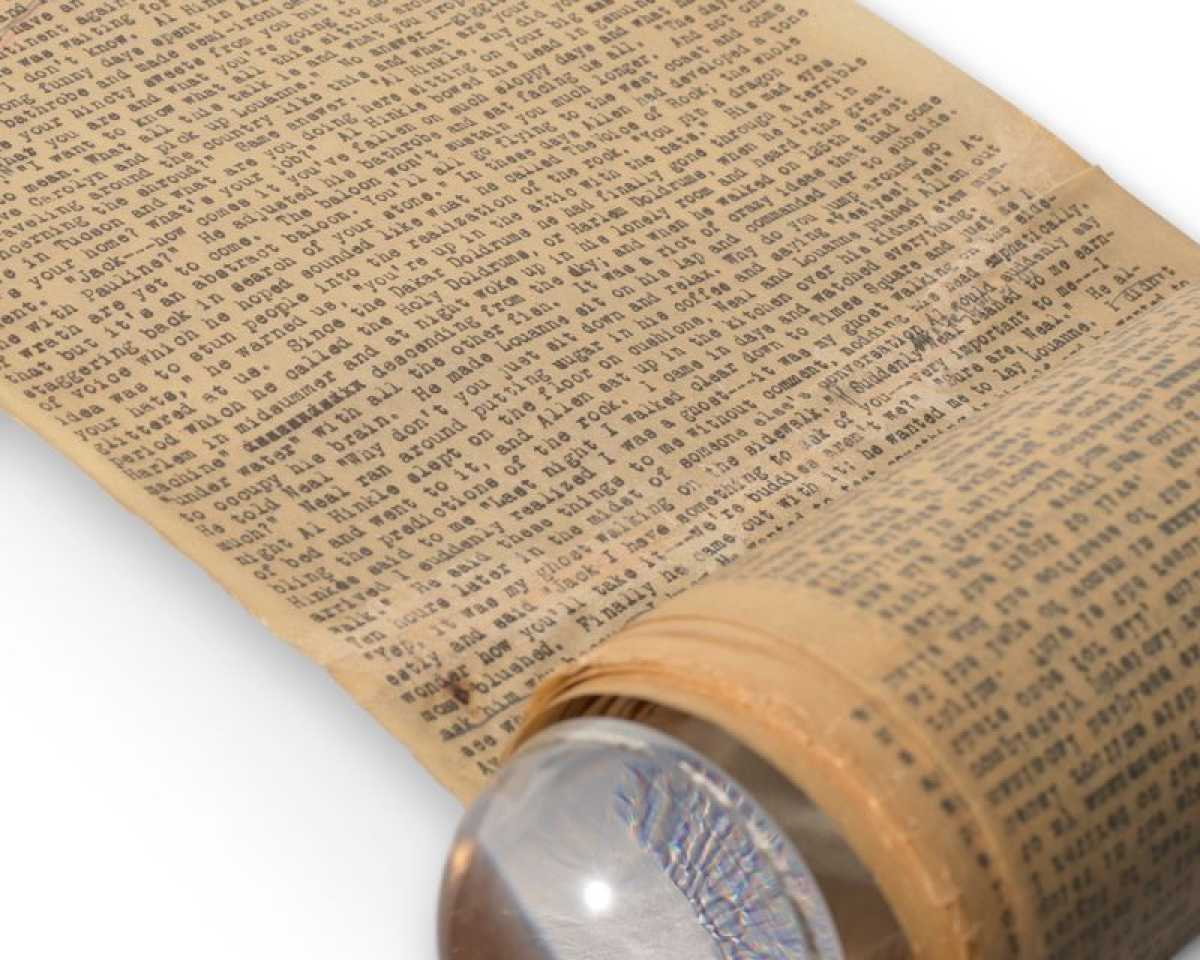
The first major acquisition in Irsay’s collection came in 2001, with his $2.4-million purchase of the original 120-foot scroll for Jack Kerouac’s 1957 novel, “On the Road.” He loved the book and wanted to preserve it, Walker said. But he also frequently lent it out, just like he regularly toured his guitar collection beginning 20 years later.

A scroll of writing.

Jim Irsay purchased the original 120-foot scroll manuscript of Jack Kerouac’s “On the Road” for $2.4 million in 2001.

(Christie’s Images)

Advertisement

“He said publicly, ‘I’m not the owner of these things. I’m just that current custodian looking after them for future generations,’ ” Walker said. “And I think that’s what true collectors always say.”

At its L.A. highlight exhibition, Irsay’s collection held an air of synchronicity. Paul McCartney’s handwritten lyrics for “Hey Jude” hung just a few steps from a promotional poster — the only one in existence — for the 1959 concert Buddy Holly, Ritchie Valens and J.P. “The Big Bopper” Richardson were en route to perform when their plane crashed. The tragedy spurred Don McLean to write “American Pie,” about “the day the music died.”

Holly was McCartney’s “great inspiration,” Christie’s specialist Zita Gibson said. “So everything connects.”

Later, the Beatles’ 1966 song “Paperback Writer” played over the speakers near-parallel to the guitars the song was written on.

Irsay’s collection also contains a bit of whimsy, with gems like a prop golden ticket from 1971’s “Willy Wonka & the Chocolate Factory” — estimated between $60,000 and $120,000 — and reading, “In your wildest dreams you could not imagine the marvelous surprises that await you!”

Advertisement

Another fan-favorite is the “Wilson” volleyball from 2000’s “Cast Away,” starring Tom Hanks, estimated between $60,000 and $80,000, Gibson said.

Historically, such objects were often preserved by accident. But as the memorabilia market has ballooned over the last decade or so, Gibson said, “a lot of artists are much more careful about making sure that things don’t get into the wrong hands. After rehearsals, they tidy up after themselves.”

If anything proves the market value of seemingly worthless ephemera, Walker added, it’s fans clawing for printed set lists at the end of a concert.

“They’re desperate for that connection. This is what it’s all about,” the specialist said. It’s what drove Irsay as well, she said: “He wanted to have a connection with these great artists of his generation and also the generation above him. And he wanted to share them with people.”

In Irsay’s home, his favorite guitars weren’t hung like classic paintings. Instead, they were strewn about the rooms he frequented, available for him to play whenever the urge struck him.

Advertisement

Thanks to tune-up efforts from Walker, many of the guitars headed to auction are fully operational in the hopes that their buyers can do the same.

“They’re working instruments. They need to be looked after, to be played,” Walker said. And even though they make for great gallery art, “they’re not just for hanging on the wall.”

Continue Reading

Movie Reviews

Film reviews: ‘How to Make a Killing,’ ‘Pillion,’ and ‘Midwinter Break’

Published

on

Film reviews: ‘How to Make a Killing,’ ‘Pillion,’ and ‘Midwinter Break’

‘How to Make a Killing’

Directed by John Patton Ford (R)

★★

Continue Reading

Entertainment

After ‘Yellowstone’ and a twist of fate, Luke Grimes rides again as Kayce in ‘Marshals’

Published

on

After ‘Yellowstone’ and a twist of fate, Luke Grimes rides again as Kayce in ‘Marshals’

This story contains spoilers for the pilot of “Marshals.”

When the curtain came down on “Yellowstone” last year, Kayce Dutton had finally found his happily-ever-after.

The youngest son of wealthy rancher John Dutton (Kevin Costner) had secured a modest cabin in a mountainous region where he could reside in secluded peace with his beloved wife, Monica (Kelsey Asbille), and son, Tate (Brecken Merrill), far from the turbulent dysfunction of his family.

“Kayce found his little peace of heaven, getting everything he ever wanted and fought for,” said Luke Grimes, who plays the soft-spoken Dutton in “Yellowstone.”

Grimes reprises the role in CBS’ “Marshals,” which premiered Sunday. But in the new series, Kayce’s serenity has been brutally shattered, forcing him to find a new path forward after an unimaginable tragedy.

Advertisement

The drama is the first of several planned spinoffs of “Yellowstone,” which became TV’s hottest scripted series during its five-season run. And while some familiar faces return and events unfold against the magnificent backdrop of towering mountains and lush greenery, “Marshals” is definitely not “Yellowstone” 2.0.

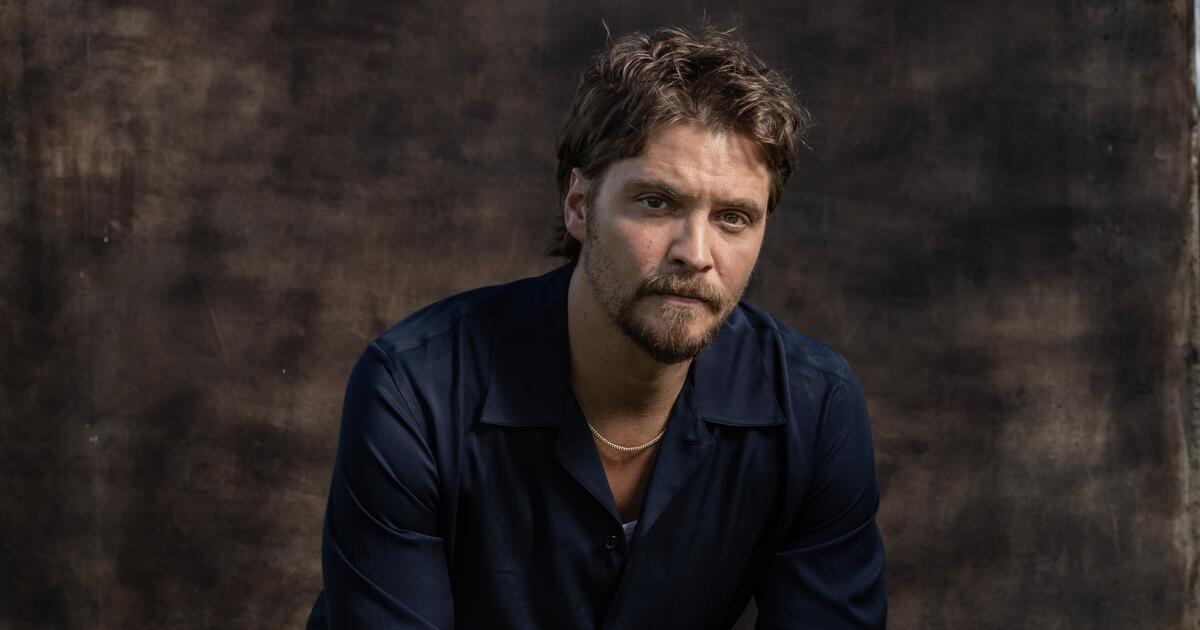
Luke Grimes as Kayce Dutton in “Marshals,” which combines the gritty Western flavor of “Yellowstone” with the procedural genre.

(Sonja Flemming / CBS )

In “Marshals,” Kayce joins an elite squad of U.S. Marshals headed by his Navy SEAL teammate Pete Calvin (Logan Marshall-Green). The drama combines two distinct brands — the gritty Western flavor of “Yellowstone” with the procedural genre, a flagship of CBS’ prime-time slate.

Advertisement

During an interview at an exclusive club in downtown Los Angeles, Grimes expressed excitement about dusting off his cowboy hat and boots, though he admitted to having initial concerns about whether the project was a fit.

“I had never watched a procedural before, so I had to do some homework on what that was,” Grimes said hours before the gala premiere of “Marshals” at the Autry Museum of the American West in Griffith Park. “And I just couldn’t wrap my head around it at first. In the finale, Kayce had ridden off into the sunset. So I thought, ‘Let him be, let him go.’ ”

Those doubts eventually ebbed away.

“To be honest, there was a part of me that didn’t want to let Kayce go just yet,” Grimes said. “Saying goodbye to him was really hard, so the opportunity to keep this going was something I couldn’t pass up. We get to show his backstory and also this other side of him that we didn’t see in ‘Yellowstone.’ ”

But this Kayce is a man in crisis. “Yellowstone” devotees will likely be shocked by the “elephant in the room” — the revelation in the pilot episode that Monica has died of cancer. The couple’s sexy and loving chemistry was a key element in the series while also establishing Grimes as a heartthrob.

Advertisement

“I think fans will be upset — and they should be,” Grimes said as he looked downward. “Kayce is very upset. It’s the worst thing that could have happened to him. But as much as I’m really upset not to work with Kelsey, it’s a good idea for the show.”

He added, “His dream life is no longer available to him. Now the only thing he has is his son, who is not so sure he wants the same life as Kayce. A big part of the season is Kayce learning how to manage all these new things — new job, being a single father.”

A bearded man with his hands in his jeans looking downward.

“His dream life is no longer available to him. Now the only thing he has is his son, who is not so sure he wants the same life as Kayce,” said Luke Grimes about his character Kayce.

(Jay L. Clendenin / For The Times)

Executive producer and showrunner Spencer Hudnut (CBS’ “SEAL Team”) acknowledged in a separate interview that viewers may be stunned by the tragedy. “Real life intervenes for Kayce. Unfortunately it happens to so many of us.”

Advertisement

But he stressed that although Monica is physically gone, her presence will be heavily felt this season.

“She is guiding Kayce, and their relationship is moving forward,” Hudnut said. “His dealing with his inability to confront his grief is a big part of the season. It became clear that something horrible had to happen to put Kayce on a different path.”

As the development evolved, Grimes embraced the procedural concept: “This is a very different show and structure. This is an action show, very fast paced. I meet a lot of fans who say they really want to see Kayce go full Navy SEAL.”

Alumni from “Yellowstone” returning in “Marshals” include Gil Birmingham as tribal Chairman Thomas Rainwater and Mo Brings Plenty as his confidante Mo.

“Yellowstone” co-creator Taylor Sheridan, who had already spearheaded the prequels “1883” and “1923,” will further expand the “Yellowstone” universe later this month with “The Madison,” starring Michelle Pfeiffer and Kurt Russell, about a New York City family living in Montana’s Madison River territory. Later this year, Kelly Reilly and Cole Hauser will star in “Dutton Ranch,” reprising their respective “Yellowstone” roles as John Dutton’s volcanic daughter Beth Dutton and her husband, boss ranch hand Rip Wheeler.

Advertisement

Hudnut said fans of “Yellowstone” will recognize themes that were central to that series: “The cost and consequences of violence, man versus nature, man versus man.”

“We’re trying to tap into what people loved about ‘Yellowstone’ but to tell the story in a different framework,” he said. “The procedural brand is obviously very successful for CBS. And nothing has been bigger than ‘Yellowstone.’ So the challenge is, how do you marry those things?”

Taking on the lead role prompted Grimes to reflect on how “Yellowstone” transformed his life after co-starring roles in films like “American Sniper” and “Fifty Shades of Grey” and playing a vampire in the TV series “True Blood.”

“‘Yellowstone’ changed my life in many, many ways,” he said. “The biggest change is that I now live where we shot the show in Montana. The first time I went there, I would have never thought I would ever live there.

“I would come back to the city after shooting. But a little bit more each year, I felt more out of place here, and more peace and at home there. I’m a big nature person — I never was a big city person, but I had to be here to do what I wanted. But after the third season, my wife and I decided to move there. We wanted to start a family.”

Advertisement

The topic of a Kayce spinoff kept coming up during the filming of the finale, but “meanwhile we were having a baby, so that was the biggest thing on my plate.”

A man in a blue shirt standing with his arms crossed as horses with saddles graze in the background.

“‘Yellowstone’ changed my life in many, many ways,” said Luke Grimes.

(Jay L. Clendenin/For The Times)

Grimes was also dealing with the off-screen drama that impacted production due to logistical and creative differences between Costner and Sheridan. Costner, who was the show’s biggest attraction, exited after filming the first part of the final season. His character was killed off.

Asked about the backstage tension, Grimes said, “I just tried to do my job to the best of my ability, and not get caught up in all that. It was sort of frustrating, but I felt lucky to have a job.”

Advertisement

He recalled getting a call from Sheridan about the plans for a spinoff: “He said, ‘I think you should talk to the guy who is going to be the showrunner. I’m not telling you to do it, and I’m not telling you not to do it. But Spencer is great and he has some good ideas.’ ”

Hudnut said Kayce “was always my favorite character. Also, Luke is not Kayce. Kayce is an amazing character, but Luke is really thoughtful and smart. He is a true artist and has an artist’s soul, while Kayce is kicking down doors and terrorizing people. And Luke has such a great presence. He can do so much with just a look to the camera. He is a true leading man.”

In addition to starring in “Marshals,” Grimes is also an executive producer. He pitched the opening sequence — a flashback showing Kayce in the battlefield. He also performs the song that plays over the final scene, in which he visits his wife’s grave. The ballad is from Grimes’ self-titled country album which was released last year.

“Luke’s creative fingerprints are all over the pilot,” Hudnut said.

Grimes said he does not feel pressure about being the first follow-up from “Yellowstone” to premiere.

Advertisement

“We’re not trying to make the same show, so no matter what happens, its a win-win,” he said. “I had a blast doing it.”

Continue Reading

Trending