Entertainment
Jordan Jensen's comedy is for freaks, but she hopes normies still relate to her Netflix special


Jordan Jensen’s comedy is hard to categorize, just like the rest of her. And while that’s generally how we like our funny people — layered, nuanced, tortured — it tends to wreak havoc on the actual lives of the comics themselves. Not quite fitting in a box (even though she definitely knows how to build one) has basically been Jensen’s schtick since birth. She grew up in upstate New York, raised in a heavy-construction family that included three lesbian moms and a dad who died when she was young. Because of that unconventional background, she says her level of hormone-fueled boy craziness mixed with her rugged ability to swing a hammer and basically turned her into “a gay man.” Somewhere in her teens she hit a “fat mall goth” phase that never left her, even after becoming a popular comedian worthy of a Netflix special. Combining her inner Hot Topic teen with freak-flag feminism and alpha-male energy, her style makes not fitting in feel like one of the coolest things you can do — because it is.
On a recent Saturday night, before her new Netflix special “Take Me With You” drops Tuesday, Jensen prepared herself for one last run of weekend shows before starting from scratch with material for a new hour. Before going onstage in front of a crowd of a suburban crowd at the Brea Improv, the comedian’s Zen-like confidence felt like yet another thing she’s built from the ground up, along with her comedy career … and probably a patio deck or two. But onstage, her love of all things spastically weird and macabre makes her humor a fun and frightening project to unpack for fans and unsuspecting “normie” audiences alike.
How does this moment before your Netflix special “Take Me With You” drops feel for you? Are you past the anxiety of it?
I can’t see the numbers, so if it tanks, I won’t know — so I like that. I’m slightly dissociated because it’s already been done, so I feel good; I don’t feel anxious about it now. I was definitely anxious leading up to it. But the second that night [of filming it] was over it was a relief.
And you filmed it in New York City [at the Gramercy Theatre]. But where did your comedy career actually start?
My career really started in Nashville, and then I moved to New York after a year. I’m originally from upstate New York. I grew up in Ithaca and then I moved to Buffalo and started trying to do comedy. I moved to Buffalo because my friend became paralyzed, and I moved there to be near here, and then I basically started doing open mic in front of her paralyzed body because she wasn’t allowed to run away. Then my dad died, and I was going to move to New York City and instead [some friends of mine living in Nashville] said I should come live with them, so I did that instead for a year and really got into comedy there before eventually moving back to New York.
Did doing comedy in Nashville help you develop your career?
Definitely. I met [comedian] Dusty Slay, who helped me out. Lucy [Sinsheimer] from [the comedy club] Zanies got me all this feature work, and I drove my truck all around the South.
What is like to hit the touring circuit hard as a young comedian?
You do an open mic and someone says you can be on a show, and suddenly you think you’re hot s—, and every step of the way you kinda think you’re doing really well, so you’re driving around being like, “I’m on tour,” and making weird tour posters, and you’re not even looking at people who are at a different level; you’re just trying to do the most you can do at your level. So, for me, it was the same as it is now. I’m on tour every weekend, and I’ll come back home and hit the [open mics] and get my material and go off again. Even though I was losing money on the road, I felt like I was a touring comic.
You have jokes in “Take Me With You” about going through a ”mall goth” phase. Are you still a goth kid on the inside?
I stayed in a little punk era in Nashville and dabbled in being everything from punk to goth to hippie to whatever was the shape of my body at that time. But Nashville being similar to where I’m from, which is Ithaca, where I worked as a carpenter, it reaffirmed that you can be a dirty carpenter, and that’s also kinda cool. So I said I’m just gonna dress like I do at work. So I stopped being full goth in ninth grade when I wanted to get a boyfriend.
Judging by the blood–red stage design for your special, I’d say you’re still a little goth. What was your thought process for how you wanted your stage to look?
I’m obsessed with “Rocky Horror Picture Show” and with Dr. Frank-N-Furter as a character, this bizarre alien trying to fit in with humanity and he’s this beautiful [trans person], you don’t know if he’s a man or woman — and I feel very similar to that. I don’t feel transgender, but I do feel like an alien. So I wanted it to feel like I had scrapped together a set to basically put on a show for my weird alien crowd. And I wanted the red in the curtains to be reminiscent of period blood, reproductive organs. I wanted it be really gnarly, and with the construction netting, I have a construction background, so I wanted it to look like somebody said, “You’re doing a Netflix special” and I’m just a weird creature going, “OK, time to do my big day!” and the stage crew did a great job with that direction.
Were you working in construction right up until you started doing comedy full time?
Yeah, I built houses with my parents and I’ve roofed. I’ve done mason work and landscaping and stuff. But in New York I did remodeling, so I’d do things like turn a crepe shop into a hair salon. So it was like flipping places in New York and making them hip and trendy. And nobody should’ve hired me; there’s nothing better than an all-male construction crew, and I was one woman. People were just so proud of patting themselves on the back for hiring a woman that they didn’t notice I took four times as long as a regular crew — and I hired a lot of day laborers.
In your special, you talk about battling the lesbian energy that you get labeled with in comedy, but I’m guessing that also happened in the construction gig?
It’s always been that way because I was raised by lesbians and they [didn’t] know how to raise a feminine child; they just raised me to be in their construction crew. And my dad wanted a son so I became his son, so I’ve always been super boy crazy and also so boy crazy in that I look and dress like a boy. So I’m basically a gay man … it’s not only being a woman that’s in the trades, but if you have any sort of energy that’s utilitarian, you’re gay and that’s always been a problem for me. Because I’ve liked cars or efficiency and building things, and I’ve never understood dressing up with makeup and jewelry.

“I’m obsessed with ‘Rocky Horror Picture Show’ and with Dr. Frank-N-Furter as a character, this bizarre alien trying to fit in with humanity and he’s this beautiful [trans person], you don’t know if he’s a man or woman,” Jensen said. “And I feel very similar to that.”
(Mindy Tucker)
As a New York comic, what’s your perception of the L.A. comedy scene right now?
The L.A. scene has less of a fire under its ass, but it has the same amount of good comics — or roughly the same amount because of the population difference. But the difference between doing comedy in L.A. and doing comedy in New York is if you don’t write a new joke in New York every week, everybody knows. Whereas in L.A. they can chill more — they have a dog, they have a hike, they can do ayahuasca, and there’s more to life than comedy.
But in New York, you have 10 people living with you and you have to take a train every day, and you’re so comedy-focused because you’re trying to climb out of that life and into the comfy place of L.A. So they’re just as good, but New York comedy is way more prolific, but [in] L.A. they’re just as funny. Like Josh Johnson, I don’t think that guy is coming out of L.A. Because we’re trying to get to where the L.A. people are — they’re comfortable and have a nice house and they’re gonna be OK. But in New York we’ve committed our lives to being miserable so that we keep producing.
What’s a note that Netflix producers gave you before the filming process of your special that you didn’t follow?
Netflix was like, “All that stuff that’s f— up about your family, put that way sooner in the special,” and I ended up not doing that because the way I do my regular set I try to ease them into that. Because when if you’re sitting there as a watcher, listening to all the stuff I say about my dad, you need to be loose. Netflix was like, “Just put it up top because it’s your story,” and I decided I’m just gonna go it how I normally do it, because I get it that it’s my story, but I can imagine turning that s— off so fast once your hear some of that stuff. Just like, “No!” So I’m trying to get you to understand me and then letting it rip. The first half-hour is my story, but it isn’t about being raised by lesbian moms and having the dead dad. I just had to gamble and not do the whole closer first thing and do a ramp-up instead.
Considering you’ve now achieved getting a Netflix special, do you think you’re still as hungry as you were before?
I thought the hunger would turn down a bit, but it doesn’t because as soon as the hour is done, you just have all this pressure to come up with a new hour, and the whole thing comes down to performance. When you’re onstage, you want to be giving them a really good show. So even though I can rest on my laurels, I can’t do anything from the special; I don’t want them to watch the special on Tuesday and see repeats. So I feel better on myself, but there’s no less drive. The special didn’t do what I thought it would do; I thought it would make me less of a love addict, I thought it make me less desperate to have people’s affection, but it doesn’t do s—. The only thing I care about is that women from Middle America who are not disgusting mongrels see the special. I want men and normie women to see the special — that’s why Netflix is important. Because my audience is all freaks, but I need nonfreaks to see it so they can feel freaky for an hour. That’s all I want.

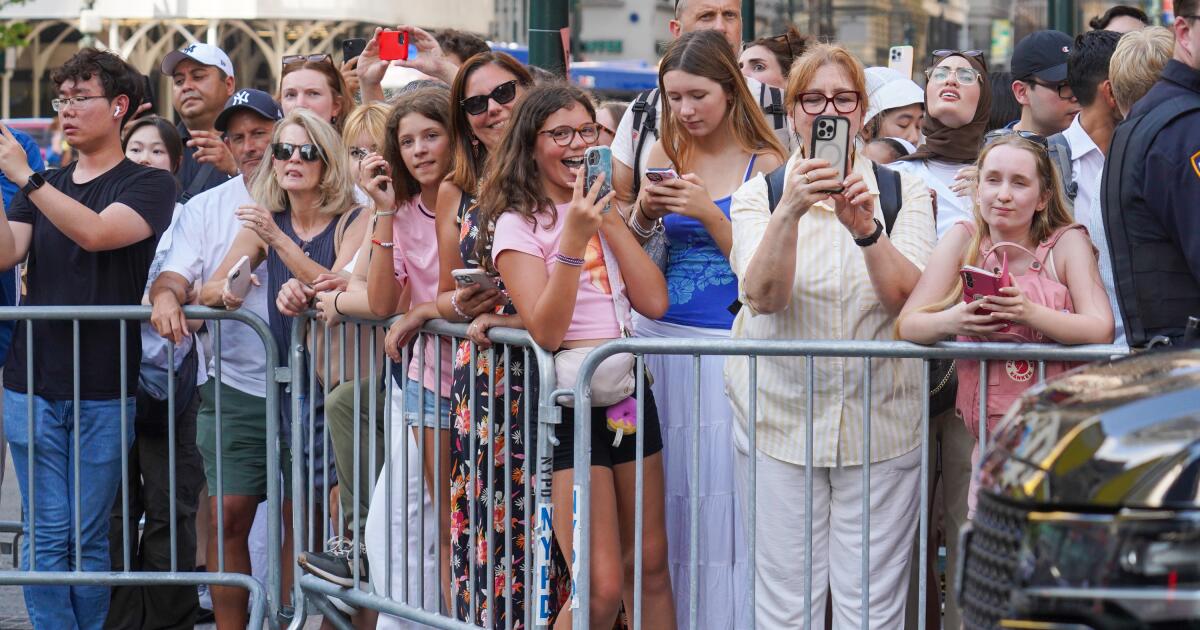
NEW YORK — Manhattan was sweltering at 100 degrees and preparing to mark 250 years since the United States declared independence from Great Britain.
But on Friday, the city seemed transfixed by what might be the closest the country gets to a royal wedding: The nuptials of pop superstar Taylor Swift and Kansas City Chiefs tight end Travis Kelce.
The two were married Friday night, but the party is expected to continue into the morning. Swift’s publicist confirmed the marriage to several news organizations.
Madison Square Garden and its surrounding streets — 31st and 33rd streets toward 6th and 8th avenues — were blocked off as guests arrived for the event. Fans craned their necks for any views they could get from the street.
The world-famous arena was reportedly set to transform into a “massive castle,” surrounded by a garden fit for pop culture’s royal couple, both 36. While the complete event details and guest list have been kept a secret, the Associated Press reportedly obtained a city permit showing Friday’s wedding event was set to start at 5 p.m. Eastern time and could last until 4 a.m.
Secrecy surrounding the event is so tight that the reported venue has been cordoned off with privacy tents, tarps and barricades. But neither those measures nor Friday’s sizzling temperatures stopped fans from gathering in hopes of sneaking a peak at their longtime idol and sending Swift their well wishes.
“I heard we won’t be able to see her either way because the spot that they picked is going to be covered,” said Sarah Shrestha, 21, an Anaheim resident visiting friends in Manhattan.
Madison Square Garden was a good venue for the couple’s nuptials because “in interviews, [Swift] said she wanted to be able to invite everybody to the wedding so it’s still a good venue for that,” she added.
Ellie Kitschke, 13, and her mother, Mymy Nguyen, 38, were visiting New York City from Adelaide, Australia.
Ellie said she thought it was a weird choice for the venue.
“It’s like a stadium. I get that no one can come inside but I think it’s a bit much blocking up the roads,” added Ellie, who attended the Eras tour in Sydney with her mom.
The two said they also thought it was odd Swift didn’t choose a venue or date that included her lucky number, 13, saying it “didn’t add up.”
“If she does get married, we wish her well,” Nguyen said. “We’d love to see her.”
Emma Rasco, 19, was also surprised by the choice in wedding venue.
“When I heard it, I was like, that’s definitely a choice,” Rasco said. “It’s a little unconventional and very forward-facing.”
Swift and Kelce announced their engagement in August after two years of dating, to much fanfare. “Your English teacher and your gym teacher are getting married,” Swift wrote in the caption of her Instagram post.
While the Swift camp didn’t release a guest list, various news organizations staked out local hotels and Madison Square Garden and began counting bold-face names headed to the event. The New York Times obtained a schedule for the wedding, which included a cocktail hour followed by a 5 p.m. wedding and reception. The event was set to end at 2 a.m.
The AP reported the guests included Hugh Grant, Ethan Hawke and Jason Sudeikis, Karlie Kloss and Kareem Hunt.
The couple were first linked in July 2023, when Kelce mentioned his desire to meet the pop superstar on his podcast, “New Heights,” and made their relationship public that September. Their coupling instantly captured the attention and hearts of fans around the world, and Swift’s presence at Chiefs games was even credited with bolstering female interest in NFL football.
Kelly, 36, is a longtime Swift fan who said she grew up listening to her music. She came from her apartment on the Upper West Side to 33rd Street to see if she could catch a glimpse of Swift entering the stadium.
“I feel like I was the same peer group growing up with her, and am just so happy that she had her happy ending,” she said. “I want to see what a royal American wedding looks like.”
Kelly said she admires Swift and Kelce for donating to charity. The couple donated a combined $26 million to 20 local and national charities ahead of their nuptials, Swift’s publicist told Business Insider.
“They really are a positive influence,” she added.
Kelly said Madison Square Garden made sense as a venue for the privacy and security of guests.
“It’s not an ideal wedding venue but they’re both creative and have their own stages in a way,” she added.
By mid-afternoon Friday, dozens of fans clustered near MSG as black SUVs and vans with tinted windows, presumably filled with wedding attendees, turned the corner toward the stadium.
New York Police Department sources told The Times that streets will be blocked off all Friday and should return to normal by Saturday morning.
In October, Swift told TV host Graham Norton that she was casting a wide net with the guest list, joking that she would invite “anyone I’ve ever talked to.”
“I shouldn’t have said any of that,” she added.
Pulling off an event of this magnitude — which many described as America’s “royal wedding” — required considerable preparation, with a particular emphasis on privacy. Guests were reportedly required to sign nondisclosure agreements before receiving any event details (although the NDAs were said not to have included any penalties for violating the terms).
The couple were also linked to wedding planner Mark Seed, who previously orchestrated the 2023 wedding of Jack Antonoff and Margaret Qualley and the 2019 wedding of Jennifer Lawrence and Cooke Maroney. Seed is known for his elaborate event builds and notable discretion.
On the Tuesday before the event, workers were photographed installing a red carpet outside of MSG, which one individual reportedly said was for “a wedding,” according to Page Six. It was quickly removed that same day.
Lin reported from New York; Garcia and Rollins-Fife from Los Angeles.

Obsession, dir. Curry Barker
Obsession is the debut feature from director Curry Barker, which follows Bear (Michael Johnston), an awkward teenager desperately in love with his friend Nikki (Inde Navarrette). When he is given a mystical chance to make one wish come true, he decides to make Nikki fall head-over-heels in love with him, unaware of the horrific consequences that will arise. A twisted tale of entitlement and regret, Obsession is eager to let audiences sit with the discomfort it offers.
The film’s cast is mostly made up of unknown actors (Andy Richter not included) who bring life and levity to an, at times, very heavy script. Michael Johnston’s puppy dog eyes and tender demeanour make him apt for this tortured lead, especially as we watch him descend deeper into the hell of his own making. However, Inde Navarrette’s gutting portrayal of Nikki is Obsession’s standout performance, as she carries the weight of the film on her shoulders with seeming ease. Navarrette captures the vacancy and lifelessness that this character requires, with moments of lucidity and terror that will undoubtedly make this a horror performance discussed for years to come.
Obsession is a mean film at its heart — one that does not let the audience feel comfortable at any moment, and that thrives in its grime and dimness. The “hero” of the story is hateable and places every character around him into terrible scenarios, leaving the audience to squirm as he tries to make things right. Barker’s direction provides palpable suspense for moments of sudden intensity and horror, yet the film remains comedic in its efforts to relieve tension. I, however, left this screening with a pit in my stomach. Highly recommend!
Dead Lover, dir. Grace Glowicki
Presented at my screening in sickly “Stink-O-Vision,” Dead Lover is the sophomore feature of writer, director, and actress Grace Glowicki. Inspired by works of Gothic horror like Frankenstein and The Cabinet of Dr. Caligari, Dead Lover is a gloriously grotesque, goofy, and grody romantic horror-comedy that centres a smelly gravedigger (Glowicki) who goes to monstrous and comedic extremes to reanimate her one true love (Ben Petrie) after he perishes at sea.
Though the film is co-written by her partner and frequent collaborator, Ben Petrie, Dead Lover feels like Glowicki’s brain-child, harnessing her aptitude for the cartoonish and the outrageous. This is best exemplified through its use of Stink-O-Vision, a scratch-and-sniff technology seen previously in John Waters’ “Odorama” for Polyester, placing these filmmakers in conversation for their vulgarity, comedic stylings, and embracement of camp.
Dead Lover, shot entirely on black-box stages over the course of two weeks, uses only four actors playing multiple parts in heightened makeup and costumes, evoking the feeling of a filmed stage show. The film employs over-the-top performances, handcrafted sets, stage props, and colourful, high-contrast lighting reminiscent of German expressionism. Indeed, Glowicki’s directorial vision seems to be heavily inspired by the handmade aesthetics and experimentalism of independent theatre and silent-era filmmaking, akin to the work of fellow Canadian, Guy Maddin.
Dead Lover’s plot is more of a contrivance to get to the next excellent set piece, disgusting smell, or gonzo performance, though still remaining full of twists and tenderness. While the film may grate at times and the sickly scents conjured by the scratch-and-sniff cards were certainly gag-inducing, Dead Lover carries an infectious sense of fun and delight that keeps audiences laughing. Recommend!
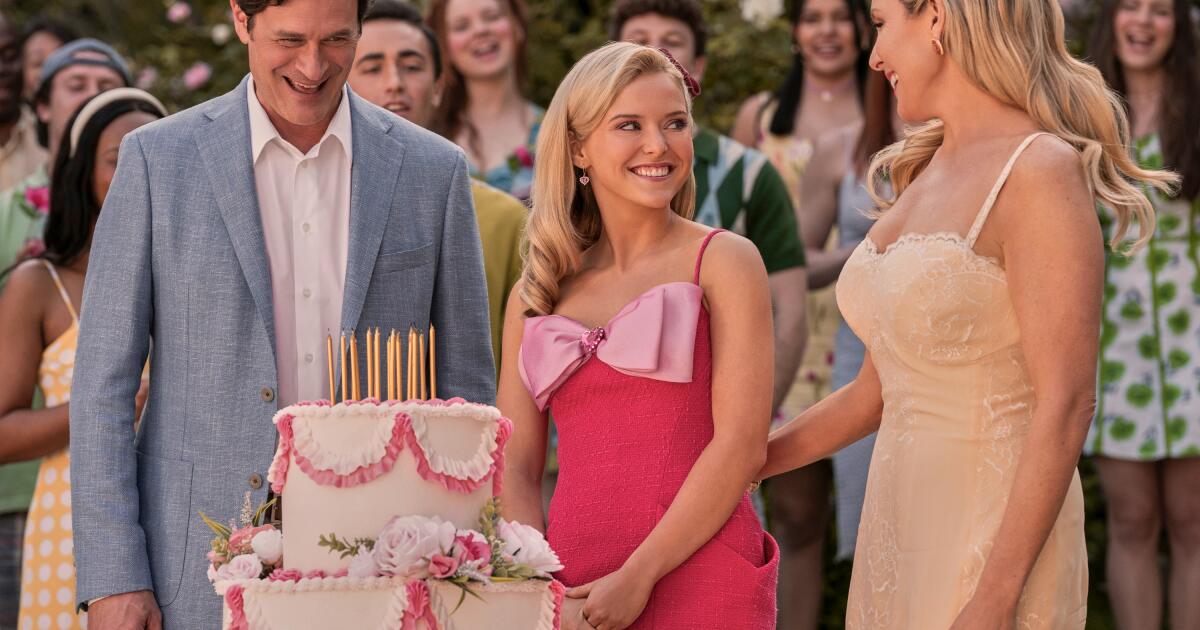
“I’ve talked about rain on this show more than I have in my entire life,” Kittrell says.
It was a constant consideration, both on set and in the writers room. Weather became a way to distinguish Elle from those around her in Seattle. The locals never carry umbrellas; Elle shows up with a pink one.
“We had a writer from Seattle who always said the city gets a bad rap because of the rain,” Kittrell says. “But the rain is what makes it beautiful — it makes Seattle green.”
Elle entering the halls of Rainier West High School with her pink umbrella.
(Kimberley French / Prime Video)
That philosophy stayed with the writers, later showing up in a line Miles (Jacob Moskovitz), Elle’s crush, says to her, and ultimately leading them to Garbage’s “Only Happy When It Rains” as the show’s theme. “We were like, of course,” says Kittrell. “This is what we’ve been talking about the entire time.”
The song was originally meant to end the pilot. “Then we decided we should just be hearing it in every single episode,” says Neustadter. (The pilot instead uses Radiohead’s “Creep,” which also bookends the series.) The main title sequence, an animated “saga sell” from the studio Shine, tells the story of Elle’s move from Bel-Air to Seattle.
“We’re constantly reminding the audience of the contrast between Elle’s essence and the world she’s now in,” Neustadter adds. “There’s an optimism to ‘Only Happy When It Rains’ that feels very Elle Woods. And the irony of it is so delightful.”
-

 Technology3 minutes ago
While you’re watching the World Cup, the feds may be watching you
-

 World10 minutes ago
Conservative Keiko Fujimori officially declared winner of Peru’s presidential runoff election
-

 Politics13 minutes ago
Trump hails America as ‘most exceptional nation ever to exist’ in Mount Rushmore speech
-

 Health18 minutes ago
Scientists discover possible link between 9/11 and accelerated aging
-

 Sports25 minutes ago
Messi, Argentina avoid a shocking upset in wild knockout stage match against Cape Verde
-

 Technology28 minutes ago
Zoox robotaxi redesign brings big rider upgrades
-
 Business33 minutes ago
Commentary: It’s not just vaccines — from infancy to adolescence, Republicans are waging war on children’s health
-
Entertainment40 minutes ago
Taylor Swift, Travis Kelce married at lavish Madison Square Garden wedding

