Entertainment
Inga Ibsdotter Lilleaas breaks out in ‘Sentimental Value.’ But she isn’t interested in fame


One of the most moving scenes in Joachim Trier’s “Sentimental Value” happens near the end. During an intense moment between sisters Nora (Renate Reinsve) and Agnes (Inga Ibsdotter Lilleaas), who have both had to reckon with the unexpected return of their estranged father, Gustav (Stellan Skarsgård), Agnes suddenly tells Nora, “I love you.” In a family in which such direct, vulnerable declarations are rare, Agnes’ comment is both a shock and a catharsis.
The line wasn’t scripted or even discussed. Lilleaas was nervous about spontaneously saying it while filming. But it just came out.
“[In] Norwegian culture, we don’t talk so much about what we’re feeling,” explains Lilleaas, who lives in Oslo but is sitting in the Chateau Marmont lounge on a rainy afternoon in mid-November. If the script had contained that “I love you” line, she says, “It would’ve been like, ‘What? I would never say that. That’s too much.’ But because it came out of a genuine feeling in the moment — I don’t know how to describe it, but it was what I felt like I would want to say, and what I would want my own sister to know.”
Since its Cannes premiere, “Sentimental Value” has been lauded for such scenes, which underline the subtle force of this intelligent tearjerker about a frayed family trying to repair itself. And the film’s breakthrough performance belongs to the 36-year-old Lilleaas, who has worked steadily in Norway but not often garnered international attention.
Touted as a possible supporting actress Oscar nominee, Lilleaas in person is reserved but thoughtful, someone who prefers observing the people around her rather than being in the spotlight. Fitting, then, that in “Sentimental Value” she plays the quiet, levelheaded sister serving as the mediator between impulsive Nora and egotistical Gustav. Lilleaas has become quite adept at doing a lot while seemingly doing very little.
“In acting school, some of the best characters I did were mute,” she notes. “They couldn’t express language, but they were very expressive. It was freeing to not have a voice. Agnes, she’s present a lot of the time but doesn’t necessarily have that many lines. To me, that’s freedom — the [dialogue] very often comes in the way of that.”
Inga Ibsdotter Lilleaas in “Sentimental Value.”
(Kasper Tuxen)
Lilleaas hadn’t met Trier before her audition, but they instantly bonded over the challenges of raising young kids. And she sparked to the script’s examination of parents and children. Unlike restless Nora, Agnes is married with a son, able to view her deeply flawed dad from the vantage point of both a daughter and mother. Lilleaas shares her character’s sympathy for the inability of different generations to connect.
“A lot of parents and children’s relationships stop at a point,” she says. “It doesn’t evolve like a romantic relationship, [where] the mindset is to grow together. With families, it’s ‘You’re the child, I’m the parent.’ But you have to grow together and accept each other. And that’s difficult.”
Spend time with Lilleaas and you’ll notice she discusses acting in terms of human behavior rather than technique. In fact, she initially studied psychology. “I’ve always been interested in the [experience] of being alive,” she says. “Tremendous grief is very painful, but you can only experience that if you have great love. I’ve tried the more psychological approach of studying people, but it wasn’t what I wanted. Acting is the perfect medium for me to explore life.”
Other out-of-towners might be disappointed to arrive in sunny Southern California only to be greeted by storm clouds, but Lilleaas is sanguine about the situation. “I could have been at the beach, but it’s fine,” she says, amused, looking out the nearby windows. “I can go to the movies — it’s perfect movie weather.”


Inga Ibsdotter Lilleaas. (Evelyn Freja / For The Times)
Her measured response to both her Hollywood ascension and a rainy forecast speak to her generally unfussed demeanor. During our conversation, Lilleaas’ candor and lack of vanity are striking. How often does a rising star talk about being happy when a filmmaker gives her fewer lines? Or fantasize about a life after acting?
“Some days I’ll be like, ‘I want to give it up. I want to have a small farm,’” she admits. “We lived on a farm and had horses and chickens when I grew up. I miss that. But at the same time, I need to be in an urban environment.”
She gives the matter more thought, sussing out her conflicted feelings. “Maybe as I grow older and have children, I feel this need to go back to something that’s familiar and safe,” she suggests. “I think that’s why I’m searching for small farms [online] — that’s, like, a dream thing. I need some dreams that they’re not reality — it’s a way to escape.”
Lilleaas may have decided against becoming a psychologist, but she’s always interrogating her motivations. This desire for a farm is her latest self-exploration, clarifying for her that she loves her profession but not the superficial trappings that accompany it.
“Ten years ago, this would maybe have been a dream, what’s happening now,” she says, gesturing at her swanky surroundings. “But you realize what you want to focus on and give value. I don’t necessarily want to give this that much value. I appreciate it and everything, but I don’t want to put my heart in it, because I know that it goes up and down and it’s not constant. I put my heart in this movie. Everything that comes after that? My heart can’t be in that.”



Just when you think Pixar’s petting-zoo cute new movie “Hoppers” is flagrantly ripping off James Cameron, the characters come clean.
movie review
HOPPERS
Running time: 105 minutes. Rated PG (action/peril, some scary images and mild language). In theaters March 6.
“You guys, this is like ‘Avatar’!,” squeals 19-year-old Mabel (Piper Curda), the studio’s rare college-age heroine.
Shoots back her nutty professor, Dr. Fairfax (Kathy Kajimy): “This is nothing like ‘Avatar!’”
Sorry, Doc, it definitely is. And that’s fine. Placing the smart sci-fi story atop an animated family film feels right for Pixar, which has long fused the technological, the fantastical and the natural into a warm signature blend. Also, come on, “Avatar” is “Dances With Wolves” via “E.T.”
What separates “Hoppers” from the pack of recent Pix flix, which have been wholesome as a church bake sale, is its comic irreverence.
Director Daniel Chong’s original movie is terribly funny, and often in an unfamiliar, warped way for the cerebral and mushy studio. For example, I’ve never witnessed so many speaking characters be killed off in a Pixar movie — and laughed heartily at their offings to boot.
What’s the parallel to Pandora? Mabel, a budding environmental activist, has stumbled on a secret laboratory where her kooky teachers can beam their minds into realistic robot animals in order to study them. They call the devices “hoppers.”
Bold and fiery Mabel — PETA, but palatable — sees an opportunity.
The mayor of Beaverton, Jerry (Jon Hamm), plans to destroy her beloved local pond that’s teeming with wildlife to build an expressway. And the only thing stopping the egomaniacal pol — a more upbeat version of President Business from “The Lego Movie” — is the water’s critters, who have all mysteriously disappeared.
So, Mabel avatars into beaver-bot, and sets off in search of the lost creatures to discover why they’ve left.
From there, the movie written by Jesse Andrews (“Luca”) toys with “Toy Story.” Here’s what mischief fuzzy mammals, birds, reptiles and insects get up to when humans aren’t snooping around. Dance aerobics, it turns out.
Per the usual, “Hoppers” goes deep inside their intricate society. The beasts have a formal political system of antagonistic “Game of Thrones”-like royal houses. The most menacing are the Insect Queen (Meryl Streep — I’d call her a chameleon, but she’s playing a bug), a staunch monarch butterfly and her conniving caterpillar kid (Dave Franco). They’re scheming for power.
Perfectly content with his station is Mabel’s new best furry friend King George (Bobby Moynihan), a gullible beaver who ascended to the throne unexpectedly. He happily enforces “pond rules,” such as, “When you gotta eat, eat.”
That means predators have free rein to nosh on prey, and everybody’s cool with it. Because of bone-dry deliveries, like exhausted office drones, the four-legged cast members are hilarious as they go about their Animal Planet activities.
No surprise — talking lizards, sharks, bears, geese and frogs are the real stars here. They far outshine Mabel, even when she dons beaver attire. Much like a 19-year-old in a job interview, she doesn’t leave much of an impression.
Yes, the teen has a heartfelt motivation: The embattled pond was her late grandma’s favorite place. Mabel promised her that she’d protect it.
But in personality she doesn’t rank as one of Pixar’s most engaging leads, perhaps because she’s past voting age. Mabel is nestled in a nebulous phase between teenage rebellion and adulthood that’s pretty blasé, even if a touch of tension comes from her hiding her Homo sapien identity from her new diminutive pals. When animated, kids make better adventurers, plain and simple.
“Hoppers” continues Pixar’s run of humble, charming originals (“Luca,” “Elio”) in between billion-dollar-grossing, idea-starved sequels (“Inside Out 2,” probably “Toy Story 5”). The Disney-owned studio’s days of irrepressible innovation and unmatched imagination are well behind it. No one’s awed by anything anymore. “Coco,” almost 10 years ago, was their last new property to wow on the scale of peak Pixar.
Look, the new movie is likable and has a brain, heart and ample laughs. That’s more than I can say for most family fare. “A Minecraft Movie” made me wanna hop right out of the theater.
Entertainment
Ulysses Jenkins, Los Angeles artist and pioneer of Black experimental video, dies at 79
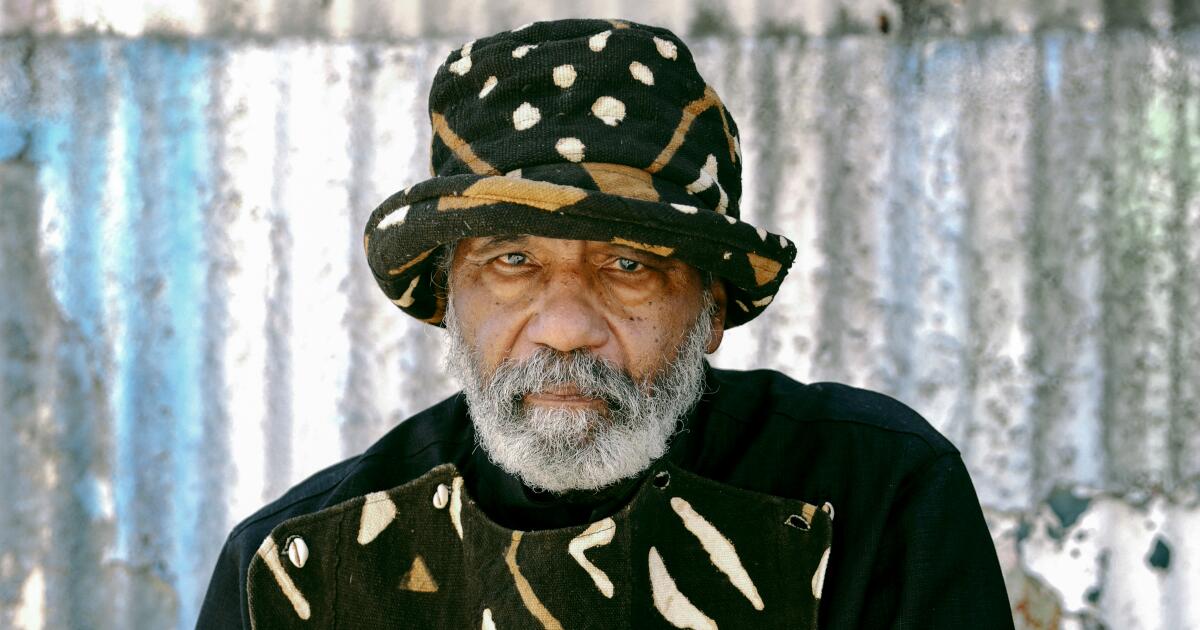
Ulysses Jenkins, the pioneering Los Angeles-born video artist whose avant-garde compositions embodied Black experimentalism, has died. He was 79.
Jenkins’ death was confirmed by his alma mater Otis College, where he studied under renowned painter and printmaker Charles White in the late 1970s and returned as an instructor years later. The Los Angeles art and design school shared a statement from the Charles White Archive, which said, “Jenkins had a profound impact on contemporary art and media practices.”
“A trailblazing figure in Black experimental video, he was widely recognized for works that used image, sound, and cultural iconography to examine representation, race, gender, ritual, history, and power,” the statement said.
A self-proclaimed “griot,” Jenkins throughout his decades-spanning career maintained an art practice grounded in the tradition of those West African oral historians who came before him. Through archival documentaries like “The Nomadics” and surrealist murals like “1848: Bandaide,” he leveraged alternative media to challenge Eurocentric representations of Black Americans in popular culture.
He was both an artist and a storyteller who sought to “reassert the history and the culture,” he told The Times in 2022. That year, the Hammer Museum presented Jenkins’ first major retrospective, “Ulysses Jenkins: Without Your Interpretation.”
“Early video art was about the problems with the media that we are still having today: the notions of truth,” Jenkins said. “To that extent, early video art was a construct that was anti-media … a critical analysis of the media that we were viewing every night.”
Born in 1946 to Los Angeles transplants from the South, Jenkins was ambivalent about the city, which offered his parents some refuge from the blatant systemic racism they encountered in their hometowns, but housed an entertainment industry that had long perpetuated anti-Black sentiment.
“What Hollywood represents, especially in my work, is the classic plantation mentality,” Jenkins told The Times in 1986. “Although people aren’t necessarily enslaved by it, people enslave themselves to it because they’re told how fantastic it is to help manifest these illusions for a corporate sponsor.”
Jenkins, who participated in a group of artists committed to spontaneous action called Studio Z, was naturally drawn to video art over Hollywood filmmaking. “I can address any issue and I don’t have to wait for [the studios’] big OK. I thought this was a land of freedom, and video allows me that freedom and opportunity that I can create for myself and at least feel that part of being an American,” he said.
Jenkins went on to deconstruct Hollywood’s vision of the Black diaspora in experimental video compositions including “Mass of Images,” which incorporates clips from D.W. Griffith’s notoriously racist “The Birth of a Nation,” and “Two-Tone Transfer,” which depicts, in Jenkins’ words, a “dreamscape in which the dreamer awakens to a visitation of three minstrels who tell the story of the development of African American stereotypes in the American entertainment industry.”
Jenkins’ legacy is not only artistic but institutional, with the luminary having held teaching appointments at UCSD and UCI, where he co-founded the digital filmmaking minor with fellow Southern California-based artists Bruce Yonemoto and Bryan Jackson.
As artist and educator Suzanne Lacy penned in her social media tribute to Jenkins, which showed him speaking to students at REDCAT in L.A., “he has been an important part of our histories here in Southern California as video and performance artists evolved their practices.”

4/5 stars
Bounding into cinemas just in time for spring, the latest Pixar animation is a pleasingly charming tale of man vs nature, with a bit of crazy robot tech thrown in.
The star of Hoppers is Mabel Tanaka (voiced by Piper Curda), a young animal-lover leading a one-girl protest over a freeway being built through the tranquil countryside near her hometown of Beaverton.
Because the freeway is the pet project of the town’s popular mayor, Jerry (Jon Hamm), who is vying for re-election, Mabel’s protests fall on deaf ears.
Everything changes when she stumbles upon top-secret research by her biology professor, Dr Sam Fairfax (Kathy Najimy), that allows for the human consciousness to be linked to robotic animals. This lets users get up close and personal with other species.
Montana Lottery Powerball, Lotto America results for March 2, 2026
Nebraska Lottery results: See winning numbers for Powerball, Pick 3 on March 2, 2026

EDITORIAL: Nevada still vulnerable as tourist downturn continues

Bedford man barred from conducting any securities business in New Hampshire

Newark-bound United flight returns to LA airport for evacuation after reported fire

Florida High School Football Rankings: Top 25 teams – Oct. 21

Cleary's 21 help Le Moyne down Central Connecticut State 69-64 in OT

How old is Bo Nix? What to know about Oregon quarterback ahead of 2024 NFL Draft

99th annual Pony Swim held in Virginia

Indiana Members Credit Union announced as new anchor tenant at Bottleworks District

Trump sends official notification to Congress on strikes against Iran

Unexpected birth brings hope to near-extinct Amazon tribe

Supreme Court blocks redrawing of New York congressional map, dealing a win for GOP

Map: Earthquake Shakes Central California

Gas prices could jump as Middle East tensions threaten global oil supply
-

 World5 days ago
Exclusive: DeepSeek withholds latest AI model from US chipmakers including Nvidia, sources say
-

 Massachusetts6 days ago
Mother and daughter injured in Taunton house explosion
-

 Denver, CO5 days ago
10 acres charred, 5 injured in Thornton grass fire, evacuation orders lifted
-

 Louisiana1 week ago
Wildfire near Gum Swamp Road in Livingston Parish now under control; more than 200 acres burned
-

 Technology1 week ago
YouTube TV billing scam emails are hitting inboxes
-

 Politics1 week ago
OpenAI didn’t contact police despite employees flagging mass shooter’s concerning chatbot interactions: REPORT
-

 Technology1 week ago
Stellantis is in a crisis of its own making
-

 Oregon4 days ago
2026 OSAA Oregon Wrestling State Championship Results And Brackets – FloWrestling