Entertainment
In the enjoyable 'Franklin,' Michael Douglas plays a flirtatious founding father

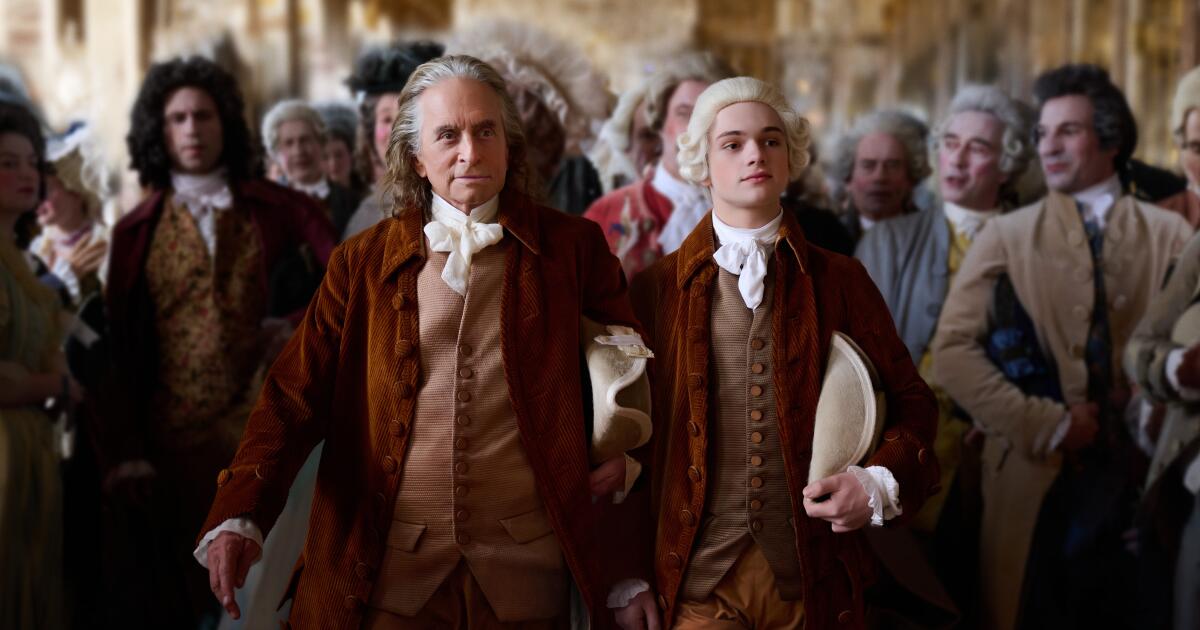
Michael Douglas, star of “Romancing the Stone,” “Fatal Attraction,” “The American President” and so much more, is not the actor one would think of as first in line to play portly, balding man on the money Benjamin Franklin, but he has nevertheless done just that.
In the very enjoyable if not always convincing “Franklin,” which premieres Friday on Apple TV+ and follows the founding father through seven of the nine years he spent in Paris, crafting an alliance with the French and negotiating a peace treaty with the British, he’s neither portly nor balding, but something of a hunk. Franklin’s notoriety in France has been regularly compared to that of a “rock star,” at least since that was a term, and though Douglas, 79, is technically too old for the role — Franklin was 77 when the Treaty of Paris ended the Revolutionary War in 1783 — we live in age of fit septuagenarian pop idols, and Franklin, in his seventies, was reportedly catnip to women. We might say, then, that the actor is playing the essence of the man, rather than the form.
Written top to bottom by Kirk Ellis and Howard Korder and directed by Tim Van Patten, “Franklin” is based on Stacy Schiff’s 2005 lively work of scholarship “A Great Improvisation: Franklin, France and the Birth of America” — which is to say, it borrows its research, changes some things, leaves much out and adds a bunch of stuff, as such projects have done before the movies could talk. It’s a handsome production, a feast for the costumers, the hair and makeup artists, the production designers and set decorators. The crowd scenes are well populated, which I ever regard as a sign of seriousness on the part of the producers, or whoever writes the checks to make that so. And the toy-theater credits are so good I watched them with close attention every time.
The eight-episode series begins in December 1776 as Franklin and his teenage grandson, Temple (Noah Jupe), who has come along to act as his secretary, are rowed ashore in Brittany on a cold and windy night. They make their way to Paris, where Franklin’s coach is mired in admiring crowds.
“They have it in their heads that I invented electricity,” Franklin explains. “Who am I to dissuade them?”
Anne Louise Brillon de Jouy (Ludivine Sagnier) in a scene from “Franklin.”
(Apple TV+)
The Franklins alight into the company of Edward Bancroft (Daniel Mays), who in this telling is conceived as Ben’s bosom buddy, personal physician and nonspecific sometime assistant, and (factually) a man with a secret. Other players are gradually introduced, portrayed with various degrees of historical fidelity. Having been told that he has connections at Versailles, Franklin approaches Pierre-Augustin Caron de Beaumarchais (Assaad Bouab) as he rehearses one of his “Figaro” plays. (There are some nice evocations of late 18th century show business through the series.) Beaumarchais, an exuberant sort who has a habit of referring to himself in the third person, is high on the American project and, when not plopped down in the prompter’s box, will smuggle arms to the rebels.
The wealthy merchant Jacques-Donatien Le Ray de Chaumont (Olivier Claverie) will lodge the Franklin party in a wing of his Passy estate, west of Paris, for the duration, where Franklin will establish a printing press and get chummy with his lovely neighbors: unhappily married Anne Louise Brillon de Jouy (Ludivine Sagnier), who plays the harpsichord and sits with him in the park making up stories about passersby like Woody and Diane in “Annie Hall”; and Anne Louise’s free-spirited, freethinking rival for his profligate affections, Anne-Catherine de Ligniville, Madame Helvétius (Jeanne Balibar), for whom he performs upon his famous glass armonica.
“You are terribly ancient,” she coos to him, “but you still have most of your hair.”
“Perhaps you’d like to fluff it,” Franklin replies.
Among the wining and dining, some work gets done. Thibault de Montalembert (Mathias from “Call My Agent”) plays Louis XVI’s foreign minister Charles Gravier, comte de Vergennes, the man Franklin has to convince to get the king to come to his side. De Montalembert’s somewhat weary authority makes De Vergennes seem like a fully formed human, more than most of the characters here; it’s an unusually warm performance for a person whose scenes are almost entirely centered on political gamesmanship. (That he has a smart wife, played by Isabelle Candelier, whose advice he takes, on work and clothing, makes us like him even more.) Many of Douglas’ best scenes are played opposite him.
Thibault de Montalembert plays Louis XVI’s foreign minister, Charles Gravier, comte de Vergennes, in “Franklin.”
(Apple TV+)
If the series does a thorough job of picturing the highlights of Franklin’s time in Paris, with its romance, intrigue and salon diplomacy — a subject colorful enough that it became a Broadway musical, the 1964 “Ben Franklin in Paris,” with “Music Man” Robert Preston in the title role — it’s less successful when following Temple’s largely imagined adventures. I would guess that at some point in the series’ development the grandfather-grandson relationship seemed a profitable peg on which to hang the narrative. And there was real-life drama in the family, involving Franklin’s son and Temple’s father, William Franklin, the royal governor of New Jersey, who supported the crown and plotted against the Americans, causing a rift never to heal, which is cataloged here if not explored. There is “errata in every man’s life,” says Franklin, ever the Philadelphia printer, when his grandson accuses him — fairly, unfairly, who are we to judge — of being a bad husband, parent, etc.
But the Temple storyline, which runs for the most part on a separate track from Franklin’s and occupies a good deal of screen time, seems designed primarily to get some roistering young people into a series dominated by sedentary middle-age and elderly folk. Horses are ridden, swords drawn, revelry reveled.
Invention is unavoidable in such a project, but the plotting around Temple feels increasingly unlikely — even in the fictionalized context it’s too goofy by half — to the point that the character himself becomes annoying. He falls in with not so much bad as boisterous companions, of whom the most serious is Gilbert du Motier, Marquis de Lafayette (Théodore Pellerin), itching to get to America and kill British soldiers. His friends fill his head with notions and dust his face with powder, and Paris, against whose temptations his grandfather has warned him, does the rest. It’s like a teenage “Rake’s Progress.” Will Temple come to his senses in time to witness the Treaty of Paris, concluded with late-arriving John Adams (Eddie Marsan), Franklin’s temperamental nemesis — his frenemesis — forever incensed over what he sees as the older man’s devil-may-care attitude to just about everything?
Douglas has opted for a strangely dry, deliberate delivery, which, for all anyone knows, might be exactly the way Franklin spoke. (The Ben I hear in my head is the one played by Stan Freberg on his album “Stan Freberg Presents the United States of America Volume One: The Early Years,” and that is surely not accurate.) Paradoxically — or perhaps not, since we are in Paris where Franklin is the foreigner — this “natural” American, who eschews the fripperies of fashionable dress for a trapper’s fur hat and simple cloth clothing, comes off a little stiff. Or perhaps he is being subtle. His most dynamic scenes show him working wordlessly at his printing press; they give us a taste of Franklin’s capability and Douglas’ own.
And as to Franklin’s chronologically asymmetrical flirtations, well, let’s remember who’s married to Catherine Zeta-Jones.



Entertainment
Stephen A. Smith doubles down on calling ICE shooting in Minneapolis ‘completely justified’

Stephen A. Smith is arguably the most-well known sports commentator in the country. But the outspoken ESPN commentator’s perspective outside the sports arena has landed him in a firestorm.
The furor is due to his pointed comments defending an Immigration and Customs Enforcement agent who fatally shot a Minneapolis woman driving away from him.
Just hours after the shooting on Wednesday, Smith said on his SiriusXM “Straight Shooter” talk show that although the killing of Renee Nicole Good was “completely unnecessary,” he added that the agent “from a lawful perspective” was “completely justified” in firing his gun at her.
He also noted, “From a humanitarian perspective, however, why did he have to do that?”
Smith’s comments about the agent being in harm’s way echoed the views of Deputy of Homeland Security Secretary Kristi Noem, who said Good engaged in an “act of domestic terrorism” by attacking officers and attempting to run them over with her vehicle.
However, videos showing the incident from different angles indicate that the agent was not standing directly in front of Good’s vehicle when he opened fire on her. Local officials contend that Good posed no danger to ICE officers. A video posted by partisan media outlet Alpha News showed Good talking to agents before the shooting, saying, “I’m not mad at you.”
The shooting has sparked major protests and accusations from local officials that the presence of ICE has been disruptive and escalated violence. Minneapolis Mayor Jacob Frye condemned ICE, telling agents to “get the f— out of our city.”
The incident, in turn, has put a harsher spotlight on Smith, raising questions on whether he was reckless or irresponsible in offering his views on Good’s shooting when he had no direct knowledge of what had transpired.
An angered Smith appeared on his “Straight Shooter” show on YouTube on Friday, saying the full context of his comments had not been conveyed in media reports, specifically calling out the New York Post and media personality Keith Olbermann, while saying that people were trying to get him fired.
He also doubled down on his contention that Good provoked the situation that led to her death, saying the ICE agent was in front of Good’s car and would have been run over had he not stepped out of the way.
“In the moment when you are dealing with law enforcement officials, you obey their orders so you can get home safely,” he said. “Renee Good did not do that.”
When reached for comment about his statements, a representative for Smith said his response was in Friday’s show.
It’s not the first time Smith, who has suggested he’s interesting in going into politics, has sparked outside the sports universe. He and journalist Joy Reid publicly quarreled following her exit last year from MSNBC.
He also faced backlash from Black media personalities and others when he accused Democratic Rep. Jasmine Crockett of Texas of using “street verbiage” in her frequent criticisms of President Trump.
“The way that Jasmine Crockett chooses to express herself … Aren’t you there to try and get stuff done instead of just being an impediment? ‘I’m just going to go off about Trump, cuss him out every chance I get, say the most derogatory things imaginable, and that’s my day’s work?’ That ain’t work! Work is, this is the man in power. I know what his agenda is. Maybe I try to work with this man. I might get something out of it for my constituents.’ ”

In 1977, a man named Tony Kiritsis fell behind on mortgage payments for an Indianapolis, Indiana, property that he hoped to develop into an affordable shopping center for independent merchants. He asked his mortgage broker for more time, but was denied. This enraged him because he suspected that the broker and his father, who owned the company, were conspiring to defraud him by letting the property go into foreclosure and acquire it for much less than market value. He showed up at the offices of the mortgage company, Meridian, for a scheduled appointment regarding the debt in the broker’s office, where he took the broker, Richard O. Hall, hostage, and demanded $130,000 to settle the debt, plus a public apology from the company. He carried a long cardboard box containing a shotgun with a so-called dead man’s wire, which he affixed to Hall as a precaution against police interference: if either of them were shot, tackled, or even caused to stumble, the wire would pull the trigger, blowing Hall’s head off.
That’s only the beginning of an astonishing story that has inspired many retellings, including a memoir by Hall, a 2018 documentary (whose producers were consultants on this movie) and a podcast drama starring Jon Hamm as Tony Kiritsis. And now it’s the best current movie you likely haven’t heard about—a drama from director Gus Van Sant (“Good Will Hunting”), starring Bill Skarsgård as Tony Kiritsis and Dacre Montgomery as Richard Hall. It’s unabashedly inspired by the best crime dramas from the 1970s, including “Dog Day Afternoon,” “The Sugarland Express,” “Network,” and “Badlands,” and can stand proudly alongside them.
From the opening sequence, which scores the high-strung Tony’s pre-crime prep with Deodato’s immortally groovy disco version of “Thus Spake Zarathustra” played on the radio by one of Tony’s local heroes, the philosophical DJ Fred Temple (Colman Domingo); through the expansive middle section, which establishes Tony as part of a thriving community that will see him as their representative in the one-sided struggle between labor and capital; through the ending and postscript, which leave you unsure how to feel about what you’ve seen but eager to discuss it with others, “Dead Man’s Wire” is a nostalgia trip of the best kind. Rather than superficially imitate the style of a specific type of ’70s drama, Van Sant and his collaborators connect with the essence of what made them powerful and memorable: their connection to issues that weighed on viewers’ minds fifty years ago and that have grown heavier since.
Tony is far from a criminal genius or a potential folk hero, but thinks he’s both. The shotgun box with a weird bulge, barely held together with packing tape, is a correlative of the mentality of the man who carries it. His home is filled with counterculture-adjacent books, but he’s a slob who loudly gripes during a brief car ride that his “shorts have been ridin’ up since Market Street,” and has a vanity license plate that reads “TOPLESS.” His eloquence runs the gamut from Everyman acuity to self-canceling nonsense slathered in profanity . He accurately sums up the mortgage company’s practices as “a private equity trap” (a phrase that looks ahead to the 2008 financial collapse, which was sparked by predatory lending on subprime mortgages) and hopes that his extreme actions will generate some “some goddamn catharsis” for himself and his fellow citizens, and “some genuine guilt” among Indianapolis’ lending class.
He’s also intoxicated by his sudden local fame. The hostage situation migrates from the mortgage company to Tony’s shabby apartment complex, which is quickly surrounded by beat cops, tactical officers, and reporters (including Myha’La as Linda Page, a twenty-something, Black local TV correspondent looking to move up. Tony also forces his way into the life of his idol Temple, who tapes a phone conversation with him, previews it for police, and grudgingly accepts their or-else request to continue the dialog and plays their regular talks on his morning show.
Despite these inroads, Tony is unable to prevent his inner petty schmuck from emerging and undermining his message, such as it is. He vacillates between treating Hall as a useless representative of the financial elite (when the elder Hall finally agrees to speak with Tony via phone from a tropical vacation, Tony sneers to Hall the younger, “Your daddy’s on the line—he wants to know when you’ll be home for supper!”) and connecting with him on a human level. When he’s not bombastic, he’s needy and fawning. “I like you!” he keeps telling people he just met, but Fred most of all—as if a Black man who’d built a comfortable life for himself and his wife in 1977 Indiana could say no when an overwhelmingly white police force asked him to become Tony’s fake-confidant; and as if it matters whether a hostage-taking gunman feels warmly towards him.
Ultimately, though, making perfect sense and effecting lasting change are no higher on Tony’s agenda than they were for the protagonists of “Dog Day Afternoon” and “Network.” Like them, these are unhinged audience surrogates whose media stardom turned them into human megaphones for anger at the miserable state of things, and the indifference of institutions that caused or worsened it. These include local law enforcement, which—to paraphrase hapless bank robber Sonny Wirtzik taunting cops in “Dog Day Afternoon”—wanna kill Tony so bad that they can taste it. The discussions between Indianapolis police and the FBI (represented by Neil Mulac’s Agent Patrick Mullaney, a straight-outta-Quantico robot) are all about how to set up and take the kill shot.
The aforementioned phone call leads to a gut-wrenching moment that echoes the then-recent kidnapping of John Paul Getty III, when hostage-takers called their victim’s wealthy grandfather to arrange ransom payment, and got nickel-and-dimed as if they were trying to sell him a used car. The elder Hall is played by “Dog Day Afternoon” star Al Pacino, inspired casting that not only officially connects Tony with Wirtzik but proves that, at 85, Pacino can still bring the heat. The character’s presence creeps into the rest of the story like a toxic fog, even when he’s not the subject of conversation.
With his frizzy grey toupee, self-satisfied Midwest twang, and punchable smirk, Pacino is skin-crawlingly perfect as an old man who built a fortune on being good at one thing, but thinks that makes him a fountain of wisdom on all things, including the conduct of Real Men in a land of women and sissies. After watching TV coverage of Tony getting emotional while keeping his shotgun on Richard, Jr., he beams with pride that Tony shed tears but his own son didn’t. (Kelly Lynch, who costarred in another classic Van Sant film about American losers, “Drugstore Cowboy,” plays Richard, Sr.’s trophy wife, who is appalled at being confronted with irrefutable evidence of her husband’s monstrousness, but still won’t say a word against him.)
Van Sant was 25 during the real-life incidents that inspired this movie. That may partly account for the physical realism of the production, which doesn’t feel created but merely observed, in the manner of ’70s movies whose authenticity was strengthened by letting the main characters’ dialogue overlap and compete with ambient sounds; shooting in existing locations when possible, and dressing the actors in clothes that looked as if they’d been hanging in regular folks’ closets for years. Peggy Schnitzer did the costumes, Stefan Dechant the production design, and Arnaud Poiter the cinematography, all of which figuratively wear bell-bottom pants and platform shoes; the soundscape was overseen by Leslie Schatz, who keeps the environments believably dense and filled with incidental sounds while making sure the important stuff can be understood. It should also be mentioned that the film’s blueprint is an original script by a first-timer, Adam Kolodny, with a bona-fide working class worldview; he wrote it while working as a custodian at the Los Angeles Zoo.
More impressive than the film’s behind-the-scenes pedigree is its vision of another time that unexpectedly comes to seem not too different from this one. It is both a lovingly constructed time machine highlighting details that now seem as antiquated as lithography and buckboard wagons (the film deserves a special Oscar just for its phones) and a wide-ranging consideration of indestructible realities of life in the United States, which are highlighted in such a way that you notice them without feeling as if the movie pointed at them.
For instance, consider Tony’s infatuation with Fred Temple, which peaks when Tony honors his hero by demonstrating his “soul dancing” for his hostage, is a pre-Internet version of what we would now call a “parasocial relationship.” An awareness of racial dynamics is baked into this, and into the film as a whole. Domingo’s performance as Temple captures the tightrope walk that Black celebrities have to pull off, reassuring their most excitable white fans that they understand and care about them without cosigning condescension or behavior that could escalate into harassment. Consider, too, the matter-of-fact presentation of how easy it is for violence-prone people to buddy up to law enforcement officers, especially when they inhabit the same spaces. When Indianapolis police detective Will Grable (Cary Elwes) approaches Tony on a public street soon after the kidnapping, Tony’s face brightens as he exclaims, “Hi Mike! Nice to see you!”
And then, of course, there’s the economic and political framework, which is built with a firm yet delicate hand, and compassion for the vibrant messiness of life. “Dead Man’s Wire” depicts an analog era in which crises like this one were treated as important local matters that involved local people, businesses, and government agents, rather than fuel for a global agitprop industry posing as a news media, and a parasitic army of self-proclaimed influencers reycling the work of other influencers for clout. Van Sant’s movie continually insists on the uniqueness and value of every life shown onscreen, however briefly glimpsed, from the many unnamed citizens who are shown silently watching news coverage of the crisis while working their day jobs, to Fred’s right hand at the radio station, an Asian-American stoner dude (Vinh Nguyen) with a closet-sized office who talent-scouts unknown bands while exhaling cumulus clouds of pot smoke.
All this is drawn together by Van Sant and editor Saar Klein in pop music-driven montages that show how every member of the community depicted in this story is connected, even if they don’t know it or refuse to admit it. As John Donne put it, “No man is an island/Entire of itself/Each is a piece of the continent/A part of the main.” The struggle of the individual is summed up in one of Fred’s hypnotic radio monologues: “Let’s remember to become the ocean, not disappear into it.”
Entertainment
‘Sinners,’ ‘One Battle After Another’ and ‘Hamnet’ among 2026 Producers Guild of America nominees

The Oscar race for best picture came into clearer focus as the Producers Guild of America announced its annual nominees for the Darryl F. Zanuck Award on Friday morning. The 10 nominees (full list below) represent established Oscar-season contenders like “Sinners,” “One Battle After Another,” “Hamnet” and “Marty Supreme,” as well as a handful of films whose awards footing is less certain, including “Weapons,” “F1” and “Bugonia.”
The Producers Guild Awards are considered one of the most reliable bellwethers in the Oscar race because their preferential ballot closely mirrors the academy’s best picture voting system. The PGA Awards have named the future best picture winner in 17 of the last 22 years. Last year, eight of the 10 PGA nominees went on to receive best picture Oscar nominations, including Sean Baker’s “Anora,” which ultimately won both prizes.
Winners will be announced at the PGA’s awards ceremony on Feb. 28 at the Fairmont Century Plaza in Century City.
See the full list of nominees below:
Darryl F. Zanuck Award for outstanding producer of theatrical motion pictures
“Bugonia”
“F1”
“Frankenstein”
“Hamnet”
“Marty Supreme”
“One Battle After Another”
“Sentimental Value”
“Sinners”
“Train Dreams”
“Weapons”
Award for outstanding producer of animated theatrical motion pictures
“The Bad Guys 2”
“Demon Slayer: Kimetsu no Yaiba Infinity Castle”
“Elio”
“KPop Demon Hunters”
“Zootopia 2”
Norman Felton Award for outstanding producer of episodic television — drama
“Andor”
“The Diplomat”
“The Pitt”
“Pluribus”
“Severance”
“The White Lotus”
Danny Thomas Award for outstanding producer of episodic television — comedy
“The Bear”
“Hacks”
“Only Murders in the Building”
“South Park”
“The Studio”
David L. Wolper Award for outstanding producer of limited or anthology series television
“Adolescence”
“The Beast in Me”
“Black Mirror”
“Black Rabbit”
“Dying for Sex”
Award for outstanding producer of televised or streamed motion pictures
“Bridget Jones: Mad About the Boy”
“The Gorge”
“John Candy: I Like Me”
“Mountainhead”
“Nonnas”
Award for outstanding producer of nonfiction television
“aka Charlie Sheen”
“Billy Joel: And So It Goes”
“Mr. Scorsese”
“Pee-wee as Himself”
“SNL50: Beyond Saturday Night”
Award for outstanding producer of live entertainment, variety, sketch, standup and talk television
“The Daily Show”
“Jimmy Kimmel Live!”
“Last Week Tonight with John Oliver”
“The Late Show with Stephen Colbert”
“SNL50: The Anniversary Special”
Award for outstanding producer of game and competition television
“The Amazing Race”
“Jeopardy!”
“RuPaul’s Drag Race”
“Top Chef”
“The Traitors”

The Best Weight Loss Medications and Supplements in 2026

In ‘No Other Choice,’ a loyal worker gets the ax — and starts chopping

Betterment’s financial app sends customers a $10,000 crypto scam message

UAE cuts funding for citizens studying at UK universities over campus radicalization fears: report

Federal judge blocks Trump from cutting childcare funds to Democratic states over fraud concerns

Florida High School Football Rankings: Top 25 teams – Oct. 21

Cleary's 21 help Le Moyne down Central Connecticut State 69-64 in OT

How old is Bo Nix? What to know about Oregon quarterback ahead of 2024 NFL Draft

99th annual Pony Swim held in Virginia

Video: ‘It Didn’t Have to Happen This Way:’ U.Va. Faculty Call for Review of Police Response to Protests
Federal judge blocks Trump from cutting childcare funds to Democratic states over fraud concerns

Russia-Ukraine war: List of key events, day 1,416

Trump administration can’t block child care, other program money for 5 states: Judge

AOC accuses Vance of believing ‘American people should be assassinated in the street’
Mercosur: How Macron’s domestic weakness undercut his Brussels clout
-

 Detroit, MI6 days ago
2 hospitalized after shooting on Lodge Freeway in Detroit
-

 Technology4 days ago
Power bank feature creep is out of control
-

 Dallas, TX5 days ago
Defensive coordinator candidates who could improve Cowboys’ brutal secondary in 2026
-

 Health6 days ago
Viral New Year reset routine is helping people adopt healthier habits
-

 Iowa3 days ago
Pat McAfee praises Audi Crooks, plays hype song for Iowa State star
-

 Nebraska3 days ago
Oregon State LB transfer Dexter Foster commits to Nebraska
-
 Nebraska3 days ago
Nebraska-based pizza chain Godfather’s Pizza is set to open a new location in Queen Creek
-

 Dallas, TX1 day ago
Anti-ICE protest outside Dallas City Hall follows deadly shooting in Minneapolis