Entertainment
How California's worst fire season — so far — became a writer's most powerful metaphor

On the Shelf
The Last Fire Season
By Manjula Martin
Pantheon: 352 pages, $29
If you buy books linked on our site, The Times may earn a commission from Bookshop.org, whose fees support independent bookstores.
By common measures, Manjula Martin is not a hopeful person. “In the current discussion of climate change,” she said, “‘hope’ is often used as a shorthand for returning to normal, otherwise known as business as usual.”
The sentiment pervades the writer’s new memoir, “The Last Fire Season,” but it prompts an important question, which I brought up during a video chat with Martin in late December: Why would people who feel hopeless about climate change still be motivated to do anything about it?
“I don’t actually believe there’s no hope for continued human existence, but if that’s true, then it’s even more important that we take care of each other and respect the land,” Martin says. A former editor of Zoetrope magazine, she co-wrote the 2019 horticultural guide “Fruit Trees for Every Garden” — hardly the product of a fatalist. She turns the question around: “That process of learning to give and take real care is actually the best chance we have of constructing real hope.”
But then she adds, “If mutual care isn’t working for you either, maybe try anger?”
This interplay of care and anger is partly what makes “The Last Fire Season” riveting. It is both a chronicle and a handbook of the struggle to fight the distortion of grief into despair.
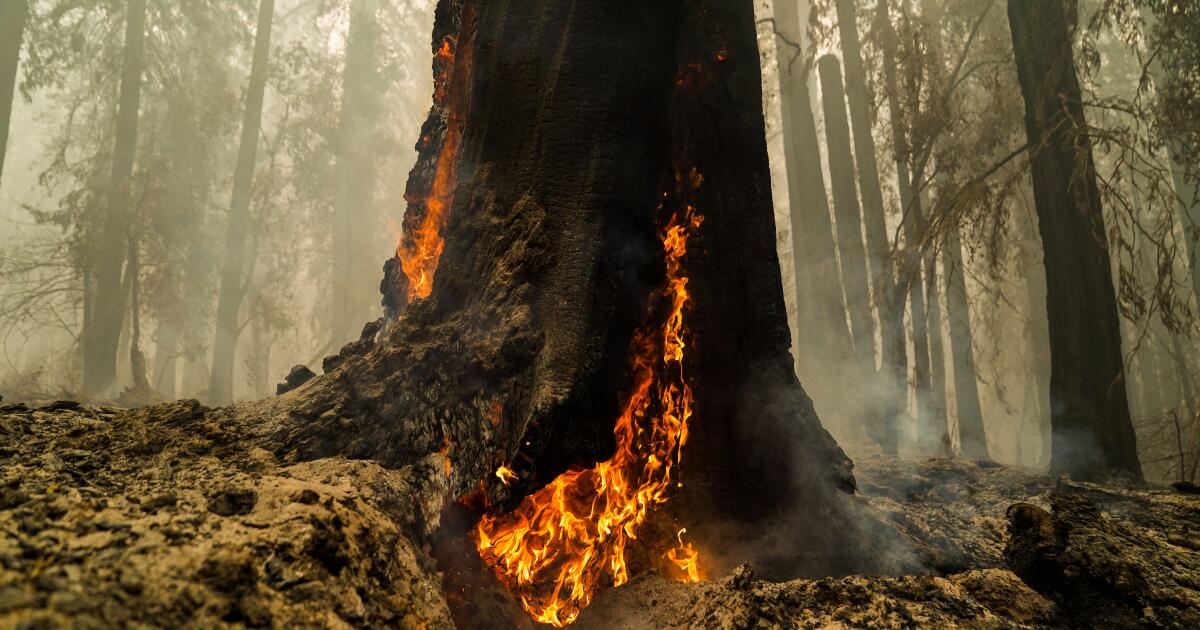
The fire season of the title took place in 2020, a year of catastrophes for Martin, California and the world. COVID-19 filled hospitals and morgues and led to widespread isolation, U.S. democracy was challenged as never before and 58,258 forest fires nationwide burned more than 10 million acres, including 4.3 million in California. Martin, who grew up in Santa Cruz, lives two hours north of San Francisco in a heavily forested part of Sonoma County.
One night that August, she and her partner witnessed a furious storm. “The blades of electricity bisected the air,” Martin writes in the book. “My insides were set abuzz. My lungs contracted like they’d just hit cold water; my jaw compacted into itself; every muscle in my pelvis … felt as though it had been turned to wood. Somewhere inside my brain every synapse fired, and I was thrust into a whorl of anxiety: go, go, go.”
“The response to disaster can’t be to do the exact same thing all over again,” says Manjula Martin, author of the new memoir “The Last Fire Season.”
(Manjula Martin)
They decided to evacuate a few days later, as the rapidly developing Lightning complex fire was drawing near. The coastal redwoods that towered over her house had never seemed so vulnerable — and neither had she.
Packed in her “go bag” was an ample supply of pain medication. A dislodged IUD had led to a hysterectomy and other surgeries, leaving Martin with chronic, debilitating pain. She was learning to live in a changing, damaged body, just as the forest over her head was adapting its own series of catastrophes. As a writer, she loves embracing that metaphor, along with its contradictions.
“I think the ghost of Susan Sontag is always looking over my shoulder when I talk about my health crisis and compare it to the wildfire crisis,” she says with a laugh, in reference to Sontag’s famous excoriation of “Illness as Metaphor.” But the parallels resonated in her life.
“In a practical way, an everyday life kind of way, I found that I had skills that I didn’t know I had because of my health crisis,” she adds. “Those skills included understanding that things are never gonna be the same. And that sucks. But it also opens up all these interesting, weird … nonconventional ways of thinking and interacting with each other and with the land.”
Like the scorched forests around her home, she had also been harmed by companies “who are OK with a certain margin of error in their product.” At the same time, “accidents are accidents. They’re not always someone’s fault. But that was really the key to connecting my personal experience of harm with these larger systems that are very intricately linked to climate change.”
What opened her up to the parallels, Martin says, was gardening. “Once I started gardening as I was recovering from my surgeries — there’s that very cliché thing of putting your hands in dirt — but that cliché comes from truth. It wasn’t that feeling of life cycles and generation and renewal necessarily. It was the pleasure.” It was also the stark, clarifying push-and-pull with nature: “You do things that are harmful, like cutting things, and the plants push back, and then you have to wait a year to find out what’s gonna happen.”
Waiting for a body or a forest to heal involves an analogous kind of patience. But if Martin had simply dropped her metaphor and left it at that, her memoir would be much shorter and less interesting. Instead, the author is quick to acknowledge the flaws and contradictions in such comparisons. Gardening, for one, is a privilege, and she is well aware of the ways economics, race and historical forces have influenced her relationship with nature.
The stewardship of the land by California’s Indigenous people included “good fire,” the types of prescribed burns increasingly recognized as a key to preventing massive firestorms. In recent years, many tribal fire experts have been asked to fix the forests.
But Martin says the approach needs to be cooperative and collaborative. Her book quotes Margo Robbins, a Yurok fire expert: “Native people can’t do it on their own … we don’t own that much of the land, for one thing.”
“I think it’s especially the responsibility of those who have carried out these harmful actions to make reparations,” Martin tells me, “both to the land and its original inhabitants. And it’s the responsibility of all who benefit from these harms to ensure that happens. I include myself in that group, as a white property owner who is a direct beneficiary of the colonization of the land where I live.”
This is one reason that, despite the fact that 2020 was definitely not the last fire season, Martin and her partner are staying put. “What you have to do is learn to adjust and live in the new normal as it will be,” she says.
Just don’t attach a hashtag to her actions: “In some neighborhoods, you’ll see a lot of signs that say ‘Thank you, firefighters.’ I don’t fault those emotions. They’re very real. But it’s what I call ‘hashtag hope.’ The response to disaster [can’t] be to do the exact same thing all over again.”
Martin understands that terms like “new normal” might feel like defeat — as toothless in its way as the dreaded word hope. In the book, however, she draws inspiration from eco-psychologist Joanna Macy, who argues that despair opens us up possibilities for change. Martin’s body and her environment have taught her a lot about despair, but also about adaptation.
As we finish our chat, Martin asks me to stay on the line while she moves outside. “They’re babies,” she says, gesturing to the hundred-year-old redwoods that tower over her lawn. “I used to wonder why, when it’s windy, trees don’t just instantly fall down, they’re so tall,” she says. “And I realized it’s because they’re alive. The same way a person standing upright doesn’t fall down — they’re alive. They dance.”
Berry writes for a number of publications and tweets @BerryFLW.



![[*LIVE*] Los Angeles Lakers vs Milwaukee Bucks Live Free Streams On Sport’sTvl 30 March 2026](https://i3.wp.com/encrypted-tbn0.gstatic.com/images?q=tbn:ANd9GcReQZPBURuIIuh0fPF6YTAqOY-y1_BeWJWzPA&s&w=400&resize=400,240&ssl=1 "[*LIVE*] Los Angeles Lakers vs Milwaukee Bucks Live Free Streams On Sport’sTvl 30 March 2026")


Movie Reviews
‘The Last Critic’ Review: A Captivating Portrait of Robert Christgau, the Brilliant Mad Professor of Rock Critics, and How He Made the Grade

As a critic, I should probably take offense at the title of “The Last Critic.” The movie is a captivating portrait of Robert Christgau, the legendary music writer who was one of the founding fathers of what was once known as “rock criticism.” (These were the days before poptimism, not to mention the Taylor Swift fan base.) To be fair, the film never asserts the claim of its title — that Christgau was or is “the last critic.” He was, in fact, one of the first writers to establish rock criticism as a vibrant and essential form, the others being Greil Marcus and the late Ellen Willis (both of whom he was close to; Marcus is featured in the documentary) as well as Lester Bangs, the brilliant bad boy who died in 1982.
The singular thing about Christgau is that he invented, and owned, his very own form of criticism. Born in 1942, he started out as a gifted writer and reporter, with the makings of a star journalist (in 1966, he published an award-winning piece about a girl who died from being on a macrobiotic diet). Attracting the attention of Esquire magazine, which was then at the epicenter of a hip new media world, he began to write a youth-culture column there, and in 1969 he came up with Christgau’s Consumer Guide, a monthly series of capsule reviews that would evaluate — and grade! — the latest slate of rock albums.
That doesn’t sound too remarkable, but Christgau’s prose had a quirky electricity, and in a world where rock writers were nerdish monks (Marcus was a rich-kid academic who smoked a pipe), he had a sixth sense for how to brand himself. An acerbic wise guy, brimming with egomaniacal snark, he once jokingly introduced himself as “the dean of American rock critics,” and the label stuck. From that point on, that’s how he was referred to and thought of.
In the Village Voice, where the Consumer Guide became one of the fabled alt-weekly’s go-to features from the ’70s through the ’90s, Christgau wrote like a possessed fan who breathed insight, making every capsule sound like a psychedelic sonnet. And the notion of affixing each densely compact review with a letter grade (from A+ to E-) was so counterintuitive — at least in the post-counterculture world — that it became Christgau’s signature.
He was playful in his judgments (on Prince’s “Dirty Mind”: “He takes care of the songwriting, transmutes the persona, revs up the guitar, muscles into the vocals, leans down hard on a rock-steady, funk-tinged four-four, and conceptualizes — about sex, mostly.” On Bryan Adams’ “Reckless”: “Maybe I’ll let Bruce Springsteen teach me how to hear John Cougar Mellencamp, but damned if I’m going to let John Cougar Mellencamp teach me how to hear Bryan Adams”). He was famous enough to inspire disgruntled album-track shoutouts from Lou Reed and Sonic Youth, and I guess that you could also call Christgau the unintentional godfather of Entertainment Weekly. At one point in the documentary, Christgau talks about a certain grade category he thinks of as “a high B+,” adding that “no one knows what that means” except him. As a critic who handed out grades at EW for decades, I may be just about the only other person on the planet who knows exactly what that means.
In “The Last Critic,” we meet Christgau as an elder stateman of rock-crit (he’s now 83), a downtown stalwart knocking around the streets of the East Village. He’s a bit more bent than he was, with white hair and a touch of arthritis, but he’s still a wry specimen, lean and mean, with a machine-gun mind, ageless in his vigor (and in his hunger for new music). And God bless him, he still pumps out the Consumer Guide each month (it’s now on Substack). The way he goes about it is the real subject of the documentary, because writing the Consumer Guide is the very spine of Robert Christgau’s life; every aspect of it reflects his obsessiveness. The film opens with him tapping out the following quote on an old word processor: “To the eternal ‘Opinions are like assholes — everyone’s got one,’ I just say, but not everybody’s got ten thousand of them.” Christgau has 14,000 reviews and counting, and that’s his glory and his compulsion.
He and his wife, the writer Caroline Dibbell, have lived in the same 2nd Ave. apartment for 50 years. And though it has seven rooms, Christgau has it organized like the encyclopedic pack rat he is. The place is lined with hundreds of feet of books, and he built special industrial shelves to house his 36,000 vinyl albums and CDs (and even cassette tapes), which cover every square inch of wall space in his cramped office. It’s his cave of knowledge, and he sits each day at the center of it, fumbling with CD players that kind of work, listening to music all day long, tapping out his thoughts on an old computer, feeling at every moment that this is his bliss. It’s criticism as a calling, a mission, a drive to find all the new music that’s good, and to capture each album’s worth in one heightened poetic paragraph. That’s what makes Christgau get up in the morning, and what keeps his spirit young. (Recovering from surgery, he won’t take three days off and not write.)
He has mellowed with age (actually, not much), but he’s still a wit and a scholar and a bit of a pedant. He’s bluntly contentious — in his heyday, he was not only a critic but a Village Voice editor who became fabled for his literary-dictator ways. He would make writers sweat (but only in the quest to make them the best version of themselves), and he would sometimes bike over to their apartments to stalk them for copy that was late. But what cemented the Christgau legend was the weirdly rational mania that informed the Consumer Guide. When it came to music, Christgau genuinely believed in the existence of a hidden grand order. He wanted to turn the act of consuming records into a system — a celestial hierarchy of judgment, of which he was the all-seeing lord.
That’s a way of thinking that some critics have (exhibit A: myself). Yet Christgau, through the Consumer Guide, was the only music critic to wear his system-making brains on the outside. The title of the column was a provocation, because here was this writer on the cutting edge of a rock world that still imagined itself as a “revolution,” yet he had the audacity to say that the revolution was a form of consumerism. He meant it as a joke (“I was thumbing my nose at my colleagues,” he says), the joke being that he was actually serious about it. He was going to grade the counterculture like the ultimate professor of cool.
And that’s what Christgau became. The documentary features plenty of footage of him back in the day, when a bohemian New York critic could still be a celebrity, and when he was just about the only person you could name who turned having long hair and oversize glasses and an ironic smirk into a punk look. He was like a sexy underground version of Poindexter. By the late ’70s, it felt like he was the last guy left with stringy hair that reached his shoulders, but the attitude was as far from hippie as you could get. Christgau was from Queens, the son of a fireman, and he had that working-class outer-borough lack of respect for the elites, even as he himself became one.
“The Last Critic,” directed with lively reverence by Matty Wishnow, is full of pithy testimonials to Christgau’s special qualities as a critic. We hear from writers like Kit Rachlis and Ann Powers and Amanda Petrusich and Chuck Eddy and Rob Sheffield. Nelson George and Greg Tate make the vital point that Christgau, in orchestrating a music review section in the ’70s that showcased diverse voices, walked the walk of what the Village Voice was supposed to be about. As someone who grew up in the early rock-crit days, I especially enjoyed the film’s portrait of Christgau’s friendship with Greil Marcus, an equally legendary critic based on the West Coast (we see the two of them seated today in Christgau’s living room, looking like the Statler and Waldorf of rock criticism). They wrote letters to each that were like intellectual mash notes, and they spoke several times a month on the phone but had serious disagreements. “I don’t think he feels hip-hop,” says Christgau of Marcus. “And I think that’s a function of whether you feel James Brown. And that’s a real gap.”
Christgau felt James Brown, all right (he was a major advocate of funk), but I would argue that his Achilles’ heel as a critic is that he didn’t feel pop. We see him in a TV interview from the ’80s where he catalogues his eclectic tastes, saying, “I love African music, I really love some country music, I like the best of what’s called world music, I love rap, I’ve got nothing against pop, I like funk and dance music quite a lot…” Consider that statement: I’ve got nothing against pop. It reflects something that nearly all the formative rock critics (with the exception of Stephen Holden) felt about pop music, which is that they actually did have something against it. They thought it was glossy, superficial, sentimental, fake, confectionary, corrupt, “commercial,” or some other descended-from-the-left-wing-ether bullshit. At one point in the documentary, we see a roster of albums in different Christgau grade categories, and forgive me, but I don’t live in a world where Sleater-Kinney’s “Dig Me Out” is an A and Madonna’s “Like a Virgin” is a B. (I live in a world where Supertramp’s “Breakfast in America” is an A+, and where Hall and Oates are greater than the Replacements.) The anti-pop animus of classic rock criticism reflected nothing so much as a neurotic puritanism, or maybe just a snobbish inability to hear the deep beauty of pop.
My grousing aside, the early rock critics actually forged their own brand of beauty. The reason they were able to plant this form of criticism on the map is that they were extraordinary writers. What you feel, in every Robert Christgau capsule, is that he’s channeling whatever he’s writing about, and that’s what always made the Consumer Guide such a compulsive read — the drama of listening to Christgau let each of those albums flow through him. “The Last Critic” is a portrait of a venerable voice, but mostly it’s a testament to everything a great critic is: a priest, a fan, an assassin, an aesthete, a merciless truth-teller, and a vessel of love.

Peter Alexander, who covered Washington for NBC News for more than a decade, is leaving the network to join MS NOW, according to people familiar with his plans.
Alexander, 49, will serve as an anchor and chief national reporter for MS NOW. He will have a weekday program and also handle breaking news coverage throughout the day.
A 22-year veteran of NBC News, Alexander served as chief White House correspondent and co-host of the Saturday edition of “Today” with Laura Jarrett. He is among the most familiar faces in the White House briefing room.
Alexander told viewers at the end of his Saturday broadcast that he is departing NBC News but did not mention his new job. A representative for MS NOW declined comment.
MS NOW is the progressive-leaning cable channel formerly known as MSNBC. The network changed its name after it was spun off from Comcast into a new company called Versant.
After the split, MS NOW ended its relationship with NBC News. Journalists who worked on both MSNBC and NBC News had to chose which entity they would work for going forward.
Correspondents Jacob Soboroff and Ken Dilanian switched from NBC News to MS NOW. Data guru Steve Kornacki decided to stick with NBC News as he also has assignments at NBC Sports. Willie Geist, a co-host on MS NOW’s “Morning Joe,” is an exception as he continues to anchor NBC’s “Sunday Today.”
Alexander is the first NBC journalist to cross over to MS NOW since the split. His deal with Versant also gives him the opportunity to contribute to sports coverage on the company’s other cable properties, USA Network and the Golf Channel.
Alexander will anchor the 11 a.m. Eastern hour on MS NOW, succeeding Ana Cabrera, who is leaving the network when its daytime programming changes take effect in June.
Alexander joined NBC News after serving as an anchor on KPCQ in Seattle.
He was White House correspondent from 2012 to 2026, covering four presidencies.
An aggressive questioner, Alexander has been chastised by President Trump publicly over news conference questions that made him unhappy.
Movie Reviews
Movie reviews reveal 2026’s best Certified Fresh films are arriving in March – Art Threat
Show summary Hide summary
Movie Reviews reveal 2026’s best Certified Fresh films are arriving this month with stellar critical acclaim. March 2026 brings an extraordinary lineup of top-rated releases. Critics and audiences are celebrating these exceptional films together.
🔥 Quick Facts
- Project Hail Mary: 95% Tomatometer, 96% audience score, released March 20, 2026
- Certified Fresh Status: 75% critic rating or higher with 5+ Top Critics reviews required
- March Releases: Hoppers (94%), GOAT (84%), Send Help (93%) all certified fresh
- Streaming Options: Multiple platforms including Netflix, Peacock with exclusive March releases
Project Hail Mary Dominates with 95% Critical Acclaim
Project Hail Mary opened March 20, 2026, becoming the standout theatrical certif fresh hit of the month. Ryan Gosling stars as science teacher Ryland Grace, waking up light-years from home with no memory. The sci-fi epic, directed by Phil Lord and Chris Miller, earned 95% from critics and 96% audience approval. Cinephiles praise its visual splendor and emotional depth.
According to reviews, the film balances spectacular space sequences with genuine human moments that resonate deeply. Amazon MGM Studios released this 156-minute masterpiece based on Andy Weir’s beloved novel. Early box office numbers exceed expectations significantly.
Streaming Certified Fresh Titles Light Up March
March 24, 2026 delivered major streaming victories. GOAT (Greatest of All Time) hit platforms with 84% critic score and 93% audience approval. This animated sports comedy features Caleb McLaughlin as an anthropomorphic goat chasing championship glory. Send Help arrived simultaneously, earning 93% critical praise with 87% viewer satisfaction. Both titles capture hearts through humor and heart.
Streaming platforms flooded March with 69 new movies and shows total. Critics celebrated the diverse quality spanning cult classics, acclaimed dramas, and blockbuster franchises all at once.
Beyond the Blockbusters: Other Standout Certified Fresh March Releases
| Title | Tomatometer Score | Release Date | Status |
| Hoppers | 94% | March 6, 2026 | Theaters |
| Ready or Not 2 | 73% | March 20, 2026 | Theaters |
| Late Shift | 96% | March 20, 2026 | Theaters |
| Two Prosecutors | 97% | March 20, 2026 | Theaters |
“Visually, it is strong and immersive, but the real strength of Project Hail Mary is not spectacle alone. It is the sense of wonder and humanity running through the entire experience. The film knows when to be exciting, when to be funny, and when to slow down and let the emotional moments land.”
— IMDb Critics, Film Review Community
What Makes a Film Certified Fresh on Rotten Tomatoes
Certified Fresh status represents the industry’s gold standard for quality filmmaking. A movie earning this distinction must achieve at least 75% rating from professional critics. Additionally, films require 5 or more Top Critics reviews for certification. Recent updates tightened these standards to ensure only genuinely excellent films qualify.
This rigorous process explains why March’s nine certified fresh titles matter significantly. Critics spent hours analyzing each film thoroughly before adding their names. The combined critical weight behind these movies suggests spring viewing will be exceptional.
Plan Your March Movie Marathon Now – Which Film Will You Watch First?
Theater-goers should prioritize Project Hail Mary before it leaves cinemas. The 156-minute runtime demands a big screen experience. Meanwhile, streaming subscribers face delightful choices between GOAT’s comedy charm and Send Help’s heartfelt drama. Ready or Not 2 and Late Shift round out theatrical options perfectly.
New releases continue flowing through March 27, 2026, keeping entertainment options fresh. Kiki’s Delivery Service rereleased March 13, while Stand by Me returned March 27 with new appreciation. Which certified fresh film matches your mood this weekend?
Sources
- Rotten Tomatoes – Official certification database and critical scoring system
- Variety – Best movies streaming in March 2026 coverage
- The Wrap – Most anticipated films arriving in March analysis
Give your feedback
★★★★★
Be the first to rate this post
or leave a detailed review

Game Thread: Denver Nuggets vs Golden State Warriors. March 29th, 2026. – Denver Stiffs

Trio helps Ottawa beat Seattle 2-0, spoiling return of Torrent captain Hilary Knight

Home damaged by fire in Carmel Valley
![[*LIVE*] Los Angeles Lakers vs Milwaukee Bucks Live Free Streams On Sport’sTvl 30 March 2026](https://i3.wp.com/encrypted-tbn0.gstatic.com/images?q=tbn:ANd9GcReQZPBURuIIuh0fPF6YTAqOY-y1_BeWJWzPA&s&w=80&resize=80,80&ssl=1 "[*LIVE*] Los Angeles Lakers vs Milwaukee Bucks Live Free Streams On Sport’sTvl 30 March 2026")
[*LIVE*] Los Angeles Lakers vs Milwaukee Bucks Live Free Streams On Sport’sTvl 30 March 2026

Braves-Athletics preview: Atlanta’s rotation a key question entering series vs. A’s

Florida High School Football Rankings: Top 25 teams – Oct. 21

How old is Bo Nix? What to know about Oregon quarterback ahead of 2024 NFL Draft

Cleary's 21 help Le Moyne down Central Connecticut State 69-64 in OT

99th annual Pony Swim held in Virginia

Indiana Members Credit Union announced as new anchor tenant at Bottleworks District

Scathing report claims nation’s oldest labor union ‘betrayed’ MAGA members through ‘shocking’ spending

Republican US lawmaker demands Congress vote on any Iran troop deployment

So you went to a No Kings protest. Now what?

JD Vance says he was ‘obsessed’ with UFOs, believes aliens are actually ‘demons’
The EU's recipe for trade deals : easy on beef, tough on wine
-

 Sports1 week ago
IOC addresses execution of 19-year-old Iranian wrestler Saleh Mohammadi
-

 New Mexico1 week ago
Clovis shooting leaves one dead, four injured
-

 Miami, FL4 days ago
Jannik Sinner’s Girlfriend Laila Hasanovic Stuns in Ab-Revealing Post Amid Miami Open
-

 Tennessee6 days ago
Tennessee Police Investigating Alleged Assault Involving ‘Reacher’ Star Alan Ritchson
-

 Minneapolis, MN4 days ago
Boy who shielded classmate during school shooting receives Medal of Honor
-

 Politics1 week ago
Schumer gambit fails as DHS shutdown hits 36 days and airport lines grow
-

 Science1 week ago
Record Heat Meets a Major Snow Drought Across the West
-

 Technology1 week ago
YouTube job scam text: How to spot it fast