Entertainment
Happy 95th birthday, Frank Gehry. Let's give you the Disney Hall you really wanted

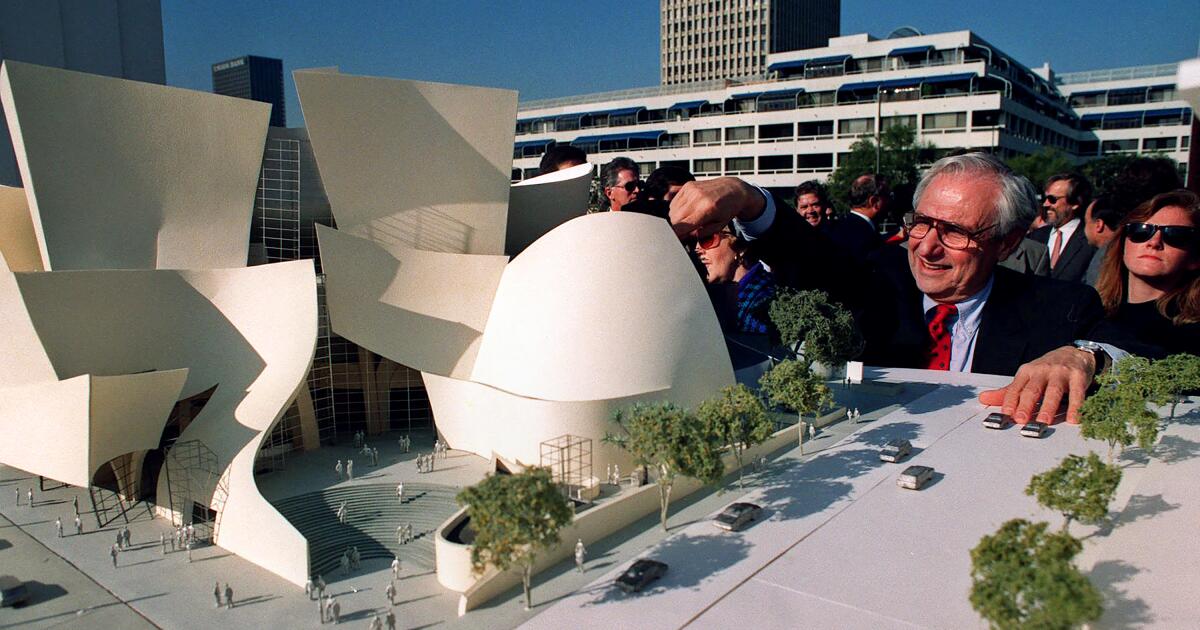
Over the last two decades, Walt Disney Concert Hall has blazed cultural trails like no place else. We can rightfully talk about the L.A. Philharmonic before and after Frank Gehry built it a hypnotizing new home. We can divide downtown L.A. into pre- and post-Disney. We can go so far as to distinguish orchestral life, not only in L.A. but everywhere, in the same way.
Gehry turns 95 on Wednesday, and the L.A. Phil season, which began with a gala led by Gustavo Dudamel celebrating the architect, has, in ongoing tributes to the hall and in just doing its thing for these nearly five months, readily revealed, week after week, all that Disney is. And, alas, all that Disney inexcusably isn’t. At least not yet. But the best of Disney first.
Building Disney was a long, laborious, contentious, financially dicey process, one for which we’ve never had a full or convincing account. I’ve never gotten straight answers about who did what to whom and when.
In 1987, Ernest Fleischmann, at the time the transformative head of the L.A. Phil, enticed Lillian Disney to give $50 million for a concert hall to be built in honor of her late husband, Walt, as an addition to the Music Center. Fleischmann, who had once hailed the Dorothy Chandler Pavilion, built for the L.A. Phil in 1964 as an acoustic wonder, eventually pronounced it unworthy. It still is, but that’s another story.
Presumably, Fleischmann assured Lillian Disney that this generous sum would be sufficient for the new hall, knowing full well that much more would be needed (ultimately, more like $274 million). Although Fleischmann and Gehry were close friends, Gehry was viewed as far too radical for the conservative classical music establishment, which feared chain-link fences and whatnot. One Music Center board member proposed that the original blueprints for the Chandler be dug up and that they just build “the same damn thing” across the street.
A competition was arranged. Gehry’s model, which was exciting but far more conventional than the masterpiece he ultimately designed, was so superior to the others, especially in its welcoming feeling, that even Gehry’s detractors begrudgingly approved. The four other models, all by distinguished architects, were suspiciously clueless.
I never could get Fleischmann, or anyone else close to the competition, to explain why. Did Fleischmann and others on the jury know all along that Gehry was exactly what the orchestra and the city needed and that the only way to get it was to rig the competition by misleading the other architects? All insisted it was fair. Until evidence proves otherwise, I’m sticking with Fleischmann’s visionary flare eclipsing committee-compromised fair.
The construction site for Disney Hall at 1st Street and Grand Avenue in 1995.
(Carol Cheetham / For The Times)
It would take 16 years to build Disney. Fundraising stalled repeatedly. Gehry’s detractors (including some leading voices at this newspaper) had a field day. The Music Center did not display much enthusiasm.
In the early 1990s, the L.A. riots, the Northridge earthquake and a recession took further wind out of the new hall’s prospective sails. When I arrived at The Times in spring 1996, everyone told me that the hall was moribund. The county, which owns the Music Center and the land on which Disney sits, had built only the parking lot. The county’s supervisors, with the exception of Zev Yaroslavsky, were ready to pull the plug.
But Fleischmann tenaciously hung on. Much later, Esa-Pekka Salonen, then-music director, confessed to me that he had offered his resignation to Fleischmann, in part over his disappointment of the hall’s seeming failure and figuring that maybe another conductor could do more. There was also considerable disgruntlement among board members and patrons over Salonen’s advocacy of new music, despite the fact that he was attracting a younger audience and was increasingly seen as a vital new voice in classical music.
A fundraising deadline loomed, and Fleischmann persuaded Salonen to stick it out a little longer. Just in time, the tide turned, thanks to three fortuitous events. Gehry’s new museum in Bilbao, Spain, wowed the world. A Stravinsky festival that Salonen and the L.A. Phil put on in Paris wowed not only the French but also L.A. Phil board members, including Disney skeptics. The clincher was a series of individual gifts of $5 million each from the publisher of the L.A. Times, then-Mayor Richard Riordan (using his personal money to make what was at the time an anonymous donation) and philanthropist Eli Broad, who then took over the final fundraising.
Disney Hall under construction in 2001.
(Wally Skalij / Los Angeles Times)
Disney opened as an instant icon. It catapulted the L.A. Phil to far greater fame than the orchestra had ever known. It spearheaded the revival of downtown and shaped the identity of DTLA, as it would soon be known.
With Disney, the 21st century orchestra was born. The immediacy of the acoustics, the intimate connection between the musicians and listeners, the warmth and visual allure of the interior — all were thrilling. The new hall invited making and consuming new music seem natural. The interior, shaped a little like a ship, put an audience in the mood for adventure.
For the next two decades, the L.A. Phil went from strength to innovative strength, helped by two progressive music directors, Salonen and, beginning in 2009, Dudamel.
Starting with the “Tristan Project” in 2004, Wagner’s “Tristan und Isolde,” conducted by Salonen with video by Bill Viola and staged by Peter Sellars, Disney Hall inspired a full expansion of the notion of what classical music could be. The symphony orchestra, with traditions that go back more than three centuries, now had a venue ripe for experimenting with emerging technologies and for incorporating other musical genres and traditions, even other art forms — be they painting, sculpture, dance, theater, performance art, poetry, cinema, video. The L.A. Phil became a model of how an institution could matter, and its home became a tourist attraction, a site to see and a place to be.
Artist Refik Anadol designed projections that lighted up Disney Hall to celebrate the L.A. Phil’s centennial in 2018. Gehry’s original plan for the hall called for live images of the orchestra to be projected on the hall during performances.
(Luis Sinco / Los Angeles Times)
We’ve had a taste of that this season in concerts by Dudamel and Salonen with a range of music, old and memorably new.
At the gala, Dudamel conducted Salonen’s quirky “Fog,” a tribute to Gehry, written five years ago for his 90th birthday. It recalled the first time the composer and conductor heard anything played in the hall while it was under construction.
A few weeks later, Salonen led the premiere of “Tiu,” a big orchestral piece celebrating the hall’s 20th anniversary. Based on the Swedish word for 20, but which also can be Finnish for counting eggs or a musical score, Salonen played with the ordering of 20 chords, turning them into a resplendent phantasmagoric series of dances, fanfares, misty harmonic clouds and melancholic melody.
In what has been an informal festival of Salonen’s scores, the Los Angeles Master Chorale — which has also grown into the big time as the other resident company in Disney — joined the L.A. Phil for Salonen’s wild, dada-inspired “Karawane.”
Dudamel premiered two new works by Mexican composer Gabriela Ortiz, the second of which, “Revolución Diamantina” (Glitter Revolution), a five-act ballet score that revolves around the celebrated 2019 feminist march in Mexico City, is relentless in its sonic invention.
Dudamel’s performance of Stravinsky’s “The Firebird,” Salonen’s of Strauss’ “An Alpine Symphony” and Ravel’s “Daphnis and Chloé,” along with Zubin Mehta’s of Mahler’s First Symphony, sounded unlike they might be played by any other orchestra in any other space — namely site specific, an occasion.
Just this month, British composer and part-time Angeleno Thomas Adès introduced his recent “Five Spells From the Tempest.” When Adès conducted the premiere of his second opera, based on Shakespeare’s “The Tempest,” at Royal Opera in 2004, shortly after Disney Hall had opened, the London orchestra sounded lackluster in Covent Garden. The opera seemed a misfire and wasn’t all that more impressive when it went to the Metropolitan Opera in New York. Yet Adès’ 22-minute symphonic condensation of the opera score was a knockout when he conducted at Disney.
So it goes. But Disney has also made us complacent. The sorry fact is that the hall has never been the best it can be, and there seems to be far too little motivation to take the place to its necessary next step, almost as if it were 1996 again.
Downtown has not recovered from the pandemic. The Gehry-designed mixed-used development the Grand opened across the street from Disney in fall 2022 but has yet to come to life, struggling to entice restaurants and retail. It has fixtures in which projectors can be installed to create images on Disney. Gehry originally chose a steel skin suitable for projecting video of whatever concert was occurring at night. That’s never happened. He couldn’t get the Music Center to properly light the building at all.
Gustavo Dudamel conducts the L.A. Phil in a modest orchestra pit for Wagner’s “Das Rheingold” in January. Gehry originally wanted the option of a deeper pit, but it was lost in cost-cutting.
(Allen J. Schaben / Los Angeles Times)
Gehry also designed an orchestra pit for the hall that was cut because of cost. Earlier this year, he got a chance to try out that notion with a shallow, makeshift pit created for a staging of Wagner’s “Das Rheingold,” for which the architect also designed sets that essentially turned the whole hall into glorious installation art. Installing a real pit, acoustically tuned, should be a no-brainer.
There are the other long-proposed modifications that include turning BP Hall, where pre-concert talks are held, into a full-fledged chamber music hall, revamping the outdoor amphitheater into an enclosed jazz club and replacing the 1st Street steps with a glass enclosed bar that Gehry would name the Ernest, in honor of Fleischmann.
But who is even around to make that happen? Downtown feels grim. County supervisors show little interest in the Music Center. The new Colburn School concert hall on 2nd Street that Gehry designed has just begun construction after bureaucratic delays. The project’s crucial plaza, though, has been indefinitely postponed. An arts corridor on Grand Avenue surely would, as Disney proved, spark a new DTLA resurgence, but City Hall is not acting like it cares.
As for the Music Center: Over the second weekend this month, I attended Pina Bausch’s “The Rite of Spring” in the Dorothy Chandler Pavilion and Matthew Bourne’s “Romeo and Juliet” at the Ahmanson Theatre, and I felt like I had wandered back in time.
Bausch’s once supposedly revolutionary Stravinsky ballet, which she choreographed in 1975 when she was just beginning, was included in the first U.S. appearances of her company at the Pasadena Civic Auditorium as part of the 1984 Olympic Arts Festival. Even then, impressive as it was, with magnificently disciplined dancers dashing on a peat-moss floor, it was clear that this was the kind of old-school abstractly modernist ballet that Bausch had outgrown.
Stravinsky’s score to “The Rite” culminated Salonen’s opening night concert for Disney in 2003, and that was all it took to understand what this hall could do. The first recording in Disney was Salonen conducting “The Rite,” and he performed it often enough in the hall, as has Dudamel, that it is a kind of informal Disney theme song.
(Kirk McKoy / Los Angeles Times)
In the Chandler, Bausch’s company played a recording of “The Rite.” Neither the conductor nor the orchestra of the lumbering performance was credited. The recording quality was coarse, and the score was loudly amplified, a solo bassoon in its mysterious high register sounding like a pigeon being tortured. The “Rite” of Disney was terribly wronged.
At the other end of the recently renovated Music Center plaza, bland and lifeless, Bourne brought the 10th of his choreographic productions to the Ahmanson. This take on Prokofiev’s “Romeo and Juliet,” set in a sanatorium with teenagers climbing the walls, has Bourne’s signature clever movement, which can be delightful, and tons of talent onstage.
But how un-Disney to have those gleaming tile walls for a set. Again; the music was recorded, Prokofiev reduced in length and instrumentation, the score sanatorium-sanitized.
In 2018, L.A. choreographer Benjamin Millepied created a site-specific gender-bending version of Prokofiev’s ballet with his L.A. Dance Project for Dudamel and the L.A. Phil. The dance took over Disney — the stage, the seating areas, backstage, the dressing rooms, the garden — as Millepied followed his dancers around with a video camera. Dudamel conducted a soaring performance, and every inch of the hall came to life. Romeo and Juliet weren’t locked away under key, they were among us, their world ours.
That has been the beauty of Gehry’s creation. He wanted it to be our city’s living room, part of our lives. And he left room for more. But we don’t have a Fleischmann. The L.A. Phil is leaderless without a chief executive and with Dudamel’s tenure ending after two more seasons. Who at the Music Center or City Hall can make anything happen? Time is running out. The 2028 Olympics are practically around the corner. Gehry isn’t getting any younger. And it appears that Los Angeles is not getting any wiser.
Frank Gehry looks toward Disney Hall from the Conrad hotel at the Grand across the street.
(Jay L. Clendenin / Los Angeles Times)



Entertainment
Ulysses Jenkins, Los Angeles artist and pioneer of Black experimental video, dies at 79

Ulysses Jenkins, the pioneering Los Angeles-born video artist whose avant-garde compositions embodied Black experimentalism, has died. He was 79.
Jenkins’ death was confirmed by his alma mater Otis College, where he studied under renowned painter and printmaker Charles White in the late 1970s and returned as an instructor years later. The Los Angeles art and design school shared a statement from the Charles White Archive, which said, “Jenkins had a profound impact on contemporary art and media practices.”
“A trailblazing figure in Black experimental video, he was widely recognized for works that used image, sound, and cultural iconography to examine representation, race, gender, ritual, history, and power,” the statement said.
A self-proclaimed “griot,” Jenkins throughout his decades-spanning career maintained an art practice grounded in the tradition of those West African oral historians who came before him. Through archival documentaries like “The Nomadics” and surrealist murals like “1848: Bandaide,” he leveraged alternative media to challenge Eurocentric representations of Black Americans in popular culture.
He was both an artist and a storyteller who sought to “reassert the history and the culture,” he told The Times in 2022. That year, the Hammer Museum presented Jenkins’ first major retrospective, “Ulysses Jenkins: Without Your Interpretation.”
“Early video art was about the problems with the media that we are still having today: the notions of truth,” Jenkins said. “To that extent, early video art was a construct that was anti-media … a critical analysis of the media that we were viewing every night.”
Born in 1946 to Los Angeles transplants from the South, Jenkins was ambivalent about the city, which offered his parents some refuge from the blatant systemic racism they encountered in their hometowns, but housed an entertainment industry that had long perpetuated anti-Black sentiment.
“What Hollywood represents, especially in my work, is the classic plantation mentality,” Jenkins told The Times in 1986. “Although people aren’t necessarily enslaved by it, people enslave themselves to it because they’re told how fantastic it is to help manifest these illusions for a corporate sponsor.”
Jenkins, who participated in a group of artists committed to spontaneous action called Studio Z, was naturally drawn to video art over Hollywood filmmaking. “I can address any issue and I don’t have to wait for [the studios’] big OK. I thought this was a land of freedom, and video allows me that freedom and opportunity that I can create for myself and at least feel that part of being an American,” he said.
Jenkins went on to deconstruct Hollywood’s vision of the Black diaspora in experimental video compositions including “Mass of Images,” which incorporates clips from D.W. Griffith’s notoriously racist “The Birth of a Nation,” and “Two-Tone Transfer,” which depicts, in Jenkins’ words, a “dreamscape in which the dreamer awakens to a visitation of three minstrels who tell the story of the development of African American stereotypes in the American entertainment industry.”
Jenkins’ legacy is not only artistic but institutional, with the luminary having held teaching appointments at UCSD and UCI, where he co-founded the digital filmmaking minor with fellow Southern California-based artists Bruce Yonemoto and Bryan Jackson.
As artist and educator Suzanne Lacy penned in her social media tribute to Jenkins, which showed him speaking to students at REDCAT in L.A., “he has been an important part of our histories here in Southern California as video and performance artists evolved their practices.”

4/5 stars
Bounding into cinemas just in time for spring, the latest Pixar animation is a pleasingly charming tale of man vs nature, with a bit of crazy robot tech thrown in.
The star of Hoppers is Mabel Tanaka (voiced by Piper Curda), a young animal-lover leading a one-girl protest over a freeway being built through the tranquil countryside near her hometown of Beaverton.
Because the freeway is the pet project of the town’s popular mayor, Jerry (Jon Hamm), who is vying for re-election, Mabel’s protests fall on deaf ears.
Everything changes when she stumbles upon top-secret research by her biology professor, Dr Sam Fairfax (Kathy Najimy), that allows for the human consciousness to be linked to robotic animals. This lets users get up close and personal with other species.

In the summer of 1991, Nirvana filmed the music video for “Smells Like Teen Spirit” on a Culver City sound stage. Kurt Cobain strummed the grunge anthem’s iconic four-chord opening riff on a 1969 Fender Mustang, Lake Placid Blue with a signature racing stripe.
Nearly 35 years later, the six-string relic hung on a gallery wall at Christie’s in Beverly Hills as part of a display of late billionaire businessman Jim Irsay’s world-renowned guitar collection, which heads to auction at Christie’s, New York, beginning Tuesday. Each piece in the Beverly Hills gallery, illuminated by an arched spotlight and flanked by a label chronicling its history, carried the aura of a Renaissance painting.
-
Share via
Irsay’s billion-dollar guitar arsenal, crowned “The Greatest Guitar Collection on Earth” by Guitar World magazine, is the focal point of the Christie’s auction, which has split approximately 400 objects — about half of which are guitars — into four segments: the “Hall of Fame” group of anchor items, the “Icons of Pop Culture” class of miscellaneous memorabilia, the “Icons of Music” mixed batch of electric and acoustic guitars and an online segment that compiles the remainder of Irsay’s collection. The online sale, featuring various autographed items, smaller instruments and historical documents, features the items at the lowest price points.
A portion of auction proceeds will be donated to charities that Irsay supported during his lifetime.
The instruments of famous musicians have long been coveted collector’s items. But in the case of the Jim Irsay Collection, the handcrafted six-strings have acquired a more ephemeral quality in the eyes of their admirers.
Amelia Walker, the specialist head of private and iconic collections at Christie’s, said at the recent highlight exhibition in L.A. that the auction represents “a real moment where these [objects] are being elevated beyond what we traditionally call memorabilia” into artistic masterpieces.
“They deserve the kind of the pedestal that we give to art as well,” Walker said. “Because they are not only works of art in terms of their creation, but what they have created, what their owners have created with them — it’s the purest form of art.”
Cobain’s Fender was only one of the music history treasures nestled in Christie’s gallery. A few paces away, Jerry Garcia’s “Budman” amplifier, once part of the Grateful Dead’s three-story high “Wall of Sound,” perched atop a podium. Just past it lay the Beatles logo drum head (estimated between $1 million and $2 million) used for the band’s debut appearance on “The Ed Sullivan Show,” which garnered a historic 73 million viewers and catalyzed the British Invasion. Pencil lines were still visible beneath the logo’s signature “drop T.”

Pencil lines are still visible on the drum head Ringo Starr played during the Beatles’ debut appearance on “The Ed Sullivan Show.”
(Christie’s Images LTD, 2026)
It is exceptionally rare for even one such artifact to go to market, let alone a billion-dollar group of them at once, Walker said. But a public sale enabling many to participate and demonstrate the “true market value” of these objects is what Irsay would have wanted, she added.
Dropping tens of millions of dollars on pop culture memorabilia may seem an odd hobby for an NFL general manager, yet Irsay viewed collecting much like he viewed leading the Indianapolis Colts.
Irsay, the youngest NFL general manager in history, said in a 2014 Colts Media interview that watching and emulating the legendary NFL owners who came before him “really taught me to be a steward.”
“Ownership is a great responsibility. You can’t buy respect,” he said. “Respect only comes from you being a steward.”
The first major acquisition in Irsay’s collection came in 2001, with his $2.4-million purchase of the original 120-foot scroll for Jack Kerouac’s 1957 novel, “On the Road.” He loved the book and wanted to preserve it, Walker said. But he also frequently lent it out, just like he regularly toured his guitar collection beginning 20 years later.
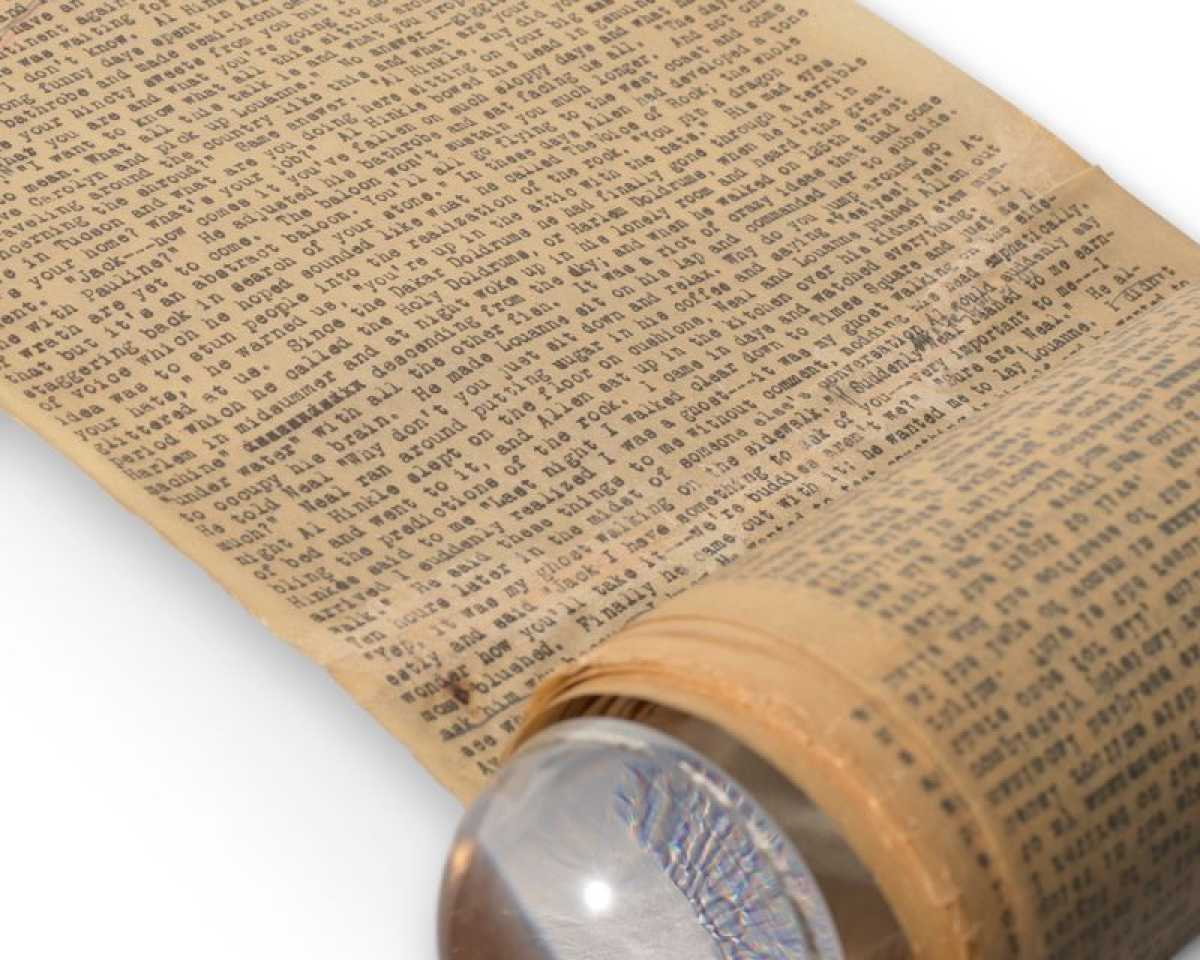
Jim Irsay purchased the original 120-foot scroll manuscript of Jack Kerouac’s “On the Road” for $2.4 million in 2001.
(Christie’s Images)
“He said publicly, ‘I’m not the owner of these things. I’m just that current custodian looking after them for future generations,’ ” Walker said. “And I think that’s what true collectors always say.”
At its L.A. highlight exhibition, Irsay’s collection held an air of synchronicity. Paul McCartney’s handwritten lyrics for “Hey Jude” hung just a few steps from a promotional poster — the only one in existence — for the 1959 concert Buddy Holly, Ritchie Valens and J.P. “The Big Bopper” Richardson were en route to perform when their plane crashed. The tragedy spurred Don McLean to write “American Pie,” about “the day the music died.”
Holly was McCartney’s “great inspiration,” Christie’s specialist Zita Gibson said. “So everything connects.”
Later, the Beatles’ 1966 song “Paperback Writer” played over the speakers near-parallel to the guitars the song was written on.
Irsay’s collection also contains a bit of whimsy, with gems like a prop golden ticket from 1971’s “Willy Wonka & the Chocolate Factory” — estimated between $60,000 and $120,000 — and reading, “In your wildest dreams you could not imagine the marvelous surprises that await you!”
Another fan-favorite is the “Wilson” volleyball from 2000’s “Cast Away,” starring Tom Hanks, estimated between $60,000 and $80,000, Gibson said.
Historically, such objects were often preserved by accident. But as the memorabilia market has ballooned over the last decade or so, Gibson said, “a lot of artists are much more careful about making sure that things don’t get into the wrong hands. After rehearsals, they tidy up after themselves.”
If anything proves the market value of seemingly worthless ephemera, Walker added, it’s fans clawing for printed set lists at the end of a concert.
“They’re desperate for that connection. This is what it’s all about,” the specialist said. It’s what drove Irsay as well, she said: “He wanted to have a connection with these great artists of his generation and also the generation above him. And he wanted to share them with people.”
In Irsay’s home, his favorite guitars weren’t hung like classic paintings. Instead, they were strewn about the rooms he frequented, available for him to play whenever the urge struck him.
Thanks to tune-up efforts from Walker, many of the guitars headed to auction are fully operational in the hopes that their buyers can do the same.
“They’re working instruments. They need to be looked after, to be played,” Walker said. And even though they make for great gallery art, “they’re not just for hanging on the wall.”

How President Trump’s Image Permeates the White House and Beyond

The Latest on Natural Ozempic Alternatives: How To Lose Weight Without GLP-1s

‘Hamnet’ star Jessie Buckley looks for the ‘shadowy bits’ of her characters

Anthropic upgrades Claude’s memory to attract AI switchers

Iran nuclear talks ‘didn’t pass the smell test’ before Trump launched strikes, says Vance

Florida High School Football Rankings: Top 25 teams – Oct. 21

Cleary's 21 help Le Moyne down Central Connecticut State 69-64 in OT

How old is Bo Nix? What to know about Oregon quarterback ahead of 2024 NFL Draft

99th annual Pony Swim held in Virginia

Indiana Members Credit Union announced as new anchor tenant at Bottleworks District

Trump sends official notification to Congress on strikes against Iran

Unexpected birth brings hope to near-extinct Amazon tribe

Supreme Court blocks redrawing of New York congressional map, dealing a win for GOP

Map: Earthquake Shakes Central California

Gas prices could jump as Middle East tensions threaten global oil supply
-

 World5 days ago
Exclusive: DeepSeek withholds latest AI model from US chipmakers including Nvidia, sources say
-

 Massachusetts5 days ago
Mother and daughter injured in Taunton house explosion
-

 Denver, CO5 days ago
10 acres charred, 5 injured in Thornton grass fire, evacuation orders lifted
-

 Louisiana1 week ago
Wildfire near Gum Swamp Road in Livingston Parish now under control; more than 200 acres burned
-

 Technology1 week ago
YouTube TV billing scam emails are hitting inboxes
-

 Politics1 week ago
OpenAI didn’t contact police despite employees flagging mass shooter’s concerning chatbot interactions: REPORT
-

 Technology1 week ago
Stellantis is in a crisis of its own making
-

 News1 week ago
World reacts as US top court limits Trump’s tariff powers