Entertainment
Essay: Decoding Bad Bunny’s triumphantly Puerto Rican Super Bowl halftime show

Thanks to Bad Bunny, it’s been a banner month for us Puerto Ricans.
Coming off the heels of his emotional, history-making Grammy win for album of the year, which made it the first time an all Spanish-language album has won the category, Bad Bunny continued to break ground on Sunday with his Super Bowl halftime performance.
As Latines in the United States, we’re still struggling to be properly and proportionately represented in Hollywood, politics and in the music industry, where Latin artists have been historically boxed into smaller roles, limited to exotic window dressing in the anglophone-dominated landscape of American pop. But through Bad Bunny, Puerto Rico had something to say: He tapped into his unique star power with his zeitgeist-defining magnum opus, his 2025 album “Debí Tirar Más Fotos.” Then, at the Super Bowl, he used a platform usually reserved for bombastic shows of U.S. patriotism to ensure that Puerto Rico, along with many other nations and territories that make up the Americas, would be celebrated, even as we are routinely being denigrated by American conservatives.
Sports have a rich history in Puerto Rico, from boxing to baseball — but with the exception of Super Bowl Sunday, American football doesn’t typically reach us. My parents, who have never watched a football game in their lives, excitedly watched back home on the island, while I, over a thousand miles away, watched from my freezing New York City apartment with my partner, wishing we were basking in the warmth of the Isla Del Encanto. But it didn’t matter where we were watching, as boricuas — and Latines — were united.
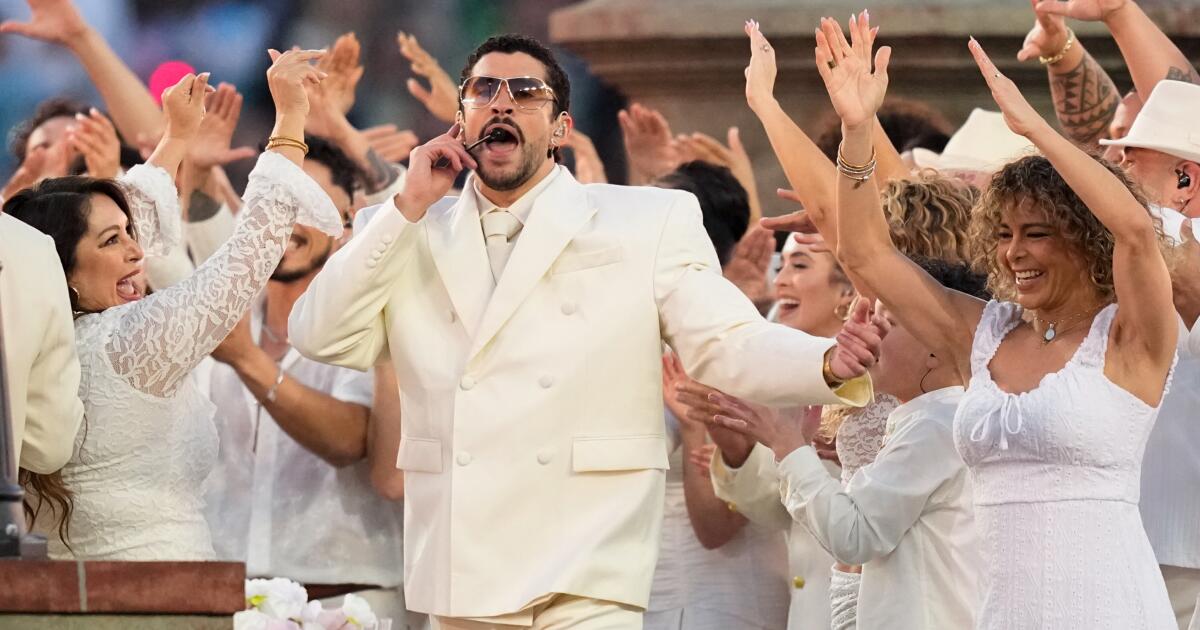
(Eric Thayer / Los Angeles Times)
The Instagram stories on my feed were filled with Puerto Ricans and other Latines hosting watch parties, taking in this much-needed moment of sheer joy during a treacherous time when speaking in our native language, or being a brown-skinned person is enough of a risk factor in being abducted by ICE. Having had the privilege of seeing Bad Bunny at the Choliseo during his residency in San Juan last August, I knew this performance would not only be an impactful homage to my island, but the Super Bowl halftime show carried an underlying, defiant message, that no matter how much conservatives prop up hatred and fear-mongering toward Latines and immigrants, nothing will stop us from being proud of our roots.
And Bad Bunny’s performance literally started straight from the roots. Levi’s Stadium was transformed into a labyrinthine sugarcane field, perhaps as a nod to Central San Vicente, the first sugarcane refinery in Puerto Rico, established in 1873 in Bad Bunny’s hometown of Vega Baja. Opening the show was an acoustic guitarist donning traditional jíbaro clothing — a straw pava hat and white linen — whose words, “qué rico es ser Latino,” established instant solidarity with Latinos all over the world.
While launching into his 2022 dembow-trap hit, “Titi Me Preguntó,” Bad Bunny walked the cameras through the makeshift sugar cane field, which was tilled by dancers dressed as jíbaros. He was decked out in a custom all-white outfit, featuring a jersey bearing his mother’s last name, Ocasio, and the number 64, which is the number his uncle once wore as a football player.
Bad Bunny’s set was staged with many scenes from working-class life in Puerto Rico: a coconut stand, a piraguero, old men playing dominoes, manicurists, baddies, construction workers and a jeweler who buys back “oro y plata.” These scenes served as reminders that Puerto Rican music wasn’t made by and for the elite, but forged by everyday people with limited resources.
Everything about the performance was a wink to the Puerto Rico I grew up in: from the skirts worn by the backup dancers, reminiscent of Taíno taparrabos, to the temperamental power grids, and the garita, or the lookout tower inspired by Old San Juan. During the staged wedding sequence, I saw myself in the tired child napping over two chairs, waiting for the adults to wind down the party so I could go home to my own bed.
We’d seen the famously star-studded house, or the casita, in both his San Juan residency and international tour run, which was duly brought back for the halftime show. The Super Bowl edition of the casita was filled with Latinx pop culture icons like Cardi B, Pedro Pascal, Jessica Alba, Karol G, Ronald Acuña Jr. and Young Miko. But there was another set that was vital for this performance: a New York City backdrop that included a bodega, a barbershop and a bar modeled after Toñitas, a famous Caribbean social club in Williamsburg, Brooklyn.
Bad Bunny not only name-dropped Toñitas in “NUEVAYoL,” but its owner and namesake, María Antonia “Toñita” Cay, made a cameo during the halftime show from behind the bar — serving him a shot. Since the 1970s, Toñitas has become a symbol of resistance amid growing gentrification in the neighborhood, where businesses owned by people of color have been shuttered and longtime Williamsburg residents pushed out by exorbitant rent hikes. It’s a rare safe space for Latines in the city, one where anyone is welcome, but unmistakably ours. As one of many Puerto Ricans who’ve relocated to New York City, it meant a lot that Bad Bunny paid tribute to boricuas in the diaspora, showing that this moment is, too, for those who carry our pride far from home.
Yet unlike Bad Bunny’s first Super Bowl appearance — back in 2020 for Shakira and Jennifer Lopez’s joint headlining performance — this wasn’t an all-Latinx affair. Lady Gaga, who shared a touching moment with Benito at the Grammys, surfaced for a surprise salsa rendition of her collaborative hit with Bruno Mars, “Die With a Smile,” accompanied by Los Sobrinos. She had her own nod to the island with a brooch of a Flor de Maga, Puerto Rico’s national flower.
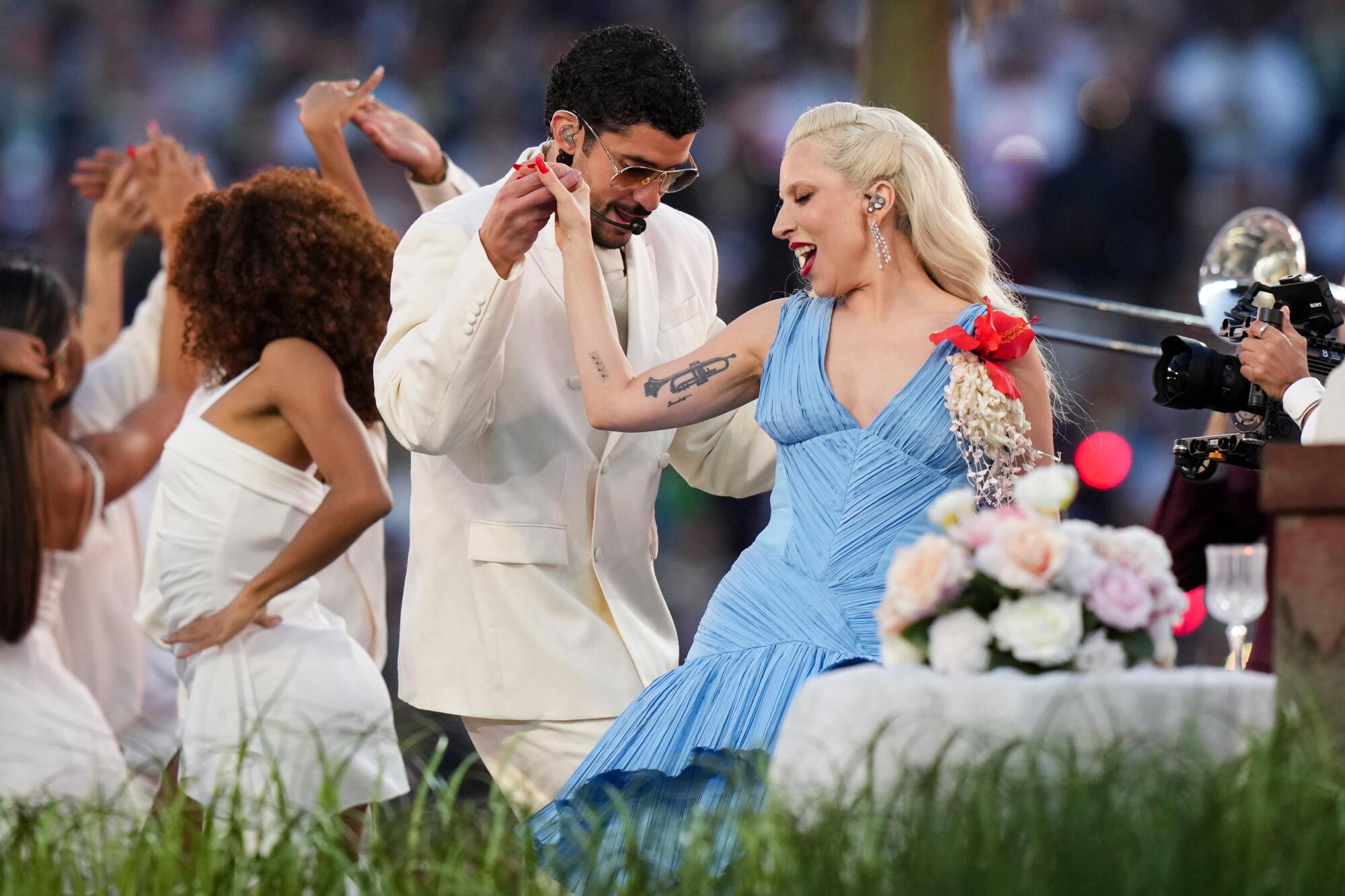
(Lynne Sladky / Associated Press)
While it feels like a loss to omit Bruno Mars (who is of Puerto Rican descent), it’s understandable why Bad Bunny chose Lady Gaga as the only non-Latinx person to perform during the set. Not only is Bad Bunny a longtime Gaga fan himself, but they have both used their platforms to champion trans and queer rights. It’s evident she feels a kinship with Bad Bunny not just for dedicating his career to fighting for the same rights she did, but also for creating opportunities for marginalized people in the face of conservative backlash. While speaking to the press after the Grammys, she raved about how lucky we are to have a musical leader like Bad Bunny speak up for “what is true and what is right.”
Surprisingly, though, one of the most powerful political moments from the halftime show didn’t come from Bad Bunny, but rather from another Puerto Rican icon: Ricky Martin.
Martin, who made himself a household name in the States with English-language songs like “Livin’ La Vida Loca” and “She Bangs,” never tried to posit himself as a revolutionary. But sitting in a plastic chair modeled after the “DTMF” album cover, he sang an impassioned rendition of Bad Bunny’s protest song “Lo Que Le Pasó a Hawaii” — in which he warns that Puerto Rico could face the same whitewashing that Hawaii experienced upon becoming a U.S. state, citing the privatization of our beaches and the gentrification of our hometowns as threats to our culture’s legacy.
Seeing Bad Bunny emerge with our original flag moments later only drove the pro-independence sentiment further; woven in a shade of baby blue, this version of the Puerto Rican flag was created to represent the island’s independence from Spain, but was outlawed from 1898 to 1957 once the island became a U.S. territory.

Bad Bunny carries the original Puerto Rican flag Sunday during the Super Bowl LX halftime show at Levi’s Stadium in Santa Clara, Calif.
(Eric Thayer / Los Angeles Times)
The average Super Bowl viewer may not know about the light-blue flag, or understand the words behind the heartbreaking song about the perils of being a colony. But for those native Puerto Ricans watching, it was a triumphant reminder that Puerto Rico no se vende. It is not a tax haven for gringos, nor is it a “floating island of garbage”; it’s a gem that needs to be nurtured for generations to come. And to Puerto Ricans like me, that will never be achieved through U.S. statehood.
Because Puerto Rico is a colony, its citizens cannot vote in presidential elections, but it is still affected by the U.S. government. The island’s governor, Jenniffer González Colón, is a staunch supporter of President Trump who pushes conservative values — such as banning gender-affirmative care for trans Puerto Ricans under 21 and approving a law that grants personhood to fetuses from conception. It’s been difficult for Puerto Ricans to feel like we’re being heard when we’re trapped in a political situation we didn’t ask for.
When Bad Bunny was announced as this year’s performer, conservatives voiced their opposition on Fox News and social media, designating themselves as the true judges of who’s “American enough” to perform at the Super Bowl. They seemingly forgot that the U.S. has occupied Puerto Rico for over a century — and that performing in a language besides English doesn’t make Bad Bunny any less of a citizen of this country.
The right tried, and failed, to draw attention elsewhere, with conservative group Turning Point USA organizing an “All-American Halftime Show” headlined by Kid Rock and featuring additional performances by MAGA-friendly country acts like Brantley Gilbert, Lee Brice and Gabby Barrett. While it drew in 6.1 million concurrent viewers, that number paled in comparison to the 135 million viewers who tuned in to Bad Bunny’s halftime show, according to initial reports from NBC and CBS News.
But there was one moment during the performance that stuck with me, when Bad Bunny gave an impassioned motivational speech in Spanish, urging the audience to recognize their worth.
“My name is Benito Antonio Martínez Ocasio. And I’m here at the Super Bowl 60 because I never stopped believing in myself — and you should also believe in yourself,” he said in Spanish. “You’re more valuable than you think. Believe it.”
As agents of the federal government continue to kidnap immigrants and place them in what have effectively become concentration camps — taking the dignity of those who’ve left their homes behind searching for a better life, only to render their hard work and assimilation as worthless — Bad Bunny’s halftime show felt like a call to make us even louder and prouder. The U.S. can no longer deny us Puerto Ricans and Latines of our value; its time we act like it. It’s time we move forward with love for ourselves and our communities, no matter how much hate and fear they try to lodge into us.
After all, as Bad Bunny put it at the halftime show: “The only thing more powerful than hate is love.”



NEW YORK (OSV News) – As its title suggests, “Scream 7” (Paramount) is the latest extension of a long-lived horror franchise, one that’s currently approaching its 30th anniversary on screen. Since each chapter of this slasher saga has been a bloodsoaked mess, the series’ longevity will strike moviegoers of sense as inexplicable.
Yet the slog continues. While the previous film in the sequence shifted the action from California to New York, this second installment, following a 2022 quasi-reboot, settles on a Midwestern locale and reintroduces us to the series’ original protagonist, Sidney Evans, nee Prescott (Neve Campbell).
Having aged out of the adolescent demographic on whom the various murderers who have donned the Ghostface mask that serves as these films’ dubious trademark over the years seem to prefer to prey, Sidney comes equipped with a teen daughter, Tatum (Isabel May). Will Tatum prove as resourceful in evading the unwanted attentions of Ghostface as Mom has?
On the way to answering that question, a clutch of colorless minor characters fall victim to the killer, who sometimes gets — according to his or her lights — creative. Thus one is quite literally made to spill her guts, while another ends up skewered on a barroom’s pointy beer tap.
Through it all, director Kevin Williamson and his co-writer Guy Busick try to peddle a theme of female empowerment in the face of mortal danger. They also take a stab, as it were, at constructing a plotline about intergenerational family tensions. When not jarring viewers with grisly images, however, they’re only likely to lull them into a stupor.
The film contains excessive gory violence, including disembowelment and impaling, underage drinking, mature topics, a couple of profanities, several milder oaths, pervasive rough and considerable crude language and occasional crass expressions. The OSV News classification is O — morally offensive. The Motion Picture Association rating is R — restricted. Under 17 requires accompanying parent or adult guardian.
Read More Movie & TV Reviews
Copyright © 2026 OSV News
Entertainment
His underground puppet shows draw massive crowds to L.A. street corner — and fans don’t even know his name
The artist known as Jeffrey’s Human Persona has remained anonymous for nearly 25 years — the same length of time that he has staged guerrilla-style musical puppet shows titled “almighty Opp” on a gritty street corner in Koreatown on the last Saturday of each month. He missed only three shows in the first 19 years of what he refers to as his “services.” However, the COVID-19 pandemic forced him online in 2020 and a family tragedy kept him away from the corner for another few years.
In December he returned live in front of the used car dealership at Western and Elmwood for the first time since the pandemic-induced shutdown, drawing a crowd of several hundred devoted fans. In February he staged his first ticketed event called “Secret Somewhere Services,” which drew close to 50 guests who paid $100 each for the pop-up show at a private residence in the San Fernando Valley where Willie Nelson’s youngest son, Micah, served as the opening act with his art rock project Particle Kid.
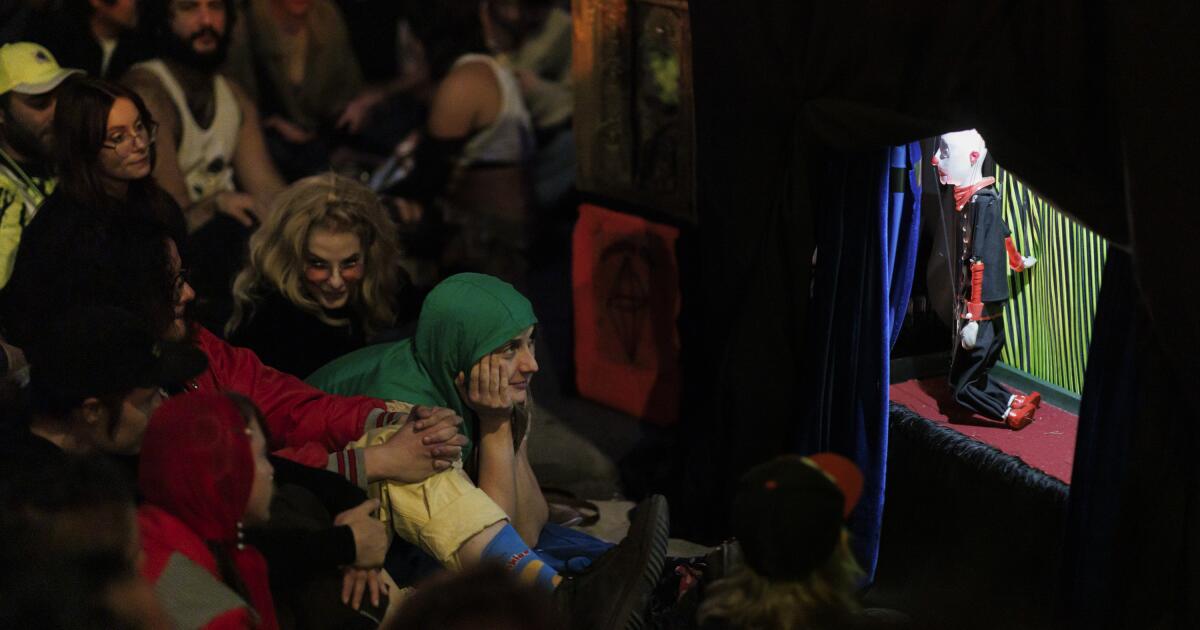
The view of the stage from the back of the crowd during January’s “almighty Opp” puppet show, which has returned to Koreatown after a nearly five-year break due to the COVID-19 pandemic and a family tragedy.
(Carlin Stiehl / For The Times)
“I missed funerals, I missed Christmases, I missed friends’ birthdays. I never took a vacation,” Jeffrey says of his devotion to his monthly performances during a recent phone interview after his late January show, which also drew a large, excitable crowd of supporters. “I treated it like a knife to my heart.”
“Almighty Opp” is truly about Jeffrey’s heart. Services take place in a specially designed black stage populated with a variety of custom fabricated puppets. These creations are not from Mister Rogers’ Neighborhood of Make-Believe. At a recent show the ringleader wore a red dirndl with gray knee socks and black ankle boots. His angular head topped with a green felt crown; his toothy mouth a sinister, grimacing gash; his eyes blackened with what looks like charcoal. Other puppets cavorted around him: A tubby, clownish, snowman-like creature that spits water at the crowd; a tall, spindly clown that uses a miniature pump; a weird sock puppet made out of adhesive bandages; a discarded, disheveled baby doll on strings.
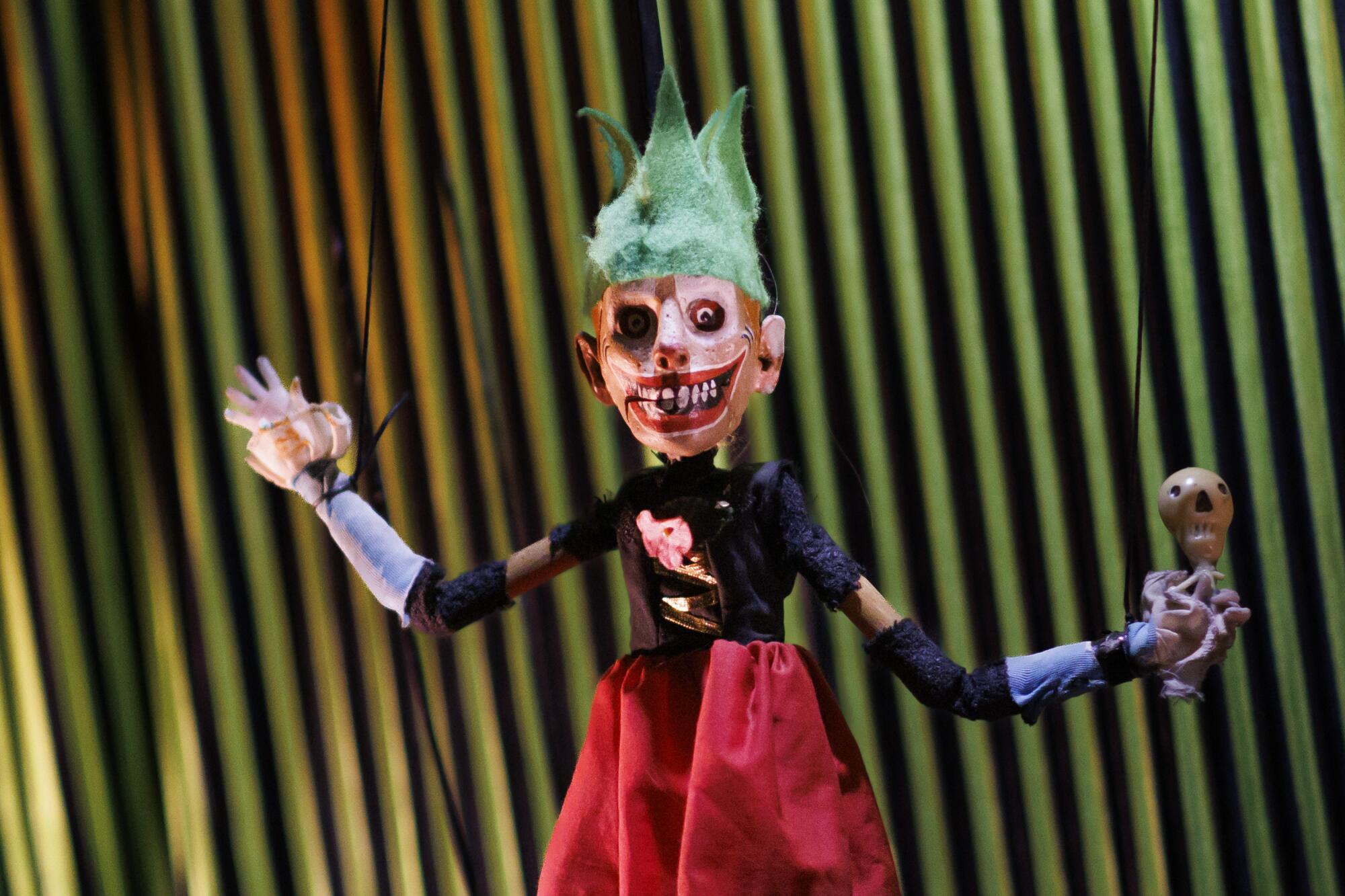
One of the main marionettes used in the “almighty Opp” street show. The puppets sing songs written by the show’s creator, an artist who goes by the name of Jeffrey’s Human Persona.
(Carlin Stiehl / For The Times)
Music is the focal point of each service, with Jeffrey playing guitar and keyboards behind the curtain, singing in a wavering voice reminiscent of Jeff Mangum about the subjects, ideas and feelings that have occupied his mind at various stages of his life. To date, “almighty Opp” has put out 33 albums on Bandcamp featuring songs from services over the years with titles including “Every Day’s the Worst Day,” “Misbegotten Human Beings” and “Bubble Burster.”
“Pretending I had a choice, just as long as we said we did, but now it’s much worse than it seems five years later,” sings a puppet that looks like a bizarro Humpty Dumpty with a huge egg head on a body of red pants during January’s show. “Supporting someone else’s dreams because your good nature’s being used.”
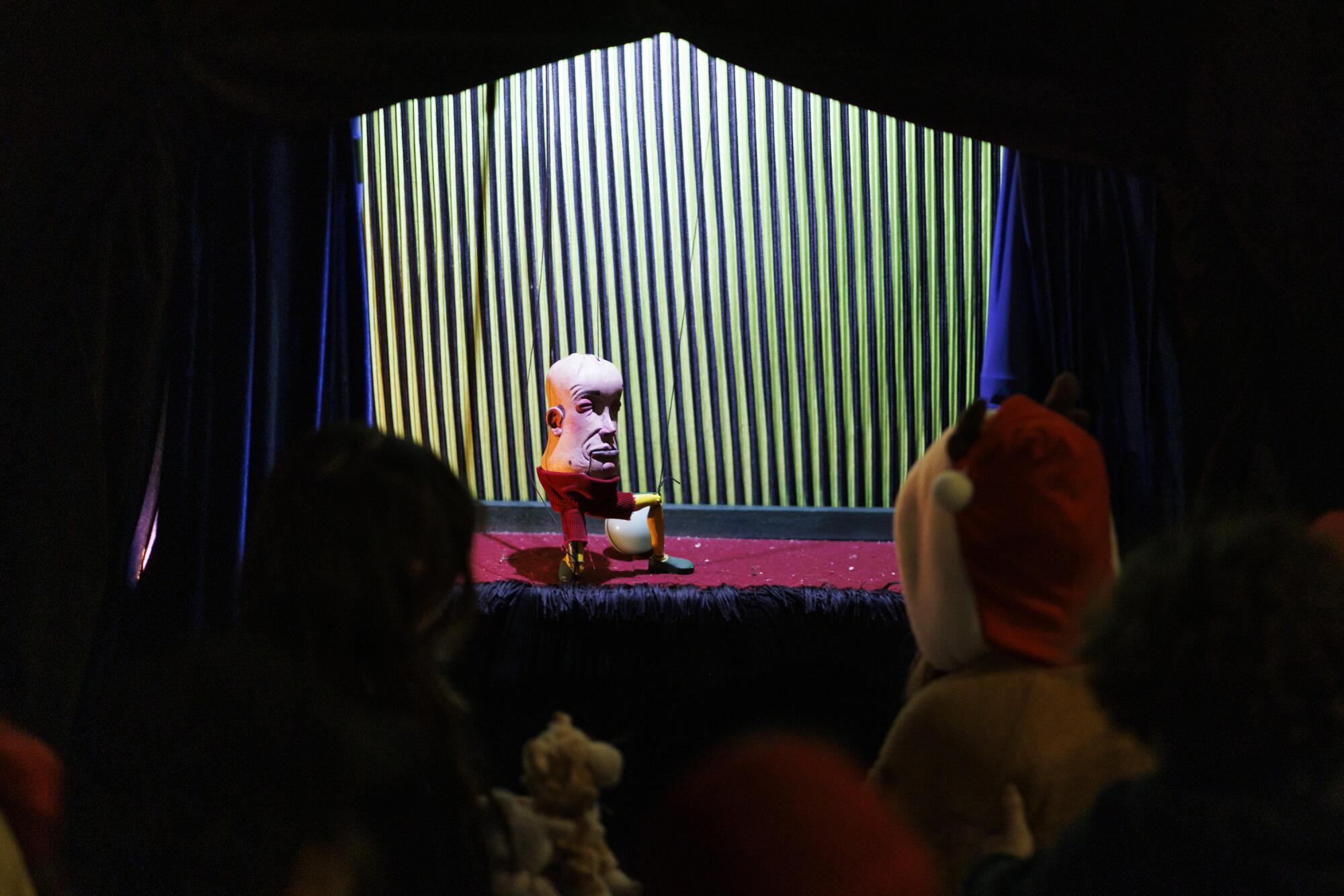
“Almighty Opp” employs a variety of richly detailed, hand-crafted puppets. The show’s creator once worked as an assistant to sculptor Chris Burden.
(Carlin Stiehl / For The Times)
A common refrain, which almost everyone gathered on the gum-stained sidewalk sings in unison, is, “It’s OK to not be OK.”
Jeffrey loves the spontaneous possibilities of the street corner and what he calls the “stumble upon” nature of the services, but the core audience is a returning one. The nearly 200 people gathered on this January evening just past 9 p.m. stand on stools and chairs in the back and loll on the sidewalk on their elbows in the front. They scream and chant and sing along. They turn and hug one another or shake hands when Jeffrey encourages them to meet their neighbors at different points in the show.
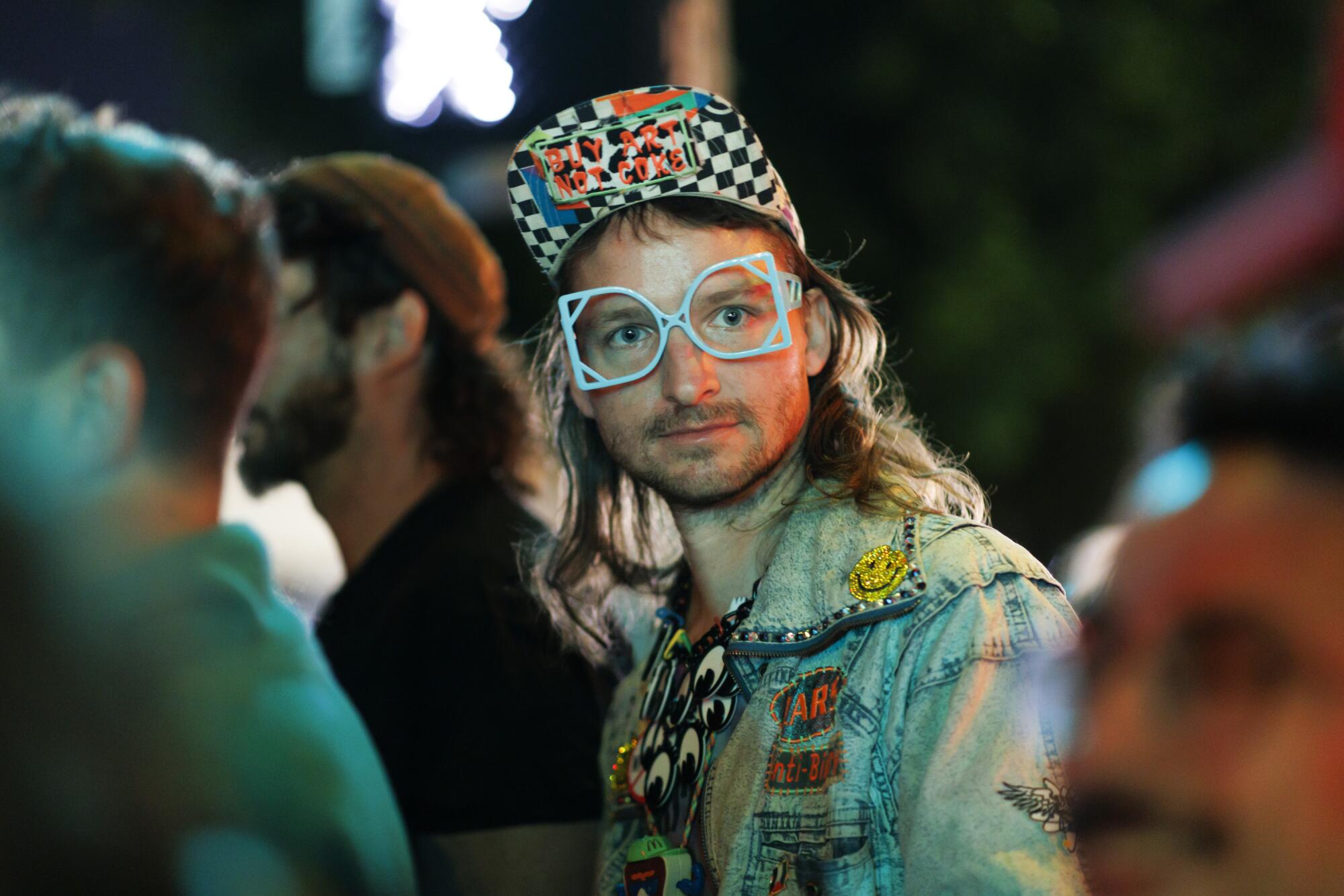
Lars Adams attends an “almighty Opp” show on the last Saturday in January. During the show the crowd is encouraged to turn and greet their neighbors.
(Carlin Stiehl / For The Times)
“Even though I’m performing, I don’t really consider myself a performer,” Jeffrey says. He also isn’t a busker, although his shows are free community events. And even though there are puppets, he doesn’t call “almighty Opp” a puppet show. He is, he says, “an obsessive maker.” The audience is “just coming along for the ride with me — life’s ride — of how I’m feeling at that time. It’s kind of like a Catholic Church service, where the sermon changes, but the structure of it remains the same.”
Unlike a church service, shows are rowdy and a bit untethered. A bus whooshes by, an unhoused man screams as he walks by with a shopping cart. Jeffrey’s wife, known as Shambles, operates the puppets from behind the curtain, while wearing their 5-year-old daughter, known as Crumbo, in a sling. Two other assistants, called DingDing and Cylo, can also be seen behind the black curtain — their faces hidden in knitted clown masks or shielded by makeup. Jeffrey comes before the crowd toward the end of the show — wearing a white mask and a red hoodie — and asks audience members to give testimonials. People stand up and talk about having been changed by the show over the years.
That’s what happened with Micah Nelson. He came when Jeffrey used to hold mirrors in front of people’s faces and have them watch themselves while the crowd watched them. The sessions were uncomfortably long. Nelson later contacted Jeffrey to say he was covering some of his songs, and that his experience with the mirror had a profound effect on him.
When Nelson introduced Jeffrey at the recent “Secret Somewhere” show, the things he said about Jeffrey made the performer blush. Life, Jeffrey said, has a funny way of coming full circle.
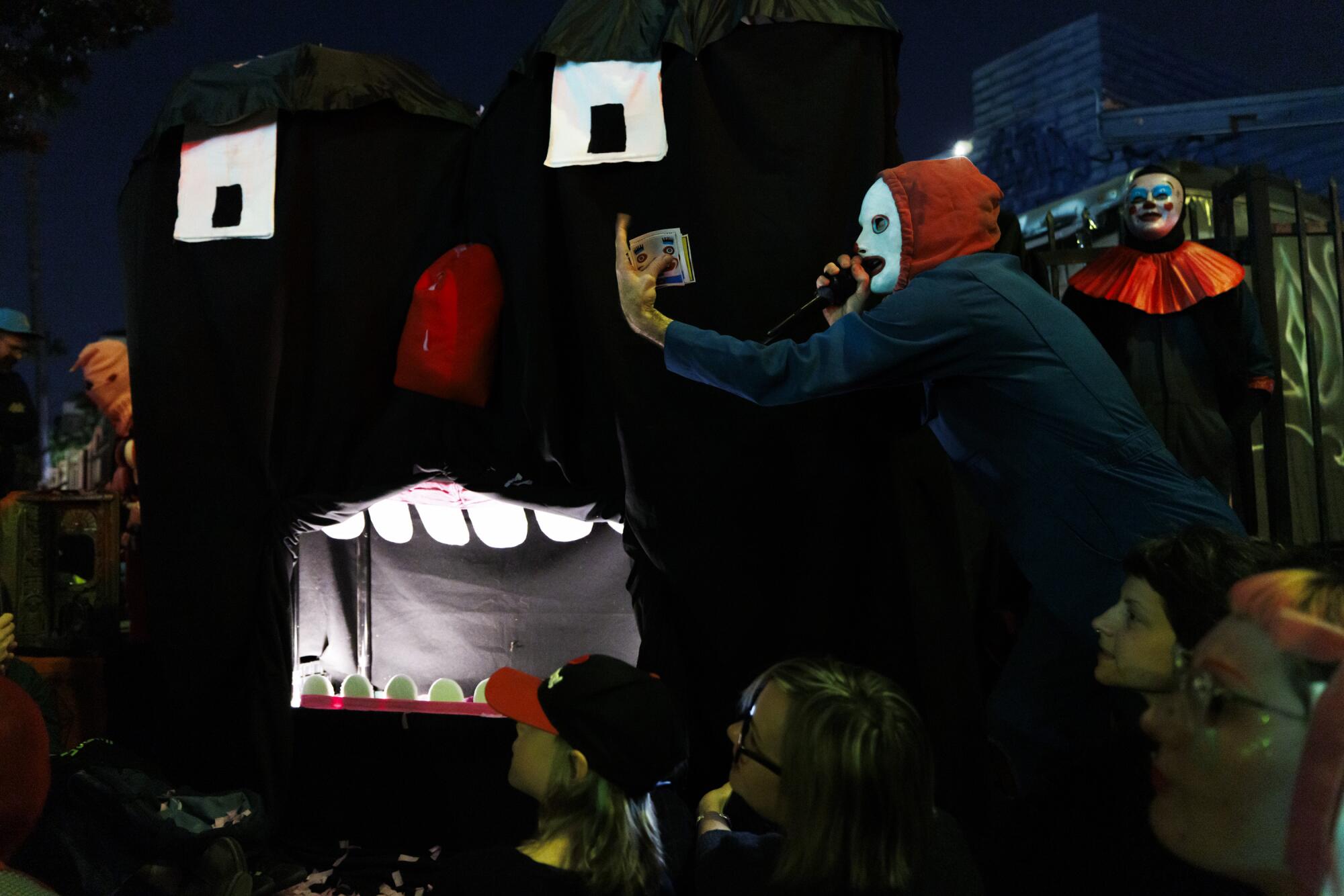
Jeffrey’s Human Persona, who created “almighty Opp” in the early aughts, asks audience members gathered on a Koreatown street corner to give testimonials about the show, which he calls a “service.”
(Carlin Stiehl / For The Times)
Jeffrey moved to L.A. from Pittsburgh in 1995 when he was 19. His father bought him the plane ticket after Jeffrey found himself in a bit of a boredom rut with friends and getting into the wrong kind of trouble. He wanted to work in the film industry — he thought L.A. would be like a 1970s Jim Morrison fever dream, but found it not as inspiring. The film business, in which he worked making fantasy art and other fabrications, was not a creative haven, but rather a soul-sucking void.
“I’m tired of making other people’s puppets,” he told a friend one day, and “almighty Opp” was born.
“If you just show up for a paycheck, what are you really doing?” asked Jeffrey during our interview. “I’d rather be a flop and believe in it.”

Children gather at the very front of the stage during January’s “almighty Opp” show, which features original songs on guitar and keyboard. A total of 33 “almighty Opp” albums are available on Bandcamp.
(Carlin Stiehl / For The Times)
He made the original puppets and wrote the first “almighty Opp” album in the second-floor apartment where he lived, just a stone’s throw from the corner where he still performs — the corner where he would propose to his wife during a particularly difficult period of his life. During all those years he worked in a variety of creative roles to support himself: for the toy industry; briefly for the Disney Imagineers; and for about eight years as an assistant to sculptor Chris Burden for whom he helped fabricate the whizzing future land “Metropolis II,” which resides in Los Angeles County Museum of Art’s permanent collection.
Now that “almighty Opp” is live again, Jeffrey is benefiting from the therapeutic aspects of writing down his emotions and experiences. The “Secret Somewhere Services” will continue once a month, or maybe every two months. Guests can check Instagram for tips on how to score a coveted ticket, which comes with its own handcrafted entrance token and map to the ever-changing private venue. Jeffrey is making big puppets for these performances — one is 7 feet tall — and experimenting with the form of the event.
Still, the street corner will remain the soul of his operation — and the music at the heart of it all.
“It’s all about honesty, and the people who understand it and keep coming, they know that it’s something absolutely real,” he says.
Almighty Opp
Where: Corner of Western and Elmwood avenues, in Koreatown
When: The last Saturday of every month, 9 p.m.
Tickets: Free
Running time: Varies, but usually about an hour.

By ABBIE BERNSTEIN / Staff Writer
Posted: March 8th, 2026 / 08:00 PM
THE BRIDE movie poster | ©2026 Warner Bros.
Rating: R
Stars: Jessie Buckley, Christian Bale, Annette Bening, Jake Gyllenhaal, Peter Sarsgaard, Penelope Cruz, Jeannie Berlin, Zlatko Burić
Writer: Maggie Gyllenhaal, based on characters created by Mary Shelley and William Hurlbut and John Balderston
Director: Maggie Gyllenhaal
Distributor: Warner Bros.
Release Date: March 6, 2026
“THE BRIDE!” (as with the recent “WUTHERING HEIGHTS,” the quotation marks are part of the title) is awash in homages, and not just the ones we might reasonably expect in a movie that takes its most obvious inspiration from 1935’s BRIDE OF FRANKENSTEIN.
There’s that, of course, plus its source, Mary Shelley’s 1818 novel FRANKENSTEIN; OR THE MODERN PROMETHEUS, and its sober 1931 film adaptation FRANKENSTEIN. But there are also big nods to wilder takes on the legend, including YOUNG FRANKENSTEIN and THE ROCKY HORROR PICTURE SHOW and even movies that have nothing to do with FRANKENSTEIN, like BONNIE AND CLYDE.
Writer/director Maggie Gyllenhaal casts a wide net in metaphors and ideas and looks. Sometimes “THE BRIDE!” is a comedy, sometimes it’s a crime drama, sometimes it’s a love story, occasionally, it’s even a musical.
Mary Shelley (Jessie Buckley) narrates the tale to us from beyond the grave. She is haughty and naughty, intoxicated by verbiage and her own literary genius. She is going to tell us a story, she says, that she didn’t even dare imagine while alive.
We’re in 1930s Chicago, where a young escort (also Buckley) is having a really awful evening out at a fancy restaurant with some of her peers and a bunch of crass gangsters. Shelley dubs the woman “Ida” and takes possession of her, causing her to speak and act in ways that get her escorted outside. There she stumbles and takes a fatal fall.
The two goons who were with Ida are happy to describe her tumble as the result of their intentional actions to their horrible gangster boss (Zlatko Burić). Ida was suspected of talking to the cops.
Around the same time, Frankenstein’s creation (Christian Bale) – let’s just call him “Frank,” like everybody else does – comes to Chicago to seek out the groundbreaking scientist Dr. Euphronious (Annette Bening), whose published works he has read.
Frank wants the doctor to create a companion for him. His appearance is unusual, but the most alarming injuries are covered by clothing, so he’s not as extreme-looking as, say, Boris Karloff in the role. This isn’t about sex, Frank explains when Euphronious asks why he doesn’t just hire a prostitute. After over a century of loneliness, he seeks a soulmate, and he is sure this can only be achieved by reviving a corpse.
So, Euphronious and Frank dig up the grave that turns out to belong to Ida (we never do learn how they know it belongs to a soulmate candidate as opposed to a shot-and-dumped male gangster). Euphronius revives her. Ida remembers how to walk and talk, but not who she is or what happened, so Frank and the doc tell her she’s been in an accident.
Even without Ida’s beauty, Frank is already devoted to the very notion of her. A more accommodating suitor would be hard to find. Frank has another passion, the musical films of Ronnie Reed (Jake Gyllenhaal, the filmmaker’s brother), a Fred Astaire-like star. Frank imagines himself in the midst of those dance routines, and we get some more within “THE BRIDE!”’s “real” action.
One thing leads to another, Frank and Ida go on the run, leaving a trail of bodies in their wake. They are pursued all over the country. Among those seeking them are sad-eyed police detective Jake Wiles (Peter Sarsgaard) and his secretary Myrna Mallow (Penélope Cruz), who’s better at this whole crime-solving business than he is.
It’s all very kaleidoscopic and energetic, occasionally impressive and sometimes very funny. Bening as the frazzled, worldly Euphronious has some great moments. Buckley, currently and justifiably Oscar-nominated leading performance in HAMNET, juggles the very unalike personas of Mary and Ida with impact.
Oddly, Bale underplays Frank. We get that he is trying his hardest not to spook Ida (or anyone else), but it seems like he should have a bit more spark. Cruz, going for a snappy ‘30s working woman, has her own style that works.
But in addition to being entertaining and eye-catching, Gyllenhaal has a message that gets very muddled. This is less because it’s so familiar by now that it feels a little redundant, and more because a crucial part of the set-up collides head-on with the feminist slant.
Ida seeks to be her own person, but she is literally bodily controlled by Mary Shelley, who puts her creation in danger with her outbursts. This may help get Ida out of the clutches of the mob, but it is possession, the aftereffects of which the character understandably finds confusing and upsetting.
If Gyllenhaal wanted to discuss or dramatize the clash between what Mary, as a woman, is doing to this other woman, that would make sense, but it seems we’re just meant to somehow overlook this while being immersed in how men control women. The resulting cognitive dissonance adds another layer to a movie that already has more than it can comfortably service.
Additionally, when Mary has one of her outbursts while inhabiting Ida, the plot comes to a screeching halt until she’s finished. Many viewers will wish Mary would stop declaiming and just let Ida be herself.
“THE BRIDE!” succeeds in being trippy and some of it is memorable. By the end, though, it is more disjointed than even a movie about experiments and a character made up of multiple people’s body parts ought to be.
Related: Movie Review: NFT: CURSED IMAGESRelated: Movie Review: SCREAM 7
Related: Movie Review: OPERATION TACO GARY’S
Related: Movie Review: ANACORETA
Related: Movie Review: THIS IS NOT A TEST
Related: Movie Review: GHOST TRAIN
Related: Movie Review: COLD STORAGE
Related: Movie Review: THE HAUNTED FOREST
Related: Movie Review: “WUTHERING HEIGHTS”
Related: Movie Review: THE MORTUARY ASSISTANT
Related: Movie Review: THE STRANGERS: CHAPTER 3
Related: Movie Review: PILLION
Related: Movie Review: JIMPA
Related: Movie Review: ISLANDS
Related: Movie Review: WORLDBREAKER
Related: Movie Review: MOTHER OF FLIES
Related: Movie Review: 28 YEARS LATER: THE BONE TEMPLE
Related: Movie Review: NIGHT PATROL
Related: Movie Review: THE CONFESSION (2026)
Related: Movie Review: WE BURY THE DEAD
Related: Movie Review: ANACONDA
Related: Movie Review: AVATAR: FIRE AND ICE
Related: Movie Review: IS THIS THING ON?
Related: Movie Review: MANOR OF DARKNESS
Related: Movie Review: DUST BUNNY
Follow us on Twitter at ASSIGNMENT X
Like us on Facebook at ASSIGNMENT X
Article Source: Assignment X
Article: Movie Review: “THE BRIDE!”
Related
Related Posts:

Kim Kardashian Never Tried to Buy Rare Hermès Bag for North West, Despite Report

U.S. and Israeli war in Iran, which Trump says will be ‘short term,’ has global reach

Hawks’ strip club collab became a PR nightmare for the NBA. Now it’s been scrapped

Europe and Asia battle for LNG as Iran war chokes supply

NATO intercepts another Iranian missile in Turkish airspace

Florida High School Football Rankings: Top 25 teams – Oct. 21

Cleary's 21 help Le Moyne down Central Connecticut State 69-64 in OT

How old is Bo Nix? What to know about Oregon quarterback ahead of 2024 NFL Draft

99th annual Pony Swim held in Virginia

Indiana Members Credit Union announced as new anchor tenant at Bottleworks District
NATO intercepts another Iranian missile in Turkish airspace

Is Iran another Iraq? : Sources & Methods

Trump says Iran war will be “over pretty quickly” as oil price hits 6 year high | BBC News

China-linked birth tourism under scrutiny as GOP lawmakers press Trump admin for answers

What defence support could Ukraine offer Middle East states amid Iran war?
-

 Wisconsin1 week ago
Setting sail on iceboats across a frozen lake in Wisconsin
-

 Massachusetts7 days ago
Massachusetts man awaits word from family in Iran after attacks
-

 Maryland1 week ago
AM showers Sunday in Maryland
-

 Florida1 week ago
Florida man rescued after being stuck in shoulder-deep mud for days
-

 Pennsylvania4 days ago
Pa. man found guilty of raping teen girl who he took to Mexico
-

 News1 week ago
2 Survivors Describe the Terror and Tragedy of the Tahoe Avalanche
-

 Sports5 days ago
Keith Olbermann under fire for calling Lou Holtz a ‘scumbag’ after legendary coach’s death
-

 Virginia5 days ago
Giants will hold 2026 training camp in West Virginia