Entertainment
Does adding scents to a symphony make sense? Scriabin and synethesia in San Francisco


It was a cold and wet afternoon as I strolled down forlorn Telegraph Avenue in Berkeley. A countercultural thoroughfare in the late 1960s, the street retained next to nothing of its once colorful flower power. But all of sudden, I smelled incense and heard a recording of Messiaen’s psychedelic “Turangalila-Symphonie.” Annapurna, the head shop that opened in 1969 at the same time as the historic demonstrations at the now boarded-up People’s Park, has survived.
The combination of this specific smell and music, so familiar from my student days here, acted like some kind of nostalgia drug. For an astonishing moment, I was transported back in time. But even more mysterious, it was music, scent and color that recently brought me to the Bay Area in the first place.
The San Francisco Symphony happened to be experimenting with scents in the concert hall for Scriabin’s “Prometheus, The Poem of Fire,” a 20-minute symphony that includes solo piano. The mystical Russian composer experienced synesthesia, the neurological condition in which the brain involuntarily associates one sense with another. Scriabin’s brain — as had, coincidentally, Messiaen’s — ascribed specific colors to specific harmonies.
In “Prometheus,” Scriabin went so far as to include a part for “color organ,” a newly invented instrument that projected colored lights, in his 1910 score. But instead of one color blending into another for dramatic effect, the result was murky gray. Technology has evolved, and Jean-Yves Thibaudet, San Francisco Symphony’s soloist, had long dreamed of adding more senses to the Scriabin mix. Why not scent? The orchestra’s music director, Esa-Pekka Salonen, was intrigued.
I was dubious. Smells linger. As a kid enamored of movie gimmicks, I cajoled my parents to take me to the 1960 Smell-O-Vision “Scent of Mystery,” which had dozens of everyday odors blown from under your seat. By the end, there was an all-purpose stink in the theater. It was disgusting.
Mathilde Laurent, a perfumer at Cartier in Paris, created three original scents for “Prometheus.” Capsules of dry concentrate were projected from diffusers under every third seat. Large wooden devices around the hall chilled and dried the air, so the scents didn’t linger. That sort of worked.
A corona of neon tubes overhead and along the walls of Davies Symphony Hall looked cheesy but approximated Scriabin’s color concept. That sort of worked as well.
“Prometheus” is an extraordinary score, Scriabin’s extravagance going far beyond synesthesia. Written for large orchestra and inspired by Madame Helena Blavatsky’s Theosophical Society, the symphonic tone poem is a fantastical transformation of the Greek myth of Prometheus, who steals fire from the gods. Scriabin’s rich mix of erotic and spiritual ecstasy follows the mystical process of humankind (the piano), in the form of an all-encompassing ego (brass assert in endless refrain an “I am” theme) arising out of imperceptibly quiet, inchoate chaos and merging into earsplitting, delirious joy, in which an otherworldly chorus joins.
The lighting effects are intended to be full of symbolic intent. There are themes of creative principle and will and the like. Blue, for instance, is overcome by the yellow of the sun, and that is supposed to mean something. But nobody’s going to get that.
The scents supposedly have been added for a different purpose. The highly publicized event caught the attention of the weekly British magazine New Scientist, which points out in its latest issue that olfaction bypasses reason. Smell stimulates the parts of the brain tied to memories and emotions, just as Annapurna’s incense had done for me. Presumably, then, the art of olfaction can ready our minds for new experiences.
At a preconcert talk for the Sunday matinee, which I attended, Laurent described her first scent as evoking a sense of anxiety at the start, where the music represents the world before civilization. It was a bit fungal. She selected a perfume she had already invented for Cartier, sweet and sexy, to accompany fire and passion. The last one was grassy for joy.
Maybe it was just me, but the scents landed on the wrong part of my brain, knocking on reason’s door. Scriabin leaves you with enough questions as it is, and here were more. Salonen’s and Thibaudet’s sensational performance of “Prometheus” — transparent, nuanced and colorful — had no need for further tickling the senses.
Michelle DeYoung and Gerald Finley sing as Esa-Pekka Salonen conducts Bartók’s “Duke Bluebeard’s Castle.”
(Brandon Patoc / San Francisco Symphony)
A further revelation came after intermission with an even more impressive concert performance of Bartók’s “Duke Bluebeard’s Castle” that demonstrated the radical difference between theater and synesthesia. The neon lights this time underscored the atmosphere — red for blood dripping in the castle’s creepy rooms, green for grass. Neither annoying nor augmenting, they were merely obvious.
But in one of the most magnificent orchestral climaxes in symphonic literature, when Bluebeard opens a door revealing a vast landscape, Salonen turned to face the audience as he conducted, and the hall burst into brilliant daylight. Dazzling illumination and overwhelming orchestral effect, not color, made this heart-stopping.
Otherwise, this “Bluebeard” needed no theater, thanks to Salonen’s unerring sense of drama, along with ideal soloists — an entrancing Breezy Leigh (the narrator), soul-searching Gerald Finley (Bluebeard) and radiant Michelle DeYoung (Judith).
I was in Berkeley on Saturday for one of Kronos Quartet’s “Five Decades” programs, celebrating the groundbreaking group’s 50th anniversary. The program at Zellerbach Hall included Sofia Gubaidulina’s Quartet No. 4, one of the well over 1,000 Kronos commissions.
It just so happens that Gubaidulina is another Russian synesthete with a strongly spiritual bent, and she included color lighting effects in her score. Among its multitude of innovations, Kronos had pioneered performing its chamber music concerts with lighting design shortly before the 1992 Gubaidulina premiere in Carnegie Hall.
That had been advertised as a big deal in New York. The work uses recorded string quartet sounds on tape along with the live performance. Gubaidulina wanted one kind of lighting for what she called “unreal” sounds of bouncing balls on the strings on tape and another for “real” live sounds. I remember the music from that premiere but don’t recall the lighting being much of anything.
At Zellerbach, Gubaidulina’s quartet was given as part of a wildly mixed program highlighted by the world premiere of Javanese composer Peni Candra Rini’s “Segara Gunung,” which featured her as arresting vocalist. For arresting visual effect, she included shadow puppet theater.
I ran into the Kronos first violinist, David Harrington, at “Prometheus” on Sunday and asked him about the decision to leave out Gubaidulina’s desired lighting. He said Kronos never used Gubaidulina’s lighting even for the Carnegie premiere. He felt it was too garish for this exquisite score.
Live performance is theater. Lighting, movement, design, staging, acoustic projection all have their place, and maybe scent can as well. But you need a director who can translate a synesthesia vision onto the stage.
Salonen, in fact, had just that in a “psychedelic night” at the Hollywood Bowl a quarter century ago, when he was Los Angeles Philharmonic music director. For that, Peter Sellars related “Prometheus” to Native American ritual. The scents were from whatever the party next to you brought for a picnic dinner, or a furtive puff of marijuana.


It’s a good year when we get movies like Remarkably Bright Creatures and The Sheep Detectives at the same time. If there’s one type of emotional draw we’ll never say no to when it comes to the fiction we consume, it’s wholesome. The kind of movies and TV shows that leave you with a bit more hope than you expected. The kind of stories that make you believe that humanity isn’t as broken as it really is.
The Sheep Detectives is essentially tailor-made for anyone who loves a good whodunnit that’s rich with nuance and humor. The clever decision to shift the genre into something both kids and adults could appreciate together is no small feat, and that’s largely where its mass appeal lies. Murder is a heavy subject to deal with—as is grief—yet this story makes sitting with the weight of both a little easier. It could kickstart a number of thoughtful conversations while it simultaneously delivers plenty of laughs along the way.
For adults, there’s also a huge appeal in the casting—the voice actors especially. Anyone who knows me knows that Ted Lasso is the kind of show I’ll always put first, so hearing Brett Goldstein voice a sheep is the kind of A+ decision that’s effortless to appreciate. Hugh Jackman, Nicholas Galitzine, Molly Gordon, Nicholas Braun, Emma Thompson, Julia Louis-Dreyfus, Bryan Cranston, Bella Ramsey, Regina Hall, Rhys Darby, Patrick Stewart, Hong Chau, and the whole cast do an exceptional job as well, making every moment of The Sheep Detectives thoroughly entertaining.

It’s hard to imagine anyone coming out of the movie not thinking it’s one of the best things we’ll watch all year, and that’s a high compliment considering 2026 is full of gems like Project Hail Mary and the upcoming The Odyssey. It’s the exact kind of movie we could all use, but more than anything, the kind of story we could use more of. If there’s any sort of sequel, sign me up. Let’s make it a trilogy. Give us more of the sheep.
The cinematography is gorgeous, the writing is sharp, the performances are thrilling, and the message is a gem worth holding onto. The Sheep Detectives is the kind of feel-good treasure that does an excellent job of reminding us why movies like this will always matter. There’s a thoughtful message about how grief is meant to be shared and why it’s so important to carry those who’ve passed with us. Yes, it’d be convenient to forget our pain by sheer mental willpower, but we aren’t meant to do that. As humans and as animals, I imagine that the good, bad, and ugly are all part of what makes life beautiful, and that’s a comforting message to sit with.
The concept of a whodunnit featuring sheep solving a murder sounds so wild on paper, yet everything about it results in the kind of movie that should signal to Hollywood we want more creative approaches to what’s familiar. There’s a reason The Muppets are so popular, and we shouldn’t be afraid of making things that sound a bit too whimsical on paper. In other words, The Sheep Detectives embraces the whimsy, and it’s exactly what makes it so delightful.
The Sheep Detectives is now streaming on Prime Video.
First Featured Image Credit: ©Amazon MGM Studios
Related
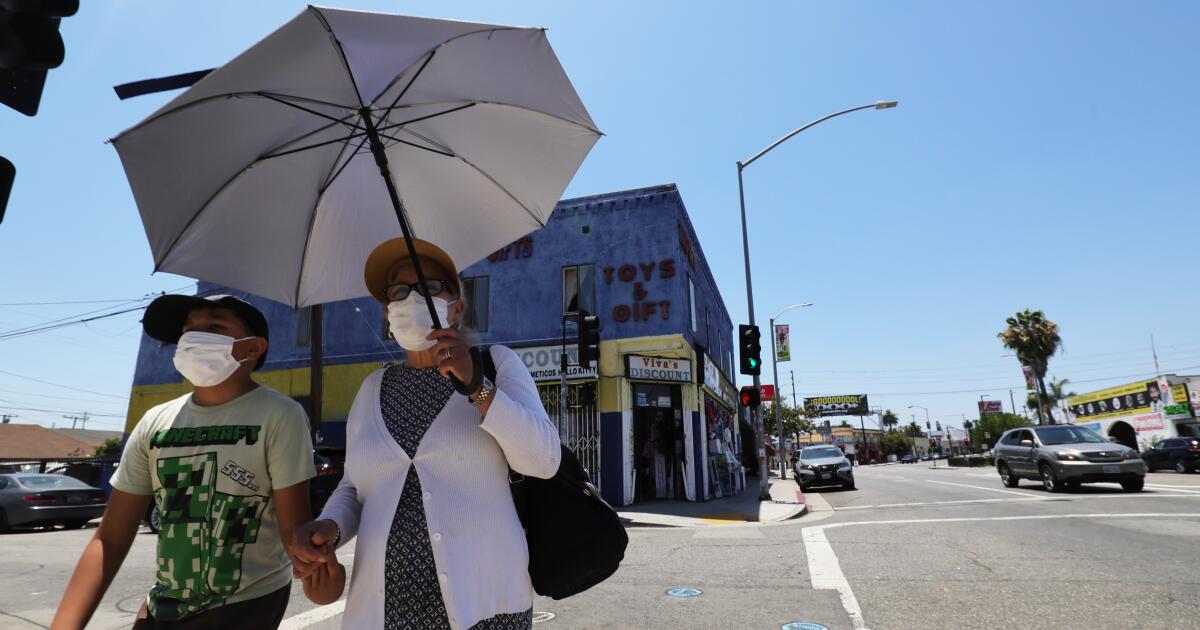
The National Weather Service has issued a heat advisory for this week that includes Los Angeles County and other parts of the Southland, especially in valleys and away from the coast.
Temperatures are expected to rise in the Santa Clarita Valley, the east and west San Fernando Valley, as well as parts of the San Gabriel Valley and northwest L.A. County mountains beginning Tuesday and lasting through Thursday, with warm, seasonably elevated fire weather conditions, according to the National Weather Service.
Forecasts indicate the mercury will reach 90 to 105 degrees in the interior, 80 to 90 degrees in the inland coastal plain — including downtown L.A. — with highs in the 80s and lower 90s in the foothills and canyons of southwest Santa Barbara County.
Rose Schoenfeld, meteorologist with the National Weather Service in Oxnard, said temperatures should be five to 10 degrees above normal for this time of year thanks to a high-pressure system building up over the region.
Though temperatures are expected to drop after Thursday, don’t expect that cooling to last.
“Looking ahead, you might be seeing some outlooks that look pretty favorable, but that heat will linger and redevelop with a pretty impressive heat wave for much of the west, that would be starting next weekend or so,” Schoenfeld said. “It doesn’t seem like we’re out of the woods, even if temperatures start to drop after Thursday.”
The rising mercury coincides a with major marine heat wave across the Pacific Ocean that has the potential to affect weather events around the world, bringing months of warmer oceans, which trigger thunderstorms and extreme heat thousands of miles away.
In recent weeks, record heat waves have baked parts of Europe, with temperatures hitting 104 degrees in some countries. France has reported more than 1,000 heat-related deaths.
In the U.S., record heat has gripped much of the Midwest and East Coast, with temperatures between 110 and 115 degrees in major metropolitan areas, with the National Weather Service issuing an extreme heat warning for much of the Midwest, Mid-Atlantic and Northeast.
The sweltering temperatures have disrupted travel and led to a number of cancellations planned for celebrations over the Fourth of July weekend, including Philadelphia’s Salute to Independence parade. The Great American State Fair, on the National Mall in Washington, was forced to shut down for a few hours.
Amtrak canceled some trains in the Northeast because of excessive heat that could affect the tracks.

The Isolate Thief, 2026.
Directed by John Suits.
Starring Mackenzie Foy, Odeya Rush, Joe Pantoliano, Sean Bean, Jack Kesy, Ty Simpkins, Bryan Martin, and Martin Sensmeier.
SYNOPSIS:
A young woman struggles to conceal the gold she stole from violent outlaws who have seized control of her remote outpost, outwitting them amid a deadly winter where survival becomes a game of cunning and betrayal.

Set at a Union outpost in frigid temperatures, John Suits’ The Isolate Thief transcends what was likely a small budget with a fittingly chilly, oppressive look, and an ensemble that sneaks up on you as not only packed but smartly cast. Front and center is Mackenzie Foy shedding her Twilight and Disney-oriented roots for gritty period-piece work that she handles capably and convincingly, whether it be fending off wolves at the outpost, bandaging a wound, playing a deceitful game for survival, or wielding a firearm.
That’s only the start, though, as Joe Pantoliano shows up as a harmless graverobber only to re-enter the picture as the hostage of a group of Union soldiers led by Sean Bean on a search for gold thought to be discovered by him, which in reality has been hidden away by Mackenzie Foy’s parentless (her father recently died in the war, meaning she is all alone at the outpost), grieving, underestimated caretaker waiting for the right moment to make a break with the gold for San Francisco. The merciless candor with which the Union soldiers are comfortable torturing the drifting graverobber should also be enough to signal that something is off about the group and that our hero probably shouldn’t trust them.

Without giving too much away, Ada (Mackenzie Foy) is up against a violent group of outlaws posing as Union soldiers under orders from Sean Bean’s Fiddler, who will stop at nothing for this gold (accompanied by fellow evildoers played by a range of underappreciated names such as Ty Simpkins and Jack Kesy). In the forest, she also stumbles across a badly injured Emily (Odeya Rush), who has a connection to these outlaws, reduced to being treated as a sex object (they refer to her as an unflattering term for a prostitute, which feels inaccurate given that such a term would imply she has a choice rather than having her agency regularly taken as it is here), so broken by her experiences with them that she advises Ada to give in to their demands as defying them typically results more horrifying outcomes.
Even if the screenplay from Kevin Lefler doesn’t necessarily crackle the way a pressure-cooker story like this should (there’s a lot of The Hateful Eight in the film’s DNA, but without anywhere near that level of character and thematic complexity), the cast elevates the material and provides a quiet intensity simmering underneath the casual conversations and deceptions that we know will eventually blow up in Ada’s face. It’s also a story that isn’t afraid to go to some fairly bleak places and put these women through the wringer as they fight back and try to make it out alive.

What it boils down to is a simplistic cautionary tale of ruthless, misogynistic outlaws underestimating the women they are up against. That is also desperately felt when the women turn the tables in the third act. Effectively accomplishing what it sets out to do. A freezing locale is used for atmospheric advantage (the ground is frozen solid, meaning graves can’t be dug, to give an idea of just how cold it is) while allowing Mackenzie Foy to tap into some new acting tools demonstrating resourcefulness, alongside Sean Bean believably going from calm to terrifying on a dime. The Isolate Thief is a feminist period-piece Western that organically empowers through familiar, albeit competent and engaging, storytelling, culminating in some tense battle-of-the-sexes action.
Flickering Myth Rating – Film: ★ ★ ★ / Movie: ★ ★ ★
Robert Kojder
https://www.youtube.com/watch?v=embed/playlist
-

 Detroit, MI10 minutes ago
Power outage forces flaring at Marathon’s Detroit refinery; portion of Schaefer Road closed
-

 San Francisco, CA22 minutes ago
San Francisco’s fireworks show ends in hours of gridlock involving Waymo cars
-

 Dallas, TX25 minutes ago
FIFA Fan Fest in Dallas paused due to lighting in the area Sunday evening
-

 Miami, FL30 minutes ago
Venezuelan Independence Day: Aid efforts continue after devastating earthquake
-

 Boston, MA37 minutes ago
Timeline: Looking back on Jaylen Brown’s Celtics career – The Boston Globe
-

 Denver, CO40 minutes ago
Denver police arrest suspect in fatal July 4 triple stabbing
-

 Seattle, WA45 minutes ago
UPDATE: Water-rescue response off west end of Alki Beach
-
 San Diego, CA52 minutes ago
San Diego County Gas Prices Still Dropping

