Entertainment
Cannes: 'Fury Road' prequel ‘Furiosa’ forgets what makes the 'Mad Max' movies great

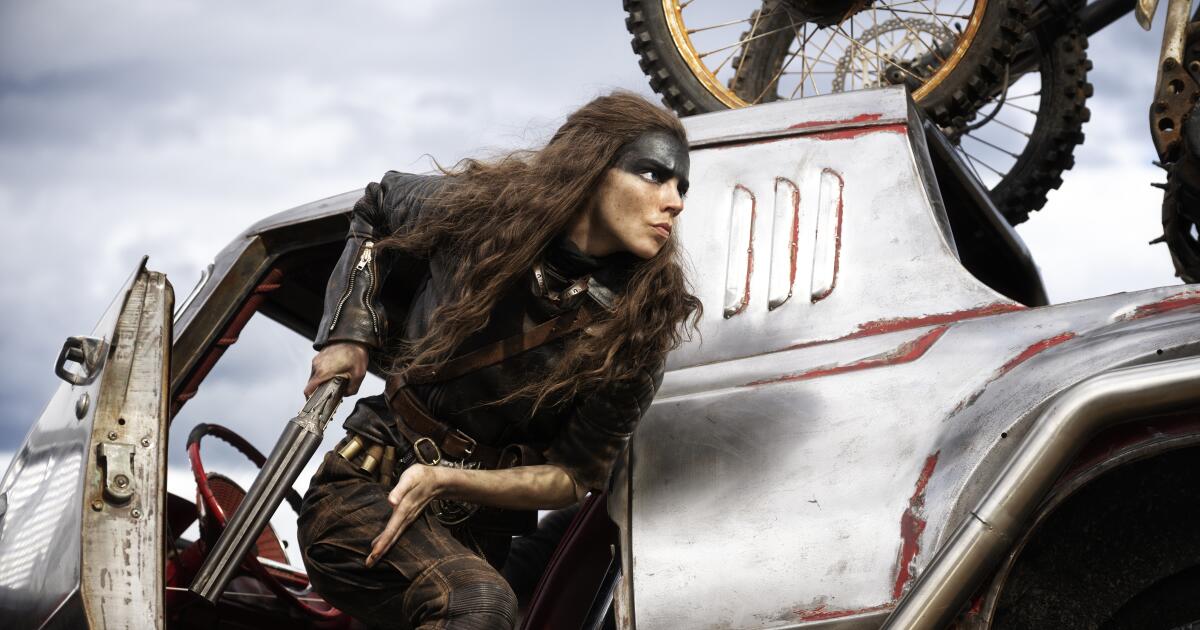
When Australia’s George Miller came here in 2016 to serve as jury president, just months after his “Mad Max: Fury Road” won six Oscars, he swept in like a conquering hero. His movie was undeniable: a reinvigoration of both his career and the action genre. Often, the relationship between Cannes and the blockbuster directors it invites comes off as strained — see French artist Zaho de Sagazan serenading “Barbie” filmmaker and this year’s jury president Greta Gerwig at Tuesday’s opening ceremony — but with Miller, the moment felt right.
Things change. His “Furiosa: A Mad Max Saga” (in theaters May 24), a somewhat dutiful new prequel to “Fury Road,” had its world premiere out of competition Wednesday, unspooling at the capacious Grand Lumière Theatre to a rapt audience that, it must be said, didn’t laugh once. “Who laughs at the end of the world?” you may ask. But that would be to deny Miller the richness of his grungy post-apocalyptic series, one that pairs brutal action sequences with emotional resonance, dark mythmaking, sociopolitical alarm and, yes, the odd Ozploitative chuckle at some catastrophic personal misfortune.
Some of that is in evidence in “Furiosa,” but nowhere near enough. For the first time in Miller’s now-five-film franchise, he seems to be falling shy of the immediacy he’s sustained, often deliriously, for an entire feature. Any prequel would necessitate a certain distance: This is what happened before the story you already know. And if you ever confused Charlize Theron’s hollowed-out stare in “Fury Road” for a lack of backstory (that’s actually the performance you’re noticing), “Furiosa” is here to supply that material for you, not unentertainingly. But with every supersaturated blue sky, russet-colored desert shot and faux-literary chapter heading (“2. Lessons from the Wasteland”), the movie gets further away from feeling like a tale that’s happening, to one that’s already been told, cleaned up and prettified.
Miller still mounts a story more confidently than just about anyone on the planet, and his kickoff, a 10-minute, near-wordless chase, is the definition of getting off on the good foot. A ferociously protective mom (the wonderful Charlee Fraser) trails, on horseback and motorcycle, a gang of kidnappers who have fled with her preteen daughter Furiosa (Alyla Browne, expressive during the film’s first hour). The latter, while unfortunate to be caught, is resourceful in her own way, chewing through fuel lines and blessed with the benefit of an especially prescient name. Flung over the back of a bike, her long hair flowing in the wind, the shot brings to mind to another defiant woman in Miller’s 1982 “The Road Warrior.”
A scene from the movie “Furiosa: A Mad Max Saga.”
(Jasin Boland / Warner Bros. Pictures)
A word about that stone-cold classic: By dint of the technology that was then on hand (i.e., no digital effects and a nutso stunt crew), “The Road Warrior” throws you into bodily panic with every kinetic setup. “Furiosa” rarely feels dangerous. Too much of its blood and fire is the work of computers, and for the first time, that work is obvious. There’s something very un-“Mad Max” about this; the tactility of the earlier films fed into the realness of potentially surviving the fall of civilization, even if that meant coming face to face with a tyrannical Tina Turner.
But the punkish spirit of the young Furiosa — forced to sit in a cage like a sad pet — goes a long way to setting up our connection with the story. Less so her captor, Dementus, played by Chris Hemsworth, who, though he tries hard to build an arm-swinging, cape-wearing, motormouthed swagger, doesn’t have the lines to give his gang leader the kind of vanity we could relish in a villain. Eventually we get those bleach-pale War Boys from “Fury Road” again, along with the monstrously masked Immortan Joe (Lachy Hulme), his thuggish mutant son Rictus (Nathan Jones) and a geographical trade war that’s a bit more complex than it needs to be.
Miller, who with co-screenwriter Nick Lauthoris worked out these script details before they approached “Fury Road,” mainly have their sights set on a centerpiece that comes close to redeeming the entire film: a lavishly armed War Rig truck barreling down an endless highway, hounded by attackers with propellers strapped to their backs. Finally, the grandeur of the older movies is here, as is Anya Taylor-Joy, whose Furiosa has now gone through her Yentl-passing-for-a-boy phase and now seems meant to wear a glamorous black smudge on her forehead and learn everything she needs to know about “road war” from Praetorian Jack (Tom Burke of “The Souvenir,” channeling the Leone-esque minimalism that marked Mel Gibson’s original antihero).
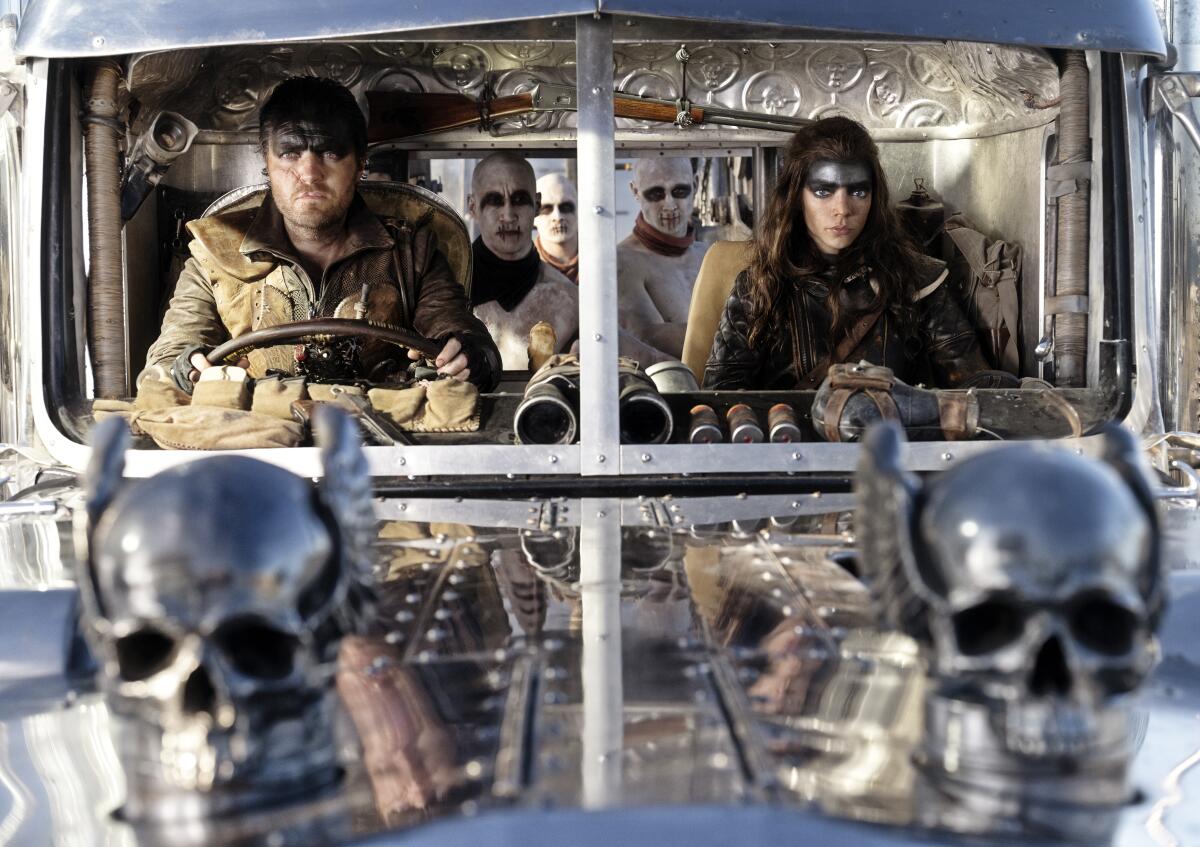
Tom Burke and Anya Taylor-Joy in the movie “Furiosa: A Mad Max Saga.”
(Jasin Boland / Warner Bros. Pictures)
We have a lot to learn about road war as well. What’s a bommy-knocker? (I won’t spoil it, but generally, you pay extra for that option.) There’s a finding-your-calling film built into “Furiosa” — maybe it took the apocalypse for this former fruit-picker to discover what she does well — plus a hint of a front-seat romance that’s never made explicit. But just as the movie is hitting its stride and Simon Duggan’s cinematography settles down, Miller strays back to a less-exciting vengeance narrative.
Much has already been made of Taylor-Joy’s lack of dialogue — hardly a drawback when you take in her burning stares and see how potently she’s making something out of nothing. If the movie has a deficiency (and it does), it’s not one of exposition but euphoria. The “Mad Max” universe was never that cautionary, not if you yourself ever wondered how you’d make it through societal meltdown and what kind of mohawk you’d get. The exhilaration of the polecats sequence in “Fury Road” — that fact that there’s such a thing as polecats — made the series a constant source of glee.
“Furiosa,” to its distinction and detriment, ends up being too self-regarding, too downbeat. It takes the fun out of survival. Miller’s imagination has fed into “The Last of Us,” “Fallout” and a host of other grayscale nightmares for movies and TV. He knows better than anyone that forward momentum is key to a “Mad Max” movie. Leave the prequels to those who don’t have any gas left in the tank.







PopHorror had the chance to check out Anacoreta (2022) ahead of its streaming release! Does this meta-horror flick provide interesting story telling or is it a confusing mess.
Let’s have a look…
Synopsis
A group of friends heads to a secluded woodland cabin for a weekend getaway, planning to film an experimental horror movie. As the shoot progresses, the project begins to fall apart—until a real and terrifying presence emerges from the darkness.
Anacoreta is directed by Jeremy Schuetze. It was written by Jeremy Schuetze and Matt Visser. The film stars Antonia Thomas (Bagman 2024), Jesse Stanley (Raf 2019), Jeremy Schuetze (Jennifer’s Body 2009), and Matt Visser (A Lot Like Christmas 2021)
My Thoughts
Antonia Thomas delivered an outstanding performance as the female lead in Anacoreta. It was remarkable to watch her convey such a wide range of emotions with authenticity and depth. I was continually impressed by her ability to switch seamlessly between different dialects. I absolutely loved her delivery of the dialogue of telling The Scorpion and the Frog fable.
Anacoreta employs a distinctive, meta-horror style of storytelling. The narrative follows a group of friends creating a “scripted reality” horror film, and as the plot unfolds, the boundary between their staged production and their actual lives becomes increasingly blurred. This was interesting, but at the same time frustrating as a viewer.

Check out Anacoreta on Prime Video and let us know your thoughts!

Todd Meadows, a crewmember on one of the fishing vessels featured on the long-running reality series “Deadliest Catch,” has died. He was 25.
Rick Shelford, the captain of the Aleutian Lady, announced in a Monday post on Facebook and Instagram that Meadows died Feb. 25. He called it “the most tragic day in the history of the Aleutian Lady on the Bering Sea.”
“We lost our brother,” Shelford wrote in his lengthy tribute. “Todd was the newest member of our crew, he quickly became family. His love for fishing and his strong work ethic earned everyone’s respect right away. His smile was contagious, and the sound of his laughter coming up the wheelhouse stairs or over the deck hailer is something we will carry with us always.
“He worked hard, loved deeply, and brought joy to those around him,” he added. “Todd will forever be part of this boat, this crew, and this brotherhood. Though we lost him far too soon, his legacy will live on through his children and in every memory we carry of him.”
A fundraiser set up in Meadows’ name described the deckhand from Montesano, Wash., as a father to “three amazing little boys” who died “while doing what he loved — crabbing out on Alaskan waters.”
According to the Associated Press, Meadows died after he was reported to have fallen overboard around 170 miles north of Dutch Harbor, Alaska.
“He was recovered unresponsive by the crew approximately ten minutes later,” Chief Petty Officer Travis Magee, a spokesperson with the Coast Guard’s Arctic District, told the AP. The Coast Guard is investigating the incident.
Meadows was a first-year cast member of “Deadliest Catch,” the Discovery Channel reality series that follows crab fishermen navigating the perilous winds and waves of the Bering Sea during the Alaskan king crab and snow crab fishing seasons. The show debuted in 2005. No episodes from Meadows’ season has aired.
Deadline reported that the show was in production on its 22nd season when the incident occurred, with the Shelford-led Aleutian Lady being the last of the vessels still out at sea at the time. Production has subsequently concluded, per the outlet.
“We are deeply saddened by the tragic passing of Todd Meadows,” a Discovery Channel spokesperson said in a statement that has been widely circulated. “This is a devastating loss, and our hearts are with his loved ones, his crewmates, and the entire fishing community during this incredibly difficult time.”
Meadows is the latest among “Deadliest Catch” cast members who have died. Previous deaths include Phil Harris, a captain of one of the ships featured on the show, who died after suffering a stroke while filming the show’s sixth season in 2010. Todd Kochutin, a crew member of the Patricia Lee, died in 2021 from injuries he sustained while aboard the fishing vessel, according to an obituary. Other cast members have died from substance abuse or natural causes.

“So it’s like Avatar?” one character quips in Disney and Pixar’s “Hoppers,” bluntly translating the film’s high-concept premise for the sugar-fueled kids in the audience. And yes, the comparison is apt. The story follows a nature-obsessed teenage girl who manages to quite literally “hop” her consciousness into the body of a robotic beaver in order to spark an animal rebellion against a greedy mayor determined to bulldoze their forest for a freeway.
It’s a clever hook. The kind of big, elastic idea Pixar used to make look effortless. “Hoppers” does not reach the rarified air of “Up,” “Wall-E,” or “Inside Out,” but after a stretch of uneven originals like “Turning Red” and “Luca,” and outright misfires such as “Elemental” and “Elio,” this feels like a genuine course correction. The environmental messaging is clear without being preachy, the animals are irresistibly anthropomorphized, and the studio’s once-signature emotional sincerity is back in sturdy form.
Pixar can afford to gamble on originals when it has a guaranteed cash cow like this summer’s “Toy Story 5” waiting in the wings, but “Hoppers” earns its place in the catalogue. Director Daniel Chong crafts a warm, heartfelt film that occasionally strains under the weight of its own ambition, yet remains grounded by character and theme. Its meditation on conservation and animal displacement feels timely in a way that never tips into after-school-special territory.
We meet Mabel, voiced with bright conviction by Piper Curda, as a child liberating her classroom pets and returning them to the wild. Her moral compass is shaped by her grandmother, voiced by Karen Huie, who imparts wisdom about nature’s sanctity. True to both Pixar tradition and the broader Disney playbook, this beacon of guidance does not survive past the opening act. Loss, after all, is Pixar’s favorite inciting incident.
Years later, Mabel is still fighting the good fight, squaring off against the smarmy Mayor Jerry, voiced with slick menace by Jon Hamm. He plans to flatten the glade where Mabel and her grandmother once found solace. Mabel’s resistance feels noble but futile. The animals have already mysteriously vanished, the machinery is coming, and her last-ditch plan involves luring a beaver back to the abandoned forest in hopes of jumpstarting the ecosystem.
That’s when the film gleefully pivots into mad-scientist territory. At Beaverton University, Mabel discovers her professor, voiced by Kathy Najimy, has developed a device that can project human consciousness into synthetic animals. The process, dubbed “hopping,” allows Mabel to inhabit a robotic beaver and infiltrate the forest from within. It’s an inspired escalation that keeps the film buoyant even when the plotting grows predictable.
Her new posse includes King George, a lovably beaver voiced by Bobby Moynihan with distinct Bing Bong energy; a sharp-tongued bear voiced by Melissa Villaseñor; a regal bird king voiced by the late Isiah Whitlock Jr.; and a fish queen voiced by Ego Nwodim. As is often the case with Pixar, even in its lesser efforts, the world-building is meticulous. The animal hierarchy, complete with titles like “paw of the king,” is layered with jokes that play for kids while slyly winking at adults.
The plot ultimately follows a familiar template. Scrappy underdog rallies community. Corporate villain twirls metaphorical mustache. Emotional third-act sacrifice looms. At times, you can feel the machinery working a little too cleanly. Pixar, and Disney at large, has grown increasingly reliant on sequels and established IP, and “Hoppers” does not radically reinvent the wheel. In an animated landscape where films like “K-Pop: Demon Hunters,” “Across the Spider-Verse,” and “Goat” are pushing stylistic and narrative boundaries, being safe and sturdy may not always be enough.
And yet, there is something refreshing about a Pixar original that remembers how to tug at the heart without squeezing it dry. “Hoppers” is playful, peppered with cheeky needle drops, and builds to a sweet emotional catharsis that may or may not have left this critic a little misty-eyed. It feels earnest and engaged.
“Hoppers” may not be top-tier Pixar. But it is a welcome return to form, a reminder that the studio still knows how to marry big ideas with a bigger heart.
HOPPERS opens in theaters Friday, March 6th.

Mojtaba Khamenei, son of former supreme leader, tipped to become Iran’s next head of state

Las Vegas first responders conduct seven-hour rescue of injured climber stranded 600 feet up rock face

Breaking: Arkansas Announces Significant Partnership With Tyson Foods, Including New Uniform Patch Logos

Ted Cruz endorses Texas state Rep Steve Toth in GOP primary challenge to Dan Crenshaw

New York AG orders Manhattan hospital to resume gender-transition treatment for transgender youth

Florida High School Football Rankings: Top 25 teams – Oct. 21

Cleary's 21 help Le Moyne down Central Connecticut State 69-64 in OT

How old is Bo Nix? What to know about Oregon quarterback ahead of 2024 NFL Draft

99th annual Pony Swim held in Virginia

Indiana Members Credit Union announced as new anchor tenant at Bottleworks District
Mojtaba Khamenei, son of former supreme leader, tipped to become Iran’s next head of state

Video: Senators Question Kristi Noem on ICE Immigration Tactics

Combustible Republican Senate primary in Texas heading into overtime

Hungarian veto proves EU needs less unanimity, says new Dutch PM

Pregnant migrant girls are being sent to a Texas shelter flagged as medically risky
-

 World6 days ago
Exclusive: DeepSeek withholds latest AI model from US chipmakers including Nvidia, sources say
-

 Massachusetts7 days ago
Mother and daughter injured in Taunton house explosion
-

 Denver, CO7 days ago
10 acres charred, 5 injured in Thornton grass fire, evacuation orders lifted
-

 Louisiana1 week ago
Wildfire near Gum Swamp Road in Livingston Parish now under control; more than 200 acres burned
-

 Oregon5 days ago
2026 OSAA Oregon Wrestling State Championship Results And Brackets – FloWrestling
-

 Florida3 days ago
Florida man rescued after being stuck in shoulder-deep mud for days
-

 Maryland3 days ago
AM showers Sunday in Maryland
-

 Culture1 week ago
Try This Quiz on Thrilling Books That Became Popular Movies