Entertainment
Adapting 'Lady in the Lake' for TV meant centering the women at the core of the story


The seeds of “Lady in the Lake” were planted in 1969 with the disappearances and deaths of an 11-year-old Jewish girl and a 33-year-old Black woman in Baltimore. These crimes inspired Laura Lippman to write her 2019 novel, in which multiple narrators tell the stories of aspiring newspaper reporter Maddie Schwartz, a Jewish woman trying to establish herself as a journalist as she breaks away from her traditionalist family; and Cleo Sherwood, a Black waitress who gets on the wrong side of her criminal employers.
Now “Lady in the Lake” has been adapted into a seven-episode limited series, created by Alma Har’el and premiering Friday on Apple TV+. The story, about women pushing against hard glass ceilings, a city on the brink, and the different ways that different people look for freedom, has undergone significant changes on the path from the streets of Baltimore to the pages of a bestseller and now to the screen. In separate interviews, Lippman, Har’el and members of the cast, including stars Natalie Portman and Moses Ingram, shared their thoughts about bringing “Lady” to life.
The novelist
Lippman is a Baltimore native and former reporter at the Baltimore Sun. As a child, she read about Esther Lebowitz, an 11-year-old girl who in 1969 went missing and was later found dead. But it wasn’t until Lippman went to work at the Sun that she learned of Shirley Parker, the Black woman who received almost no coverage in the city’s white, mainstream press when her decomposed body was found in a lake fountain soon thereafter.
“I grew up reading the newspaper, but I had to go work at the newspaper and take the rewrite guys’ tour of Baltimore to find out about the Lady in the Lake,” she said in an interview from her Baltimore home. “I was very much interested in the idea that a little girl died and everybody knew, and a Black woman died, and we’ve never even had an official cause of death. They’ve never even been able to rule it a homicide, and at this point, there’s not going to be any determination made in that death.”
This discrepancy fascinated Lippman. But she didn’t want to just write a novel about these two deaths. When she writes fiction, she doesn’t do deep research into specific cases.
“I don’t reach out to the real-life families who might have connections to these cases because I don’t want to inflict pain,” Lippman said. “I’m thinking about this all the time. There have been some crime podcasts that do this that I have really had trouble with.”
Instead, she set out to write a novel with a very specific theme: “I decided to go really meta and write a story about a white woman who exploits Black pain for her own gain.”
Moses Ingram, left, stars as Cleo Johnson and Byron Bowers as her husband, Slappy Johnson, in “Lady in the Lake.”
(Apple)
Enter Maddie, played in the series by Portman — in her first recurring TV role — and Cleo, played by Ingram (“The Queen’s Gambit”), whose surname is Johnson in the adaptation. The disappearance of the little girl sends Maddie into an existential tailspin. She leaves her husband, moves into a predominantly Black neighborhood and rekindles an old passion for journalism. She grows increasingly obsessed with the missing girl, and then with Cleo, who chides Maddie, perhaps from the grave, for missing the big picture.
“Lady in the Lake” plays differently on the screen than on the page — Maddie is a little more redeemable in the series than in the novel — and the myriad narrative voices in the book have given way to a dialogue of sorts between Maddie and Cleo.
Lippman, who calls the series “terrific,” has no problem with such changes. The author, who was married to David Simon, creator of the quintessential Baltimore series “The Wire,” said she knows a lot about how TV is made but that she doesn’t write for the screen.
“I don’t think of it as my story anymore,” Lippman said. “I didn’t from the moment I sold it. I come to adaptation as a novelist.”
The creator
Har’el, who was born and raised in Israel but is now a longtime Los Angeles resident, was struck by how the story handled Maddie’s Jewish identity when the project was first brought to her by producers Nathan Ross and the late Jean-Marc Vallée.
“The idea of Jewishness creates an opportunity to explore persecution, racism, and both oppression and being an oppressor,” she said in a video interview from her Los Angeles home. “It also lets you look at assimilation, or having the possibility to even assimilate.”

Alma Har’el, creator, writer and director of Apple TV+’s “Lady in the Lake.”
(Rob Berry)
These ideas swirl around Maddie, whose family eats kosher and observes the high holidays, and who rebels against her culture’s expectations of her as a wife and mother.
But the Black characters in “Lady in the Lake” intrigued her as well, particularly the different ways they represent the idea of freedom. Har’el’s romantic partner, comedian Byron Bowers, inspired her to create a husband for Cleo, Slappy “Dark” Johnson, whom he plays in the series. Slappy is a Richard Pryor-like comic testing creative boundaries in the mid-‘60s (both novel and series take place in 1966) and exploring topics that resonate within the Black community. Bowers was also a consulting producer on the series, and several of the series’ writers are Black.
“Everybody in the series is fighting their own war inside, and finding freedom outside of what society says, which is something I try to do in real life,” Bowers said in a separate interview. “This is a world of Black people I didn’t even know. I came up in the crack epidemic. But this is when families still were families and Black people had hope before heroin and the Vietnam War.”
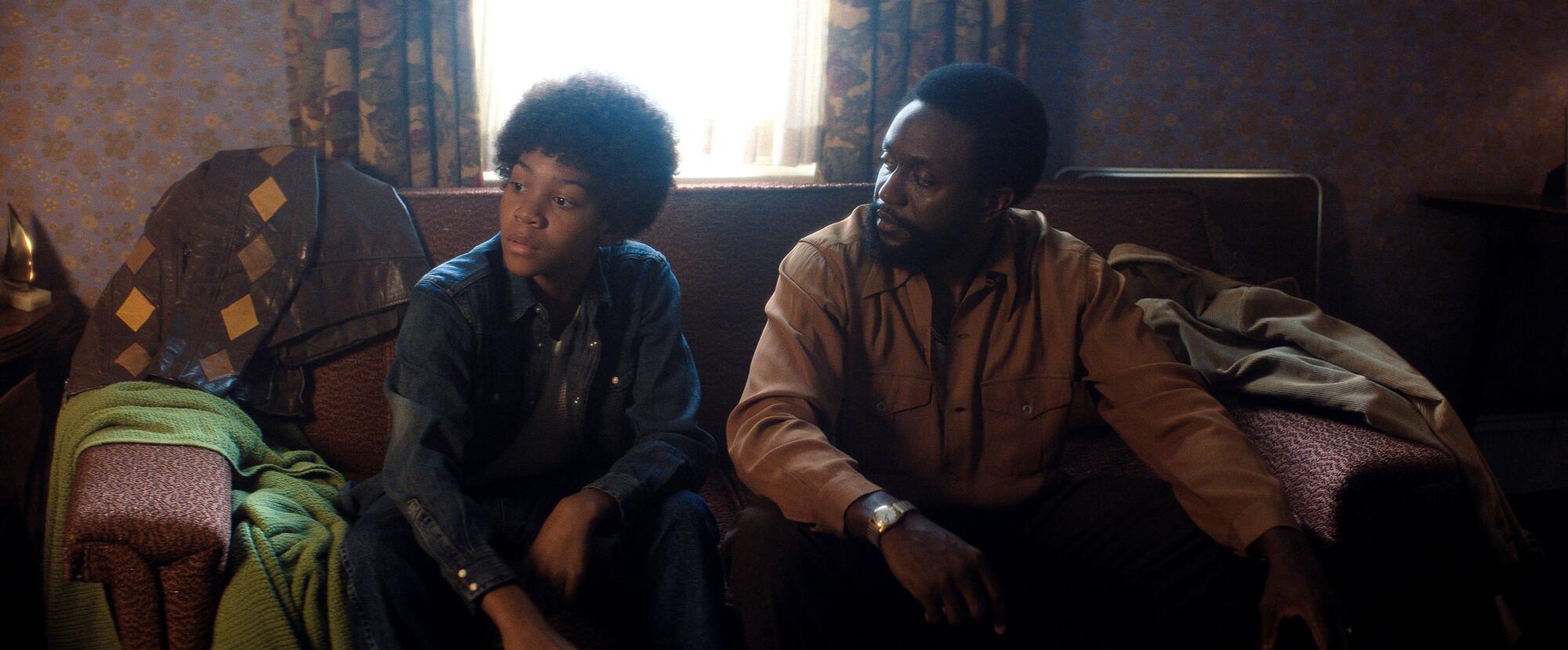
Tyrik Johnson, left, and Byron Bowers in “Lady in the Lake.”
(Apple)
Where Lippman’s novel incorporates multiple narrators, some more reliable than others, Har’el immediately zoomed in on the voices of Cleo and Maddie, two women desperately trying to break free of the strictures created by a very patriarchal society. Maddie can’t even sell her own car without her soon-to-be-ex-husband’s signature; Cleo lives largely under the thumb of her gangster/club owner boss, played by Wood Harris, who combines Black Power rhetoric with a ruthless command of the city’s numbers racket.
Har’el, who was the lead writer and also directed all seven episodes of the series, sees the characters as part of the same push-pull duality that fuels the entire story.
“There’s a Jungian underbelly going on in the show that is trying to seduce you to maybe see beyond the politics of it all and into human experience,” she said. “It turns that experience into something that, hopefully, the characters get to touch.”
But without her stars, she says, the ideas mean little.
“The credit goes to the actors,” she says. “They come to that emotional place with authenticity, and it’s pretty magical to see them do that.”
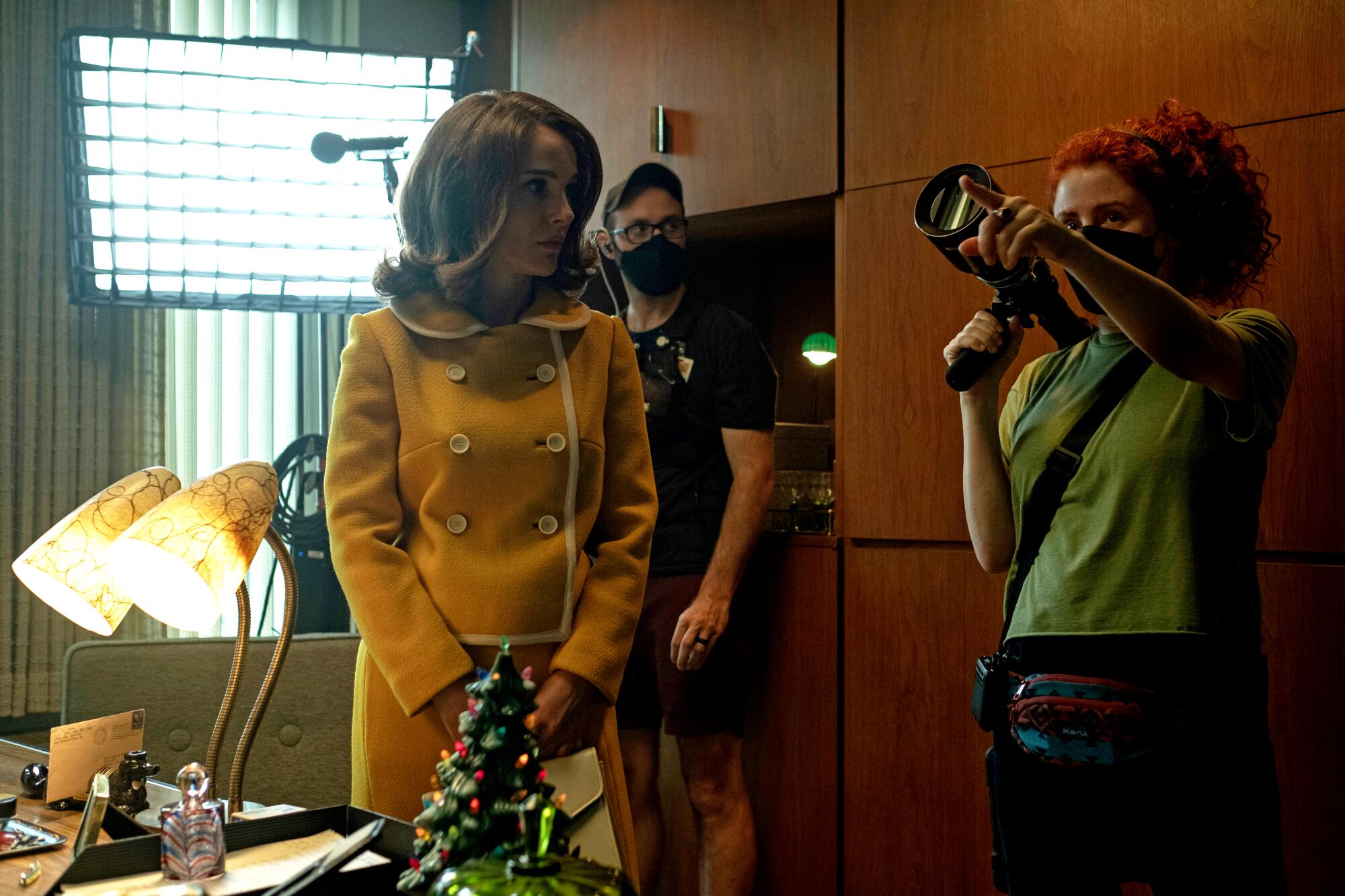
Natalie Portman, left, on set with Alma Har’el.
(Apple)
The stars
Portman was attached to the project from the beginning, as a star and executive producer. At one point Lupita N’yongo was slated to play Cleo, but the character ultimately wasn’t cast until shooting had commenced; “Nobody could agree,” Har’el says. “But when Moses came in, it was so clear. Everybody saw it right away.”
Ingram and Portman rarely appear on screen together, but they’re linked from the moment they see each other in the first episode. In the opening scenes, blood from the lamb that Maddie has purchased for her family’s dinner has spilled onto her dress, and she eyes the outfit that Cleo is modeling in the window of a department store. For Portman, this moment speaks volumes.
“In that initial scene of them together, where she’s looking at Cleo in the dress, she’s really just looking at the dress,” Portman said in a video interview alongside Ingram. “It’s kind of symbolic of how she treats Cleo. She’s using her as a vehicle for her own needs and to further her own ambition.”
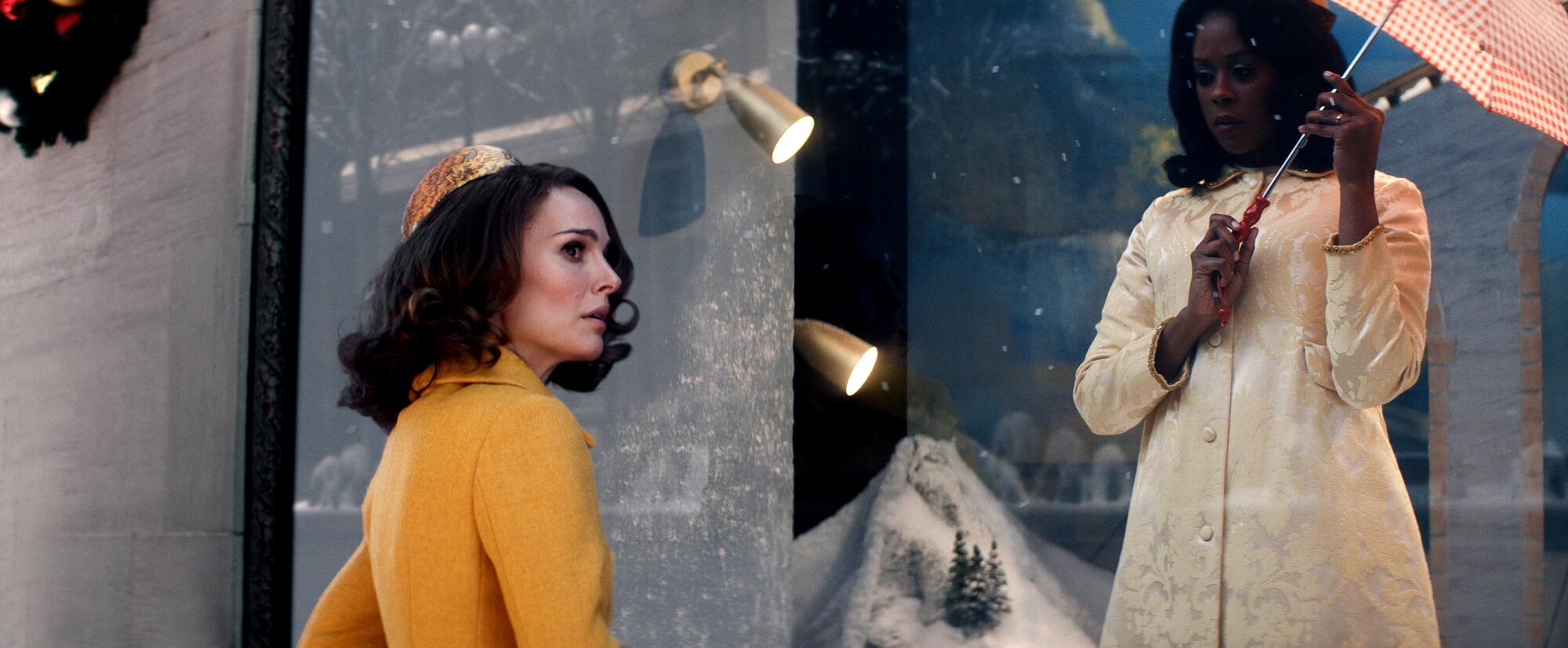
The moment Maddie (Natalie Portman) and Cleo (Moses Ingram) first meet in “Lady in the Lake.”
(Apple TV+)
And yet, the series takes pains to connect them, thematically and visually, in the editing process, through crosscutting that links them throughout different periods of their lives.
“I think they’re living in a very similar world that’s affecting them both in similar ways,” Ingram said. “Being women, being mothers, taking care of the husband and the children and also trying to figure out what they might want for themselves, let alone how to get it — those are all things they share.”
In the series, Maddie is a bit softer than she is in the novel, a little less single-minded in the way she uses Cleo’s story to establish a journalism career. But she’s still deeply flawed and somewhat blind to the lives she writes about. (Lippman: “I joke that if you want to be a human-interest writer, it helps to have some interest in humans”).
For Portman, the fact that Maddie is no angel made the role more interesting, and more human.
“It speaks to the tragedy of the fact that, even if you’re oppressed, you can still be an oppressor,” she says. “That’s something that we have to be very conscious of, because I think the opposite story is usually told: ‘Oh, if someone did something to you, you don’t do it to someone else.’ And that’s just unfortunately not very true.”
For Lippman, a somewhat kinder, gentler Maddie speaks to the different roads taken in a different medium. And she’s quite happy with the results.
“Natalie Portman’s Maddie is much bigger, much more layered and complicated than my Maddie,” she said. “How can I not love that? There’s a big difference between asking readers to come along with a not particularly likable character and asking people to watch that character in a limited series, especially if it’s a female. I really respect the choices made in this adaptation, because they’re thoughtful.”


Richard Montoya of Culture Clash doesn’t mince words when it comes to politics, current events or the state of mainstream Hollywood. But he does sugarcoat his technological limitations as a 67-year-old comic in the dreaded age of video calls with a punchy Chicano twist.
“I’m a low-tech Aztec,” he writes via email when requesting a Zoom link to our Monday interview.
Culture Clash — which includes members Montoya, Ric Salinas and Herbert Sigüenza — arrived on the scene as a guerrilla sketch theater group from the San Francisco Mission District in 1984. By that time, the Chicano movement had reached its peak, thanks to the United Farm Workers labor movement, as well as student activist organizations like Movimiento Estudiantil Chicano de Aztlán (MEChA), which advocated for Chicano unity, political empowerment and educational access.
Luis Valdez, founder of El Teatro Campesino — who began putting on social justice-oriented plays for the striking Delano farmworkers in 1965 — backed the slapstick satire troupe, considering the trio “the cutting edge of fresh, new Latino comic genius.”
Culture Clash stood out in a time when Chicanos became more vocal and visible — and its members challenged an entertainment industry that has historically lacked Latino representation. Between 1993 and 1996, Culture Clash hosted its own self-titled TV show on the syndicated Fox network. The show, which was filmed at the Mayan Theater in downtown Los Angeles, is widely considered the first Latino sketch comedy to air on American television.
Throughout the last four decades, Culture Clash has parodied nearly every prominent Latino figure in history, including Che Guevara, Frida Kahlo, Ritchie Valens, Rita Moreno, Edward James Olmos and others. Its members have mocked hard-shell cholos and gangsters, often by placing them in funny scenarios. For instance, take this clip, in which the trio take on cholo characters and reimagine what it would be like to surf on the Southern California shore.
But they’ve also taken on more serious topics in their classic “Chavez Ravine” play, which looks into one of the darkest chapters in L.A. history: the forceful removal and displacement of families, mostly Mexican, in the 1950s under eminent domain. Recently Montoya attended a live reading adapted by Somos El Teatro, led by Xolo Maridueña, Mariana da Silva and Angel Villalobos at Elysian Park.
“It gives us so much life that people are finding the issues of swindlers, whether it’s gentrification, the taking over of settlements,” says Montoya. “The generational trauma of losing your home in L.A. has never gone away.”
But not every Culture Clash joke or skit has been safe from criticism. Montoya still remembers how a conservative pundit chastised the group for using light humor to discuss the 1992 riots, when LAPD officers were acquitted for using excessive force in the arrest and beating of Rodney King.
“By looking at it and treating it as dynamite, exploding it and then by bringing some levity and a whole lot of seriousness to the Rodney King matter allows us a moment, a fraction of time to look at the issues a little bit differently,” says Montoya. “That laugh allows us a moment to examine it differently.”
On June 27, Culture Clash will return to Grand Performances, a free summer concert series at California Plaza in downtown L.A., with comedic sketches colored by political and social satire. The show, titled “American Payasos! Culture Clash’s End Times Cabaret” will be co-presented with De Los.
While their 40-year-plus legacy might merit a show reminiscent of old goofball skits — like their early 1989 show “The Mission” that poked fun at the problematic Spanish Franciscan missionary Junipero Serra — this will not be an “oldies but goodies show,” as Montoya put it. “We are highly pissed off about a lot of stuff right now.”
“ We’re thinking a lot about the Mexican American patriarchy, Cesar Chavez, Dolores Huerta and it’s time to address some of these things,” says Montoya. “ We want to look at the service workers of Los Angeles, the people that sell cotton candy in MacArthur Park, the people that sell ice cream in Echo Park and the people working the World Cup.”
For the veteran comic, son of the late Chicano poet Jose Montoya, it is also impossible to ignore the immigration enforcement raids that have rattled Los Angeles communities in recent years.
“This is a very strange moment for satirists,” says Montoya. “We have a responsibility to use those tools to say what’s going on in our city and country and provide these moments where we can do a little bit closer examination because the people in power aren’t telling us what’s going on.”
In the last five years, Montoya has fiddled around with digital media, creating sporadic videos featuring old clips of the troupe, as well as videos of Latino media, to connect with technologically diverse audiences of all ages. (One example is a video calling on people to get out the vote, that features clips of Speedy Gonzales and honors political figures like Huerta.)
Although Montoya believes Culture Clash is nearing the end of its career, there’s a question lingering inside his mind: What does a graceful exit look like for a group like Culture Clash, which has never been fully integrated into mainstream Hollywood and still left such a profound legacy in the world of Latino entertainment?
The answer to that might still be unknown, but like any Culture Clash project, it will likely be wickedly satirical and punchy. Says Montoya: “We’re ready to go out with a huge, loud bang that can say something against the power structure.”
Culture Clash will take center stage on June 27 at Grand Performances, in partnership with De Los. Also performing is the retro cumbia-quebradita musician É Arenas (bassist of Chicano Batman), the cumbia-fusion, luchador-masked cumbia group La Nueva Ola de Cumbia, as well as DJ Dali.

In the Hand of Dante, 2025.
Directed by Julian Schnabel.
Starring Oscar Isaac, Gal Gadot, Gerard Butler, John Malkovich, Louis Cancelmi, Sabrina Impacciatore, Benjamin Clementine, Martin Scorsese, Al Pacino, Franco Nero, Jason Momoa.
SYNOPSIS:
A handwritten manuscript of Dante Alighieri’s poem “The Divine Comedy” makes its way from a priest to a mob boss in New York City, where it is taken by Nick Tosches after he’s asked to verify its authenticity.

Outrageously ambitious with an absurd narrative that veers between slick scuzzy fun and philosophically snoozy, the key issue with co-writer/director Julian Schnabel’s excessively long In the Hand of Dante is that it’s more engaging as a dopey early 2000s crime thriller about mobsters employing the services of novelist Nick Tosches (also the writer of the novel the film is based on, inserting himself into it as a fictional character, here played by Oscar Isaac in the adaptation by Schnabel and Louise Kugelberg) and Dante Alighieri specialist to steal the recently unearthed original manuscript of his 14th-century masterwork The Divine Comedy from Italian priests than it does as its other side to that coin, a flashback story about the creation of that story complete with actors portraying secondary characters to eventually get at some points about reincarnation.
This means that the film mostly begins with Oscar Isaac entangled in a web of crime alongside slur-slinging, trigger-finger-happy Louie (in what might be the best performance of Gerard Butler’s career, despite the steep drop in quality in the second half), John Malkovich as a mob boss seeing nothing but dollar signs if they can get a hold of the original manuscript, authenticate it, and sell it on the black market, and even Al Pacino popping up for a scene and stealing it set during Nick’s childhood following a violent incident that is so bonkers readers might not believe it even if I typed it out here, to something close enough to a mess culminating in a confrontation between the excellent Oscar Isaac and the shudderingly bad Gal Gadot and Jason Momoa in important roles, the former a lover placed in danger to the mob by her proximity to Nick, and the latter a greedy killer in a relationship with literary historian Dr. Susanna Pulice (Sabrina Impacciatore).

Martin Scorsese also appears in the 14th-century section (for someone who loves to assert what real cinema is vs cinematic theme park rides, he has now appeared in 3 mediocre-to-terrible movies this year), offering sage-like advice to Dante (also Oscar Isaac) in a hilariously over-the-top beard piece. Much of this is a mental journey, but also has something to do with Pope Boniface VIII (also Gerard Butler) placing the Mark of Cain on Dante following a falling out, the writer’s inability to find inspiration in his current lover Gemma Donati (also Gal Gadot) compared to his first love Beatrice, executed in stark contrast from the much more accessible and palatable modern day crime story. A blunter way to put it is that any time the film shifts to these flashbacks, it’s quite boring and never finds a sense of rhythm, drive, or purpose.
Unquestionably, some of this is by design and baked into other elements of the presentation, which includes flashbacks only receiving color as a means of implying that they were more enriching days for artistic freedom and integrity, compared to the black-and-white 2000s material that further homes in on greed and only financial gain for a manuscript no one even knows how to price if it turns out to be authenticated. Expanding on that thought, there are certainly no qualms to be had with the striking cinematography from Roman Vasyanov.

The other encroaching thought here is that, for as carefully considered as the film looks and as captivating as about half the performances are (we truly do not need to talk anymore about Gal Gadot and Jason Momoa, neither of whom can deliver convincing accents without eliciting laughs), it’s not going anywhere interesting, especially once the mobsters exit the narrative. Technically, they are replaced by a hitman, although a lengthy amount of time is spent watching Nick fly around the world for different aspects of the identification process, sometimes involving technology that even he doesn’t understand and tunes out of. In the novel, there appears to be a greater emphasis on Nick’s inner thoughts about the current state of the art world and on finding flaws in classic works or restrictive prose, which is alluded to here but not interrogated enough to emerge as a compelling element. It’s enough to make one wonder what else was lost in translation from the book.
The filmmakers seem to think the romantic subplot will sustain intrigue for the second half, but it’s devoid of emotion and comes across as aimless in the 14th-century portion. At a certain point, one simply longs for a more focused movie about mobsters stealing recently discovered historic manuscripts for profit; it’s far more fun and amusing than the rest of the sluggish, artfully tedious In the Hand of Dante. No one here seems to realize that this should be a comedic crime caper, and it works that way until it takes itself far too seriously, with flashbacks that bore rather than provide insight or meaningful context.
Flickering Myth Rating – Film: ★ ★ / Movie: ★ ★ ★
Robert Kojder
https://www.youtube.com/watch?v=embed/playlist

On the Shelf
The Last Human Bear
By Greg Sarris
Heyday Books: 384 pages, $30
If you buy books linked on our site, The Times may earn a commission from Bookshop.org, whose fees support independent bookstores.
Before her death in 1993, Mabel McKay — one of the last living dreamers of the Pomo Indian people — shared a prophecy while driving through the Sonoma hills. One day, this paradise would burn.
“Everything is going to go dry. Everything will burn. That’s my latest vision,” she said, gesturing to the idyllic landscape.
Startled, writer Greg Sarris asked what could be done to stop it.
“You live the best way you know how,” McKay replied.
Since her passing, Sonoma County experienced the most destructive wildfires in California history in 2017, only for another, more destructive fire to surpass it a year later. “She always used to say, ‘Whether you believe it or not, it’s true,’” Sarris recalls.
McKay and her visions are the inspiration behind Sarris’ latest work. His first novel in 28 years, “The Last Human Bear,” is loosely based on the spiritual leader McKay, whose wisdom and companionship served as a refuge to Sarris during a tumultuous childhood in Sonoma County.
A reluctant casino mogul
On a Monday morning in California, Sarris sits in his sleek office at the Federated Indians of Graton Rancheria in Rohnert Park. Sarris, 74, has served as chairman of the Federated Indians of Graton Rancheria for more than 30 years. In his office, diplomas and academic certificates crowd the walls. A framed poster for the 2023 film “Joan Baez: I Am a Noise” hangs nearby — she’s a close friend. Behind him, an American flag ripples in the distance outside the window, blurred by the summer heat.
Just up the road sits a multibillion-dollar tribe-owned casino, Graton Resort & Casino — a project the writer oversees. “I had never been in a casino. I have a PhD in modern thought and literature from Stanford,” says Sarris.
How does an accomplished author find himself at the helm of a multibillion-dollar casino enterprise? It’s a question that still puzzles Sarris. “I told them if we can raise our people and become a platform for social justice and environmental stewardship to benefit Indian and non-Indian alike, I’ll do it.”
Before his stint as a reluctant casino mogul, Sarris was a prolific author and university professor at UCLA and Sonoma State. In 2023, he was appointed a regent of the University of California by Gavin Newsom. Over the course of his career, he published six books, and his novel “Grand Avenue” became an HBO original film in 1996.
California’s Native history: revisited
From early in his career, Sarris wanted to depict Indians as he knew them, rather than as Hollywood depicted them. “We’ve been erased by Hollywood, because the idea of Indians has always been Plains Indians or Southwest,” Sarris explains. “It’s easier for Americans to access Buffalo Bill.”
Greg Sarris’ new novel “The Last Human Bear.”
(Josh Edelson / For The Times)
“California Indians have always been left out of the picture,” says Sarris.
“The Last Human Bear” is Sarris’ latest attempt to revive the legacy of California’s Native history. The novel follows Mary Hatcher, a Pomo Indian in Sonoma County, from Prohibition through the 21st century. It’s told in the first person through Hatcher’s compelling voice as she narrates the horror and heartbreak of her lifetime over the course of a century, echoing William Faulkner’s literary style, which influenced Sarris.
‘California Indians have always been left out of the picture,’ says Sarris.
“I’m curious why you want to know about me,” reads the first line. The novel unfolds like an oral storytelling tradition, driven by a voice that Sarris painstakingly crafted, evoking his conversation with McKay. “The voice comes. I have to call it, almost like a spirit,” says Sarris. “I wanted it to feel like an oral story.”
Hatcher — a Pomo shape-shifter who dodges prejudice by passing as Mexican in the novel — is a thorny protagonist, often cunning, scheming and unforgiving. “An American Indian woman is as richly complicated as anybody else. I wanted to show this rich and complicated character who’s negotiated a history that she’s showing you,” says Sarris.
Acclaimed Northern California writer and activist Rebecca Solnit, who has authored 17 books and is a friend of Sarris’, says that she was fascinated by his ability to evoke so many aspects of female life in “The Last Human Bear.” Solnit was especially moved by Sarris’ rendering of California’s tragic history. “It’s shocking, given how rich California’s Indigenous cultures were — 99 different language groups, mythologies, belief systems and linguistic traditions. Every North American Indigenous language family is represented in California. It’s weird how this history has been erased, and how horrific what happened was.”
Climate change and ongoing ecological disasters have made Indigenous perspectives more vital than ever, the author argues. “I think Indigenous people have been hugely influential in giving us a point of view in which we were never separate from nature,” she says. According to Solnit, Sarris’ novels are part of a broader resurgence of interest in Native culture.
In the early chapters of the “The Last Human Bear,” the protagonist gets a job on a ranch by posing as Mexican, since Indians were forbidden from working as housekeepers. What follows is a tale of tension, deception and a forbidden love that sours, reminiscent of Brontë novels.
Sarris hopes that the novel illuminates an uncomfortable history of Sonoma County that remains largely invisible, looming beneath the soil of wine country. The novel offers “a history of this county that a lot of people haven’t seen,” says Sarris.
“There were more Indian people right where we’re sitting per capita than anywhere else in the entire New World outside Mexico City, which was the Aztec capital,” says Sarris. “The genocide was so horrendous.”
Identity, revenge and a search for home are themes that arise throughout the novel — subjects Sarris knows well in his own life.

Greg Sarris feeds chickens at an organic farm across the street from Graton Resort & Casino, which he heads, in Rhonert Park.
(Josh Edelson / For The Times)
Uncovering a hidden Native heritage
In 1952, Sarris’ teenage mother gave him up for adoption, her family hoping to evade the embarrassment of their Jewish daughter becoming pregnant by a Native American Filipino man. Sarris grew up in a white family in Santa Rosa alongside three siblings. His adopted father, George Sarris, became abusive, causing Greg to flee the house with his adopted mother’s blessing. “God bless her. She let me go out and live on ranches and run with other people to get away from him.”
It was in these formative years that Greg became acquainted with Native American people in Santa Rosa, always feeling a mysterious pull toward them. It was these years that also shaped his sensibility as a writer. “I was a lost kid on the streets, so I was always paying attention to everyone, listening, and people would tell me stories.”
Native Americans lived on the fringe of town, often practicing healing ceremonies that were frowned upon by white Catholic families in the suburbs Sarris explains. “When I was 15, I met Mabel McKay, who I wrote the book about. I knew she did some of those strange things that I heard about, but I liked her,” he says. “I had no idea that I was related to these people. I thought I was a mixed-blood Mexican or Spanish.”
At age 30, Sarris uncovered the identities of his birth parents and learned of his Native heritage. He learned his birth mother was buried in a pauper’s grave at the Calvary Catholic Cemetery in Santa Rosa, with “nothing to mark her grave but an upside-down horseshoe that has her name in it.” In the opening pages of the novel, a dedication to her: Bunny Hartman.
Excitedly, Sarris presented proof of his Indian heritage to McKay, his trusted confidant. “I thought it was a big deal that I had Indian blood,” says Sarris. He showed McKay a photo of his father, which she met with indifference. Naturally, Sarris was disappointed. “She told me something later: ‘You’re never any more Indian than your experience.’”
A lifelong outsider
Questions surrounding the legitimacy of Sarris’ heritage haunted him for decades and ultimately informed the novel. Being adopted by a white family, only to be shunned by the Native community, perpetuated his lifelong feeling of being an outsider. “I keep thinking maybe I just got in with this group of people and my Indian relatives so that I would feel rejected again,” he says. “We gravitate towards what we know as home emotionally.”
“I didn’t grow up on a reservation. I’m fair-skinned,” he says. “Being adopted, it feeds into that feeling of not being good enough,” he says, adding: “Illegitimacy is a medicine in the end.”
In the Native American literary community, Sarris has often felt excluded from discourse. When in doubt, he reminds himself of his involvement with the tribe. “Who among them have done this much for their people?” he asks. “Who among them has given this much time and sacrificed a writing career for their people?”
Jane Fonda, the two-time Academy Award-winning actress and activist, struck up a friendship with Sarris through a shared cause. “We met during the campaign to secure health and safety setbacks that would finally prevent oil wells from being drilled within 3,200 feet of a community. Greg and the federated tribes helped us win that fight against Big Oil,” Fonda explained in an email.
“I can tell from his books and my time with him that he embodies indigenous wisdom and beliefs,” Fonda says. “I see Greg Sarris as a man who embodies the best of two worlds — the mercantile culture of Western civilization and the indigenous world that knows we are part of nature and interdependent with it. It’s a rare and valuable combination.”

Greg Sarris, who holds a PhD in literature from Stanford, inside the casino he works for to help fund his tribe’s future.
(Josh Edelson / For The Times)
Inside the polarizing casino kingdom
The Graton Resort & Casino, launched by Sarris over 12 years ago, now plays a vital role in supporting the Pomo Indian community. “I promised early on: roof over everyone’s head, an insurance policy in every pocket and a college degree paid for,” he says. “We give $2.5 million a year in perpetuity to the University of California, so that all California Indians can go to the University of California tuition-free.” The casino has funded theater programs, youth writing intensives and revenue sharing with neighboring tribes.
On the car ride to the casino, Sarris is riffing on his friendship with Grateful Dead member Mickey Hart, who bought Sarris a quarter horse as a gift. In the casino, Sarris eagerly greets his employees with a friendliness that betrays his repeated insistence that he’s a reclusive writer. He points out blown-glass flower sculptures, an embellishment he once saw at the Four Seasons in Paris. He walks past the baccarat room, where he hosts high rollers from Beijing, whom he boasts, “play $100,000 in a hand.”
Early on, news of the casino’s construction caused waves of controversy across Sonoma County — some of which resulted in death threats against Sarris’ life. Concerns that a casino would invite debauchery into the county circulated, which Sarris points out is ironic for a community predicated on wine: “Beyond whether gambling is right or wrong, what is implicit is their privilege and elitism,” says Sarris. “People were getting scared because these brown people, who were the poorest in Sonoma County, are suddenly going to have power.”
Admittedly, Sarris says their newfound wealth has not been without repercussions in the tribe. “People who have been traumatized with generational poverty are the most vulnerable to the lure of materialism,” he says.
When time catches up
In the final chapters of “The Human Bear,” the protagonist, at the end of her life, recalls: “Human Bears often like to even the score before they die.” Revenge is futile, she concludes. “If I was going to avenge our people, I would have to poison nearabout all of history.”
Sarris recalls a similar epiphany he had speaking with McKay. He explains Pomo Indians believed that each action had a consequence. “Ethnographers always said we’re a culture predicated on black magic and fear. No, we were cultures predicated on profound respect for the complexity of all life,” says Sarris.
Then, white men came and seemingly bent the laws of natural order. “The Kashaya Pomo word for white people was ‘miracles’, because they came in and killed everything and did all these things. Nothing could come back to them,” says Sarris.
He explained to McKay that he thought of the white man’s fate differently. “Look, there’s no water. There’s no air. Everything’s poison,” he says, gesturing around him to this vast, broken world. “It’s all come back. It just took time.”
Connors is a culture journalist from Sonoma County. She covers books, food, entertainment and offbeat Los Angeles. She’s currently at work on a book of essays about tourism in all its forms.
-

 Technology3 minutes ago
A new paper argues Microsoft exaggerated its quantum claims a year ago
-

 World8 minutes ago
Colombia’s ‘El Tigre’ secures presidency as leftist rival finally concedes defeat
-

 Politics15 minutes ago
Comer probes alleged Biden collusion with gun control activists in Glock lawsuit
-

 Sports23 minutes ago
2026 World Cup Third-Place Standings: Who’s In, Who’s On The Bubble
-

 Technology30 minutes ago
FCC phone ID plan could end burner phones
-
 Business33 minutes ago
Sony Pictures invests $100 million in virtual reality venue Cosm
-
Entertainment38 minutes ago
Culture Clash knows the end is near. It wants to go out with a bang
-
 Politics48 minutes ago
Vice President JD Vance’s visit gives ‘The View’ a ratings boost

