Entertainment
A live orchestra in an echoey cathedral? Hundreds of mikes? 'Maestro' sound duo is on it


It should have been an easy job for the sound team of “Maestro” — Mahler’s Resurrection Symphony played in England’s Ely Cathedral. Normally they would pre-record the music and run playback while musicians and conductor Leonard Bernstein (as played by Bradley Cooper), mime along. But that’s not how Cooper, also the co-writer and director of the film, wanted it. He’d been working on conducting for six years and felt the performance would be more authentic if he were to actually conduct the piece.
On-set sound mixer Steven Morrow recalls it as a terrifying proposition — miking 200 chorus and orchestra members performing live in an echoey cathedral. So, he huddled with re-recording mixer Tom Ozanich, with whom he’d also worked on Cooper’s “A Star Is Born.” On that film they recorded all the singing live, but this was different.
“With vocals it’s harder to fake,” notes Morrow. “With music you can fake it a little bit. But the overall experience with this performance and the orchestra playing this music, it jumps off the screen because it is real. And the whole movie is played that way where it’s real. If you cheat it, you lose some of that.”
They had three days to get it. In addition to their own Dolby Atmos mikes on timpani, horns and opera soloists, they hired Classic Sounds of London, who have miked the Ely Cathedral before. Sixteen microphones were set up in all, some suspended from above.
Bradley Cooper conducts as Leonard Bernstein in “Maestro.”
(Jason McDonald / Netflix)
“The first day was a wipeout in the conducting aspect of it,” Ozanich recalls. He is nominated twice this year, for “Maestro” and “The Creator,” bringing his total Oscar nominations to four. “Bradley was really good about having the instinct to know he wasn’t great. And the London Symphony Orchestra is good enough that they ignore him and move on and do their thing. So, he came in and said we’re going to do it again. We’re going to do one long Technocrane shot. And the orchestra came up to him after and said. ‘That was it, you really conducted it.’ So, I think that’s where the decision to go live versus faking it, because he could feel it in his own performance the day before, it wasn’t that great.”
The scene in the film is roughly the take described by Ozanich — a six-minute Technocrane shot on Cooper conducting, intercut with B-roll of musicians and choral members. It’s an uplifting and deceptively simple-seeming reproduction of the original 1973 performance with the camera moving in time with the music.
The movie’s other great challenge came with party scenes, of which there are many. The usual method is to mike the principals and lay in group effects in post. Not on “Maestro.” Group scenes here required everyone to be miked. Cooper had seen a movie Morrow and Ozanich made with Jason Reitman called “The Front Runner,” on which they miked everyone in crowd scenes, and requested the same.
“When you ask people to fake talk, they over-exaggerate when they’re doing it because they’re not actually doing it,” notes Morrow. With so many people talking at once, they bleed into each other’s mikes, creating headaches for him. “Other mikes are picking up somebody and it does some weird things to the sound. So, you have to be able to dodge around that stuff. And the group and effects crowd in there help to fill it in and give us some layers of depth.”
“It’s an avalanche of audio,” laments Ozanich. “It’s a ton of dialogue because you’re locked into it and when you cut back and forth between takes, there’s going to be jumps.”
The audio was orchestrated throughout, as with a symphony, including every detail from Cooper’s rhythmic delivery of lines (which he kept up between takes), to the birdsong in the background of a bucolic setting, to a sudden gust of wind. Such keen attention to craft is part of what garnered the film seven Oscar nominations in all, including best picture and lead actor for Cooper.
“He’s very interested in collaboration as opposed to workers doing their job,” Ozanich says of Cooper. “He wants you to have an opinion, have some input and partake in it. I watched him learn very rapidly on ‘A Star Is Born.’ You could tell he was becoming a student of sound. He was trying to understand it.”
Both Ozanich and Morrow were nominated for “A Star Is Born,” and Ozanich received another for “The Joker.” They’re currently working together on “Joker: Folie à Deux,” and Morrow is working on “Juror #2,” reuniting with Clint Eastwood, with whom he’d worked with on 2018’s “The Mule.”
“We run a tight set to make sure we’re not wasting valuable time,” he says of working with the 93-year-old icon. “Everybody is on the same page trying to get what he wants.” As for the legendary Eastwood one-take method, he says, “I’ve always heard that, but working with him, he’ll be happy to take another one or two. And if the actors said, can I get another one? No problem at all. He gives it to them. But for the most part, we don’t do many takes. Clint’s very focused on what he wants.”
For Ozanich, the recognition from his peers that comes with a nomination is an award in itself. “There are so many great artists and people in this business that inspired me and I look up to the work they did. And to have those people say, ‘Whoa, you did a really great job on this!’ That’s the award. ‘Maestro’ is a very unique sound job and you never quite know if people are going to get it, or appreciate it for what it is. So, I think that would be the biggest thing. Wow, they got it.”
Morrow’s first nomination was for “La La Land.” “When we lost, I felt devastated for weeks because you figure that’s it, I’m never going to get nominated again. Then it happens a few more times and now, I don’t know, you’d have to ask me after the win, if we win. But I feel like it’s a special experience to be included in the discussion of what people found great for the year. For me, that’s it. You look at a guy like Bradley who’s been nominated 12 times, hasn’t won. I don’t think that lessens the amount of sacrifice he did to get there. I think that’s the same for all of us. But you hope the producers that usually hire you don’t think all of a sudden you’re twice the price, because you’d never get hired again.”



Entertainment
Ulysses Jenkins, Los Angeles artist and pioneer of Black experimental video, dies at 79

Ulysses Jenkins, the pioneering Los Angeles-born video artist whose avant-garde compositions embodied Black experimentalism, has died. He was 79.
Jenkins’ death was confirmed by his alma mater Otis College, where he studied under renowned painter and printmaker Charles White in the late 1970s and returned as an instructor years later. The Los Angeles art and design school shared a statement from the Charles White Archive, which said, “Jenkins had a profound impact on contemporary art and media practices.”
“A trailblazing figure in Black experimental video, he was widely recognized for works that used image, sound, and cultural iconography to examine representation, race, gender, ritual, history, and power,” the statement said.
A self-proclaimed “griot,” Jenkins throughout his decades-spanning career maintained an art practice grounded in the tradition of those West African oral historians who came before him. Through archival documentaries like “The Nomadics” and surrealist murals like “1848: Bandaide,” he leveraged alternative media to challenge Eurocentric representations of Black Americans in popular culture.
He was both an artist and a storyteller who sought to “reassert the history and the culture,” he told The Times in 2022. That year, the Hammer Museum presented Jenkins’ first major retrospective, “Ulysses Jenkins: Without Your Interpretation.”
“Early video art was about the problems with the media that we are still having today: the notions of truth,” Jenkins said. “To that extent, early video art was a construct that was anti-media … a critical analysis of the media that we were viewing every night.”
Born in 1946 to Los Angeles transplants from the South, Jenkins was ambivalent about the city, which offered his parents some refuge from the blatant systemic racism they encountered in their hometowns, but housed an entertainment industry that had long perpetuated anti-Black sentiment.
“What Hollywood represents, especially in my work, is the classic plantation mentality,” Jenkins told The Times in 1986. “Although people aren’t necessarily enslaved by it, people enslave themselves to it because they’re told how fantastic it is to help manifest these illusions for a corporate sponsor.”
Jenkins, who participated in a group of artists committed to spontaneous action called Studio Z, was naturally drawn to video art over Hollywood filmmaking. “I can address any issue and I don’t have to wait for [the studios’] big OK. I thought this was a land of freedom, and video allows me that freedom and opportunity that I can create for myself and at least feel that part of being an American,” he said.
Jenkins went on to deconstruct Hollywood’s vision of the Black diaspora in experimental video compositions including “Mass of Images,” which incorporates clips from D.W. Griffith’s notoriously racist “The Birth of a Nation,” and “Two-Tone Transfer,” which depicts, in Jenkins’ words, a “dreamscape in which the dreamer awakens to a visitation of three minstrels who tell the story of the development of African American stereotypes in the American entertainment industry.”
Jenkins’ legacy is not only artistic but institutional, with the luminary having held teaching appointments at UCSD and UCI, where he co-founded the digital filmmaking minor with fellow Southern California-based artists Bruce Yonemoto and Bryan Jackson.
As artist and educator Suzanne Lacy penned in her social media tribute to Jenkins, which showed him speaking to students at REDCAT in L.A., “he has been an important part of our histories here in Southern California as video and performance artists evolved their practices.”

4/5 stars
Bounding into cinemas just in time for spring, the latest Pixar animation is a pleasingly charming tale of man vs nature, with a bit of crazy robot tech thrown in.
The star of Hoppers is Mabel Tanaka (voiced by Piper Curda), a young animal-lover leading a one-girl protest over a freeway being built through the tranquil countryside near her hometown of Beaverton.
Because the freeway is the pet project of the town’s popular mayor, Jerry (Jon Hamm), who is vying for re-election, Mabel’s protests fall on deaf ears.
Everything changes when she stumbles upon top-secret research by her biology professor, Dr Sam Fairfax (Kathy Najimy), that allows for the human consciousness to be linked to robotic animals. This lets users get up close and personal with other species.

In the summer of 1991, Nirvana filmed the music video for “Smells Like Teen Spirit” on a Culver City sound stage. Kurt Cobain strummed the grunge anthem’s iconic four-chord opening riff on a 1969 Fender Mustang, Lake Placid Blue with a signature racing stripe.
Nearly 35 years later, the six-string relic hung on a gallery wall at Christie’s in Beverly Hills as part of a display of late billionaire businessman Jim Irsay’s world-renowned guitar collection, which heads to auction at Christie’s, New York, beginning Tuesday. Each piece in the Beverly Hills gallery, illuminated by an arched spotlight and flanked by a label chronicling its history, carried the aura of a Renaissance painting.
-
Share via
Irsay’s billion-dollar guitar arsenal, crowned “The Greatest Guitar Collection on Earth” by Guitar World magazine, is the focal point of the Christie’s auction, which has split approximately 400 objects — about half of which are guitars — into four segments: the “Hall of Fame” group of anchor items, the “Icons of Pop Culture” class of miscellaneous memorabilia, the “Icons of Music” mixed batch of electric and acoustic guitars and an online segment that compiles the remainder of Irsay’s collection. The online sale, featuring various autographed items, smaller instruments and historical documents, features the items at the lowest price points.
A portion of auction proceeds will be donated to charities that Irsay supported during his lifetime.
The instruments of famous musicians have long been coveted collector’s items. But in the case of the Jim Irsay Collection, the handcrafted six-strings have acquired a more ephemeral quality in the eyes of their admirers.
Amelia Walker, the specialist head of private and iconic collections at Christie’s, said at the recent highlight exhibition in L.A. that the auction represents “a real moment where these [objects] are being elevated beyond what we traditionally call memorabilia” into artistic masterpieces.
“They deserve the kind of the pedestal that we give to art as well,” Walker said. “Because they are not only works of art in terms of their creation, but what they have created, what their owners have created with them — it’s the purest form of art.”
Cobain’s Fender was only one of the music history treasures nestled in Christie’s gallery. A few paces away, Jerry Garcia’s “Budman” amplifier, once part of the Grateful Dead’s three-story high “Wall of Sound,” perched atop a podium. Just past it lay the Beatles logo drum head (estimated between $1 million and $2 million) used for the band’s debut appearance on “The Ed Sullivan Show,” which garnered a historic 73 million viewers and catalyzed the British Invasion. Pencil lines were still visible beneath the logo’s signature “drop T.”

Pencil lines are still visible on the drum head Ringo Starr played during the Beatles’ debut appearance on “The Ed Sullivan Show.”
(Christie’s Images LTD, 2026)
It is exceptionally rare for even one such artifact to go to market, let alone a billion-dollar group of them at once, Walker said. But a public sale enabling many to participate and demonstrate the “true market value” of these objects is what Irsay would have wanted, she added.
Dropping tens of millions of dollars on pop culture memorabilia may seem an odd hobby for an NFL general manager, yet Irsay viewed collecting much like he viewed leading the Indianapolis Colts.
Irsay, the youngest NFL general manager in history, said in a 2014 Colts Media interview that watching and emulating the legendary NFL owners who came before him “really taught me to be a steward.”
“Ownership is a great responsibility. You can’t buy respect,” he said. “Respect only comes from you being a steward.”
The first major acquisition in Irsay’s collection came in 2001, with his $2.4-million purchase of the original 120-foot scroll for Jack Kerouac’s 1957 novel, “On the Road.” He loved the book and wanted to preserve it, Walker said. But he also frequently lent it out, just like he regularly toured his guitar collection beginning 20 years later.
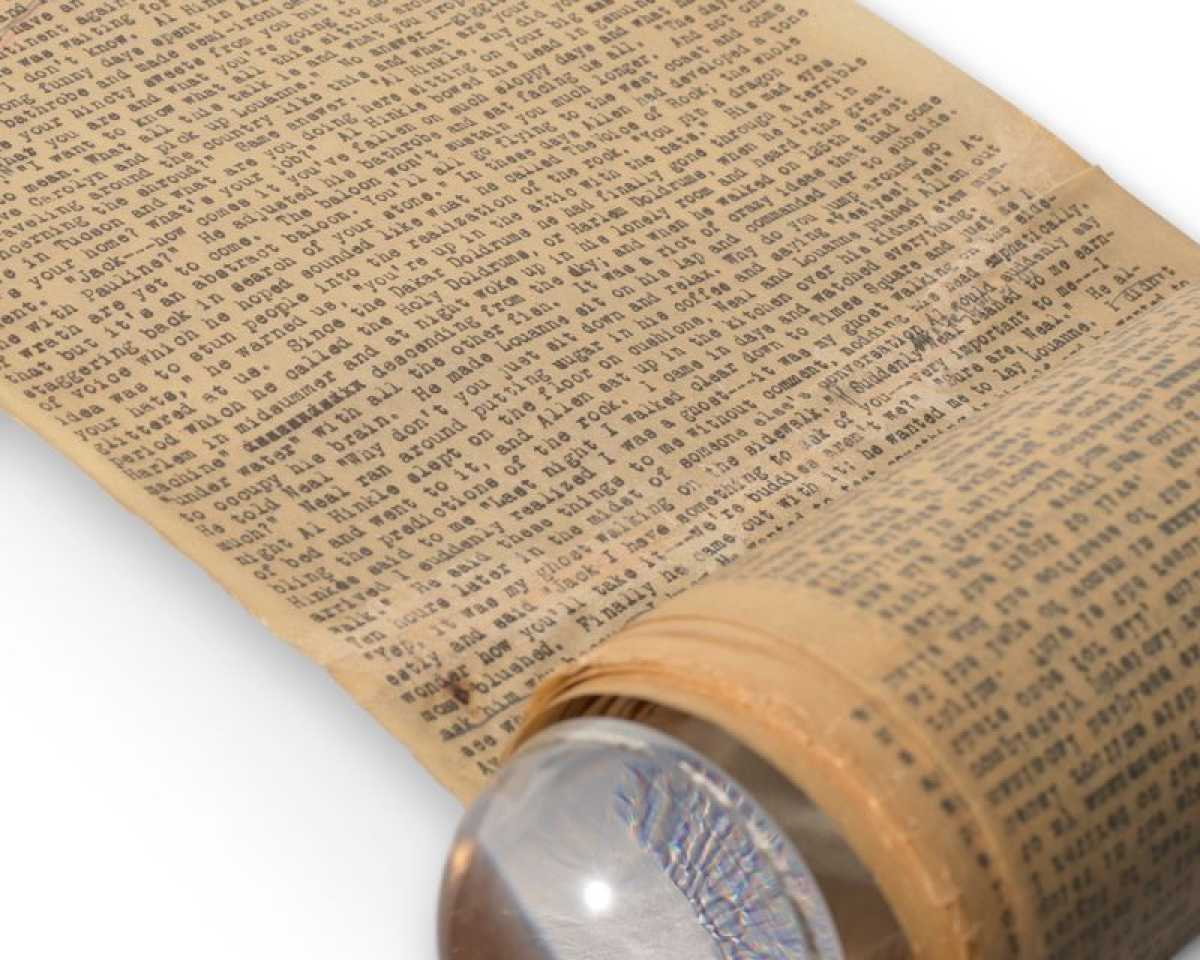
Jim Irsay purchased the original 120-foot scroll manuscript of Jack Kerouac’s “On the Road” for $2.4 million in 2001.
(Christie’s Images)
“He said publicly, ‘I’m not the owner of these things. I’m just that current custodian looking after them for future generations,’ ” Walker said. “And I think that’s what true collectors always say.”
At its L.A. highlight exhibition, Irsay’s collection held an air of synchronicity. Paul McCartney’s handwritten lyrics for “Hey Jude” hung just a few steps from a promotional poster — the only one in existence — for the 1959 concert Buddy Holly, Ritchie Valens and J.P. “The Big Bopper” Richardson were en route to perform when their plane crashed. The tragedy spurred Don McLean to write “American Pie,” about “the day the music died.”
Holly was McCartney’s “great inspiration,” Christie’s specialist Zita Gibson said. “So everything connects.”
Later, the Beatles’ 1966 song “Paperback Writer” played over the speakers near-parallel to the guitars the song was written on.
Irsay’s collection also contains a bit of whimsy, with gems like a prop golden ticket from 1971’s “Willy Wonka & the Chocolate Factory” — estimated between $60,000 and $120,000 — and reading, “In your wildest dreams you could not imagine the marvelous surprises that await you!”
Another fan-favorite is the “Wilson” volleyball from 2000’s “Cast Away,” starring Tom Hanks, estimated between $60,000 and $80,000, Gibson said.
Historically, such objects were often preserved by accident. But as the memorabilia market has ballooned over the last decade or so, Gibson said, “a lot of artists are much more careful about making sure that things don’t get into the wrong hands. After rehearsals, they tidy up after themselves.”
If anything proves the market value of seemingly worthless ephemera, Walker added, it’s fans clawing for printed set lists at the end of a concert.
“They’re desperate for that connection. This is what it’s all about,” the specialist said. It’s what drove Irsay as well, she said: “He wanted to have a connection with these great artists of his generation and also the generation above him. And he wanted to share them with people.”
In Irsay’s home, his favorite guitars weren’t hung like classic paintings. Instead, they were strewn about the rooms he frequented, available for him to play whenever the urge struck him.
Thanks to tune-up efforts from Walker, many of the guitars headed to auction are fully operational in the hopes that their buyers can do the same.
“They’re working instruments. They need to be looked after, to be played,” Walker said. And even though they make for great gallery art, “they’re not just for hanging on the wall.”

Anthropic upgrades Claude’s memory to attract AI switchers

Iran nuclear talks ‘didn’t pass the smell test’ before Trump launched strikes, says Vance

Trump sends official notification to Congress on strikes against Iran

Punch the monkey, viral star, experiences dramatic breakthrough among zoo mates

NBA player calls for Hawks to cancel their ‘Magic City’ strip club promotional night out of respect for women

Florida High School Football Rankings: Top 25 teams – Oct. 21

Cleary's 21 help Le Moyne down Central Connecticut State 69-64 in OT

How old is Bo Nix? What to know about Oregon quarterback ahead of 2024 NFL Draft

99th annual Pony Swim held in Virginia

Indiana Members Credit Union announced as new anchor tenant at Bottleworks District
Trump sends official notification to Congress on strikes against Iran

Unexpected birth brings hope to near-extinct Amazon tribe

Supreme Court blocks redrawing of New York congressional map, dealing a win for GOP

Map: Earthquake Shakes Central California

Gas prices could jump as Middle East tensions threaten global oil supply
-

 World5 days ago
Exclusive: DeepSeek withholds latest AI model from US chipmakers including Nvidia, sources say
-

 Massachusetts5 days ago
Mother and daughter injured in Taunton house explosion
-

 Denver, CO5 days ago
10 acres charred, 5 injured in Thornton grass fire, evacuation orders lifted
-

 Louisiana1 week ago
Wildfire near Gum Swamp Road in Livingston Parish now under control; more than 200 acres burned
-

 Technology1 week ago
YouTube TV billing scam emails are hitting inboxes
-

 Politics1 week ago
OpenAI didn’t contact police despite employees flagging mass shooter’s concerning chatbot interactions: REPORT
-

 Technology1 week ago
Stellantis is in a crisis of its own making
-

 News1 week ago
World reacts as US top court limits Trump’s tariff powers