Culture
What’s the Orioles’ secret to developing great hitters? Rival teams have theories


The Baltimore Orioles are a lesson in successful rebuilds, having gone from 115 losses in 2018 to one of the best teams in baseball — with one of the best farm systems — in five years. The O’s won the American League East last year, with 101 wins. Their farm system has produced the likes of young All-Stars Adley Rutschman, Gunnar Henderson and Jordan Westburg with the next wave — Jackson Holliday and Coby Mayo — recently promoted to the big leagues. Multiple current rebuilding organizations have cited Baltimore as their blueprint, particularly in producing young hitters.
The problem is identifying what exactly that blueprint is. The Orioles are mum on their secret sauce – there are plenty of theories – though some of their guiding principles aren’t necessarily groundbreaking. They’re just difficult to execute, such as the 65 new hires the Mike Elias regime made in roughly 18 months, as the organization streamlined the messaging from coaches in the minor leagues and prioritized tough work environments to breed more competition through a total culture shift.
“We have some organizational non-negotiable philosophies or values, and what we needed to do was find and hire a bunch of people that either believed in those or were willing to push those and build off those and that’s what we initially did,” said Matt Blood, who was promoted this winter from director of player development to vice president of player development and domestic scouting. “We drafted players that sort of fit in those moments as well. So we were acquiring players with these skills and we were finding coaches and building resources to reinforce these skills and then putting them to work.”
Gunnar Henderson was one of four Orioles hitters who made the All-Star team. (Nick Cammett / Getty Images)
While anecdotal evidence suggests many of the Orioles young hitters are good at the same things, Blood demurs.
“I think they’re just all good at adjustability,” he said, “and being able to compete against what the game is throwing at them.”
Still, there are some interesting theories around the league as other teams try to figure out what the Orioles do well so they can follow the same roadmap.
“They draft for VBA,” said a rival scout about the Orioles.
That’s a compelling idea, that the Orioles have found some alphabet soup that’s better than the analytics other teams use, and that they’ve used those numbers to find the best hitters in baseball.
So what is VBA?
Vertical Bat Angle is the angle of the bat respective to the ground, judged directly behind or in front of the batter. A “steeper” bat bath is generally associated with the potential to lift the ball better, though it can have some ramifications when it comes to swing-and-miss in parts of the zone. In other words, it’s great to be steep low in the zone but it’s hard to maintain that steepness and still hit a ball at the top of the zone.

This visualization of Vertical Bat Angle is from an explainer article by Eric Cressey. (Photo illustration courtesy of Eric Cressey)
So are the Orioles great at this? Do they have good swing paths? Yes and no.
At the major-league level, @SwingGraphs estimates that the Orioles are middle of the pack when it comes to VBA. But the major-league team still has some holdovers from previous regimes, as well as players who fill different roles for their current lineup. In the minor leagues, @SwingGraphs found that Baltimore’s top three prospects — Holliday, Mayo and Heston Kjerstad — were second-best in the league when compared to other top position-player prospects in terms of their “path score,” which incorporates VBA. Another team’s analyst pointed out that the Orioles’ minor leaguers have the second-highest launch angle in the sport, which would be consistent with having good VBA.
Still, it’s probably not a singular approach chasing one number in the scouting and development circles. Some evidence of this is how good the Orioles have been at slugging both pitches in the top and bottom thirds of the strike zone.

The Orioles are the only team in baseball that’s in the top five of slugging in both the top and bottom thirds of the zone, though the Minnesota Twins’ offense is close. You can also see that the Orioles don’t whiff all that much at the top of the zone — the Red Sox have a good slugging percentage at the top but whiff a lot more there. The Orioles also have the third-smallest difference between slugging at the top and slugging at the bottom. They’re good all over!
So they don’t necessarily draft for VBA or value it specifically, as multiple sources confirmed. Adjustability? That’s a different story. We just saw that their offense is multi-dimensional. Executives from other teams had more theories on how the Orioles have developed bats that can slug all over the zone.
“They draft guys with present power and improve their launch angle and swing decisions,” said a rival assistant general manager with player development responsibilities. “That present power is there in the form of top-end exit velocities, not necessarily slugging percentage. They teach better Vertical Bat Angle to reduce ground-ball rates. Swing decisions plus better VBA equals power production when those top-end exit velocities exist.”
Now we’re getting somewhere. Take raw power, add swing decisions and improve their bat paths, and you start pumping out some really good hitters? And how do they add all that? How do they improve their raw, young hitters?
“They have a lot of young coaches and throw short box with them — so those are relatively live arms, from up close, forcing the hitters to adapt and see the ball out of a release point,” said a rival director of player development. “They use weighted bats at most levels as part of the regular process to keep bat speed up. They focus on making good swing decisions and help hitters internalize that as they come up through the minors.”
This starts to line up with things that even the Orioles will admit they value.
“Our training environments are very competitive, very difficult,” said Blood. “That leads to more efficiency, in terms of learning skills.”
They want to make drill work difficult and game-like for their hitters, so the short box fits that bill. In fact, those young coaches challenged each other to develop the best stuff for their short box sessions, turning their knowledge of pitch shapes into nastiness on the mound. They want their hitters to only swing at pitches they can drive, so the nightly swing decision text messages help drive that point home. They believe in data-driven techniques that have been shown to produce on-field results, so the weighted bat training makes sense. They also use force plates — devices that measure how much force a player puts into the ground, which Driveline Baseball confirmed has a lot to do with bat speed — to check on their hitters and guide workouts throughout the season.
These examples alone give us a window into the data- and tech-driven process of developing today’s Oriole slugger. But these aren’t concepts that are foreign to other organizations. So why is it working so particularly well for the Orioles right now? The talk often comes back to the players themselves.
“I think the Orioles have done a phenomenal job of getting guys with really good makeup,” Adley Rutschman told Travis Sawchick at The Score. “And once you get enough guys who are of that same mindset, because everyone is pushing each other and everyone is on the same page, it would be really difficult if guys were not bought in. When guys are bought in, it’s a lot of fun.”
“Every single one of their All-Stars has a high baseball IQ,” agreed a rival hitting coach. “Every one has a specific way they are going to have success that night. The high IQ allows them to know what the pitcher is trying to do to them that day and adjust their swing path and approach on a pitcher-to-pitcher level. He’s throwing sinkers, I’m going to be more scoopy with my swing today! He’s got a lot of ride, I’m going to be flatter today.
“Never has it been more important to have high IQ players like that.”
(Top photo of Jackson Holliday: Cole Burston / Getty Images)



Among the many complaints made about the modern American novelist, the loudest, if not the most intelligent, has been the charge that he is not speaking for his country. A few seasons back an editorial in Life magazine asked grandly, “Who speaks for America today?” and was not able to conclude that our novelists, or at least our most gifted ones, did.
This opening paragraph is from an essay titled “The Fiction Writer and His Country” by a writer whose work was influenced by Catholicism, the rural South and peacocks. Who was it?

Welcome to Lit Trivia, the Book Review’s regular quiz about books, authors and literary culture. This week’s challenge is all about an influential group of writers, editors and other creative types known as the Algonquin Round Table. In the five multiple-choice questions below, tap or click on the answer you think is correct. After the last question, you’ll find links to related books and other information about the era if you’d like to do further reading.

A strong sense of place can deeply influence a story, and in some cases, the setting can even feel like a character itself. But as it’s summer here in the Northern Hemisphere and travel adventures abound, this week’s literary geography quiz takes you on a trivia tour of notable libraries around the world. To play, just make your selection in the multiple-choice list and the correct answer will be revealed. At the end of the quiz, you’ll find links to more information if you’d like to do further reading.
-
 Business4 minutes ago
California soccer fans sue StubHub after it fails to deliver expensive World Cup tickets
-
 Entertainment7 minutes ago
Lucas Museum to give free annual passes to South L.A. neighbors, host community preview day
-
 Lifestyle12 minutes ago
Meow Wolf taps famed L.A. animation house for its new Los Angeles venue
-
Politics19 minutes ago
Column: Trump decries ‘communism’ while his government takes ownership of companies
-
 Science22 minutes ago
‘I’d rather my house burn down than get cancer’: Herbicide use upends California’s fight to save forests
-
 Sports27 minutes ago
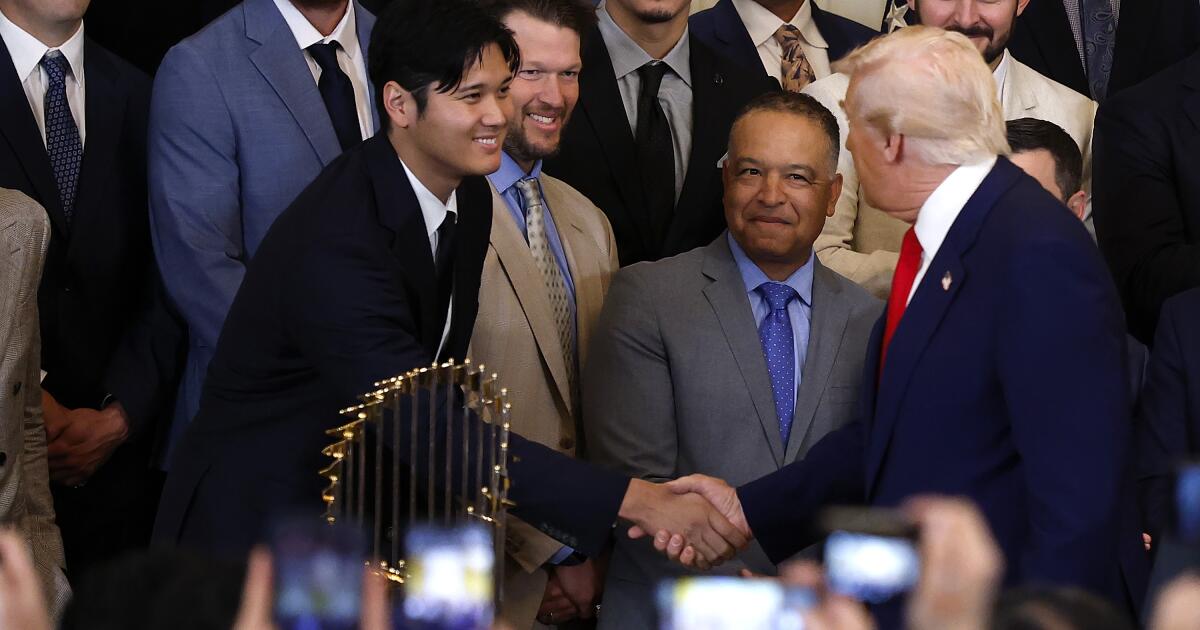
Dodgers scheduled to visit White House in late July to celebrate 2025 World Series win
-

 World37 minutes ago
Former US Olympian pleads not guilty in DC reflecting pool vandalism case
-
 News1 hour ago
Former Olympian pleads not guilty in reflecting pool vandalism charges


