Crypto
The Top 8 Cryptocurrency Staking Platforms of 2025: Maximize Your Passive Earnings | Bitcoinist.com


Cryptocurrency staking has evolved into one of the most powerful ways to earn passive income, and with the growing variety of staking platforms, it’s easier than ever to generate returns on your crypto holdings. Whether you’re just starting out with crypto or you’ve been investing for a while, picking the right crypto staking platform is crucial to getting the most out of your money.
In this article, we’ll show you the top 8 cryptocurrency staking platforms for 2025—starting with the very best one: Keynode. These platforms offer high staking rewards, security, and features that will help you unlock the full potential of your digital assets.
1. Keynode: The Ultimate Staking Solution
Keynode has quickly ascended to the top of the staking world in 2025, offering a user-friendly experience that’s as secure as it is profitable. With its unparalleled flexibility and high rewards and highest APY crypto staking, Keynode is an investor’s dream for maximizing passive earnings.
Here’s a simple guide to get started with Keynode.net:
- Visit Keynode.net -Visit the Keynode.net website to start your crypto journey.
- Create an Account – Sign up and make an account, choosing a secure password, and following the verification steps to ensure your account is protected.
- Claim Your Welcome Bonus– As a new user, you’re eligible for a $100 Welcome Bonus tied to the ETH Lite Plan.
- Deposit Funds– Deposit your preferred cryptocurrency or fiat funds into your account.
- Start Earning Through Staking or Other Plans– Choose from Keynode’s various earning options, like high-yield staking, to start growing your assets.
Earn Big with Keynode.net’s Affiliate Program (4% + Active Users Bonus)
The Keynode.net Affiliate Program is designed for crypto enthusiasts and affiliates who want to earn extra income by sharing Keynode.net with others.
Key Benefits of the Keynode.net Affiliate Program
- No Deposit Required
You can join the affiliate program, share your referral link, and begin earning without needing to make an initial deposit. - High Pay-Outs
Earn up to 4% in referral rewards for every purchase made by a user who signs up through your link, maximizing your income from each referred customer. - Instant Payments
Keynode.net ensures you get paid quickly, with referral rewards credited instantly in cryptocurrency to your account. - No Limits on Referrals
With no cap on referrals, there’s no limit to your earning potential.
How It Works
- Sign Up and Get Your Referral Link
Simply sign up for the affiliate program on Keynode.net and receive a unique referral link. - Share Your Link
Invite friends, family, and followers to join Keynode.net using your referral link. - Earn Rewards Instantly
Each time a referred user completes a purchase, your commission is credited immediately. - Active Users Bonus
Enjoy extra bonuses for each milestone in active users (those who have made a purchase). The more active users you bring in, the more you earn:
- 10 Active Users: Earn an extra $15
- 30 Active Users: Earn an extra $50
- 50 Active Users: Earn an extra $100
- 100 Active Users: Earn an extra $150
- 300 Active Users: Earn an extra $400
- 500 Active Users: Earn an extra $700
- 1,000 Active Users: Earn an extra $1,500
- 2,000Active Users: Earn an extra $3,000
Keynode.net Million Bounty Program
Keynode.net’s Million Bounty Program is your opportunity to earn rewards while contributing to the growth and success of our platform. By completing simple tasks, sharing the messages, and managing online groups, you can earn crypto rewards while contributing to the improvements of the platform.
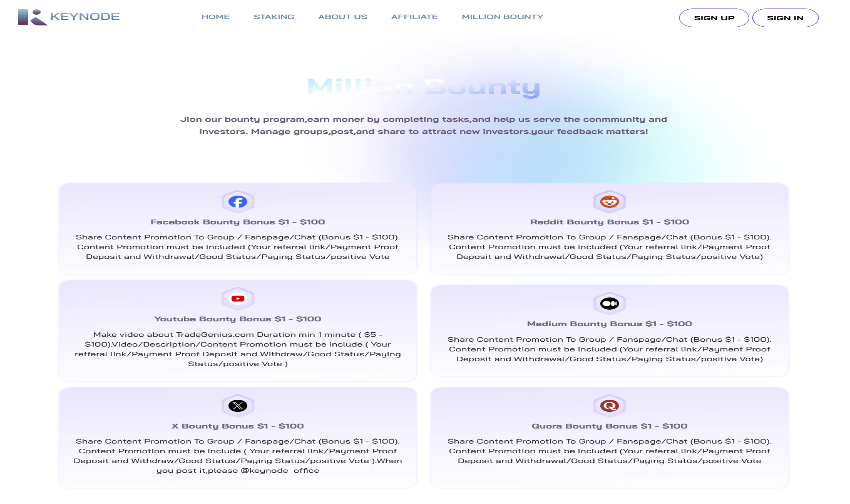
How to Claim a Bonus on KEYNODE: A Simple Guide
- Enter your username followed by “Million Bounty” on the first line.
- Provide your email address on the second line.
- Share the link to your social media post on the third line.
- Submit the information to the Support team for review.
- Approved bonuses will be issued weekly on Tuesdays and Fridays.
2. Binance: A Trusted Powerhouse in Crypto
It will be in 2025 when Binance, one of the biggest and most reputable cryptocurrency exchanges in the world, will still head in cryptocurrency staking. Offering flexibility and a vast selection of supported cryptocurrencies, Binance is an ideal platform for users looking for reliable passive income.
Why Binance Is a Top Contender:
- Flexible Staking Options: Whether you prefer flexible or locked staking, Binance offers both, catering to all types of investors.
- High Liquidity: Binance’s massive user base ensures high liquidity, making it easy to stake and unstake your assets at any time.
3. Kraken: Secure and User-Friendly
For those seeking a straightforward and highly secure staking experience, Kraken is a top choice in 2025. Kraken is well-known for its strict rules and strong security measures. It makes staking easy for both new and experienced investors.
Why Kraken Stands Out:
- Top-Tier Security: Kraken is famous for its robust security measures, ensuring your assets are always protected.
- 24/7 Support: Kraken provides round-the-clock customer support, ensuring assistance is available whenever you need it.
4. Coinbase: A Beginner’s Best Friend
For new investors in the field of cryptocurrency, Coinbase provides one of the easiest and most trusted platforms for a beginner to start staking. With its user-friendly design and robust security features, Coinbase makes it simple to grow your crypto holdings passively.
5. Gemini: Regulated and Reliable
Gemini is a regulated U.S. exchange that provides a secure and user-friendly platform for staking a variety of cryptocurrencies. Gemini is a great option for people who want a safe and secure way to stake their assets, as it’s well-known for following rules and keeping things protected.
Why Gemini Deserves a Spot:
- Reliable Rewards: Staking rewards on Gemini range from 2% to 6% annually, with reliable payouts.
- Strong Security: Gemini’s advanced security features provide peace of mind, ensuring your funds are always protected.
6. Staked: Optimized for Proof-of-Stake
Staked is an advanced platform designed specifically for staking Proof-of-Stake (PoS) assets. Dedicated to providing high yields and professional management, Staked is suitable for users intending to maximize returns out of their PoS tokens.
Why Staked is a Strong Option:
- Expert Management: Staked provides professional-grade management for your staking assets, ensuring maximum efficiency and reliability.
- High Yields: Staked offers some of the highest yields in the industry, particularly for PoS coins like Solana, Cosmos, and more.
7. Crypto.com: A One-Stop Crypto Ecosystem
Crypto.com continues to expand its ecosystem, offering not only staking but also trading, lending, and a crypto-backed debit card. If you want a place where you can manage your whole crypto portfolio, Crypto.com has got you covered.
Why Crypto.com Is Worth Your Attention:
- Attractive Rewards: Crypto.com offers competitive rewards, with yields ranging from 4% to 12% on various coins.
- Loyalty Programs: The platform’s loyalty program offers additional bonuses for users who hold the native CRO token.
8. Exodus: A Staking Wallet for the Mobile Generation
Exodus is a well-known wallet app for phones and computers. It lets users earn rewards by staking different types of cryptocurrencies directly from their wallets.Known for its intuitive interface, Exodus is perfect for users who want to stake on the go.
Why Exodus Stands Out:
- Mobile-Friendly: Exodus is designed with mobile users in mind, making it easy to stake from anywhere.
- Low Fees: Exodus offers competitive fees, making it a cost-effective choice for staking smaller amounts.
Conclusion: Maximize Your Earnings in 2025
Choosing the right cryptocurrency staking platform can significantly impact the returns you earn on your investments. With Keynode marching the way, among this top 8, everything from the most high-yield to the easiest use and the rock-solid protection is available. So, which platform will you choose to take your crypto staking experience to the next level? Let the journey to passive income begin!
Disclaimer: This is a paid release. The statements, views and opinions expressed in this column are solely those of the content provider and do not necessarily represent those of Bitcoinist. Bitcoinist does not guarantee the accuracy or timeliness of information available in such content. Do your research and invest at your own risk.


If you’re wondering how to manage risk when trading crypto, remember that this market shifts rapidly; pairing enthusiasm with prudence is the wiser approach to digital assets. In practice, risk management is the process of identifying what could go wrong in a trade, deciding in advance how much you can lose, and using tools (like position limits and exits) to keep any single mistake or market move from doing outsized damage.
Summary
Crypto and traditional securities expose investors to different kinds of risk, and treating them as identical leads to poor assumptions. Because these markets operate on distinct mechanics, each must be assessed within its own context. Risk management matters because the same volatility and structural quirks that create opportunity can also turn a small misstep into a large loss, and protecting capital is what keeps you in the game long enough to learn and improve.
In fast-moving crypto markets, a structured risk plan turns uncertainty into defined decisions you can execute consistently.
Speculative Securities: A Quick Primer
When an instrument is considered speculative, there is a real chance of losing interest, principal, or both. Understandably, many shy away from such exposure, yet outcomes are unpredictable and can result in either significant gains or losses.
Consider high-yield bonds — commonly known as junk bonds. Issuers often have low credit ratings, so defaults are more likely than with investment-grade borrowers. In the late 1980s, these bonds were labeled speculative-grade or below-investment-grade. Many issuers were in or near bankruptcy, and it was uncertain which companies would survive. Backing a firm that emerged successfully could yield outsized returns, but many investors saw capital evaporate. Even after fundamental analysis — examining company history, financials, performance data, and market trends — the uncertainty kept these assets firmly speculative.
Crypto’s Shifting Risk Profile
Cryptocurrency markets are also speculative, and the payoff potential can be dramatic; for instance, Bitcoin climbed from $10,000 to $20,000 within two weeks in December 2017. As with junk bonds in their heyday, no one can say which networks or tokens will lead over the long term. The risk drivers, however, are not the same as those in high-yield debt, and having a framework to manage exposure still matters. Key categories often include market risk (rapid price swings), liquidity risk (thin order books and slippage), operational and technology risk (platform outages and smart-contract bugs), regulatory risk (policy shifts), and custody or cybersecurity threats.
Much of crypto is new and evolves at breakneck speed. Classification remains unsettled: the Internal Revenue Service treats crypto as property subject to capital-gains tax, while the Securities and Exchange Commission views certain assets as securities that fall under its oversight. When fundamental definitions remain fluid, it’s easy to brand the space as risky — which is why approaching it with care and curiosity is sensible.
Speculative Risk-Taking Requires Deliberate Choices
Investing blends art and science, and even experienced professionals encounter surprises in the crypto market. What it should not become is a gamble. Do rigorous research, learn how the cryptocurrencies and platforms you use actually work, and understand the known hazards before you trade.
Strong risk habits tend to look similar across strategies: using stop-loss orders (or pre-defined exits) to cap downside, sizing positions so a single trade can’t meaningfully harm the account, diversifying so one token or theme doesn’t dominate outcomes, setting a risk/reward ratio before entering, and trading only with risk capital you can afford to lose without disrupting your financial life.
A simple five-step process can help bring structure to your approach: identify risks, analyze how likely and severe they are, choose controls to address them, implement those controls consistently, and then monitor results and adjust as conditions change.
Your personal risk tolerance is not just a number. It reflects your financial situation (cash needs and debt), your goals and time horizon, your experience with drawdowns, and your psychological comfort with uncertainty. Practical ways to assess it include choosing a maximum acceptable percentage loss per trade and per day/week, paper trading to observe how you react under pressure, keeping a short trading journal, and stress-testing positions by imagining a sharp drop and deciding whether you could follow your plan without freezing or panic-selling.
You can also calculate risk parameters directly. A common approach is to set a maximum account risk per trade (for example, 1%) and then size the position from the distance between entry and stop. Position size (units) can be calculated as: (Account Size × Risk %) ÷ (Entry Price − Stop Price) for a long trade.
Example: If your account is $10,000 and you risk 1% ($100) on a trade, and you plan to buy at $50 with a stop at $48, your risk per coin is $2. Your position size would be $100 ÷ $2 = 50 coins. If your target is $56, the potential reward per coin is $6, so the risk/reward ratio is $6 ÷ $2 = 3:1.
Different risk decisions also fall into four broad types: avoiding risk (skipping a trade or asset you don’t understand), reducing risk (tightening sizing rules or using exits), transferring risk (using hedges or shifting exposure off a single venue), and accepting risk (taking a measured position because the potential upside justifies the predefined downside).
Common mistakes often show up when plans aren’t written down or enforced: overleveraging, trading without a stop, letting emotions override rules, building a portfolio that is effectively one crowded bet, and ignoring market-moving news or changes in exchange conditions that can affect execution.
Keep the following factors in mind as you invest and design a crypto risk management process:
Risk Type
Description
Price-Swing Risk
Digital assets can move sharply in short windows, and sudden drawdowns can trigger forced selling or emotional decisions if losses are not capped in advance.
Regulatory Uncertainty
Rule changes, enforcement actions, and unclear jurisdiction can affect access, listings, disclosures, and what participants can do on a given platform.
Cybersecurity and Custody Threats
Account takeovers, phishing, compromised devices, and wallet or key-management failures can lead to irreversible loss of funds.
Liquidity Constraints
Thin order books and fast markets can create slippage, making it difficult to enter or exit near intended prices, especially during stress.
Operational and Technology Risk
Outages, congestion, bugs, and smart-contract failures can interrupt trading, delay transfers, or change the behavior of on-chain products.
- Market Volatility
- Market Regulation
Perhaps the most important point when shaping an effective approach is to avoid forcing legacy finance labels onto a new asset class. While many still regard the space as speculative, there is growing agreement that the underlying technology, networks, and crypto assets have real value. Methods to define and measure that value are still developing, and they will ultimately inform how traders perceive risk in this market.

Key Takeaways:
- Bitcoin difficulty rose 3.87% at block 943488 as hashrate fell 60.45 EH/s; a 15.73% cut is projected.
- Miners face $30.67 PH/s hashprice and 0.56% fees, pushing firms toward AI over BTC mining.
- Bitcoin network nears April 19, 2026, adjustment as slower 11:51 blocks signal easing difficulty ahead.
Bitcoin Mining Tightens
The Bitcoin network has logged a total of seven adjustments this year, comprising three increases and four decreases. The most recent reduction, two weeks ago, was sizable, arriving after consecutive gains of 14.73% and 0.45% across the prior two epochs.
Following the latest adjustment, the difficulty rating is now 3.87% higher, making blocks that much harder to discover, and it further stands at 138.97 trillion times more difficult than Bitcoin’s launch.
As of 4 p.m. Eastern time, 181 of the 2,016 blocks in the current epoch have been mined, placing the network roughly 9% of the way toward the next adjustment expected on April 19, 2026. While it remains early and conditions can shift considerably between now and then, current estimates point to a projected 14.27% reduction.
This outlook stems from a noticeable slowdown in block intervals over the past day, with data from hashrateindex.com indicating an average block time of 11 minutes 39 seconds, well above the expected 10-minute cadence.

What’s behind the shift? A decline in hashrate. Bitcoin.com News reported on March 28 that the Bitcoin network’s total computational power had exceeded 1,000 exahash per second (EH/s), or 1 zettahash per second (ZH/s). On that day, hashpower reached 1,022 EH/s, whereas it now sits 60.45 EH/s lower at 961.55 EH/s.
Revenue Compression Tightens the Squeeze
Compressed revenues are likely a key factor behind the downturn, alongside mining operations opting to allocate resources toward artificial intelligence (AI) infrastructure rather than mining BTC in pursuit of stronger returns. An infrastructure provider deploying its megawatts toward AI rather than mining bitcoin can realize significantly higher returns, a dynamic that has persuaded many of today’s operators to redirect their focus.
A daily hashprice of $30.67 per petahash per second (PH/s) ranks among the lowest revenue levels bitcoin miners have faced since the network’s early years, when bitcoin carried a far smaller valuation. With 106,335 blocks remaining until the next halving, conditions are poised to tighten further.

Ethereum Foundation Reaches 70,000 ETH Staking Target With $93 Million April Deposit
The Ethereum Foundation (EF) staked approximately 45,034 ETH on April 3, 2026, bringing its cumulative total to nearly 69,500 ETH…
Read Now


Ethereum Foundation Reaches 70,000 ETH Staking Target With $93 Million April Deposit
The Ethereum Foundation (EF) staked approximately 45,034 ETH on April 3, 2026, bringing its cumulative total to nearly 69,500 ETH…
Read Now
Ethereum Foundation Reaches 70,000 ETH Staking Target With $93 Million April Deposit
Read Now
The Ethereum Foundation (EF) staked approximately 45,034 ETH on April 3, 2026, bringing its cumulative total to nearly 69,500 ETH…
Adding pressure, miners cannot rely on fees, which account for just 0.56% of the block reward. In effect, the system appears to be approaching a breaking point. Yet Bitcoin’s difficulty adjustment is engineered for precisely this scenario. If miners exit and hashrate declines, difficulty adjusts downward, drawing participants back with more accessible conditions.

Cryptocurrency has rapidly transformed from a niche concept into a global financial phenomenon. With increasing adoption, digital currencies are now being explored not only as investment assets but also as tools for innovation across industries. For beginners and experienced participants alike, understanding the broader cryptocurrency landscape is essential to making informed decisions.
What Makes Cryptocurrency Unique?
Unlike traditional financial systems, cryptocurrencies operate on decentralized networks powered by blockchain technology. This means there is no central authority controlling transactions. Instead, transactions are verified by a distributed network of participants, ensuring transparency and security.
This decentralization is one of the key reasons why cryptocurrencies have gained popularity. It allows individuals to have greater control over their assets and reduces reliance on traditional financial institutions.
The Expanding Crypto Ecosystem
Over the years, the cryptocurrency ecosystem has grown significantly. It now includes a wide range of applications such as decentralized finance (DeFi), non-fungible tokens (NFTs), and blockchain-based gaming.
Each of these sectors contributes to the overall development of the industry. DeFi platforms enable lending, borrowing, and trading without intermediaries, while NFTs redefine digital ownership. Together, these innovations highlight the versatility of blockchain technology.
Understanding Market Behavior
Cryptocurrency markets are known for their volatility. Prices can fluctuate rapidly due to various factors, including:
- Global economic conditions
- Regulatory announcements
- Technological advancements
- Market sentiment and speculation
This unpredictability can create both opportunities and risks. While some participants benefit from price movements, others may face losses if they are not adequately prepared.
The Importance of Long-Term Perspective
Many newcomers enter the crypto market with the expectation of quick profits. However, experienced participants often emphasize the importance of a long-term perspective. Instead of focusing solely on short-term price changes, it is beneficial to consider the underlying value and potential of a project.
A long-term approach allows individuals to better navigate market fluctuations and make decisions based on fundamentals rather than emotions.
Spotlight on Emerging Discussions
Within the broader cryptocurrency space, certain tokens and projects frequently become part of ongoing discussions. One such example is ankr crypto. Conversations around ankr crypto often reflect a growing interest in blockchain infrastructure and decentralized cloud solutions. As discussions around ankr crypto continue, they highlight how different projects are contributing to the evolution of the ecosystem in unique ways.
The Role of Technology in Crypto Growth
Technology plays a central role in the expansion of cryptocurrency. Innovations such as smart contracts, layer-2 scaling solutions, and interoperability protocols are helping to improve efficiency and usability.
These advancements address some of the key challenges faced by the industry, including high transaction fees and network congestion. As technology continues to evolve, it is likely to drive further adoption and open up new possibilities.
Risk Management and Strategy
Given the volatile nature of the market, having a clear strategy is essential. Some common approaches include:
- Diversifying investments across multiple assets
- Setting realistic expectations
- Avoiding impulsive decisions
- Staying updated with market developments
Risk management isn’t just about keeping losses from happening. It’s also about keeping participation fair and long-lasting.
Security and Awareness
Security is a critical aspect of engaging with cryptocurrencies. Since users have full control over their assets, they are also responsible for protecting them. This includes using secure wallets, enabling authentication measures, and being cautious of scams.
Awareness and education play a significant role in minimizing risks. By understanding common threats and best practices, individuals can safeguard their investments more effectively.
The Future of Cryptocurrency
The future of cryptocurrency is shaped by continuous innovation and increasing adoption. As more industries explore blockchain technology, the role of digital assets is likely to expand beyond finance.
However, challenges such as regulatory uncertainty and scalability remain. Addressing these issues will be crucial for the long-term success of the industry.
Despite these challenges, the overall trajectory of cryptocurrency remains promising. With ongoing development and growing interest, the ecosystem is expected to evolve in ways that could redefine how value is exchanged and managed.
Conclusion
Cryptocurrency represents a dynamic and rapidly evolving field that offers both opportunities and challenges. By understanding its fundamentals, staying informed about developments, and adopting a disciplined approach, individuals can navigate the market more effectively.
While trends and discussions may come and go, focusing on the broader principles of technology, utility, and risk management can provide a solid foundation. As the digital economy continues to grow, cryptocurrency is set to remain an important part of the financial landscape.

Microplastics are everywhere — even in the labs studying them. That’s a problem for research

Three keys for UCLA as it faces South Carolina for an NCAA national championship

Hamas armed wing says disarmament demands not acceptable

Trump issues fiery new threat against Iran as details of US aviator’s rescue emerge

Strong storms leave trail of damage across Metro Detroit — cleanup could take weeks

Florida High School Football Rankings: Top 25 teams – Oct. 21

How old is Bo Nix? What to know about Oregon quarterback ahead of 2024 NFL Draft

Cleary's 21 help Le Moyne down Central Connecticut State 69-64 in OT

99th annual Pony Swim held in Virginia

Indiana Members Credit Union announced as new anchor tenant at Bottleworks District
Hamas armed wing says disarmament demands not acceptable
Trump issues fiery new threat against Iran as details of US aviator’s rescue emerge

DHS slams Democrat Sen Chris Van Hollen claim, says illegal alien caused crash while fleeing ICE

Zelenskyy warns US-Iran war could divert critical aid from Ukraine

After the Minnesota surge, ICE is moving to a quieter enforcement approach
-

 South-Carolina1 week ago
South Carolina vs TCU predictions for Elite Eight game in March Madness
-

 Atlanta, GA16 hours ago
1 teenage girl killed, another injured in shooting at Piedmont Park, police say
-

 Vermont1 week ago
Skier dies after fall at Sugarbush Resort
-

 Movie Reviews3 days ago
Vaazha 2 first half review: Hashir anchors a lively, chaos-filled teen tale
-

 Politics1 week ago
Trump’s Ballroom Design Has Barely Been Scrutinized
-

 Atlanta, GA1 week ago
Fetishist ‘No Kings’ protester in mask drags ‘Trump’ and ‘JD Vance’ behind her wheelchair
-
 Entertainment4 days ago
Inside Ye’s first comeback show at SoFi Stadium
-

 Politics1 week ago
JD Vance says he was ‘obsessed’ with UFOs, believes aliens are actually ‘demons’