Crypto
The Top 8 Cryptocurrency Staking Platforms of 2025: Maximize Your Passive Earnings | Bitcoinist.com


Cryptocurrency staking has evolved into one of the most powerful ways to earn passive income, and with the growing variety of staking platforms, it’s easier than ever to generate returns on your crypto holdings. Whether you’re just starting out with crypto or you’ve been investing for a while, picking the right crypto staking platform is crucial to getting the most out of your money.
In this article, we’ll show you the top 8 cryptocurrency staking platforms for 2025—starting with the very best one: Keynode. These platforms offer high staking rewards, security, and features that will help you unlock the full potential of your digital assets.
1. Keynode: The Ultimate Staking Solution
Keynode has quickly ascended to the top of the staking world in 2025, offering a user-friendly experience that’s as secure as it is profitable. With its unparalleled flexibility and high rewards and highest APY crypto staking, Keynode is an investor’s dream for maximizing passive earnings.
Here’s a simple guide to get started with Keynode.net:
- Visit Keynode.net -Visit the Keynode.net website to start your crypto journey.
- Create an Account – Sign up and make an account, choosing a secure password, and following the verification steps to ensure your account is protected.
- Claim Your Welcome Bonus– As a new user, you’re eligible for a $100 Welcome Bonus tied to the ETH Lite Plan.
- Deposit Funds– Deposit your preferred cryptocurrency or fiat funds into your account.
- Start Earning Through Staking or Other Plans– Choose from Keynode’s various earning options, like high-yield staking, to start growing your assets.
Earn Big with Keynode.net’s Affiliate Program (4% + Active Users Bonus)
The Keynode.net Affiliate Program is designed for crypto enthusiasts and affiliates who want to earn extra income by sharing Keynode.net with others.
Key Benefits of the Keynode.net Affiliate Program
- No Deposit Required
You can join the affiliate program, share your referral link, and begin earning without needing to make an initial deposit. - High Pay-Outs
Earn up to 4% in referral rewards for every purchase made by a user who signs up through your link, maximizing your income from each referred customer. - Instant Payments
Keynode.net ensures you get paid quickly, with referral rewards credited instantly in cryptocurrency to your account. - No Limits on Referrals
With no cap on referrals, there’s no limit to your earning potential.
How It Works
- Sign Up and Get Your Referral Link
Simply sign up for the affiliate program on Keynode.net and receive a unique referral link. - Share Your Link
Invite friends, family, and followers to join Keynode.net using your referral link. - Earn Rewards Instantly
Each time a referred user completes a purchase, your commission is credited immediately. - Active Users Bonus
Enjoy extra bonuses for each milestone in active users (those who have made a purchase). The more active users you bring in, the more you earn:
- 10 Active Users: Earn an extra $15
- 30 Active Users: Earn an extra $50
- 50 Active Users: Earn an extra $100
- 100 Active Users: Earn an extra $150
- 300 Active Users: Earn an extra $400
- 500 Active Users: Earn an extra $700
- 1,000 Active Users: Earn an extra $1,500
- 2,000Active Users: Earn an extra $3,000
Keynode.net Million Bounty Program
Keynode.net’s Million Bounty Program is your opportunity to earn rewards while contributing to the growth and success of our platform. By completing simple tasks, sharing the messages, and managing online groups, you can earn crypto rewards while contributing to the improvements of the platform.
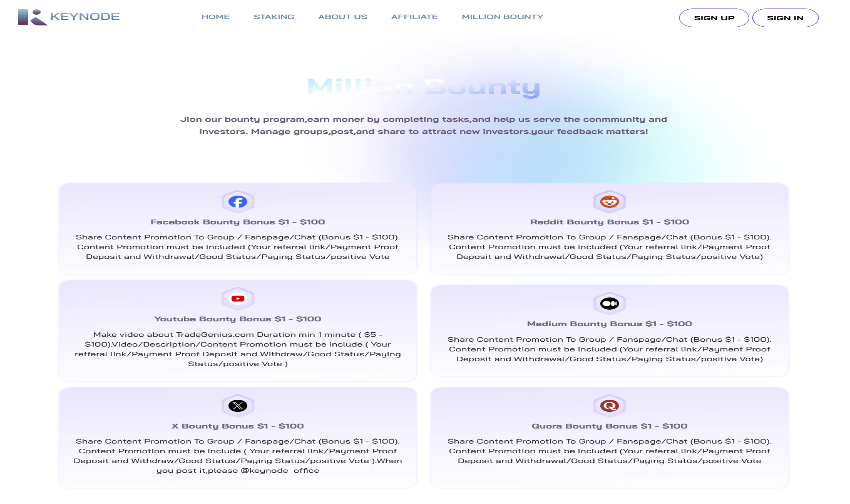
How to Claim a Bonus on KEYNODE: A Simple Guide
- Enter your username followed by “Million Bounty” on the first line.
- Provide your email address on the second line.
- Share the link to your social media post on the third line.
- Submit the information to the Support team for review.
- Approved bonuses will be issued weekly on Tuesdays and Fridays.
2. Binance: A Trusted Powerhouse in Crypto
It will be in 2025 when Binance, one of the biggest and most reputable cryptocurrency exchanges in the world, will still head in cryptocurrency staking. Offering flexibility and a vast selection of supported cryptocurrencies, Binance is an ideal platform for users looking for reliable passive income.
Why Binance Is a Top Contender:
- Flexible Staking Options: Whether you prefer flexible or locked staking, Binance offers both, catering to all types of investors.
- High Liquidity: Binance’s massive user base ensures high liquidity, making it easy to stake and unstake your assets at any time.
3. Kraken: Secure and User-Friendly
For those seeking a straightforward and highly secure staking experience, Kraken is a top choice in 2025. Kraken is well-known for its strict rules and strong security measures. It makes staking easy for both new and experienced investors.
Why Kraken Stands Out:
- Top-Tier Security: Kraken is famous for its robust security measures, ensuring your assets are always protected.
- 24/7 Support: Kraken provides round-the-clock customer support, ensuring assistance is available whenever you need it.
4. Coinbase: A Beginner’s Best Friend
For new investors in the field of cryptocurrency, Coinbase provides one of the easiest and most trusted platforms for a beginner to start staking. With its user-friendly design and robust security features, Coinbase makes it simple to grow your crypto holdings passively.
5. Gemini: Regulated and Reliable
Gemini is a regulated U.S. exchange that provides a secure and user-friendly platform for staking a variety of cryptocurrencies. Gemini is a great option for people who want a safe and secure way to stake their assets, as it’s well-known for following rules and keeping things protected.
Why Gemini Deserves a Spot:
- Reliable Rewards: Staking rewards on Gemini range from 2% to 6% annually, with reliable payouts.
- Strong Security: Gemini’s advanced security features provide peace of mind, ensuring your funds are always protected.
6. Staked: Optimized for Proof-of-Stake
Staked is an advanced platform designed specifically for staking Proof-of-Stake (PoS) assets. Dedicated to providing high yields and professional management, Staked is suitable for users intending to maximize returns out of their PoS tokens.
Why Staked is a Strong Option:
- Expert Management: Staked provides professional-grade management for your staking assets, ensuring maximum efficiency and reliability.
- High Yields: Staked offers some of the highest yields in the industry, particularly for PoS coins like Solana, Cosmos, and more.
7. Crypto.com: A One-Stop Crypto Ecosystem
Crypto.com continues to expand its ecosystem, offering not only staking but also trading, lending, and a crypto-backed debit card. If you want a place where you can manage your whole crypto portfolio, Crypto.com has got you covered.
Why Crypto.com Is Worth Your Attention:
- Attractive Rewards: Crypto.com offers competitive rewards, with yields ranging from 4% to 12% on various coins.
- Loyalty Programs: The platform’s loyalty program offers additional bonuses for users who hold the native CRO token.
8. Exodus: A Staking Wallet for the Mobile Generation
Exodus is a well-known wallet app for phones and computers. It lets users earn rewards by staking different types of cryptocurrencies directly from their wallets.Known for its intuitive interface, Exodus is perfect for users who want to stake on the go.
Why Exodus Stands Out:
- Mobile-Friendly: Exodus is designed with mobile users in mind, making it easy to stake from anywhere.
- Low Fees: Exodus offers competitive fees, making it a cost-effective choice for staking smaller amounts.
Conclusion: Maximize Your Earnings in 2025
Choosing the right cryptocurrency staking platform can significantly impact the returns you earn on your investments. With Keynode marching the way, among this top 8, everything from the most high-yield to the easiest use and the rock-solid protection is available. So, which platform will you choose to take your crypto staking experience to the next level? Let the journey to passive income begin!
Disclaimer: This is a paid release. The statements, views and opinions expressed in this column are solely those of the content provider and do not necessarily represent those of Bitcoinist. Bitcoinist does not guarantee the accuracy or timeliness of information available in such content. Do your research and invest at your own risk.


Key Takeaways
- LAB token cratered 90% over 48 hours, wiping out billions in market cap.
- ZachXBT slammed top centralized exchanges for failing to halt the July manipulation.
- Investors surged to avoid trading LAB as team token unlocks are set for later in July 2026.
LAB Trade Blames ‘Large Market Participants’
LAB, the native token of the multi-chain trading platform LAB Trade, suffered a catastrophic collapse this week, plunging from just over $7 to $1.25 on Wednesday—a staggering 80% decline in under 24 hours. This crash followed an equally brutal sell-off on Tuesday, which saw the token slide from nearly $17. In total, LAB wiped out nearly 90% of its value in just 48 hours.
The financial fallout was swift: a market capitalization that exceeded $5 billion on Tuesday morning evaporated to just $390 million by 3:30 p.m. EST on Wednesday. The freefall prompted the LAB Trade team to address the panic on X, where they expressed disappointment and deflected blame toward external heavy-sellers:
“While today’s market activity is disappointing, our product roadmap and long-term focus remain unchanged. We’re seeing significant selling pressure from large market participants. Several independent trading firms also hold substantial LAB positions that are not affiliated with our team. We’re working closely with our liquidity partners and continue to monitor market conditions,” the team said on X.
With this crash, LAB joins a notorious lineup of volatile tokens, such as RAVE, RIVER and SIREN. Each of these projects experienced meteoric rises followed by near-instantaneous erasures, sparking widespread “pump-and-dump” allegations against their respective teams and murky distribution networks.
Crypto Sleuth Slams Centralized Exchanges
Prominent on-chain detective ZachXBT, who previously flagged suspicious insider loans and market-maker coordination back in May, blasted major centralized exchanges ( CEXs) for failing to protect retail investors. Taking to X, ZachXBT criticized the lack of proactive intervention:
“Disappointing to see how no action was taken by Binance, Bitget, and Gate earlier to prevent it. If CEXs cared, profits from the accounts manipulating the price would be distributed to users at a minimum. Unlocks for investors were scheduled to begin later this month, however, multiple late vesting changes occurred in the past.”
ZachXBT reiterated his previous warnings that insiders have effectively controlled the entire circulating supply, allowing market makers to orchestrate extreme price manipulation on major exchanges. His final advice to the community was blunt: avoid trading LAB under any circumstances.

ZachXBT Names RAVE, RIVER, SIREN, and LAB as Victims of Bitget-Enabled Market Maker Fraud
Blockchain investigator ZachXBT has renewed his assault on Bitget, accusing the exchange of knowingly enabling market makers to run supply…


ZachXBT Names RAVE, RIVER, SIREN, and LAB as Victims of Bitget-Enabled Market Maker Fraud
Blockchain investigator ZachXBT has renewed his assault on Bitget, accusing the exchange of knowingly enabling market makers to run supply…
ZachXBT Names RAVE, RIVER, SIREN, and LAB as Victims of Bitget-Enabled Market Maker Fraud
Blockchain investigator ZachXBT has renewed his assault on Bitget, accusing the exchange of knowingly enabling market makers to run supply…

STARKVILLE – Potentially higher utility bills and sound pollution topped the list of concerns raised by six residents who addressed the board of aldermen Tuesday about a cryptocurrency mining facility proposed for Industrial Park Road.
Vice Mayor Roy Perkins, who represents Ward 6, said he has fielded similar concerns from constituents following the board’s June 12 work session, during which members heard a presentation about the potential project.
“I know these things need to have full accountability, full transparency and different things,” Perkins said. “… Well you can rest assured the vice mayor is going to be on assignment. I’m going to do my part. I’m not going to do anything that’s going to negatively impact this community.”
The proposed facility would be a specialized type of data center designed to mine cryptocurrency, a digital currency that operates independently of government-backed financial systems. It is stored in digital wallets and fluctuates in value.
Mining facilities use specialized computers that draw large energy loads to secure the digital transactions that take place. The center proposed in Starkville would be much smaller than “hyperscale data centers” that store and process data for large tech companies.
Utility usage topped the concerns of most residents with Pam Jones, the first to speak, set the tone.
“I understand that this is on a smaller scale than the hyper-scale facilities, and I just wanted to be sure that we had ordinances in place that will count the noise, especially at night and that there will be water and power management,” Jones said.
Other residents took issue with what they see as a lack of transparency around the proposed project.
“I was quite disappointed to learn (the mining facility) was not an agenda item today,” said Eadie Keenan, a Ward 7 resident. “… Quite frankly, I have more questions than can fit in three minutes.”
Tiffany Womack, another Starkville resident, echoed Kennan’s concerns, adding utility usage and market volatility to her own list of issues.
“If (the center was) to go bankrupt or something like that, would that possibly fall back on the responsibility of Starkville citizens?” Womack asked.
Mayor Lynn Spruill did not answer each question individually, instead encouraging those with questions to watch the June 12 presentation. Due to the project’s early stage, she noted the board does not yet know answers to all the questions raised during Tuesday’s meeting.

“I brought (the center) to the board as an opportunity for us to begin that process of learning so we are nowhere near making a decision,” Spruill said. “Which is why it isn’t on the agenda and won’t be on the agenda for some time.”
Spruill said the proposed center is currently going through the staff vetting process. Once the process is complete, staff will make a recommendation to the board on whether to pursue the center. At that time, Spruill expects to be able to answer residents’ remaining questions.
Spruill said transparency is important to her and the board while going through the process of vetting the mining center.
“Nothing is being hidden. It’s all out there for everybody to see, and we’ll make decisions based on facts not on Facebook craziness,” Spruill said. “… We want facts, and we want all decisions to be made with facts. And so hopefully that will put some of your concerns (to rest), at least to the extent that this is nowhere near something that will be on the agenda.”
Quality, in-depth journalism is essential to a healthy community. The Dispatch brings you the most complete reporting and insightful commentary in the Golden Triangle, but we need your help to continue our efforts. In the past week, our reporters have posted 24 articles to cdispatch.com. Please consider subscribing to our website for only $2.30 per week to help support local journalism and our community.
Quality, in-depth journalism is essential to a healthy community. The Dispatch brings you the most complete reporting and insightful commentary in the Golden Triangle, but we need your help to continue our efforts. In the past week, our reporters have posted 24 articles to cdispatch.com. Please consider subscribing to our website for only $2.30 per week to help support local journalism and our community.
Crypto
Jim Rickards Asked Robert Kiyosaki to Read One Manuscript, Then His View of Global Finance Changed

Key Takeaways
- Robert Kiyosaki said a manuscript shared by Jim Rickards changed how he views global finance.
- Kiyosaki warned commonly held financial assets could face pressure as financial rules shift across markets.
- His claims remain warnings, with evidence and future market developments still central.
Why Did One Manuscript Change Robert Kiyosaki’s View?
Robert Kiyosaki, the author of the best-selling personal finance book Rich Dad Poor Dad, said an advance manuscript of “The Entropy Trap” shared by Jim Rickards prompted him to rethink how he views global finance. Rickards is an economist, lawyer, and financial commentator known for writing about currencies, debt, and systemic market risk. Kiyosaki said the early reading changed his perspective on where the financial system may be headed.
The reaction was framed around a warning about financial change. The book, written by Mickey M. Maini, “blew my mind and opened my eyes to what & why global financial change is coming,” Kiyosaki described. His comments focused on what he described as a shift in the rules behind wealth, assets, and trust.
The central claim is that wealth could move away from people relying on traditional financial assumptions. Kiyosaki asserted:
“The informed will be tomorrow’s ULTRA RICH. Todays uniformed operating by the old rules of money… will become the new poor.”
The Warning Behind the Claim
The warning centers on assets that depend on trust, including U.S. bonds, exchange-traded funds (ETFs), and mutual funds. Kiyosaki framed those instruments as vulnerable under the financial shift he says is coming, placing commonly held investment products at the center of the risk.
That claim is severe, but he presented it as a warning rather than a proven outcome. He also pointed to large bondholders, including Japan, saying they have already started dumping U.S. bonds. He did not provide supporting data in the statement.
The acclaimed author shared:
“Message from book… ‘All assets that require trust, assets that most people have… such as U.S. bonds, ETFs, mutual funds will be flushed down toilets, all over the world.’”
The broader conflict is whether traditional financial assets remain reliable under the conditions Kiyosaki described. His framing divides investors between those preparing for a changed financial system and those still operating under assumptions he says may no longer hold.
What Still Needs to Be Proven
A planned August study session could clarify the warning Kiyosaki described. He said his study team would examine the message and that Rickards may join, though the evidence behind the claims has not yet been laid out.
For now, the warning rests on Kiyosaki’s account of a manuscript that changed his view. He urged readers to prepare, writing:
“I want you to be one of the world’s new rich.”
What remains unknown is whether market data, policy moves, or investor behavior will confirm the risk he described.
His recent commentary has focused on what he describes as fragility in the global monetary system, particularly around the U.S. dollar. He has pointed to rising debt, central bank policies, and inflation as risks that could trigger a sharp market downturn.
Alongside those concerns, he has repeatedly highlighted bitcoin, gold, and silver as alternative stores of value. In his view, those assets may help reduce exposure to traditional financial instruments during periods of currency weakness and market turbulence.
-

 Wisconsin2 minutes ago
South Milwaukee, Wisconsin, officials in standoff with homeowner over year-round skeleton display
-

 West Virginia7 minutes ago
West Virginia coach Rich Rodriguez wants to save college football. Here’s his pitch:
-

 Wyoming14 minutes ago
Cathy Holman named 2026 Mick & Susie McMurry Cowboy Code Try Award recipient
-

 Crypto17 minutes ago
LAB Token Crashes 80% to $1.25 as $5B Market Cap Vanishes in 48 Hours
-

 Finance22 minutes ago
Intact Financial provides update on Q2 catastrophe and large losses
-

 Fitness29 minutes ago
Wellness Wednesday: Exercise & heart disease
-

 Movie Reviews37 minutes ago
‘The Guest’ Review: Trine Dyrholm Gives a Scorcher of a Performance in a Gutsy Danish Party-Gone-Wrong Drama
-
World47 minutes ago
Le Pen, France’s Far-Right Leader, Launches Her Presidential Campaign

