Crypto
Crypto exchange Kraken says Securities and Exchange Commission to dismiss lawsuit


Crypto prices jump after Trump sets plan for US strategic reserve
Prices for bitcoin and the like have soared after Donald Trump set out plans for a U.S. cryptocurrency reserve. He said in a social media post that the stockpile would include bitcoin and ether, as well as smaller tokens XRP, solana and cardano.
Kraken, one of the world’s largest cryptocurrency exchanges, said on Monday the U.S. Securities and Exchange Commission agreed in principle to dismiss a civil lawsuit accusing it of operating illegally as an unregistered securities exchange.
In a statement on its blog, Kraken called the dismissal a turning point for cryptocurrency that ended a “wasteful, politically motivated campaign” begun during the Biden administration, and which stifled innovation and investment.
Kraken said the dismissal includes no admission of wrongdoing, no penalties, and no changes to its business. It also said the dismissal is with prejudice, meaning the SEC cannot bring the case again.
“This case was never about protecting investors,” Kraken said. “It undermined a nascent industry that repeatedly urged clear rules of the road.
“We appreciate the new leadership both at the White House and the Commission that led to this change,” Kraken added.
The SEC declined to comment.
Kraken had been sued in November 2023, as part of former SEC Chair Gary Gensler’s push to bring cryptocurrency under the regulator’s purview.
But the SEC has pulled back on crypto oversight since U.S. President Donald Trump began his second White House term in January.
Last week, the SEC ended a similar lawsuit against Coinbase COIN.O, the largest U.S. cryptocurrency exchange, and said it may resolve its civil fraud case against Justin Sun, the Chinese entrepreneur and adviser to a Trump-backed crypto project.
Trump, meanwhile, nominated Paul Atkins, a Washington lawyer seen as supportive of digital assets, to succeed Gensler as SEC chair.
The SEC had accused Payward and Payward Ventures, which operate as Kraken, of having since 2018 made hundreds of millions of dollars arranging purchases and sales of 11 crypto assets while turning a “blind eye” to securities laws.
Kraken was also accused of having deficient internal controls and record keeping.
Like the vast majority of the cryptocurrency industry, Kraken argued that crypto assets, unlike stocks and bonds, did not qualify as investment contracts subject to SEC oversight.
A federal judge in San Francisco denied Kraken’s bid to dismiss the case last August.
Kraken is the world’s 10th-ranked cryptocurrency spot exchange based on traffic, liquidity, trading volumes, and confidence in the legitimacy of reported trading volumes, according to CoinMarketCap.
Reporting by Jonathan Stempel in New York; Additional reporting by Chris Prentice; Editing by Sharon Singleton and Bill Berkrot



Key Takeaways
- LAB token cratered 90% over 48 hours, wiping out billions in market cap.
- ZachXBT slammed top centralized exchanges for failing to halt the July manipulation.
- Investors surged to avoid trading LAB as team token unlocks are set for later in July 2026.
LAB Trade Blames ‘Large Market Participants’
LAB, the native token of the multi-chain trading platform LAB Trade, suffered a catastrophic collapse this week, plunging from just over $7 to $1.25 on Wednesday—a staggering 80% decline in under 24 hours. This crash followed an equally brutal sell-off on Tuesday, which saw the token slide from nearly $17. In total, LAB wiped out nearly 90% of its value in just 48 hours.
The financial fallout was swift: a market capitalization that exceeded $5 billion on Tuesday morning evaporated to just $390 million by 3:30 p.m. EST on Wednesday. The freefall prompted the LAB Trade team to address the panic on X, where they expressed disappointment and deflected blame toward external heavy-sellers:
“While today’s market activity is disappointing, our product roadmap and long-term focus remain unchanged. We’re seeing significant selling pressure from large market participants. Several independent trading firms also hold substantial LAB positions that are not affiliated with our team. We’re working closely with our liquidity partners and continue to monitor market conditions,” the team said on X.
With this crash, LAB joins a notorious lineup of volatile tokens, such as RAVE, RIVER and SIREN. Each of these projects experienced meteoric rises followed by near-instantaneous erasures, sparking widespread “pump-and-dump” allegations against their respective teams and murky distribution networks.
Crypto Sleuth Slams Centralized Exchanges
Prominent on-chain detective ZachXBT, who previously flagged suspicious insider loans and market-maker coordination back in May, blasted major centralized exchanges ( CEXs) for failing to protect retail investors. Taking to X, ZachXBT criticized the lack of proactive intervention:
“Disappointing to see how no action was taken by Binance, Bitget, and Gate earlier to prevent it. If CEXs cared, profits from the accounts manipulating the price would be distributed to users at a minimum. Unlocks for investors were scheduled to begin later this month, however, multiple late vesting changes occurred in the past.”
ZachXBT reiterated his previous warnings that insiders have effectively controlled the entire circulating supply, allowing market makers to orchestrate extreme price manipulation on major exchanges. His final advice to the community was blunt: avoid trading LAB under any circumstances.

ZachXBT Names RAVE, RIVER, SIREN, and LAB as Victims of Bitget-Enabled Market Maker Fraud
Blockchain investigator ZachXBT has renewed his assault on Bitget, accusing the exchange of knowingly enabling market makers to run supply…


ZachXBT Names RAVE, RIVER, SIREN, and LAB as Victims of Bitget-Enabled Market Maker Fraud
Blockchain investigator ZachXBT has renewed his assault on Bitget, accusing the exchange of knowingly enabling market makers to run supply…
ZachXBT Names RAVE, RIVER, SIREN, and LAB as Victims of Bitget-Enabled Market Maker Fraud
Blockchain investigator ZachXBT has renewed his assault on Bitget, accusing the exchange of knowingly enabling market makers to run supply…

STARKVILLE – Potentially higher utility bills and sound pollution topped the list of concerns raised by six residents who addressed the board of aldermen Tuesday about a cryptocurrency mining facility proposed for Industrial Park Road.
Vice Mayor Roy Perkins, who represents Ward 6, said he has fielded similar concerns from constituents following the board’s June 12 work session, during which members heard a presentation about the potential project.
“I know these things need to have full accountability, full transparency and different things,” Perkins said. “… Well you can rest assured the vice mayor is going to be on assignment. I’m going to do my part. I’m not going to do anything that’s going to negatively impact this community.”
The proposed facility would be a specialized type of data center designed to mine cryptocurrency, a digital currency that operates independently of government-backed financial systems. It is stored in digital wallets and fluctuates in value.
Mining facilities use specialized computers that draw large energy loads to secure the digital transactions that take place. The center proposed in Starkville would be much smaller than “hyperscale data centers” that store and process data for large tech companies.
Utility usage topped the concerns of most residents with Pam Jones, the first to speak, set the tone.
“I understand that this is on a smaller scale than the hyper-scale facilities, and I just wanted to be sure that we had ordinances in place that will count the noise, especially at night and that there will be water and power management,” Jones said.
Other residents took issue with what they see as a lack of transparency around the proposed project.
“I was quite disappointed to learn (the mining facility) was not an agenda item today,” said Eadie Keenan, a Ward 7 resident. “… Quite frankly, I have more questions than can fit in three minutes.”
Tiffany Womack, another Starkville resident, echoed Kennan’s concerns, adding utility usage and market volatility to her own list of issues.
“If (the center was) to go bankrupt or something like that, would that possibly fall back on the responsibility of Starkville citizens?” Womack asked.
Mayor Lynn Spruill did not answer each question individually, instead encouraging those with questions to watch the June 12 presentation. Due to the project’s early stage, she noted the board does not yet know answers to all the questions raised during Tuesday’s meeting.

“I brought (the center) to the board as an opportunity for us to begin that process of learning so we are nowhere near making a decision,” Spruill said. “Which is why it isn’t on the agenda and won’t be on the agenda for some time.”
Spruill said the proposed center is currently going through the staff vetting process. Once the process is complete, staff will make a recommendation to the board on whether to pursue the center. At that time, Spruill expects to be able to answer residents’ remaining questions.
Spruill said transparency is important to her and the board while going through the process of vetting the mining center.
“Nothing is being hidden. It’s all out there for everybody to see, and we’ll make decisions based on facts not on Facebook craziness,” Spruill said. “… We want facts, and we want all decisions to be made with facts. And so hopefully that will put some of your concerns (to rest), at least to the extent that this is nowhere near something that will be on the agenda.”
Quality, in-depth journalism is essential to a healthy community. The Dispatch brings you the most complete reporting and insightful commentary in the Golden Triangle, but we need your help to continue our efforts. In the past week, our reporters have posted 24 articles to cdispatch.com. Please consider subscribing to our website for only $2.30 per week to help support local journalism and our community.
Quality, in-depth journalism is essential to a healthy community. The Dispatch brings you the most complete reporting and insightful commentary in the Golden Triangle, but we need your help to continue our efforts. In the past week, our reporters have posted 24 articles to cdispatch.com. Please consider subscribing to our website for only $2.30 per week to help support local journalism and our community.
-
 Lifestyle2 minutes ago
Meow Wolf taps famed L.A. animation house for its new Los Angeles venue
-
Politics9 minutes ago
Column: Trump decries ‘communism’ while his government takes ownership of companies
-
 Science12 minutes ago
‘I’d rather my house burn down than get cancer’: Herbicide use upends California’s fight to save forests
-
 Sports17 minutes ago
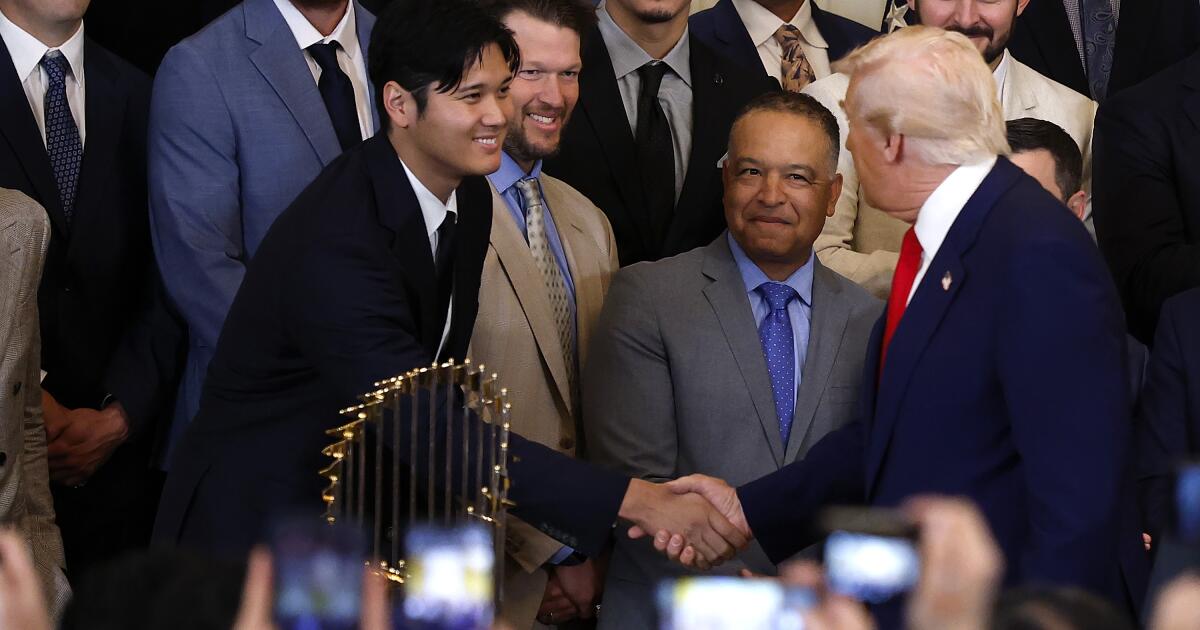
Dodgers scheduled to visit White House in late July to celebrate 2025 World Series win
-

 World27 minutes ago
Former US Olympian pleads not guilty in DC reflecting pool vandalism case
-
 News54 minutes ago
Former Olympian pleads not guilty in reflecting pool vandalism charges
-

 Los Angeles, Ca2 hours ago
Heat advisory, beach hazards in effect as Southern California sizzles
-

 Detroit, MI3 hours ago
Teen on moped hit by car after cruising through stop sign in Detroit


