Crypto
Bibles, cryptocurrency, Truth Social and gold bars: A look at Trump's reported sources of income

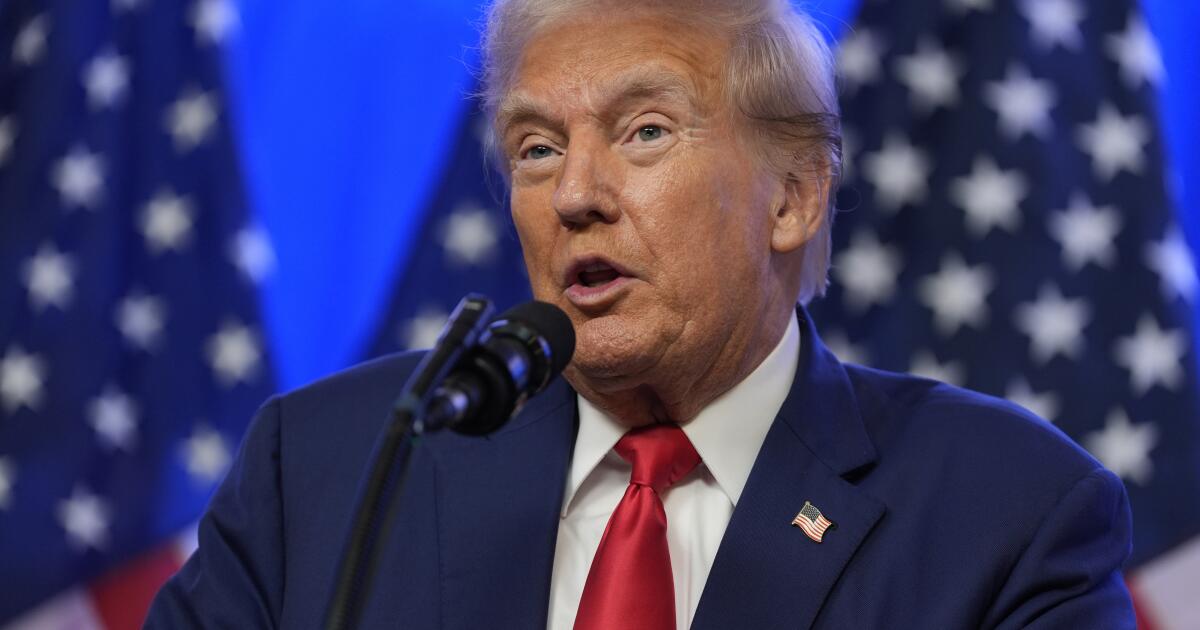
Former President Trump owns more than $1 million worth of cryptocurrency and up to $250,000 in gold bars along with his portfolio of golf courses and real estate properties, according to newly released financial disclosures.
The details come from recently released documents filed by Trump’s presidential campaign. The more than 200 pages of paperwork give a limited picture of the former president’s money and investments. In accordance with federal law, most assets’ values are listed in a range, though Trump reports the precise figure for some of his income.
The document does not detail his business losses, making it impossible to determine how much of a profit any of his myriad holdings provides.
But it provides a glimpse at Trump’s wealth and some new details about the unusual ways he makes money.
Unusual investments and sources of income
Trump reported earning $300,000 from sales of an edition of the Bible that he and country singer Lee Greenwood endorsed. He also earned $4.4 million in royalties from a book called “Letters to Trump” and $500,000 from one called “A MAGA Journey.” Trump still receives royalties on a number of other books, including “The Art of the Deal,” which came out in 1987 and netted him $50,000 to $100,000 in the last year.
As a onetime member of the Screen Actors Guild, Trump receives an annual pension of $90,776.
Trump’s fame comes from real estate, but his current biggest asset is probably his media company that operates the social media network Truth Social. The company went public in March, and Trump reports owning more than 114 million shares in the firm. He is currently unable to sell the shares as part of a “lockup” agreement preventing major shareholders from selling stock for six months after it goes public, but with company stock at about $23 per share Friday, his holdings are worth more than $2 billion.
Some of Trump’s other investments are also unusual. He reports having $1 million to $5 million worth of the cryptocurrency ethereum, a noteworthy holding because he’s vowed to lift regulations on the cryptocurrency industry should he return to the White House.
Trump also reported earning $7.15 million in licensing fees from NFT INT, which appears to be a firm selling digital tokens. His wife, Melania, earned $330,000 from selling NFTs, according to the report.
The former president also reported owning $100,000 to $250,000 in gold bars.
Those assets are dwarfed by investments in traditional stocks and municipal and school bonds, as well as his real estate holdings.
Broad business empire
Trump reports a wide range of companies and investments that span the globe. Many appear to simply be trademark claims in countries including Argentina, Belarus, Cuba and India. Others generate money for him, including more than $3 million in income that he reported from licenses in Dubai and more than $2 million in Oman.
Trump’s golf courses also make money for him, including $37 million from his club in Bedminster, N.J., where he adddressed the media on Thursday; $31 million from his golf club in Jupiter, Fla.; and 26 million British pounds (the equivalent of $33.5 million) worth of revenue from his Turnberry course in Scotland.
Trump’s Mar-a-Lago resort in Florida generated more than $56 million in income, according to the report.
Melania Trump received a $237,000 payment for speaking to the gay conservative group Log Cabin Republicans in April.
Noteworthy debts
Trump lists several debts, including one stemming from litigation against him by the New York attorney general’s office alleging business fraud and two more from a magazine writer.
A jury in 2023 found Trump liable for sexually assaulting E. Jean Carroll in 1996, and a second jury this year found he slandered her when he continued to deny it.
Trump lists his debts to Carroll as between $1 million and $5 million and more than $50 million, the highest category available. The lawsuit judgments against him were for $5 million and $88 million, respectively. Trump is appealing the verdicts.
Likewise, Trump lists his debt to the New York attorney general’s office as more than $50 million. He owes nearly $500 million in the civil fraud judgment and is appealing that verdict as well.
Riccardi writes for the Associated Press.


Key Takeaways
- Zcash targets July 21, 2026 for Ironwood mainnet activation after sealing the Orchard pool.
- ZEC trades at $462.33 on July 4, up 13.3% in seven days and over 1,000% in a year.
- Node operators must migrate to Zebra or updated clients before Ironwood’s mainnet launch.
The upgrade traces back to a discovery on May 29. Security researcher Taylor Hornby, working under contract for Shielded Labs, found a soundness flaw inside the Orchard shielded pool’s elliptic curve code. The bug lived in a piece of the halo2_gadgets crate handling point multiplication. A prover could swap in the wrong base point and still get the circuit to accept an invalid proof.
That flaw mattered because Orchard hides sender, receiver and amount by design. A counterfeit note created inside the pool would look identical to a real one. The bug had sat in the code since Orchard went live in May 2022 as part of the NU5 upgrade.
Rapid Patch, No Confirmed Losses
Zcash’s core engineers, including Daira-Emma Hopwood, Kris Nuttycombe and Jack Grigg, confirmed the issue within hours of Hornby’s report. A soft fork disabled new Orchard actions around June 1 to contain exposure. A hard fork, NU6.2, followed on June 3 with a corrected verifying key, restoring full Orchard functionality.
Orchard transactions paused for roughly a day during the rollout. Transparent and Sapling transfers kept running the whole time. Zcash Open Development Lab and Shielded Labs both say they found no evidence that the bug was ever exploited, and the network’s turnstile accounting, which tracks value entering and leaving each pool, showed no signs of unauthorized minting.
There’s a catch developers can’t patch away. Orchard’s privacy means nobody can prove a negative. No cryptographic method exists to confirm counterfeiting never happened, only that it probably didn’t.
Ironwood Closes the Gap
Announced June 6, Ironwood is the fix for that remaining uncertainty. It ships as NU6.3 and was built by ZODL alongside Tachyon, Valar Group, the Zcash Foundation and Shielded Labs.
The upgrade opens a new Ironwood shielded pool built on the patched Orchard circuit, now backed by ongoing formal verification and added independent audits. At the same time, the old Orchard pool gets sealed. Wallets will block new deposits into it, internal transfers between users inside the pool get disabled, and funds can only leave through the turnstile toward Ironwood or a transparent address.
That sealing is the actual fix. Once the legacy pool stops taking new value and stops circulating internally, any theoretical counterfeit notes get boxed in. Anyone running a full node can then add up balances across the active pools and confirm the total supply lines up with what the protocol allows, without waiting on developer assurances or a full migration.
Ironwood also carries ZIP 2005, a set of note format changes meant to support recovery in a future quantum computing scenario. It doesn’t make Zcash quantum-secure today, but it lays the groundwork for a smoother transition later.
Timeline and What Users Need to Do
Testnet activation for Ironwood landed around July 3 and 4. Zebra, the Rust client maintained by the Zcash Foundation, and Valar Group’s independent implementation are both running release candidates against it.
Mainnet activation is targeted for around July 21, tied to a zcashd end-of-support block. Developers say hashrate signaling looks ready, and existing testnet time gives wallets enough runway, so a delay isn’t currently on the table.
Node operators on older zcashd builds will need to move to Zebra or an updated client before that date. Wallets are expected to prompt users to migrate shielded funds out of the old Orchard pool with minimal friction, often a single approval.
Market Response
ZEC’s price tells its own story of the past six weeks. The token fell more than 50% from around $630 down to the $250 to $300 range once the vulnerability became public, then rebounded sharply once the patch and Ironwood plan landed.
As of July 4, ZEC trades at $462.33, up 13.3% over the past seven days, even after a flat 24-hour session. Zooming out, the coin is up more than 1,000% over the past year, a stretch that includes both a run to a 52-week high near $744 in November 2025 and the Orchard scare in late May.
Investor Chamath Palihapitiya has publicly flagged Ironwood’s supply verification model as a meaningful step for the coin, adding outside attention to what started as a bug fix.
For now, the work left is coordination. Formal verification results are due before mainnet, and wallet, exchange, and infrastructure providers still need to ship updated support in the next two and a half weeks.

US President Donald Trump has made $US1.4 billion ($2b) from cryptocurrency in the past 12 months.
$US635 million came from celebration coins royalties and $US236m came from cryptocurrency “token sales”, while the rest of his income came from assorted cryptocurrency wallets.
His celebration coin income is linked to meme coins he launched before returning to office, namely $TRUMP.
But what are meme coins and has anyone other than the Trump family profited?
Meme coins
Cryptocurrencies are a type of digital asset, not unlike a stock, which can be used as an exchangeable form of money online.
Much like paper currencies since the gold standard was ended, crypto has value because investors collectively agree it does, in part due to its security and scarcity.
Meme coins on the other hand are a bit harder to pin down.
“Meme coins are cryptocurrencies that leverage popular memes or internet trends to create a community-driven, often playful approach to digital currency,” according to crypto broker Blockchain.com.
Meme coins have no inherent value and, unlike Bitcoin, have varying limits of scarcity, rendering the price of any coin vulnerable to the rise and fall in popularity of whatever meme or trend inspired the item.
As an example Hailey Welch, an American woman, launched her own brand of meme coin after she rose to internet fame in June 2024.
The $HAWK coin released in December 2024 reached a market capitalisation of $500m before it crashed to $25m by late January.
Investors have since sued $HAWK.
The $TRUMP coin
The $TRUMP coin is valued at $US1.65 as of July 1, 2026. (Supplied: GetTrumpMemes.com)
Mr Trump’s own meme coin $TRUMP launched days before his second inauguration, also in January 2025.
At its peak it sold for almost $US75 a coin, but by the end of February its value had plummeted to about $US20 and as of July 1, 2026 its value sits at $US1.65.
This is where the bulk of Mr Trump’s $US635m in royalties and $US236m in token sales are believed to have come from.
In April 2026, Democratic Senator for California Adam Schiff said he and other senators would be investigating a Mar-a-Lago conference which invited the top 297 $TRUMP token holders to attend and offered VIP access to Mr Trump.
In a statement he said CIC Digital and Fight Fight Fight LLC, which controlled 80 per cent of $TRUMP supply, received trading revenue from all $TRUMP activity.
“The announcement of the conference ‘set off a quick but brief run-up in the price of the $TRUMP meme coin, which reached $3.08 before tumbling back down,’” the senators highlighted.
“President Trump financially benefits from the market value and activity of the $TRUMP cryptocurrency.“
Mr Schiff and his fellow senators asserted “not all” investors of $TRUMP and the similarly branded first ladies meme coin, $MELANIA, benefited from their investment.
“According to recent reports, $TRUMP, and the First Lady’s meme coin, $MELANIA, “erased an estimated $4.3 billion in retail wealth,” they said.
“Insiders, however, reportedly made a fortune: 45 ‘early-deployment wallets’ earned $1.2 billion off the meme coins, meaning that for every dollar insiders earned, retail investors lost $20.”
World Liberty Financial, another Trump family-linked business which distributed Mr Trump’s royalty and token sale revenue, provided him with an additional $65m in income.
Eric Trump and Donald Trump Jr are involved in its management and it was co-founded by Zach Witkoff, the son of Mr Trump’s special envoy to the Middle East Steve Witkoff.

Donald Trump Jr and Eric Trump with Zach Witkoff. (Reuters: Eduardo Munoz)
Mr Trump’s $236m in token sale revenue is a marked leap in profits collected compared to Mr Trump’s 2025 disclosure which only reported $US57m from token sales.
World Liberty Financial launched another cryptocurrency in May, 2025 called USD1.
USD1 rose to US$1.016 after launch and is now valued at $U0.99.
It was also used to pay bonuses to UFC fighters performing at the White House in June.
On July 1, after his disclosure came out, Mr Trump said his wealth was the result of the US stock market’s success.
“”You know why I’m profiting? Because the stock market’s going up, everybody’s profiting,” Mr Trump said, according to Reuters.

Key Takeaways
- OKX launched a 20 USDT airdrop for earthquake victims, easing the financial burden on affected residents.
- Eligible La Guaira residents receive automatic credits, providing immediate crisis relief without hurdles.
- Following Binance’s $3M pledge, OKX’s move amplifies the role of crypto in global disaster relief efforts.
OKX Opens Airdrop for Venezuelan Earthquake Victims
OKX, one of the largest cryptocurrency exchanges by volume, has taken action to help Venezuelan users affected by the twin earthquakes that left over 2,000 dead and hundreds of buildings collapsed.
On social media, using its Latam account, OKX referred to the twin earthquakes that hit Venezuela on June 24, 2026, and how the cryptocurrency community has responded to this event in one of the Latam countries with growing crypto adoption.
“We know that these days have been difficult. But we have also seen something extraordinary: the solidarity of Venezuela and the entire international community, which fills us with hope,” it declared.
To help Venezuelan users in regions hit by the natural disaster, OKX announced it will distribute 20 USDT to each user with proof of address (POA) verifying they reside in La Guaira, the state most affected by the twin earthquakes.
While OKX did not disclose the total funds available for this initiative, it pointed out that support was limited and would be distributed on a “first-come, first-served” basis.
The funds will be automatically credited to the accounts that fulfill the POA requirement. “No registration, claim code, or qualifying transaction is required; the 20 USDT reward is automatically credited once eligibility is confirmed,” the exchange explained.
“We know that the road ahead will require effort, help, and support from everyone for a long time. But you will not walk it alone. We are one region, and we will be with you on this journey. We stand with you, Venezuela.” OKX concluded.
OKX’s relief efforts follow a similar campaign by Binance. The most popular exchange in Venezuela pledged $3 million to users residing in La Guaira, Distrito Capital, Miranda, Aragua, Carabobo, Falcón, and Yaracuy, offering a similar path for users to reclaim 20 USDT via redeemable vouchers.
-
 Lifestyle37 seconds ago
But first, coffee: The drink that energized the American Revolution
-

 Technology9 minutes ago
NASA launched an emergency mission to stop the Swift Observatory from crashing to Earth
-

 World16 minutes ago
Tens of thousands of far-left protesters clash with police in anti-conservative party riots
-

 Politics19 minutes ago
Trump set to deliver ‘historic’ speech celebrating America’s 250th anniversary
-

 Health24 minutes ago
The ‘1776 Diet’: What Americans really ate during the nation’s founding
-

 Sports31 minutes ago
Kylian Mbappé’s seventh goal of the World Cup lifts France past Paraguay in physical Round of 16 match
-
 Business39 minutes ago
California is bringing back EV rebates. This is how to get one
-
 Entertainment46 minutes ago
Comedy saved her life. Now Teruko Nakajima’s ‘Made in America’ is saving others

