Business
Video: The U.S. Is Mining for Uranium


new video loaded: The U.S. Is Mining for Uranium
September 23, 2024
Miners at Pinyon Plain uranium mine, Arizona.
Advertisement
SKIP ADVERTISEMENT



Two dozen people who sued the owners and tenants of a Carson-based warehouse responsible for a putrid smell emanating from the Dominguez Channel waterway, which led to hospital visits and headaches, won a multimillion-dollar verdict Friday.
Those plaintiffs were awarded $6 million in punitive damages along with $2.89 million in compensatory damages in a mass tort lawsuit that dates back to 2021.
“Carson is a working-class community of janitors, barbers, bus drivers and longshoremen,” said attorney Gary Praglin of the Santa Monica-based law firm Cotchett, Pitre & McCarthy. “The defendants forced us to trial because they didn’t want to pay these people and this is recognition of their suffering.”
The punitive damages will be split equally among 24 Carson-area residents, amounting to $250,000 for each. The compensatory damages for medical claims ranged between $40,000 and $240,000 per client.
What remains to be seen is what happens to 13,750 additional plaintiffs who are also seeking compensation.
The court will determine the next steps, whether that’s additional trial proceedings or settlements. But should the remaining plaintiffs ultimately receive similar compensation, “we’re talking about the largest recovery for breathing toxic fumes in the history of California,” Praglin said.
On the hook for damages are San Francisco-based logistics company Prologis and its subsidiary Liberty Property LP, which owned the warehouse next to the Dominguez Channel in Carson. Prologis did not respond to an email seeking comment Friday.
Also included among the defendants are the Nourollah brothers of Los Angeles, who owned two businesses — Virgin Scent and Day to Day Imports — that operated out of that warehouse.
A call to an attorney for the Nourollahs was not immediately returned Friday.
The lawsuit is one of a few court cases against the same group of defendants, including one filed by the California Regional Water Quality Control Board.
The roots of the legal action date back to Sept. 30, 2021, when a large fire engulfed the warehouse and distribution center of the cosmetics corporation Virgin Scent. The blaze lasted multiple days and required the services of 200 firefighters to extinguish.
The warehouse and surrounding storage areas were filled with stacks of pallets and cardboard boxes containing highly flammable ethanol-based hand sanitizer, according to court documents.
The fire took place days before the Food and Drug Administration released a warning that some Virgin Scent hand sanitizers contained unacceptable levels of benzene, acetal and acetaldehyde, each of which are hazardous and potentially carcinogenic.
Though the fire was eventually put out, large amounts of soggy, charred debris and hand sanitizer remained all around the warehouse, according to court documents.
That debris eventually found its way into storm drains that flow into the Dominguez Channel, which manages water runoff from surrounding communities.
These toxic elements sat in the channel’s then-stagnant water, which led to a die-off of all vegetation and the emission of foul-smelling hydrogen sulfide.
Residents began to complain of an “unbearable” stench that they said caused headaches, nausea, and eye, ear and nose irritation. The Carson City Council eventually declared a public health nuisance in October 2021.
Within a month, at least 3,000 residents left Carson for out-of-area hotels provided by Los Angeles County. Thousands of others opted for air purifiers.
The South Coast Air Quality Management District responded to more than 4,700 odor complaints within the first month from residents in Carson, Gardena, Long Beach, Redondo Beach, Torrance and Wilmington.
The agency eventually issued five notices of violation to Virgin Scent for a variety of infractions, including for discharging “such quantities of air contaminants to cause injury, detriment, nuisance or annoyance to a considerable number of persons.”

The man set to become one of the world’s youngest artificial intelligence billionaires started his entrepreneurial journey as a bored preteen living in Los Angeles.
When Ali Ansari was 12, living with his family in a single room at his aunt’s house in Woodland Hills, his immigrant mother told him to stop wasting time staring at his phone and try making money with it.
He took his father’s loafers and listed them on eBay for $50.
“My dad was like, ‘Why the hell did you sell my shoes?’ ” Ansari said. “My mom was like, excited.”
While it was a bad deal for his dad, Ansari learned the thrill of making money. He has been chasing it ever since.
He started biking around his neighborhood, visiting garage sales and thrift stores, buying whatever he could carry to sell online.
Through middle school, high school, and college in California, he continued to build online businesses, launching an AI business in his 20s that could make him a billionaire this year, his 25th.
Ali Ansari generates the training data that makes AI models like ChatGPT and Claude smarter.
(Paul Kuroda/For The Times)
His hard hustle in his young years is paying off more than he could have imagined. The success has given him the freedom to buy his parents a house and a nice car. He has been featured in the news and gets recognized by people in the business.
But the main change from his success so far, he says, is a huge increase in the amount of work and responsibility he has to shoulder.
“I feel very grateful and very stressed,” he said. “That kind of summarizes it.”
Ansari’s AI company is called Micro1. Making AI smarter requires vast amounts of data, as well as training and testing. Micro1 recruits and manages thousands of human experts — coders, lawyers, doctors, professors and financial analysts — to gather expert information that is fed to AI models like ChatGPT. These experts review and correct the AI’s output, making it more accurate.
Micro1 is one of the key suppliers of that kind of expert human assistance for AI, alongside California competitors Scale AI, Surge and Mercor.
Micro1 went from $4 million in annualized revenue in 2024 to $200 million today, according to Ansari. Even by Silicon Valley standards, that’s a meteoric rise.
Forbes estimates that Ansari is on the verge of becoming a billionaire, based on ongoing funding conversations that value Micro1 at $2.5 billion. Micro1 was last valued at $500 million.
Ansari has a booming voice, a fashionable buzz cut and a meticulously maintained beard. He’s fast with his fingers, usually responding immediately to text despite all he is juggling. He has the confidence of someone older, though his frequent use of the word “like” in conversation marks him as Gen Z.
His startup is based in Palo Alto and during monthly visits to Los Angeles, he works out of a coworking space in Woodland Hills — minutes away from his family, high school and the memories of his many teenage side hustles.
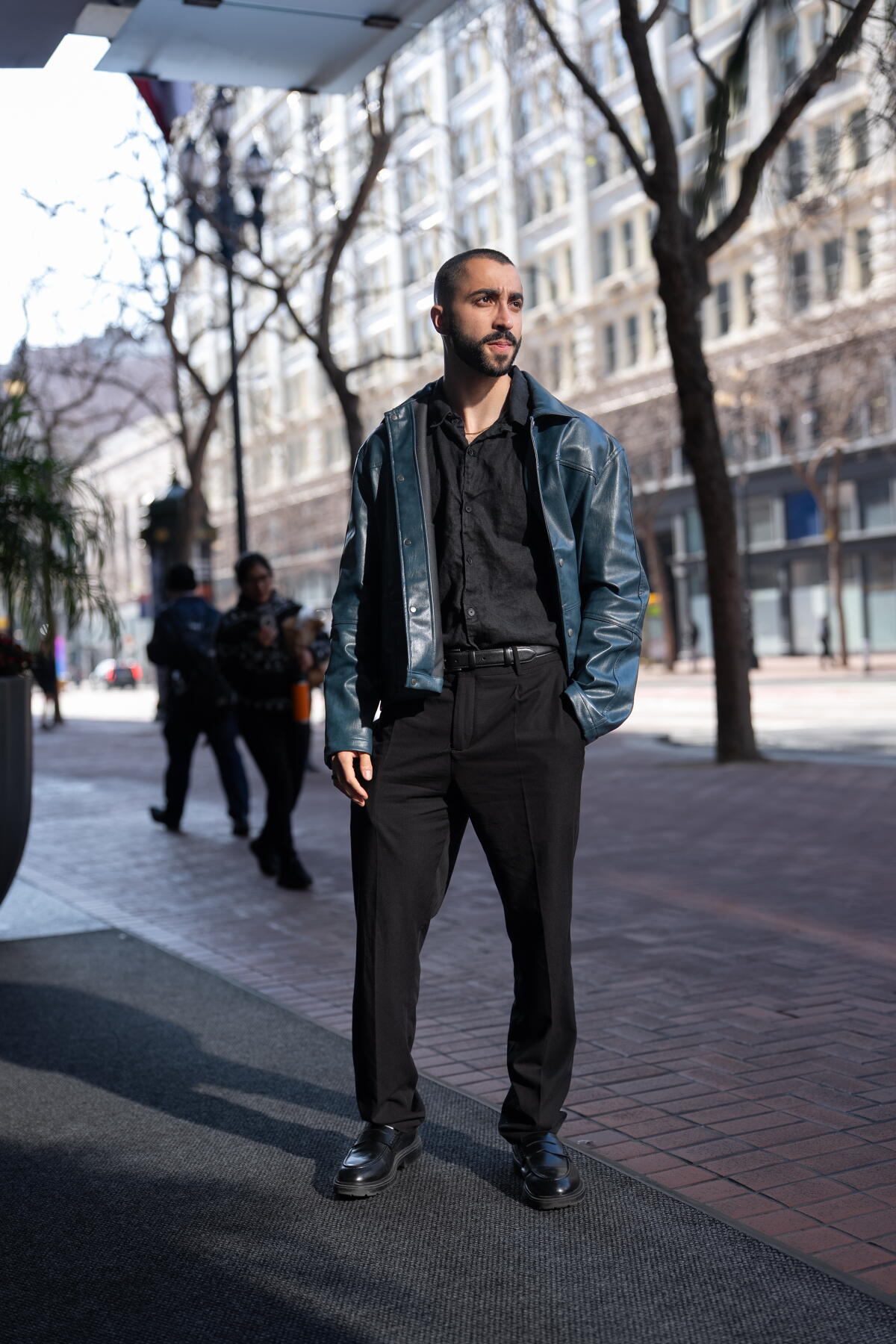
Ali Ansari is the cofounder of Micro1, a company that recruits and manages thousands of human experts to help train AI.
(Paul Kuroda/For The Times)
“This area is my entire childhood,” he said, gesturing out the window from his Woodland Hills office during an interview at the coworking space.
Ansari’s family emigrated to the U.S. when he was 10, after winning the rare U.S. green card lottery. Before the move, they had a comfortable life in a small beach town in northern Iran, where his father owned a kitchen cabinet factory.
Since the Islamic revolution of 1979, Iran has witnessed multiple waves of middle-class exodus, where Iranian immigrants moved to the U.S to escape economic collapse and persecution. The growing presence of the Persian diaspora in Westwood earned it the moniker Tehrangeles.
The family of four shared a single room at a relative’s house for the first year. His mother took a job at Target for a short time. The transition was rough for Ansari, who wasn’t fluent in English and often got in trouble for fooling around in school.
“Teachers would call my mom, and they’d be like, ‘Hey, your son’s making like, cow noises again’ or something,” he said.
At 14, he started reselling textbooks because they were easier to carry in his backpack. He figured out that procuring a steady supply of books through garage sales was hard, so he developed Cash Books Now, a website for college students to sell their textbooks. He would list them on Amazon at a 50% markup.
Buying and selling textbooks became his obsession. His bedroom wall was divided into two sections: “not listed” and “listed” to track inventory. By 16, Ansari had sold more than $100,000 in books.
“I would focus on this way more than school,” he said. “It was like the main hustle.”
In high school, he started a tutoring business that he later sold. In 2019, Ansari enrolled at UC Berkeley and started a software agency to build websites for small businesses.
Recruiting engineers to build the websites was taking up too much of his time, so he built an AI screening tool to help him with interviews. This later became Micro1, and his screening tool was used to track down, weed out and test all kinds of experts for training AI.
Still, the road to success was not without its rough patches. After raising $2 million in 2023, Ansari had a panic attack during a trip to visit his team in India.
“I kept kind of repeating this idea in my head, which was, like, some people have decided to give me millions of dollars,” he said. “And now I have this duty to really do something good with it.”
He got through it with the help of his family and reading, and has matured enough now to manage anxiety and lead with confidence.
“I am more composed than ever, and I frankly feel less anxious than ever,” he said.
Micro1’s annualized revenues surged more than 30-fold last year to $150 million. In early 2026, it crossed $200 million.
It has built a global workforce of contractors with various skills: from coders and comedians, to doctors and lawyers, to teach their skills to AI.
Ansari says leading such a fast-growing company at the heart of the hottest tech sector feels like being in a constant battle trying to meet demand, raise money and “punch back” against competitors trying to poach his employees.
He says he doesn’t have any hobbies besides work. He doesn’t watch television or movies but he devours business podcasts and personal stories of entrepreneurs such as Elon Musk.
Ansari is still adapting to the newfound fame and responsibilities. As the company’s valuation has climbed, Ansari bought his family a house in Woodland Hills. He recently hired a chief of staff to help with family and professional matters.
“I’m constantly choosing what I spend my time on, and it’s become the most difficult thing,” he said.
For future growth, Ansari is betting that demand for human training data will grow. He recently expanded Micro1 into robotics, recruiting roughly 1,000 people across 60 countries to record footage of themselves performing household tasks. The footage will be used to train robotic systems.
Ansari predicts that in the long run, human data will become a $1-trillion market — a projection he derives from the assumption that roughly 5% of all human labor will eventually be redirected toward training AI systems.
On a recent visit home, his father told him he should diversify into robots. When Ansari told him Micro1 had already started doing that, his father complained.
The man whose loafer launched an empire wanted a piece of the action this time.
“You stole my idea,” his father joked. “You got to give me equity.”
The young Ansari hopes his success will uplift more than just his family.
“I might [become] the youngest Persian billionaire in the world,” he said. “I think I’ll inspire a lot of other Iranians, which kind of feels weird to say.”

Olympic gold medals haven’t been actual gold for over a century. The last solid, 24-karat gold medal to be awarded was at the 1912 Games in Stockholm, according to the International Olympic Committee.
Since then, they’ve been mostly made up of silver — with six grams of thin gold plating on the outside.
But especially as the prices of gold and other metals have jumped recently, those six grams make a big difference.
As of Feb. 6, gold was trading at $4,889 an ounce — up 70 percent from its price a year ago. It’s about double what it was worth during the 2024 Paris Olympics.
Silver was trading at $77 an ounce — up 138 percent from a year ago, and almost triple what it was worth during the 2024 Olympics.
The values of gold and silver have soared over the last year — silver rose 60 percent in January 2026 alone — as investors seek safe places to park their money during heightened geopolitical turmoil and worries about inflation.
Olympic athletes don’t compete to resell their medals, and most are in the Games for the prestige the medals represent.
The movements in the precious metal markets in the run-up to this year’s Games in Italy, however, have drawn new attention to the real value of the athletes’ accomplishment.
Even with volatility in recent days — both metals plunged in value last week, as analysts speculated that the prices had become overvalued — gold and silver medals are worth well over twice what they were worth at the 2024 Paris Olympics.

Accident investigation underway after fatal crash in Indianapolis

Overnight fire destroys Dubuque County farm building

Interesting notes from Kentucky’s thrilling comeback win vs. Tennessee

Democrat Chasity Verret Martinez wins Louisiana state House special seat in district Trump won

2026 Maine Boys High School Basketball Tournament: Full Statewide Schedule & Matchups

Florida High School Football Rankings: Top 25 teams – Oct. 21

Cleary's 21 help Le Moyne down Central Connecticut State 69-64 in OT

How old is Bo Nix? What to know about Oregon quarterback ahead of 2024 NFL Draft

99th annual Pony Swim held in Virginia

Indiana Members Credit Union announced as new anchor tenant at Bottleworks District

West Virginia worked with ICE — 650 arrests later, officials say Minnesota-style ‘chaos’ is a choice

Week in Pictures: From Israeli air raids on Lebanon to bombing in Pakistan
Immigrant whose skull was broken in 8 places during ICE arrest says beating was unprovoked

Video: Why ICE Raids in Minneapolis Are Driving Up Demand for Guns

Calm amid chaos: Noem defies calls to resign, touts border victory as shutdowns, storms, and riots swirl
-

 Indiana7 days ago
13-year-old rider dies following incident at northwest Indiana BMX park
-

 Massachusetts1 week ago
TV star fisherman, crew all presumed dead after boat sinks off Massachusetts coast
-

 Tennessee1 week ago
UPDATE: Ohio woman charged in shooting death of West TN deputy
-

 Indiana6 days ago
13-year-old boy dies in BMX accident, officials, Steel Wheels BMX says
-

 Politics5 days ago
Trump unveils new rendering of sprawling White House ballroom project
-

 Politics1 week ago
Virginia Democrats seek dozens of new tax hikes, including on dog walking and dry cleaning
-

 Politics1 week ago
Don Lemon could face up to a year in prison if convicted on criminal charges
-
Austin, TX1 week ago
TEA is on board with almost all of Austin ISD’s turnaround plans

