Business
U.S. strikes Yemen: Are L.A., Long Beach ports ready for cargo surge?

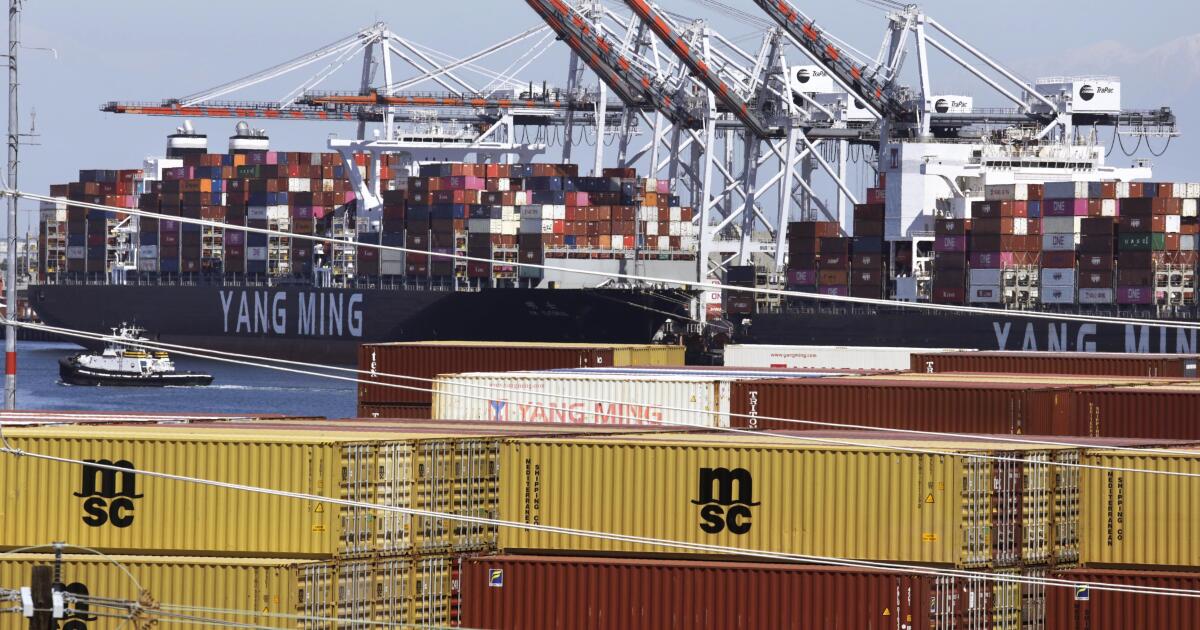
The ports of Los Angeles and Long Beach, the nation’s largest cargo complex, are bracing for a business surge created by problems elsewhere: the Suez Canal in Egypt — a sudden hot spot in a potentially widening Mideast conflict — and the Panama Canal, plagued by prolonged drought.
The canals are two of the world’s most important trade gateways. When the interconnected global supply chain gets tangled, the knots cause costly delays as retailers and manufacturers look for alternate routes to get their freight to consumers and factories.
The Suez and Panama canals also are options when shippers fear relying solely on Los Angeles and Long Beach, which weathered a series of pandemic-related backlogs and other problems starting in March 2020.
But with labor peace returned to the Southern California docks — longshore workers ratified a new contract last year after months of disruptions — lost business has returned, port officials say, and there’s plenty of capacity for more. Also past are the COVID-19 days, when U.S. consumers’ online shopping binges created a massive traffic jam in San Pedro Harbor, giving ports on the East and Gulf coasts a chance to grab cargo away from Southern California.
The back and forth matters because the ports are a key economic engine in Southern California, affecting not only dockworkers but those who drive trucks, staff warehouses and labor elsewhere in the sprawling distribution and logistics network. The L.A. and Long Beach ports combined handle nearly 40% of U.S. imports from Asia that arrive in metal shipping containers aboard vessels whose length is nearly equivalent to the height of the Empire State Building.
“Very few people had Houthi rebels disrupting the global supply chain on their bingo card,” said Salvatore Mercogliano, a maritime historian at Campbell University in North Carolina and host of a YouTube channel called “What is going on with shipping?”
On Friday, Yemen’s Houthi rebels promised retaliation for U.S. and British strikes launched Thursday. President Biden said the bombings followed diplomatic attempts to end the militant group’s attacks on commercial shipping in the Red Sea as the vessels head toward the Suez Canal.
So far, local ports are seeing more of an effect from problems at the Panama Canal than those in the Red Sea, “and we’ve been able to handle it,” said Mario Cordero, the Long Beach port’s chief executive.
“We’ve stepped back, and lessons have been learned since we had the backlog, and we’re more prepared to go to 24/7 operations if we need to than we have been in the past,” Cordero said. “We are very fluid. We are doing well, and we can handle more.”
Because of the Suez disruptions, many insurers decided that it was safer to send ships on a much longer and more expensive trip south, along the coast of Africa and through a storm-swept passage, to get to ports on the Eastern Seaboard and U.S. Gulf Coast. South Africa’s Cape of Good Hope (a long-ago Pope thought it was a friendly name) is known as the Graveyard of Ships; Southern California is seen as more hospitable, shipping experts said.
Gene Seroka, executive director of the L.A. port, about to leave on a 10-day trip to Asia to search for potential customers, spoke of laying groundwork in Indonesia, Vietnam, India and other countries to “fine-tune that relationship of trade.”
“Now we’ve got a real opportunity to look at pushing cargo away from the Suez and back to the West Coast,” he said.
The Panama Canal was expanded in 2016 to accommodate bigger cargo ships so that customers could take advantage of investments by ports on the U.S. East and Gulf coasts, which were eager to attract cargo that previously landed in Southern California, then moved east by truck and train.
But an extreme drought has dramatically reduced the level of the freshwater artificial lake that helps fill the canal’s locks and is an important source of drinking water and agricultural irrigation. Shippers were willing to pay as much as $4 million to jump ahead of congestion, according to Bloomberg, although that fee recently dropped to less than $270,000 as tankers and cargo ships found other routes.
The arrival of warmer weather patterns from El Niño is expected to worsen the drought, just as the region is entering its traditional dry season.
The Panama Canal had been allowing more than 40 ships a day to pass through on their way to the U.S. Gulf and East coasts. Canal operators have cut that number in half, creating a backlog of ships.
“It’s another disruption,” said Jonathan Gold, vice president for supply chain and customs policy for the National Retail Federation. “It’s another impact on the supply chain, and it was supposed to be an easy gateway for trade but now has restrictions.”
Seroka said the Port of Los Angeles is running at 75% of capacity and is at pre-COVID levels.
“So not only do we have capacity to grow, but we’ve also got the bottlenecks and the backlogs worked out of the system,” he said. “We took what we learned from the COVID surge and tried to apply it day in and day out.”
Consumers, meanwhile, are likely to feel shipping delays in their wallets.
“Going around the [Cape of Good Hope] is not sustainable,” said Tyler Reeb, interim executive director of Cal State Long Beach’s Center for International Trade and Transportation. “That’s particularly because these ships are huge, and they have to stop and refuel. They are going to do that in South Africa; fuel’s very expensive there.
“The bigger issue is that we have gotten ourselves out of high inflation, and this is a very inflationary-looking solution,” he added.
Reeb said that going around the cape adds 10 to 15 days to a ship’s journey.
“That’s time and money, and that’s what leads to more challenges for retailers,” he said. “They’re not going to get their goods they need in time on their shelves, and it will be challenging.”
All of that plays up Southern California’s geographic advantage, according to Mercogliano.
“You’re adding 3,500 miles to the trip and paying for an extra million dollars in fuel,” he said. “What’s beginning to happen now is shippers are saying, ‘OK, put my box on a ship for L.A., for Long Beach.’”



Singer-songwriter FKA twigs is suing her ex-boyfriend, actor Shia LaBeouf, claiming that he is trying to “silence” her from speaking out against sexual abuse through the use of an “unlawful” nondisclosure agreement.
The complaint, filed in Los Angeles Superior Court on Wednesday, seeks a court order to prohibit LeBeouf from enforcing sections of an NDA which Tahliah Barnett — the Grammy Award-winning singer’s legal name — says violates California law.
“Shia LaBeouf has tried to control Tahliah Barnett for the better part of a decade,” the filing states.
“This action was taken in response to Mr. LaBeouf’s attempt to bully and intimidate twigs through a frivolous and unlawful secret arbitration he filed against her in December in which he sought to extract money from her,” said the singer’s attorney Mathew Rosengart, national co-chair of media & entertainment litigation at Greenberg Traurig in Century City, in a statement.
Rosengart added that twigs “refuses to be bullied anymore. She is instead standing up for herself and other survivors of sexual abuse who have improperly been silenced. This is the unusual case that is not about money but about justice and upholding and enforcing California law and policy designed to protect survivors by nullifying illegal NDAs.”
LaBeouf’s attorney Shawn Holley of Kinsella Holley Iser Kump Steinsapir denied the claims.
“When Ms. Barnett and Mr. LaBeouf both decided to resolve their differences and move on with their lives, no one forced her or ‘bullied’ her to stay silent,” Holley said in a statement.
“As a woman with agency, she decided to settle the case and accepted money to dismiss her lawsuit.”
The suit arises out of litigation that Barnett brought against LaBeouf in 2020, when she accused the actor of “physical, sexual, and mental abuse” during their relationship,” as well as “knowingly infect[ing]” Barnett with a sexually transmitted disease.” That case was settled last year.
In a response to the suit, the actor told the New York Times that “many of these allegations are not true.”
But he added, “I am not in the position to defend any of my actions. I owe these women the opportunity to air their statements publicly and accept accountability for those things I have done.”
In the statement Thursday, Holley added that the claim of sexual battery “was disputed, as were the other claims made in Ms. Barnett’s lawsuit.”
Shia LaBeouf poses for photographers upon arrival at the premiere of the film “The Phoenician Scheme” at the 78th annual Cannes Film Festival May 18, 2025.
(Lewis Joly / Invision / AP)
According to the new lawsuit, LaBeouf filed a secret arbitration complaint and “improperly sought exorbitant monies” from Barnett last December, claiming she had breached their agreement by violating its nondisclosure provisions after she gave an interview to the Hollywood Reporter in October.
In the interview, Barnett was asked if she felt safe and answered that as a woman of color in the entertainment industry, she “wouldn’t feel safe” and discussed her involvement with organizations that support survivors, saying, “I think it’s less about me at this point and more about looking forward. Just, you know, moving on with my life.”
The agreement Barnett reached with LaBeouf “contained a deficient and unlawful NDA that is unenforceable,” under California’s Stand Together Against Non-Disclosure Act, according to the complaint. The law forbids NDAs from being used to silence victims of sexual misconduct.
“As the California Legislature has made clear, survivors should have the right to tell their stories without fear or coercion, and California law does not and must not allow abusers and bullies to silence them through secret agreements containing unconscionable, unlawful gag orders,” the complaint states.
The lawsuit further alleges that while LaBeouf has sought to prohibit Barnett from talking about her abuse, he has “repeatedly brought up his relationship with Ms. Barnett—on his own and without being directly asked about her—materially breaching the very confidentiality provisions that he had just contended were fully enforceable against Ms. Barnett.”
While the actor agreed to drop the arbitration in February, he has “refused to acknowledge, however, that the NDA provisions are illegal and unenforceable,” the filing states.
The latest round in LaBeouf’s legal battle with Barnett comes just weeks after a New Orleans judge ordered the actor to begin substance abuse treatment and undergo weekly drug testing after he was arrested on suspicion of assaulting two men in the city’s French Quarter. LaBeouf was also required to post $100,000 bond as part of the conditions of his release. He was charged with two counts of simple battery, the Associated Press reported.

Warner Bros. Discovery shareholders will soon render a verdict on Hollywood’s biggest merger in nearly a decade.
Warner has set an April 23 special meeting of stockholders to vote on the company’s proposed sale, for $31-a-share, to the Larry Ellison family’s Paramount Skydance.
The $111-billion deal is expected to reshape the entertainment industry by combining two historic film studios, dozens of prominent TV networks, including CBS, HBO, HGTV and Comedy Central, streaming services and two news organizations, CNN and CBS News. The tie-up would give Paramount such beloved characters as Batman, Wile E. Coyote, and Harry Potter, television shows including “Hacks,” and “The Pitt,” and a rich vault of movies that includes “Casablanca,” and “One Battle After Another.”
The $31-a-share offer represents a 63% increase over Paramount Chairman David Ellison’s initial $19-a-share proposal for the company in mid-September, and a 147% premium over Warner’s stock’s trading levels prior to news of Ellison’s interest.
“This transaction is the culmination of the Board’s robust process to unlock the full value of our world-class portfolio,” Warner Bros. Discovery Chief Executive David Zaslav said Thursday in a statement. “We are working closely with Paramount to close the transaction and deliver its benefits to all stakeholders.”
Paramount hopes to finalize the takeover by September. It has been working to secure the blessing of government regulators in the U.S. and abroad.
Should those regulatory deliberations stretch beyond September, Paramount will pay shareholders a so-called “ticking fee” — an extra 25 cents a share for every 90-day-period until the deal closes.
The transaction will leave the combined company with nearly $80-billion in debt, a sum that experts say will lead to significant cost cuts.
Paramount Skydance Chairman and CEO David Ellison attends President Trump’s State of the Union address three days before clinching his hard-fought Warner Bros. Discovery deal.
(Mark Schiefelbein / Associated Press)
For weeks it appeared that Netflix would scoop up Warner Bros.
Netflix initially won the bidding war in early December with a $27.75 offer for the studios and streaming services, including HBO Max. But Ellison refused to throw in the towel. He and his team continued to lobby shareholders, politicians and Warner board members, insisting their deal for the entire company, including the cable channels, was superior and they had a more certain path to win regulatory approval.
The Ellison family is close to President Trump. This week, Trump named Larry Ellison to a proposed White House council on technology issues, including artificial intelligence.
Warner’s board, under pressure, reopened the bidding in late February to allow Paramount to make its case. Warner board members ultimately concluded that Paramount’s bid topped the one from Netflix and the streamer bowed out. Paramount paid a $2.8-billion termination fee to Netflix and signed the merger agreement on Feb. 27.
Warner’s board is advising its shareholders to approve the Paramount deal. Failure to cast a vote will be the same as a no-vote, according to the company’s proxy.
Warner’s largest shareholders include the Vanguard Group, BlackRock, Inc. and State Street Corp.
Zaslav has significant stock and options holdings, worth about $517 million at the deal’s close, according to the proxy.
The regulatory filing also disclosed that a mysterious bidder had surfaced at the auction’s 11th hour.
A firm called Nobelis Capital, Pte., reportedly based in Singapore, alerted Warner on Feb. 18 that it was willing to pay $32.50 a share in cash.
The firm said it had placed $7.5 billion into an escrow account. However, Warner’s bankers “could not find the purported deposit at J.P. Morgan,” according to the proxy. And there was no evidence that Nobelis had any assets or any “equity or debt financing” lined up, Warner said, adding that it “took no further action with respect to the Nobelis proposal.”

new video loaded: How Kharg Island May Change the Trajectory of the Iran War
By Peter Eavis, Gilad Thaler, Edward Vega, Lauren Pruitt and Joey Sendaydiego
March 25, 2026

Retired Detroit sergeant faces new sexual assault charge involving 14-year-old victim from 2002

Trump floats sending federal agents to San Francisco to tackle crime

Dallas ISD will offer free pre-K starting next school year

Norwegian Cruise Line offers a first look at Luna, new cruise ship setting sail from PortMiami – WSVN 7News | Miami News, Weather, Sports | Fort Lauderdale

Boston ‘No Kings’ rally expected to draw 100,000; others planned across Mass.

Florida High School Football Rankings: Top 25 teams – Oct. 21

How old is Bo Nix? What to know about Oregon quarterback ahead of 2024 NFL Draft

Cleary's 21 help Le Moyne down Central Connecticut State 69-64 in OT

99th annual Pony Swim held in Virginia

Indiana Members Credit Union announced as new anchor tenant at Bottleworks District

Video: Will ICE Change Under Its New Leader?

DHS shutdown breakthrough comes at cost for Republicans as funding fights nears end

Rubio joins crucial G7 talks as Iran war set to dominate second day

A surprise resignation could open the door for an independent to win a Montana Senate seat

Video: Savannah Guthrie Says She Believes Her Mother Was Taken for Ransom
-

 Detroit, MI1 week ago
Drummer Brian Pastoria, longtime Detroit music advocate, dies at 68
-

 Science1 week ago
How a Melting Glacier in Antarctica Could Affect Tens of Millions Around the Globe
-
 Science1 week ago
I had to man up and get a mammogram
-

 Movie Reviews1 week ago
‘Youth’ Twitter review: Ken Karunaas impresses audiences; Suraj Venjaramoodu adds charm; music wins praise | – The Times of India
-

 Sports6 days ago
IOC addresses execution of 19-year-old Iranian wrestler Saleh Mohammadi
-

 New Mexico5 days ago
Clovis shooting leaves one dead, four injured
-
 Business1 week ago
Disney’s new CEO says his focus is on storytelling and creativity
-

 Technology5 days ago
YouTube job scam text: How to spot it fast