Business
Trump administration sues California over law keeping oil wells from homes, schools


California communities and environmental justice groups worked for years to win a law to prevent new oil and gas wells from being drilled near where people live, work and gather. Now, the Trump administration is suing to overturn it.
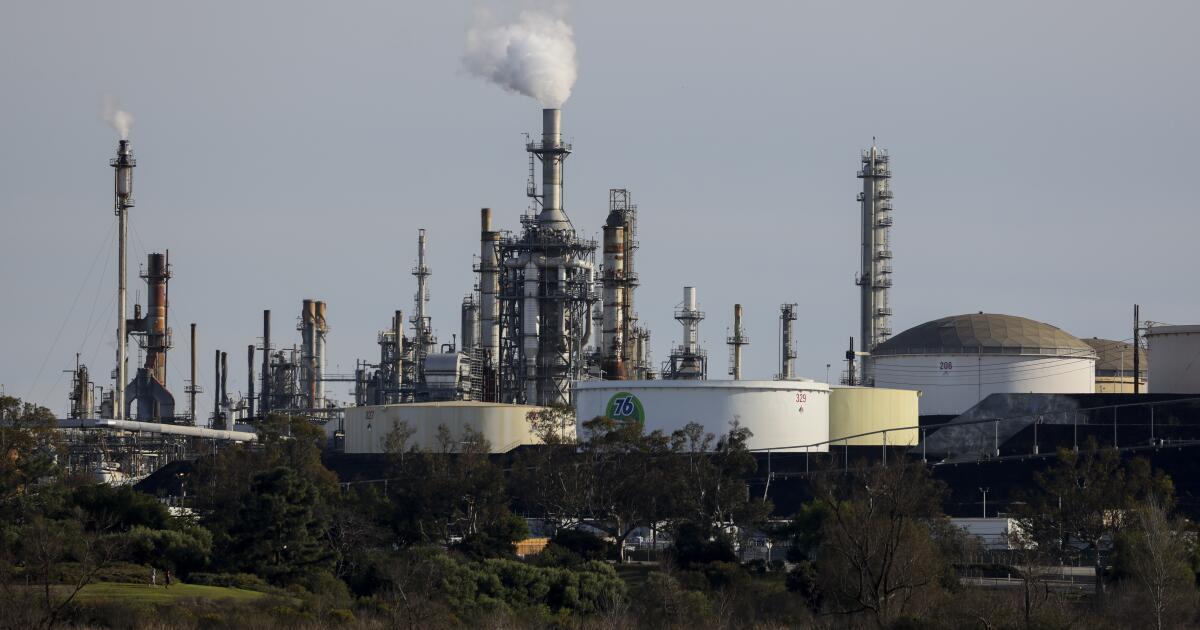
In a lawsuit filed Wednesday in the U.S. District Court for the Eastern District of California, the U.S. Department of Justice challenged Senate Bill 1137, state legislation passed in 2022 that establishes a 3,200-foot minimum setback between new oil wells and “sensitive receptors,” defined as homes, schools, community centers, parks and playgrounds, healthcare facilities or any public building.
Under the law, existing wells that are close to these places can continue to operate, but must monitor emissions, control their dust and limit nighttime noise and light.
But the Trump administration says the law would “knock out” about one-third of all federally authorized oil and gas leases in California, amounting to unconstitutional state regulation of federal lands. In its complaint, the administration argues that federal law — specifically, the Mineral Leasing Act and the Federal Land and Policy Management Act — supersedes SB 1137, and asks that the court declare the state law unconstitutional and prevent it from being enforced.
While the majority of active wells in California are on private and state lands, the federal Bureau of Land Management administers more than 600 oil and gas leases within the state, according to the lawsuit. About 218 of those leases overlap with the buffer zones established by the law.
Officials with Gov. Gavin Newsom’s office said Thursday they had not yet been served with the lawsuit, but would defend SB 1137 and the health of California communities. Living near oil and gas wells has been linked to a range of adverse health issues stemming from air and water pollution that can be released by drilling and production, especially if a well is leaking badly.
“The Trump administration just sued California for keeping oil wells away from elementary schools, homes, daycares, hospitals, and parks,” said Anthony Martinez, a spokesman for the governor. “Think about that. SB 1137 creates a science-based buffer zone so kids can go to school, families can live in their homes, and communities can exist without breathing toxic fumes that cause asthma, birth defects, and cancer.”
The lawsuit advances an April executive order issued by President Trump titled “Protecting American Energy from State Overreach,” in which the president directed Atty. Gen. Pam Bondi to identify “burdensome and ideologically motivated” state and local regulations that threaten the development of domestic energy resources and take action to stop them.
“This is yet another unconstitutional and radical policy from Gavin Newsom that threatens our country’s energy independence and makes energy more expensive for the American people,” Bondi said in a statement. “In accordance with President Trump’s executive orders, this Department of Justice will continue to fight burdensome regulations that violate federal law and hamper domestic energy production — especially in California, where Newsom is clearly intent on subverting federal law at every opportunity.”
Environmental groups were quick to condemn the action. The oil and gas setback law was hard won after multiple earlier attempts were stymied by opposition from the petroleum industry and trade unions. Its implementation was briefly paused by a 2024 referendum effort led by the California Independent Petroleum Assn., which ultimately withdrew it in light of a groundswell of public resistance.
“Attempting to block the law that protects the air we breathe and the water we drink from oil industry pollution is the Trump administration’s latest attack on our state,” said Kassie Siegel, director of the Climate Law Institute at the nonprofit Center for Biological Diversity. “Big Oil backed down from their deceitful referendum campaign because Californians wouldn’t stand for it. This is a last-ditch attempt to overturn the law’s critical health protections. I’m confident this historic law will stand.”
Rock Zierman, chief executive of the California Independent Petroleum Assn., lauded the Trump administration’s challenge against what it described as an “arbitrary setback law.”
“Just as the state has tried to shut down duly permitted in-state production on private land in violation of the fifth amendment of the U.S. Constitution, so too has the state tried to usurp federal law by shutting down production of minerals owned by the U.S. taxpayers,” Zierman said in a statement Thursday. “We welcome the U.S. Department of Justice joining our fight against these illegal actions that are leading to increased foreign imports.”
The suit marks an escalation of Trump’s battle against Newsom and California over energy and environmental policies. The president, who received substantial donations from oil and gas companies during his 2024 presidential campaign, has moved to block the state’s tailpipe emission standards, clean vehicle targets and renewable energy projects, among other efforts.
Earlier this week, the Justice Department filed another lawsuit against two California cities, Petaluma and Morgan Hill, over ordinances that ban the use of natural gas in new buildings. Both cities said they have not enforced those bans in several years.



The U.S. attack on Iran is expected to have an unwelcome impact on California drivers — a jump in gas prices that could be felt at the pump in a week or two.
The outbreak of war in the Middle East, which virtually closed a key Persian Gulf shipping lane, spiked the price of a barrel of Brent crude oil by as much as $10, with prices rising as high as $82.37 on Monday before settling down.
The price of the international standard dictates what motorists pay for gas globally, including in California, with every dollar increase translating to 2.5 cents at the pump, said Severin Borenstein, faculty director of the Energy Institute at UC Berkeley’s Haas School of Business.
That would mean drivers could pay at least 20 cents more per gallon, though how much damage the conflict will do to wallets remains to be seen.
“The real issue though is the oil markets are just guessing right now at what is going to happen. It’s a time of extreme volatility,” Borenstein said. “We don’t know whether the war will widen or end quickly, and all of those things will drive the price of crude.”
President Trump has lauded the reduction of nationwide gas prices as a validation of his economic agenda despite worries about a weak job market and concerns of persistent inflation.
The upheaval in the Middle East could be more acutely felt in the state.
Californians already pay far more for gas than the rest of the country, with the average cost of a gallon of regular at $4.66, up 3 cents from a week ago and 30 cents from a month ago, according to AAA. The current nationwide average is about $3 per gallon.
The disruption in international crude markets also comes as refiners are switching to producing California’s summer-blend gas, which is less volatile during the state’s hot summers. The switch can drive up the price of a gallon of gas at least 15 cents.
The prices in California are largely driven by higher taxes and a cleaner, less polluting blend required year-round by regulators to combat pollution — and it’s long been a hot-button issue.
The politics were only exacerbated by recent refinery closures, including the Phillips 66 refinery in Wilmington in October and the idling and planned closure of the Valero refinery in Benicia, Calif., which reduced refining capacity in the state by about 18%.
California also has seen a steady reduction in its crude oil production, making it more reliant on international imports of oil and gasoline.
In 2024, only 23.3% of the crude oil refined in the state was pumped in California, with 13% from Alaska and 63% from elsewhere in the world, including about 30% from the Middle East, said Jim Stanley, a spokesperson for the Western States Petroleum Assn.
“We could see a supply crunch and real price volatility” if the Middle East supply is interrupted, he said.
The Strait of Hormuz in the Persian Gulf, through which about 20% of the world’s oil passes, was virtually closed Monday, according to reports. Though it produces only about 3% of global oil, Iran has considerable sway over energy markets because it controls the strait.
Also, in response to the U.S. attack, Iran has fired a barrage of missiles at neighboring Persian Gulf states. Saudi Arabia said it intercepted Iranian drones targeting one of its refinery complexes.
California Republicans and the California Fuels & Convenience Alliance, a trade group representing fuel marketers, gas station owners and others, have blamed Gov. Gavin Newsom’s policies for driving up the price of gas.
A landmark climate change law calls for California to become carbon neutral by 2045, and Newsom told regulators in 2021 to stop issuing fracking permits and to phase out oil extraction by 2045. He also signed a bill allowing local governments to block construction of oil and gas wells.
However, last year Newsom changed his stance and signed a bill that will allow up to 2,000 new oil wells per year through 2036 in Kern County despite legal challenges by environmental groups. The county produces about three-fourths of the state’s crude oil.
Borenstein said he didn’t expect that the new state oil production would do much to lower gas prices because it is only marginally cheaper than oil imported by ocean tankers.
Stanley said the aim of the law was to support the Kern County oil industry, which was facing pipeline closures without additional supplies to ship to state refineries.
Statewide, the industry supports more than 535,000 jobs, $166 billion in economic activity and $48 billion in local and state taxes, according to a report last year by the Los Angeles County Economic Development Corp.
Bloomberg News and the Associated Press contributed to this report.

Fintech company Block said Thursday that it’s cutting more than 4,000 workers or nearly half of its workforce as artificial intelligence disrupts the way people work.
The Oakland parent company of payment services Square and Cash App saw its stock surge by more than 23% in after-hours trading after making the layoff announcement.
Jack Dorsey, the co-founder and head of Block, said in a post on social media site X that the company didn’t make the decision because the company is in financial trouble.
“We’re already seeing that the intelligence tools we’re creating and using, paired with smaller and flatter teams, are enabling a new way of working which fundamentally changes what it means to build and run a company,” he said.
Block is the latest tech company to announce massive cuts as employers push workers to use more AI tools to do more with fewer people. Amazon in January said it was laying off 16,000 people as part of effort to remove layers within the company.
Block has laid off workers in previous years. In 2025, Block said it planned to slash 931 jobs, or 8% of its workforce, citing performance and strategic issues but Dorsey said at the time that the company wasn’t trying to replace workers with AI.
As tech companies embrace AI tools that can code, generate text and do other tasks, worker anxiety about whether their jobs will be automated have heightened.
In his note to employees Dorsey said that he was weighing whether to make cuts gradually throughout months or years but chose to act immediately.
“Repeated rounds of cuts are destructive to morale, to focus, and to the trust that customers and shareholders place in our ability to lead,” he told workers. “I’d rather take a hard, clear action now and build from a position we believe in than manage a slow reduction of people toward the same outcome.”
Dorsey is also the co-founder of Twitter, which was later renamed to X after billionaire Elon Musk purchased the company in 2022.
As of December, Block had 10,205 full-time employees globally, according to the company’s annual report. The company said it plans to reduce its workforce by the end of the second quarter of fiscal year 2026.
The company’s gross profit in 2025 reached more than $10 billion, up 17% compared to the previous year.
Dorsey said he plans to address employees in a live video session and noted that their emails and Slack will remain open until Thursday evening so they can say goodbye to colleagues.
“I know doing it this way might feel awkward,” he said. “I’d rather it feel awkward and human than efficient and cold.”

The Writers Guild of America West has canceled its awards ceremony scheduled to take place March 8 as its staff union members continue to strike, demanding higher pay and protections against artificial intelligence.
In a letter sent to members on Sunday, WGA West’s board of directors, including President Michele Mulroney, wrote, “The non-supervisory staff of the WGAW are currently on strike and the Guild would not ask our members or guests to cross a picket line to attend the awards show. The WGAW staff have a right to strike and our exceptional nominees and honorees deserve an uncomplicated celebration of their achievements.”
The New York ceremony, scheduled on the same day, is expected go forward while an alternative celebration for Los Angeles-based nominees will take place at a later date, according to the letter.
Comedian and actor Atsuko Okatsuka was set to host the L.A. show, while filmmaker James Cameron was to receive the WGA West Laurel Award.
WGA union staffers have been striking outside the guild’s Los Angeles headquarters on Fairfax Avenue since Feb. 17. The union alleged that management did not intend to reach an agreement on the pending contract. Further, it claimed that guild management had “surveilled workers for union activity, terminated union supporters, and engaged in bad faith surface bargaining.”
On Tuesday, the labor organization said that management had raised the specter of canceling the ceremony during a call about contraction negotiations.
“Make no mistake: this is an attempt by WGAW management to drive a wedge between WGSU and WGA membership when we should be building unity ahead of MBA [Minimum Basic Agreement] negotiations with the AMPTP [Alliance of Motion Picture and Television Producers],” wrote the staff union. “We urge Guild management to end this strike now,” the union wrote on Instagram.
The union, made up of more than 100 employees who work in areas including legal, communications and residuals, was formed last spring and first authorized a strike in January with 82% of its members. Contract negotiations, which began in September, have focused on the use of artificial intelligence, pay raises and “basic protections” including grievance procedures.
The WGA has said that it offered “comprehensive proposals with numerous union protections and improvements to compensation and benefits.”
The ceremony’s cancellation, coming just weeks before the Academy Awards, casts a shadow over the upcoming contraction negotiations between the WGA and the Alliance of Motion Picture and Television Producers, which represents the studios and streamers.
In 2023, the WGA went on a strike lasting 148 days, the second-longest strike in the union’s history.
Times staff writer Cerys Davies contributed to this report.

Why Rebels are keeping pace for Mississippi State CB commit Brandon Allen Jr
Missouri Lottery Powerball, Pick 3 winning numbers for March 2, 2026
Montana Lottery Powerball, Lotto America results for March 2, 2026
Nebraska Lottery results: See winning numbers for Powerball, Pick 3 on March 2, 2026

EDITORIAL: Nevada still vulnerable as tourist downturn continues

Florida High School Football Rankings: Top 25 teams – Oct. 21

Cleary's 21 help Le Moyne down Central Connecticut State 69-64 in OT

How old is Bo Nix? What to know about Oregon quarterback ahead of 2024 NFL Draft

99th annual Pony Swim held in Virginia

Indiana Members Credit Union announced as new anchor tenant at Bottleworks District

Trump sends official notification to Congress on strikes against Iran

Unexpected birth brings hope to near-extinct Amazon tribe

Supreme Court blocks redrawing of New York congressional map, dealing a win for GOP

Map: Earthquake Shakes Central California

Gas prices could jump as Middle East tensions threaten global oil supply
-

 World5 days ago
Exclusive: DeepSeek withholds latest AI model from US chipmakers including Nvidia, sources say
-

 Massachusetts6 days ago
Mother and daughter injured in Taunton house explosion
-

 Denver, CO5 days ago
10 acres charred, 5 injured in Thornton grass fire, evacuation orders lifted
-

 Louisiana1 week ago
Wildfire near Gum Swamp Road in Livingston Parish now under control; more than 200 acres burned
-

 Technology1 week ago
YouTube TV billing scam emails are hitting inboxes
-

 Politics1 week ago
OpenAI didn’t contact police despite employees flagging mass shooter’s concerning chatbot interactions: REPORT
-

 Technology1 week ago
Stellantis is in a crisis of its own making
-

 Oregon4 days ago
2026 OSAA Oregon Wrestling State Championship Results And Brackets – FloWrestling