Business
Tony Lam was an original influencer in Little Saigon — and he's still got it


The textured mat is already on the table as Tony Lam sits down to shuffle the polished tiles. He is here to participate in a ritual that he observes four days a week, a pursuit that keeps his “head in shape.”
On this day, sitting in his daughter’s house, he is competing against his wife, son-in-law and grandson, all of whom build a wall of game pieces in front of them.
It’s mah-jongg o’clock, and he’s ready.
One by one, they roll the dice to begin their match, dealing and betting a collection of quarters. Lam, quietly fierce with a booming laugh, studies the spread, and then … his cellphone pings. The original influencer of Little Saigon has been invited to another event — one of dozens each year — a commemoration of the Vietnamese immigration experience in America.
1
2

3

1. Tony Lam, second from left, plays mah-jongg with his son-in-law James Do, left, grandson Patrick Do, second from right, and Lam’s wife, Hop Lam, in Huntington Beach. 2. Lam lines up his mah-jongg tiles. 3. The game keeps his “head in shape,” Lam says. (Jason Armond / Los Angeles Times)
He snares a suite of tiles and wins a coin within 11 minutes. Nothing seems to faze him. But as he prepares to make his next move … ping! It’s an invitation to an informal coffee shop meet-up, followed by a business groundbreaking.
Lam, 88, has been a prominent figure in Orange County’s Little Saigon for decades, but his election to the Westminster City Council in 1992 — the first Vietnamese American to win political office in the United States — cemented that status. After 10 years, he announced his retirement from politics, but his continuing activism, even into his 80s, helped set in motion a series of political movements and cultural upheaval in Southern California.

Tony Lam with his wife, Hop Lam, and three of his children.
(Courtesy of the Lam family)
On April 30, the 50th anniversary of the fall of Saigon, his community will be in the spotlight, as news reports highlight the growth and influence of the Vietnamese community in Southern California. In Orange County, where 2020 census data show nearly 242,000 residents of Vietnamese heritage, there are Vietnamese Americans on the city councils in Westminster — the original home of Little Saigon —Fountain Valley, Garden Grove and Santa Ana.
“He’s part of a wave of people that transformed California,” said Jeffrey Brody, a retired professor of communications at Cal State Fullerton who’s writing a social history of the origins of Little Saigon. “The reason the public pays attention to this group, especially locally, is because the community has invested in the building blocks of democracy.”
Lam was there from the start — opening doors, collecting awards, trying to thread the needle in controversies that threatened to destabilize his community — and he’s still filling his calendar with events — a reminder that his role as a trailblazer has not been forgotten.

A CIA employee helps Vietnamese evacuees onto a helicopter half a mile from the U.S. Embassy in Saigon in 1975.
(Bettmann Archive via Getty)
Lam grew up in northern Vietnam and made his way south after the country was split into two states. In the south, he held a series of jobs that brought him in contact with U.S. entrepreneurs and diplomats. At 28, he teamed up with an older sibling, Dean, to manage their Lam Brothers Corp. They were independent contractors unloading ammunition, building supplies and auto parts for the military at Cam Ranh Bay, one of the busiest ports in the world. Lam had learned English from his service in the Vietnamese Navy, and later, through job connections, he got his wife and six children on a flight out of their homeland before the fall of Saigon.
Lam says he stayed behind to help evacuate others. Then U.S. officials sent him to Guam, where he was “assisting in the management of the newcomers there.” After three months, he flew with his family to Camp Pendleton, where a large portion of refugees were sent. Lam was 37 years old and he, his wife, three sons and three daughters bunked in barracks on the base.
He signed on as camp coordinator, trying to bring order to the confusion around him as thousands of adults and children immersed in resettlement. Eventually, he found an American sponsor “and we had the proverbial fresh start,” he recalled, moving briefly to Florida before returning to the West Coast and renting an apartment in Huntington Beach.
In Vietnam, Lam had owned three companies. In Orange County, he took a job pumping gas, and then as a supervisor in shipping and receiving for a firm that produced practice bombs for the Navy.
“It was such irony,” said Lam, who had fled a war just months before.
His wife found work sanding guitars. When Lam picked her up after her first day, he said, he didn’t recognize her right away because her head was covered with dust. Then he burst into tears.
By the end of 1980, about 20,000 refugees were living in Orange County. Like their earlier counterparts, they had fled the communist regime, most of them drawn by news of relatives who had chosen to relocate there. Danh’s Pharmacy, the first Vietnamese-owned business in the area, had opened its doors in 1978 in Westminster, a town that would quickly balloon into a bustling immigrant community, dotted with produce markets, noodle houses, jewelry stores and bakeries.
Lam established a life insurance agency and an import-export business, and in 1984 opened Vien Dong, a restaurant in Garden Grove that quickly gained a following.
1

2

1. (Courtesy of the Lam family) 2. The Lam family in 1975. (Courtesy of the Lam family)
The Little Saigon community expanded into neighboring cities, and in the 1980s, its restaurants, cafes, jewelry and fabric shops and grocery stores started to attract attention throughout California. The first 99 Ranch Market opened in Westminster in 1984.
In 1985, when an 8.0 magnitude earthquake hit Mexico City, killing almost 10,000 people, Lam organized a fundraiser. He was one of the founders of the Vietnamese American Chamber of Commerce and the Vietnamese American Lions Club in Westminster. A law and order conservative, he joined the Republican Party.
Hop Lam, who has been married to him for 64 years, says he moves forward “always with an eye to the past. He learns and he remembers.” He was among the first organizers of the local Tet Festival to celebrate the Lunar New Year — which eventually became the largest celebration outside of Vietnam. He nurtured his businesses and was appointed to serve on Westminster’s traffic commission in 1989.

A campaign sign is posted for Lam, who won a seat on the Westminster City Council in 1992.
(Courtesy of the Lam family)
In addition, “he befriended the white families, the Mexican families and everyone he talked to,” Brody said. When he ran for City Council, “to win, he had to have the support of the Caucasians and the Latinos as well as the Asians.”
Lam’s daughter Cathy Lam said: “When there was something to be done, my father never hesitated. Public service for him is a way to include everyone in decisions and solving problems.”
His community was bound together by family, tradition and staunch anti-communist sentiment — which, in a few years, fueled a controversy that foreshadowed a political shift in Little Saigon.
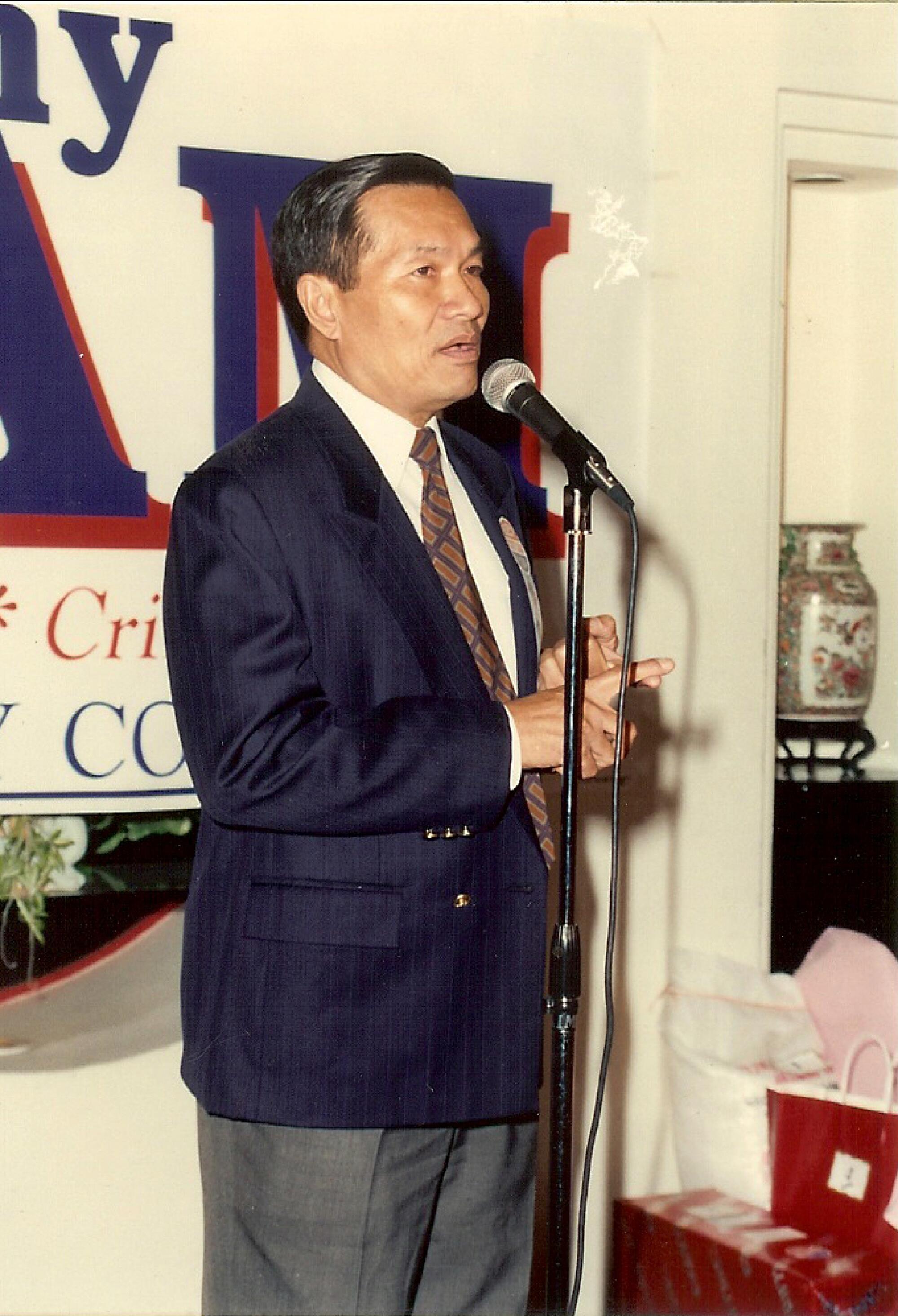
Lam delivers a speech while campaigning to be the first Vietnamese refugee elected to public office in the U.S.
(Courtesy of the Lam family)
In 1994, the U.S. lifted its trade embargo against Vietnam, and resumed diplomatic ties the following year. Longtime residents of Little Saigon were incensed and organized anti-communist protests. That anger, however, was not universal, evidenced by the interest among a few local merchants in the possibility of expanding their market by doing business in Vietnam.
A few years later, in January 1999, Truong Van Tran posted a Communist flag and a photo of Ho Chi Minh, the late Communist leader, in his video store, which was located on Bolsa Avenue, Little Saigon’s main thoroughfare. Community protests started immediately.
On Jan. 21, an Orange County judge temporarily ordered Tran to remove the items, but she soon reversed herself on Feb. 10, saying the flag and the photo constituted protected speech. The demonstrations continued for 53 days. At one point the crowd grew to about 15,000.
Lam did not join them. He said he understood the anger, but City Atty. Richard D. Jones told him and Westminster officials to stay away; they needed to stay neutral to avoid legal action.
Because Lam was a no-show, protesters picketed outside his restaurant for 73 days. He was called a communist sympathizer, and political rivals vilified him. He hired a lawyer in an attempt to stop the chaos in front of the restaurant. Speaking at a council meeting in February of that year, he said his “heart had been torn apart.” He left office in 2002.

Lam dines with his wife, Hop, and other family members on April 9.
(Jason Armond / Los Angeles Times)
It was the greatest trial of his political life, Lam said, remembering his efforts to balance his loyalty to his Vietnamese community with the city’s interests.
During the tumult, some younger members of the Vietnamese community, already questioning their status on the sidelines of a local political infrastructure that didn’t include them, inserted themselves in the conversation.
Lan Quoc Nguyen, who’d been an attorney for only three years, got involved by “negotiating with city staff and police to allow the protesters to stay” around the store property for hours on end. “Pretty soon, we realized that in order to gain respect, to be listened to by people who run the greater society, we had to have a seat at the table…. We started digging in,” Nguyen said.
Nguyen, along with Van Tran, the first Vietnamese American elected to the Garden Grove City Council in 2000, described the movement as “political empowerment.” They gathered volunteers for massive voter registration drives, one after another in consecutive elections. Offering Cokes and banh mi and often free entertainment from top refugee musical acts, the inaugural “Rock N Vote” and get-out-the-vote gatherings were staged at UC Irvine and parks with one constant element — handy translators to interpret English-language materials.

Leading figures in the arts, business, education, politics and cultural preservation were honored at a celebration in Westminster’s Little Saigon in early March. Among them was Tony Lam, right.
(Robert Gauthier / Los Angeles Times)
“This is what cemented political power,” Brody said. “Not having anyone to recruit their opinions or participation, the Vietnamese organized themselves into a powerful voting bloc and from then on, you saw all kinds of candidates running for all kinds of seats.”
In 1975, when the Vietnamese came over, Cathy Lam said, “we all worried about putting food on the table. Over the years, as our kids got older, as all of us understood more about U.S. history — the Civil Rights Act, the Clean Water Act, the Affordable Care Act, what the EPA stands for — we became a little less conservative, a little more moderate. At the end of the day, the community sees it’s making money. They have to give back by getting deeply involved in politics.”
Today in Orange County, there are at least 24 Vietnamese Americans in city and county offices, and there are others on school boards, sanitation and water boards and in Orange County Superior Court. Tri Ta, Westminster’s first Vietnamese American mayor, is serving in the state Assembly, and last year, Derek Tran became the first Vietnamese American from California elected to federal office, representing the 45th Congressional District.
Tran met Lam at his swearing-in ceremony in December. “I’ve known his name for a long, long time,” said Tran, who ousted Republican stalwart Michelle Steel in the competitive congressional race. “His daughter and her son walked the neighborhoods and knocked on doors for me, helping me get elected. Without having someone like him, it would not have been possible for me to have my seat here. He truly blazed the trail.”
1

2

1. Hop Lam prepares a family meal in April. 2. Tony Lam digs into a full spread of Vietnamese dishes. (Jason Armond / Los Angeles Times)
During the event, Lam kept pulling Tran aside to say how proud he was of the younger man, prompting the new congressman to add, “It makes me so happy to hear that from someone of his stature.”
Terry Rains, an activist who launched the Westminster Buzz Facebook page and has been a steady presence at council meetings since 2019, says she expects to see more Tony Lams in office, “but you can’t ignore the Andrew Do thing.”
Last October, Do, a former Orange County supervisor, admitted guilt in funneling more than $10 million in federal pandemic funds through a nonprofit linked to his daughter. He received more than $550,000 in bribes from money slated to buy meals for elderly Little Saigon residents — shocking the political establishment of the county.
Lam called it a “tragedy,” but his phone still pings with political newbies scheduling appointments to visit with him for advice, an endorsement or a donation. He kept his profile “as one of the originals in Little Saigon,” said Van Tran, who ascended to state office as the first Vietnamese American elected to California’s Assembly. “He inspires because he’s outspoken and true to himself.”
“My intention is to help everyone,” said Lam, at a recent playground dedication in Westminster’s Tony Lam Park. “That’s how I operate.”


Walmart is rapidly expanding its network of electric vehicle chargers designed for customers to use while they shop.
The network could help fill gaps in EV infrastructure in states with greater need for chargers. Walmart, which has more than 5,000 locations in the U.S. and hundreds in California, says more than 90% of Americans live within 10 miles of one of its stores.
The chargers also offer an incentive for customers to choose Walmart — Walmart Plus members will receive a 10% discount off an average price of $0.46 per kilowatt-hour of energy at the company’s chargers.
Walmart chargers are already available at more than 75 locations in 17 states, with Texas boasting the most charging stations, followed by Florida and Arizona.
Matthew Nelson, Walmart’s director of energy policy, said last week on LinkedIn that the network will soon reach 29 states, including California.
“We are delivering on the promise of affordable, reliable and convenient charging,” Nelson said in his post.
According to Walmart’s website, six charging stations are coming to California soon, though the company did not offer a specific timeline.
The chargers will be installed at stores in Antelope, Brea, Fresno, Stockton, Suisun City and Vallejo.
Most charging sites in California will include eight to 16 fast-charging stalls, said Walmart spokesperson Kelsey Bohl.
The company first announced plans in April 2023 to install its own EV chargers at Walmart and Sam’s Club stores, with a goal of installing thousands of chargers by 2030. Partnering with ABB E-Mobility and Alpitronic, it added 25 new charging sites this past May and six more in June.
“Walmart is building a leading retail-integrated EV fast-charging network, focused on delivering an affordable, reliable and convenient charging experience where customers already shop,” Bohl said in an emailed statement. “Customers can charge while they shop, access stations through the Walmart app they already use, and benefit from affordable pricing.”
The charging stations already available include 612 individual charging stalls using 400-kilowatt chargers. Each stall has a dual charging cord with both Combined Charging System and North American Charging Standard connectors. The standard connectors, designed by Tesla, are smaller and lighter than the combined systems.
The primary way to pay for the chargers is through the Walmart app, but the company is also experimenting with built-in credit card readers to allow those without the app to use the stations.
Customers can check charger availability on the Walmart app. The company said the chargers will be available 24 hours a day.

Robotaxis could be turning into robocops.
A self-driving Waymo reported two teens to San Mateo, Calif., police on Monday after they were found drinking alcohol and shooting toy guns in the back of the vehicle.
According to a social media post from the San Mateo Police Department, officers detained two 15-year-olds after the Waymo they were riding in contacted the department and stopped in a parking lot until law enforcement arrived.
“Parents do you know where your teens are?” the San Mateo Police Department wrote on Facebook following the incident. “Waymo does!”
Officers removed both teens from the vehicle and determined they were using toy guns to shoot Orbeez out the windows. Orbeez are small, water-absorbing beads sold at toy stores.
“Toy guns, water guns, and BB guns all pose real dangers, especially to an untrained eye,” the Police Department said. “The simple handling of them can cause fear in [passersby].” “
A video posted on Facebook shows at least five officers and a police dog responding to the scene and approaching the Waymo with their weapons raised.
Waymo did not immediately respond to a request for comment.
Waymo vehicles have internal cameras and microphones that may be used in an emergency or to “promote safety and security,” according to Waymo’s online support page.
The cameras are also used to ensure the vehicles are clean and to help find lost items, according to the support page.
The company said it does not use facial recognition or other biometric identification technologies to identify individuals.
“In more urgent circumstances, support may access live video during a trip,” the Waymo page said.
The San Mateo Police Department’s Facebook post has garnered nearly 60 comments, with one user accusing Waymo of “snitching.”
“At least they got a designated driver?!” one user commented.
Business
Commentary: How right-wing anti-transgender attacks led to a Supreme Court ruling upholding sex discrimination

At the Supreme Court, the unfounded fear of boys masquerading as girls in youth sports rolled the clock back on gender equality.
On the surface, the Supreme Court’s June 30 opinion upholding state laws barring transgender girls from women’s and girl’s sports teams looks like a victory for women’s rights.
The 6-3 opinion by Justice Brett M. Kavanaugh certainly presents itself that way. “Females and males have inherent physical differences relevant to athletic performance,” Kavanaugh wrote. “Therefore, in contact sports, forcing female athletes to compete against males can create significant safety risks.” He also asserted that “forcing female athletes to compete against males can undermine competitive fairness.”
The ruling applied to prohibitions enacted in Idaho and West Virginia against “biological” males’ participation on women’s teams in public schools. Federal judges in both states overturned the bans. The Supreme Court majority restored them. The ruling essentially upholds similar bans enacted in 25 other states.
There was no record of any transgender person participating in school sports in the State, let alone any ‘problem’ with transgender students … creating unfair competition or unsafe conditions.
— Justice Sonia Sotomayor, demolishing the Supreme Court’s argument in favor of banning transgender girls from girl’s sports
Kavanaugh, like Donald Trump and others in the anti-transgender camp, maintained that one’s gender is an immutable fact of life, established even before birth.
Anything else, Trump stated in an executive order he issued on inauguration day 2025, could only be the product of “gender ideology extremism.” The U.S., his order stated, recognizes “two sexes, male and female. These sexes are not changeable and are grounded in fundamental and incontrovertible reality.” That’s a “biological truth,” he declared.
In his own version of this overconfident and factually insupportable conclusion, Kavanaugh wrote: “As all agree, females and males have inherent physical differences relevant to athletic performance.”
Science recognizes that some people are “born with sex traits that don’t fit into typical male or female patterns,” to cite a discussion on the Cleveland Clinic web page on the topic “intersex.” The condition “may involve chromosomes, hormones, reproductive organs or genitals.”
From a psychological standpoint, medical science recognizes “gender dysphoria” as a real condition often requiring counseling and medical intervention such as the use of puberty blockers and hormones to stave off the development of secondary sex characteristics until the condition can be resolved.
No one disputes that there are physical differences between the sexes. Few would dispute that on average or even at the median, males may be bigger and more powerful than females, or that in certain contact sports the difference may be telling and on occasion dangerous.
But that’s not the same as asserting that the physical differences between males and females invariably mean that men will invariably prevail over women in all competitions or that their participation will endanger women.
The International Olympic Committee — in a policy statement Kavanaugh cited incompletely — says that in “most running and swimming events,” males have a 10% to 12% advantage over women. That’s a range that would accommodate the full spectrum of outcomes — transgender females win, cisfemales win, they tie. (The “cis” prefix denotes those living consistent with their birth gender.)
West Virginia and Idaho addressed this ambiguity by banning transgender women from all girls’ teams. So under their rules transgender girls can’t play football or soccer with cisgirls. But what’s the argument in favor of banning them from the 100-yard dash, or cross-country track, or diving, or archery?
But something else is going on here. The Supreme Court’s ruling was almost preordained, given the years-long campaign by conservatives to demonize transgender individuals as if they’re members of an alien species.
It will be recalled that during his presidential campaign, Trump spun a despicable fantasy in which children were kidnapped in school and secretly subjected to sex-change operations.
Trump’s executive order wiped out policies aimed at protecting transgender adults from discrimination. He moved to outlaw gender-affirming medical therapies for anyone under 19 by cutting off federal funding for healthcare institutions that provide such care.
He banned transgender individuals from serving in the military and ordered federal prison officials to move transgender inmates into the general populations consistent with their birth genders, which exposes them to physical assault. (Federal Judge Royce Lamberth of Washington, D.C., has blocked the government from transferring three transgender women into the male prison population or terminating their hormone treatments.)
I wrote during Trump’s first term, when his anti-transgender policies were still gestating, that the goal was to show that “one can target any community, as long as it doesn’t have a strong political voice or political power. These are the actions of bullies and cowards, pretending to be strong.”
Last year, the Supreme Court struck its first blow against transgender rights by upholding a Tennessee law banning transgender care, including puberty blockers and hormone therapy, for minors. Similar laws have been enacted in 25 other states. The majority in that ruling by Chief Justice John G. Roberts Jr. was identical to the one in the June 30 ruling — Roberts, Kavanaugh, and Justices Clarence Thomas, Samuel A. Alito Jr., Neil M. Gorsuch and Amy Coney Barrett.
Who are the targets of this ideological campaign? They number only about 1.6 million U.S. adults, or one-half of 1% of the U.S. population. About 300,000 adolescents ages 13 to 17, or 1.4%, identify as transgender, according to a study by UCLA School of Law.
In West Virginia, as Justice Sonia Sotomayor observed in her dissenting opinion, “there was no record of any transgender person participating in school sports in the State, let along any ‘problem’ with transgender students … creating unfair competition or unsafe conditions.”
In endorsing the flat bans directed at transgender women in Idaho and West Virginia, Kavanaugh argued that any attempt to implement case-by-case judgments of students’ requests to join sports teams inconsistent with their biological gender would create “an enormous practical and administrability problem.”
Is that so? That wasn’t the case in Maine, where the annual K-12 population is more than 170,000. There, a committee was charged with determining whether a student’s participation in a sport consistent with their gender identity but inconsistent with their biological sex would “result in an unfair athletic advantage” or present a risk of injury to others. The committee held 56 hearings from 2013 through 2021, or an average of seven per year. During the entire time span, only four involved transgender girls. (The outcome of those hearings couldn’t be learned.)
It was Maine’s policy, one might recall, that provoked a confrontation between Trump and Maine Gov. Janet Mills at the White House last year, when Trump threatened to withhold federal funding from the state unless it barred transgender students from competing on women’s sports teams. “We’ll see you in court,” Mills snapped.
Whether the Idaho and West Virginia laws genuinely protect girls from unfair competition is questionable. (The Idaho law is styled the “Fairness in Women’s Sports Act.”) In practice, the laws may subject women in public schools to “invasive sex verification procedures,” as educational expert George Theoharis of Syracuse University wrote after the court ruling.
They’re also based on a retrograde view of women as fragile creatures needing men’s protection, Theoharis wrote — “the same logic that has historically been used to justify excluding women from making their own healthcare decisions and girls from rigorous math and science; that physically demanding work is simply beyond them.” (There don’t appear to be any state laws barring transgender women from competing in men’s sports.)
Becky Pepper-Jackson, the plaintiff in the West Virginia case, in which she is identified only as B.P.J., is the only transgender girl who sought to join girl’s teams — track and cross-country — in the state. That was in 2021, just after West Virginia passed its law and she was about to enter sixth grade. She didn’t appear to pose any competitive risk to others on the track and cross-country teams she applied to join — her lawyers told the Supreme Court that on those no-cut teams, she “came in near the back.”
Anyway, she had not gone through male puberty, which theoretically might have endowed her with a competitive advantage, because she had been taking puberty blockers and female hormones.
Thanks to the court’s ruling, Sotomayor observed in a dissent joined by Justices Elena Kagan and Ketanji Brown Jackson, West Virginia can deny Becky access to school sports “because it thinks they have an inherent athletic advantage, even if the facts show that they do not.”
B.P.J., Sotomayor wrote, “cannot practice on girls’ teams, even if she would not take anyone’s spot in an eventual competition, even if everyone who tries out for the team makes it, and even if having the chance to participate could aid immensely in treating B. P. J.’s gender dysphoria.”
So whose interest was really protected by the Supreme Court?
-

 New Hampshire3 minutes ago
New hampshire set to approve world’s first $100 million bitcoin-backed municipal bond
-

 New Jersey6 minutes ago
Police conclude investigation at Walmart in Cherry Hill, officials say
-

 New Mexico11 minutes ago
Monsoon high shifts slightly west but rain is still possible Wednesday in New Mexico
-

 North Carolina18 minutes ago
North Carolina Republican operative shaping the state’s early voting plans is reassigned
-

 North Dakota21 minutes ago
West Fargo Attorney Chosen for North Dakota Ethics Commission Position
-

 Ohio26 minutes ago
Jeff’s Donuts opens first Ohio location, open 24 hours
-

 Oklahoma33 minutes ago
5 Things To Know: Oklahoma County inmate death, deadly OKC hit-and-run
-

 Oregon36 minutes ago
Oregon to ask court to delay Paramount deal for 60 days while it reviews records

