Business
Sony Pictures CEO Tony Vinciquerra talks 'arms dealer' strategy, defends 'Spider-Man' spinoffs

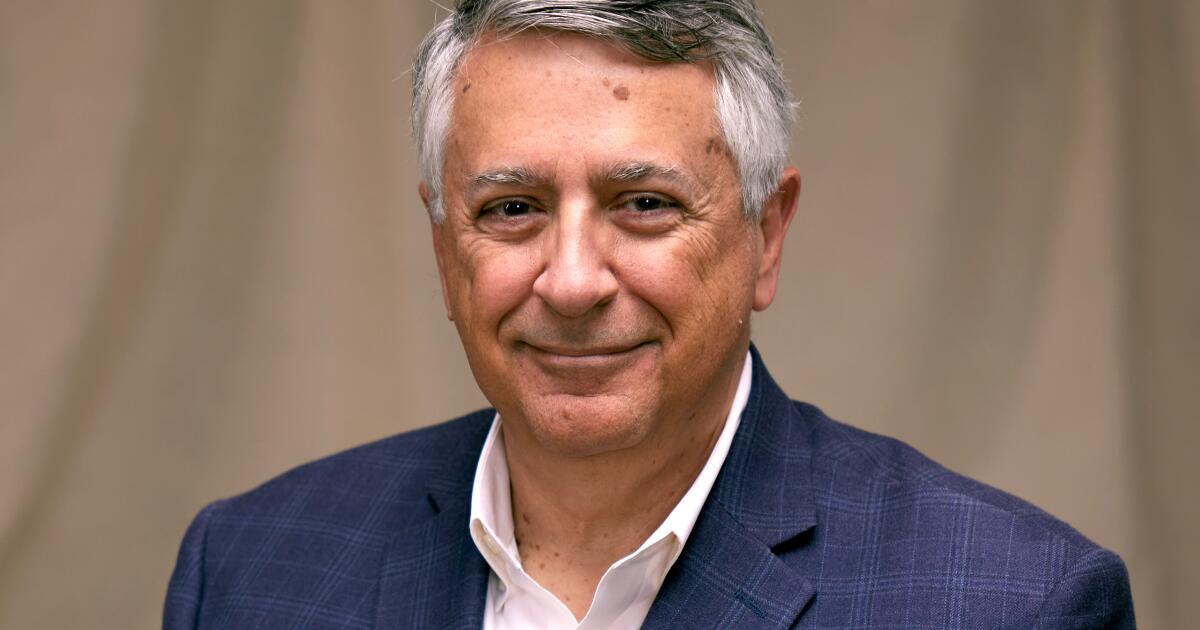
When Tony Vinciquerra arrived at Sony Pictures Entertainment in 2017, it was far from business as usual.
The Culver City studio was still reeling from a 2014 cyber attack that exposed employees’ personal information and revealed internal communications, damaging its reputation and leading to major financial losses. Its film studio was in such a slump that Tokyo parent company Sony Corp. took a nearly $1 billion write-down just months before Vinciquerra was announced as the new chief executive and chairman.
At the time, he was working at private equity firm TPG after a long career at Fox Networks.
“When people approached me about this job, I really wasn’t looking to go back to work full-time, be in the office every day,” said Vinciquerra, 70. “But what was really attractive was the potential.”
Under his leadership, Sony Pictures mounted a comeback.
The film studio revitalized several franchises, including “Jumanji” and “Bad Boys,” churned out its all-important “Spider-Man” movies and started to capitalize on its sister PlayStation video game division by making film and TV series based on that intellectual property. The studio continued to nurture its key shows “Jeopardy” and “Wheel of Fortune,” weathering host changes for both. And it branched out, making acquisitions in the anime market and in movie theaters.
But the studio also had its share of struggles. Like every studio, Sony’s business was hurt by the pandemic and last year’s dual strikes. The company mounted a failed bid for Paramount Global earlier this year. The film studio’s efforts to expand the “Spider-Man” universe into movies about characters other than the titular superhero have had middling box office results.
On Jan. 2, Vinciquerra will step down from his role and hand control to current Sony Pictures Chief Operating Officer Ravi Ahuja in a planned succession that was signaled for months.
Vinciquerra spoke with The Times ahead of his last day to reflect on his more than seven-year tenure at Sony Pictures and what’s to come for him. This conversation has been edited for clarity and length.
Describe the state of Sony Pictures when you arrived in 2017.
The environment of the studios and the business was still vibrating from the hack. There was so much damage done by that in terms of invasion of privacy and sharing of emails. It was palpable. You could feel it even in June of ’17 when I joined.
The financials showed a lot of room for improvement. The fact that Sony owned pictures, music, PlayStation and technology … there’s no other company in the business that had that combination of assets. I didn’t understand why the company wasn’t trading IP back and forth among its units, and they weren’t really working together. So I saw that as a great opportunity; it’s really why I decided to come here.
What were your main priorities when you started in the job?
All of our competitor companies either had started, or were about to start, general entertainment streaming services, and we were under some pressure to do that as well. But we realized pretty quickly that if everybody else is doing that — all seven or eight of our competitors were doing that — why should we? Knowing that they would be fighting tooth and nail to get subscribers, why wouldn’t we just be the arms dealer to supply the weapons for those streaming services to fight each other and thereby improve our business?
We also, at the time, had 110 cable networks. And it was pretty clear that that business was on the downslope. So we set a strategy to get out of that business for the most part, except in markets where cable networks are still doing really well, which is Latin America, Spain and India.
Looking back at what’s happened with all the streamers, the arms dealer decision looks pretty prescient now.
It was pretty obvious, and also the cable network decision was pretty obvious. And really, what’s going on in the business today, most of the streaming services will become profitable, but the cable networks are going in the wrong direction, and that’s not going to change. That’s really the issue for our colleague companies.
How do you feel about the future for anime?
We haven’t rolled Crunchyroll out in the entire world yet, so we still have quite a ways to go. The audience for anime is violently passionate — violent in a good way, not violent in a bad way. They are the most passionate audience ever. It’s got a great future. And unfortunately, others have noticed now and are starting to get into the business. Netflix and Hulu are starting to get in the business and raise the cost of product for us. But, you know, that comes with success.
Part of your tenure included the strikes, and you’ve commented before on how you feel the contract terms from the unions are increasing costs and forcing productions out of the U.S. Do you think the new California film tax credit proposal will change things?
I don’t think the California change will really impact [the situation] because it still doesn’t cover above-the-line actors, it doesn’t cover casting, and it’s still a very difficult process to get done in California.
Not only did the union deals raise costs, but California raises costs as well, just the regulations and the hoops that you have to jump through to get production done here. My suggestion would be, as I’m leaving this job, is that they take a real hard look at the program and the restrictions on the business and and try to figure that out.
How do you feel about the performance of the film studio during your tenure?
We’ve had mostly very, very good results. Unfortunately, [“Kraven the Hunter”] that we launched last weekend, and my last film launch, is probably the worst launch we had in the 7 1/2 years so that didn’t work out very well, which I still don’t understand, because the film is not a bad film.
But we’ve been very successful. We’ve beat our budgets every year I’ve been here, even through strikes and COVID, and max bonuses several of the years for all the employees. It was a good run, and the film studio was a big part of it.
Going back to “Kraven the Hunter,” and Sony had “Madame Web” earlier this year, which also underperformed …
Let’s just touch on “Madame Web” for a moment. “Madame Web” underperformed in the theaters because the press just crucified it. It was not a bad film, and it did great on Netflix. For some reason, the press decided that they didn’t want us making these films out of “Kraven” and “Madame Web,” and the critics just destroyed them. They also did it with “Venom,” but the audience loved “Venom” and made “Venom” a massive hit. These are not terrible films. They were just destroyed by the critics in the press, for some reason.
Do you think that the “Spider-Man” universe strategy needs to be rethought?
I do think we need to rethink it, just because it’s snake-bitten. If we put another one out, it’s going to get destroyed, no matter how good or bad it is.
How do you feel about the state of the industry going into 2025?
There’s a period of asset readjustment coming. It’s going to be for the next year and a half to two. I think it’s going to be a little bit chaotic. The one thing we do know for sure is that the demand for entertainment is not going down. It’s becoming slightly different. But once all of these companies get to the point where they’re stable, they’ll have a great run ahead of them.
2026 is going to be a great year in the film business. And the television business is still perking along, and our market share keeps going up, so we’re very content there. And then we’re looking at other businesses. The film and TV business are probably not going to be great growth businesses, but we’re looking at other things. We have Crunchyroll, we have Alamo Drafthouse and we’re looking at location-based entertainment projects. I’m pretty comfortable with where the company is right now. It’s very stable, relative to the rest of the business.
What made Sony interested in the Alamo Drafthouse deal?
It’s a very different, very unique concept for viewing a film. It’s a very small business. So we have to grow into the markets that are important to domestic box office.
Alamo, even though it only has 41 locations, has 4.5 million loyalty program members, so we have a built-in way to talk to their customers. That’s going to be a very, very big advantage of it for us in the future. And secondly, the customer profile of Alamo Drafthouse is not terribly dissimilar to Crunchyroll. So we’ll use it to promote Crunchyroll, and we’ll also use it in a lot of other ways. It was not a big cash outlay, but the results of what we’re going to gain from this by having a view of our customers’ likes and dislikes will benefit us greatly in the long run.
After you step down, you’ll be moving into an advisor role for 2025. What does that role look like?
I’m here to answer questions, and I’ll be doing some work with Sony Tokyo, but I’ll be in a different office, hidden away so nobody can find me. I don’t know. We’ll see how it works out.
What are your plans for the future?
I don’t know yet. I’ve had a lot of outreach from private equity firms and and other investment-oriented companies. I’m not going to think about it until after the holidays. But most likely will involve some return to private equity or investment companies, but not for sure.
How would you describe your legacy at Sony Pictures?
Where I get my psychic reward is helping people to do their jobs better and get better in their careers, and that’s really how I judge how well I do. The second part of that corollary is to leave a place better than I found it. And I think I’ve done that most every place I’ve been at. I like to fix things and that’s really how it all comes together.
I think I’m leaving the place in a better place, but time will tell. It feels like it’s a very stable business, and I think that’s the legacy.





The U.S. attack on Iran is expected to have an unwelcome impact on California drivers — a jump in gas prices that could be felt at the pump in a week or two.
The outbreak of war in the Middle East, which virtually closed a key Persian Gulf shipping lane, spiked the price of a barrel of Brent crude oil by as much as $10, with prices rising as high as $82.37 on Monday before settling down.
The price of the international standard dictates what motorists pay for gas globally, including in California, with every dollar increase translating to 2.5 cents at the pump, said Severin Borenstein, faculty director of the Energy Institute at UC Berkeley’s Haas School of Business.
That would mean drivers could pay at least 20 cents more per gallon, though how much damage the conflict will do to wallets remains to be seen.
“The real issue though is the oil markets are just guessing right now at what is going to happen. It’s a time of extreme volatility,” Borenstein said. “We don’t know whether the war will widen or end quickly, and all of those things will drive the price of crude.”
President Trump has lauded the reduction of nationwide gas prices as a validation of his economic agenda despite worries about a weak job market and concerns of persistent inflation.
The upheaval in the Middle East could be more acutely felt in the state.
Californians already pay far more for gas than the rest of the country, with the average cost of a gallon of regular at $4.66, up 3 cents from a week ago and 30 cents from a month ago, according to AAA. The current nationwide average is about $3 per gallon.
The disruption in international crude markets also comes as refiners are switching to producing California’s summer-blend gas, which is less volatile during the state’s hot summers. The switch can drive up the price of a gallon of gas at least 15 cents.
The prices in California are largely driven by higher taxes and a cleaner, less polluting blend required year-round by regulators to combat pollution — and it’s long been a hot-button issue.
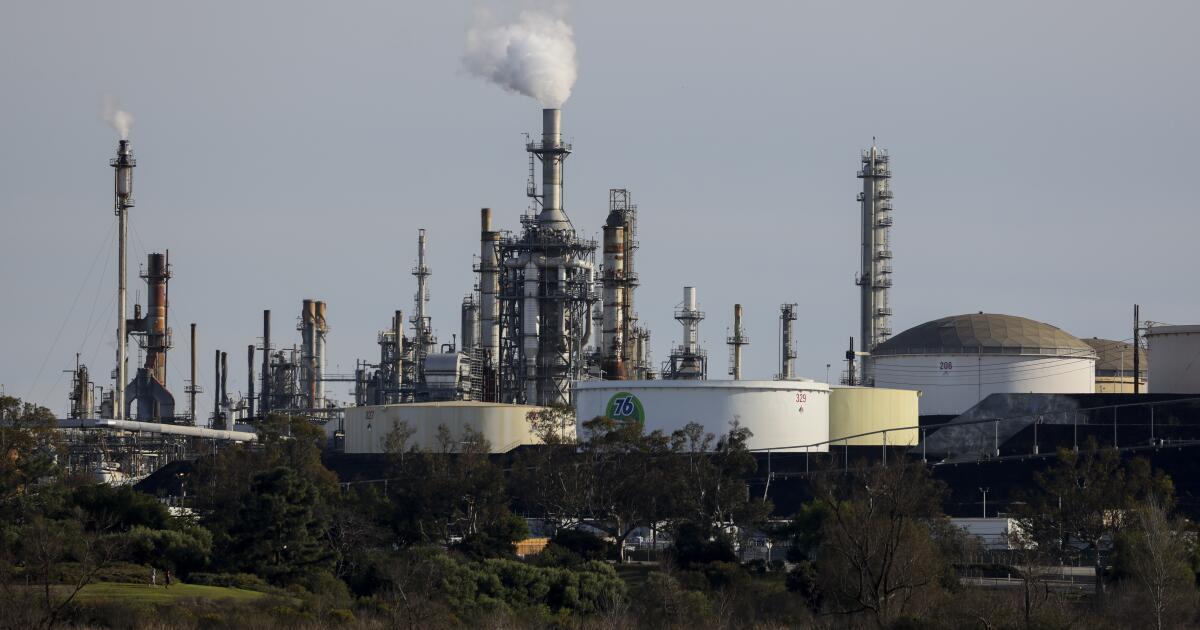
The politics were only exacerbated by recent refinery closures, including the Phillips 66 refinery in Wilmington in October and the idling and planned closure of the Valero refinery in Benicia, Calif., which reduced refining capacity in the state by about 18%.
California also has seen a steady reduction in its crude oil production, making it more reliant on international imports of oil and gasoline.
In 2024, only 23.3% of the crude oil refined in the state was pumped in California, with 13% from Alaska and 63% from elsewhere in the world, including about 30% from the Middle East, said Jim Stanley, a spokesperson for the Western States Petroleum Assn.
“We could see a supply crunch and real price volatility” if the Middle East supply is interrupted, he said.
The Strait of Hormuz in the Persian Gulf, through which about 20% of the world’s oil passes, was virtually closed Monday, according to reports. Though it produces only about 3% of global oil, Iran has considerable sway over energy markets because it controls the strait.
Also, in response to the U.S. attack, Iran has fired a barrage of missiles at neighboring Persian Gulf states. Saudi Arabia said it intercepted Iranian drones targeting one of its refinery complexes.
California Republicans and the California Fuels & Convenience Alliance, a trade group representing fuel marketers, gas station owners and others, have blamed Gov. Gavin Newsom’s policies for driving up the price of gas.
A landmark climate change law calls for California to become carbon neutral by 2045, and Newsom told regulators in 2021 to stop issuing fracking permits and to phase out oil extraction by 2045. He also signed a bill allowing local governments to block construction of oil and gas wells.
However, last year Newsom changed his stance and signed a bill that will allow up to 2,000 new oil wells per year through 2036 in Kern County despite legal challenges by environmental groups. The county produces about three-fourths of the state’s crude oil.
Borenstein said he didn’t expect that the new state oil production would do much to lower gas prices because it is only marginally cheaper than oil imported by ocean tankers.
Stanley said the aim of the law was to support the Kern County oil industry, which was facing pipeline closures without additional supplies to ship to state refineries.
Statewide, the industry supports more than 535,000 jobs, $166 billion in economic activity and $48 billion in local and state taxes, according to a report last year by the Los Angeles County Economic Development Corp.
Bloomberg News and the Associated Press contributed to this report.

Fintech company Block said Thursday that it’s cutting more than 4,000 workers or nearly half of its workforce as artificial intelligence disrupts the way people work.
The Oakland parent company of payment services Square and Cash App saw its stock surge by more than 23% in after-hours trading after making the layoff announcement.
Jack Dorsey, the co-founder and head of Block, said in a post on social media site X that the company didn’t make the decision because the company is in financial trouble.
“We’re already seeing that the intelligence tools we’re creating and using, paired with smaller and flatter teams, are enabling a new way of working which fundamentally changes what it means to build and run a company,” he said.
Block is the latest tech company to announce massive cuts as employers push workers to use more AI tools to do more with fewer people. Amazon in January said it was laying off 16,000 people as part of effort to remove layers within the company.
Block has laid off workers in previous years. In 2025, Block said it planned to slash 931 jobs, or 8% of its workforce, citing performance and strategic issues but Dorsey said at the time that the company wasn’t trying to replace workers with AI.
As tech companies embrace AI tools that can code, generate text and do other tasks, worker anxiety about whether their jobs will be automated have heightened.
In his note to employees Dorsey said that he was weighing whether to make cuts gradually throughout months or years but chose to act immediately.
“Repeated rounds of cuts are destructive to morale, to focus, and to the trust that customers and shareholders place in our ability to lead,” he told workers. “I’d rather take a hard, clear action now and build from a position we believe in than manage a slow reduction of people toward the same outcome.”
Dorsey is also the co-founder of Twitter, which was later renamed to X after billionaire Elon Musk purchased the company in 2022.
As of December, Block had 10,205 full-time employees globally, according to the company’s annual report. The company said it plans to reduce its workforce by the end of the second quarter of fiscal year 2026.
The company’s gross profit in 2025 reached more than $10 billion, up 17% compared to the previous year.
Dorsey said he plans to address employees in a live video session and noted that their emails and Slack will remain open until Thursday evening so they can say goodbye to colleagues.
“I know doing it this way might feel awkward,” he said. “I’d rather it feel awkward and human than efficient and cold.”

The Writers Guild of America West has canceled its awards ceremony scheduled to take place March 8 as its staff union members continue to strike, demanding higher pay and protections against artificial intelligence.
In a letter sent to members on Sunday, WGA West’s board of directors, including President Michele Mulroney, wrote, “The non-supervisory staff of the WGAW are currently on strike and the Guild would not ask our members or guests to cross a picket line to attend the awards show. The WGAW staff have a right to strike and our exceptional nominees and honorees deserve an uncomplicated celebration of their achievements.”
The New York ceremony, scheduled on the same day, is expected go forward while an alternative celebration for Los Angeles-based nominees will take place at a later date, according to the letter.
Comedian and actor Atsuko Okatsuka was set to host the L.A. show, while filmmaker James Cameron was to receive the WGA West Laurel Award.
WGA union staffers have been striking outside the guild’s Los Angeles headquarters on Fairfax Avenue since Feb. 17. The union alleged that management did not intend to reach an agreement on the pending contract. Further, it claimed that guild management had “surveilled workers for union activity, terminated union supporters, and engaged in bad faith surface bargaining.”
On Tuesday, the labor organization said that management had raised the specter of canceling the ceremony during a call about contraction negotiations.
“Make no mistake: this is an attempt by WGAW management to drive a wedge between WGSU and WGA membership when we should be building unity ahead of MBA [Minimum Basic Agreement] negotiations with the AMPTP [Alliance of Motion Picture and Television Producers],” wrote the staff union. “We urge Guild management to end this strike now,” the union wrote on Instagram.
The union, made up of more than 100 employees who work in areas including legal, communications and residuals, was formed last spring and first authorized a strike in January with 82% of its members. Contract negotiations, which began in September, have focused on the use of artificial intelligence, pay raises and “basic protections” including grievance procedures.
The WGA has said that it offered “comprehensive proposals with numerous union protections and improvements to compensation and benefits.”
The ceremony’s cancellation, coming just weeks before the Academy Awards, casts a shadow over the upcoming contraction negotiations between the WGA and the Alliance of Motion Picture and Television Producers, which represents the studios and streamers.
In 2023, the WGA went on a strike lasting 148 days, the second-longest strike in the union’s history.
Times staff writer Cerys Davies contributed to this report.

Mobile clinic brings mammograms to women on Skid Row

Commentary: Will Klein isn’t surprised he saved the Dodgers’ World Series dynasty

Is Iran expanding attacks to target energy and civilian sites in the Gulf?

Trump claims US stockpiles mean wars can be fought ‘forever’; Kristi Noem testifies before Congress – US politics live

Ohio courtroom devolves into chaos after sentencing in death of teen

Florida High School Football Rankings: Top 25 teams – Oct. 21

Cleary's 21 help Le Moyne down Central Connecticut State 69-64 in OT

How old is Bo Nix? What to know about Oregon quarterback ahead of 2024 NFL Draft

99th annual Pony Swim held in Virginia

Indiana Members Credit Union announced as new anchor tenant at Bottleworks District
Is Iran expanding attacks to target energy and civilian sites in the Gulf?
Trump claims US stockpiles mean wars can be fought ‘forever’; Kristi Noem testifies before Congress – US politics live

War in the Middle East: Iran’s broad retaliation in the Gulf • FRANCE 24 English

Trump sends official notification to Congress on strikes against Iran

Unexpected birth brings hope to near-extinct Amazon tribe
-

 World5 days ago
Exclusive: DeepSeek withholds latest AI model from US chipmakers including Nvidia, sources say
-

 Massachusetts6 days ago
Mother and daughter injured in Taunton house explosion
-

 Denver, CO6 days ago
10 acres charred, 5 injured in Thornton grass fire, evacuation orders lifted
-

 Louisiana1 week ago
Wildfire near Gum Swamp Road in Livingston Parish now under control; more than 200 acres burned
-

 Oregon4 days ago
2026 OSAA Oregon Wrestling State Championship Results And Brackets – FloWrestling
-

 Technology1 week ago
Arturia’s FX Collection 6 adds two new effects and a $99 intro version
-

 News1 week ago
Video: How Lunar New Year Traditions Take Root Across America
-

 Florida2 days ago
Florida man rescued after being stuck in shoulder-deep mud for days