Business
Loretta Ford, ‘Mother’ of the Nurse Practitioner Field, Dies at 104


Loretta Ford, who co-founded the first academic program for nurse practitioners in 1965, then spent decades transforming the field of nursing into an area of serious clinical practice, education and research, died on Jan. 22 at her home in Wildwood, Fla. She was 104.
Her daughter, Valerie Monrad, confirmed the death.
Today there are more than 350,000 nurse practitioners in America; it is one of the fastest growing fields, and last year U.S. News and World Report ranked it the top job in the country, a reflection of salary potential, job satisfaction and career opportunities.
That success is in large part the result of a single person, Dr. Ford, who in 1965 co-founded the first graduate program for nurse practitioners, at the University of Colorado, and subsequently mapped the outlines of what the field entailed.
At the time, nurses were important figures in the medical field, providing not just administrative support but also vital services where and when doctors were unavailable. But the training and career framework for nurses was almost completely absent.
“In nurses’ training, the focus is too much on teaching and administration,” Dr. Ford said in a speech at Duke University in 1970. “We want to make the nurse into a clinician.”
She went further in 1972, when she was hired as the first dean of the school of nursing at the University of Rochester. There she implemented the “unification” model of nursing, in which education, practice and research are fully integrated.
“It gives the profession the ability to study itself with the research, and have nurse-practitioner researchers conducting that work while educating the future work force,” Stephen A. Ferrara, the president of the American Association of Nurse Practitioners, said in an interview.
Dr. Ford’s work in the 1970s often faced resistance from doctors, who scoffed at the idea of nurses wielding influence within the medical field and, perhaps, threatening their dominance of it.
“We actually got hate letters in the mail,” Eileen Sullivan-Marx, who studied under Dr. Ford at Rochester and is now the dean emerita of the school of nursing at New York University, said in an interview.
But Dr. Ford and others pushed on, establishing state-level licensing protocols, standardizing curriculums and adjusting insurance programs to allow nurse practitioners to have a substantive, and often independent, role within the health care system.
And she emphasized that nurse practitioners were not there to replace doctors but to complement them — to do the frontline work in hospitals, but also to be out in the community, focused on health and prevention at a grass-roots level.
“It was obvious to me,” she told Healthy Women magazine in 2022, “that we needed advanced skills and an expanded knowledge base to make the decisions. Because it happens in a hospital. Who do they think makes decisions at 3 a.m.?”
Loretta Cecelia Pfingstel was born on Dec. 28, 1920, in the Bronx and raised in Passaic, N.J. Her father, Joseph, was a lithographer, and her mother, Nellie (Williams) Pfingstel, oversaw the home.
As a child, Loretta hoped to become a teacher, but the onset of the Great Depression hit her family’s finances hard, and she was forced to find work at 16. She became a nurse, and in 1941 earned a diploma in nursing from Middlesex General Hospital in New Jersey.
Her fiancé was killed in combat in 1942, inspiring her to join the U.S. Army Air Forces, intending to be a flight nurse. But her poor eyesight disqualified her from flying, and by the end of the war she was based at a hospital in Denver.
She received a bachelor’s degree in nursing in 1949 from the University of Colorado, and a master’s in public health there in 1951.
Early in her career she specialized in pediatric public health, while also teaching in the nursing program at the University of Colorado; by 1955 she was an assistant professor, and in 1961 she earned a doctorate in education from the school.
She married William J. Ford in 1947. He died in 2014. Their daughter is her only survivor.
Dr. Ford’s work took her into rural parts of Colorado, where doctors were few, poor families were many and the need for basic preventive medical care was acute. She found herself playing many roles under the title “nurse” — she was part public health official, part counselor, part all-around clinician.
At the same time, the Kennedy and Johnson administrations were bringing a new sense of urgency to the issues of rural public health and supporting innovation across all medical fields.
Working alongside Henry Silver, a pediatrician at Colorado, Dr. Ford created a graduate program for nurses, though at first it was in the form of continuing education, without a degree. But the kernel of her vision was already there: that nurses should be sufficiently trained to make independent decisions, have their own practices and participate in health care as part of a team.
“Complete independence for any health practitioner today is a myth,” she said at Duke. “It could be downright poor practice.”
By the time she retired from Rochester, in 1986, there were thousands of licensed nurse practitioners, and many doctors had come to accept them as colleagues, not supporting players.
Dr. Ford continued to write and lecture, and in 2011 she was inducted into the U.S. Women’s Hall of Fame.
“I get a lot of credit for 140,000 nurses, and I don’t deserve it,” she said in her acceptance speech. “They’re the ones who fought the good fight. They took the heat, and they stood it, and they’ve done beautifully.”




Waymo, the driverless taxi company that operates in more than 10 cities, will soon serve customers in San Diego.
The company has been testing its autonomous vehicles in San Diego with a safety driver behind the wheel since earlier this year. Rides without a human driver became available to employees Thursday and will open to members of the public later this year.
Waymo, which announced the expansion Wednesday, will also bring its taxis to Tampa, Las Vegas and Denver.
“If you’re in one of these four new cities, download the app to be notified when it’s time to ride,” the company said in a blog post.
Waymo has offered fully autonomous rides in San Francisco since 2022 and in Los Angeles since 2024.
It also serves customers in Nashville, Phoenix, Miami and other cities.
In May, Waymo launched a cheaper robotaxi dubbed the Ojai, which is better equipped for difficult driving conditions such as snowy roads.
The Ojai will supplement Waymo’s fleet of Jaguar I-Paces, the company said. In San Diego, services will be provided with the Ojai.
Waymo also announced Wednesday it’s beginning autonomous driving with a safety driver in its newest retrofitted vehicle, the Hyundai IONIQ 5.
“This phase allows us to validate our technology for fully autonomous operations as we work to bring riders even more ways to enjoy Waymo in the future,” the company said.
The company plans to eventually have tens of thousands of driverless taxis made per year, starting with the Ojai, then scaling using the IONIQ 5s.
The move into San Diego and three other cities widens the gap between Waymo and its competitors in the robotaxi race.
Elon Musk’s Tesla robotaxis and Amazon-owned Zoox are shuttling customers autonomously, but are nowhere near the scale at which Waymo operates.
Other companies are working on autonomous trucks and freight trains.
Waymo’s San Diego service area will include Pacific Beach, Normal Heights, La Playa and Southcrest, among other neighborhoods, the company said.
StubHub is getting a red card from some World Cup fans
Two World Cup customers are suing the New York-based ticket-selling company, alleging “false and misleading” advertising that left them without tickets or a refund for the World Cup games they paid to attend.
In federal court in New York last week, two Californians — Julia Reeker Moghal and Reuben Renteria — sued StubHub seeking monetary damages and a ban on the company selling World Cup tickets. The lawsuit aims to become a class action and comes after weeks of fierce criticism and complaints from customers regarding the company’s practices.
Throughout the World Cup, videos have emerged on Instagram and TikTok of StubHub customers describing their nightmare experiences with the ticket-selling platform.
Some said they had purchased tickets to World Cup games as early as November of last year, booked flights and hotels and arranged travel plans, then StubHub notified them days to weeks before the match of a refund for their tickets, which they never requested.
There were similar complaints about last-minute cancellations from people who bought Coachella tickets on StubHub.
In the lawsuit, Moghal said she had purchased three tickets for nearly $2,000 for the June 18 match between Switzerland and Bosnia-Herzegovina at SoFi Stadium in Inglewood, which were then canceled by StubHub. Moghal said she was contacted by StubHub and told her tickets would remain canceled, then was later told the tickets would be available one hour before the game.
When the match began, Moghal said she was at SoFi Stadium, but the tickets never came.
Renteria said he paid around $2,300 for the June 18 Mexico versus South Korea match in Guadalajara, Mexico, but they were canceled
“Devoted soccer fans have traveled from around the world to attend World Cup matches — and they reasonably relied on StubHub to provide the tickets they paid for as well as on StubHub’s warranty,” Blake Hunter Yagman, the attorney representing the two, said in a statement. “Instead of rewarding their business, StubHub sold them World Cup tickets that they either could not provide or on speculation, only to be stranded, in many cases, at the stadium gates without any recourse.”
According to StubHub’s website, its Fan Protect Guarantee states the platform will deliver valid tickets or refund in the event of a ticket issue, and that it will “go out of our way to find replacement tickets” of a comparable value. The lawsuit alleges the replacement tickets many fans were given by StubHub were worse than their original tickets.
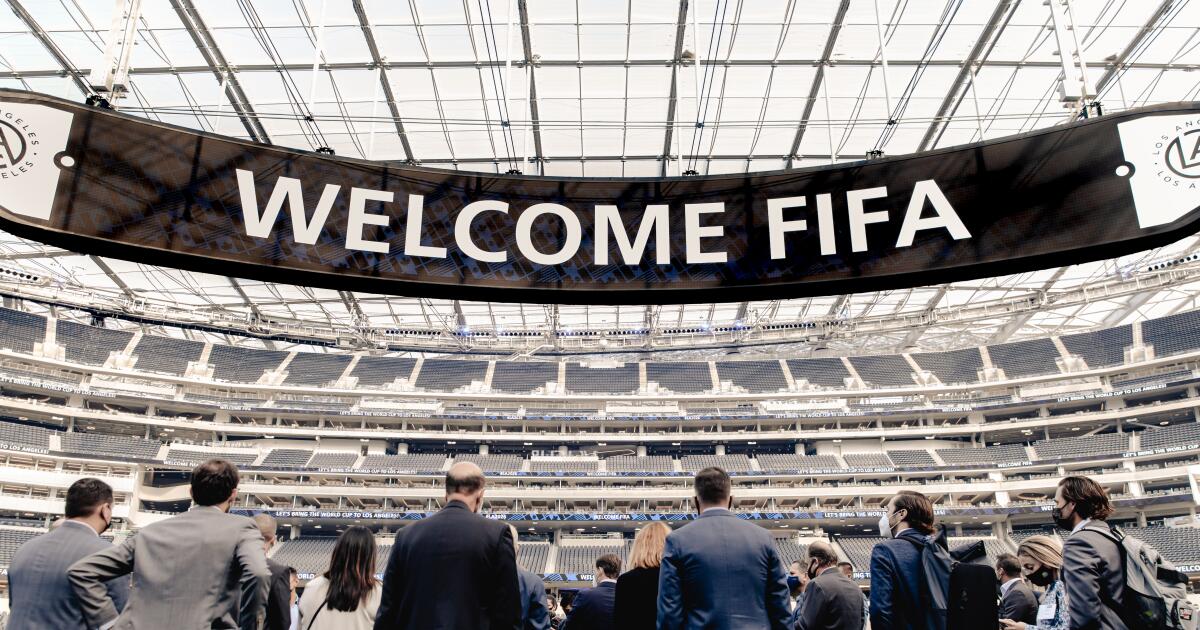
FIFA, the World Cup organizer, states in its terms and conditions that the FIFA Marketplace, its own ticket-selling platform, is the only authorized platform for World Cup tickets, and that only tickets purchased through it are guaranteed by FIFA to be valid.
Despite the risk of purchasing through a third-party platform such as StubHub, many fans opted to do so to avoid the 30% FIFA resale tax, believing that the Fan Protect Guarantee would safeguard their order.
Since World Cup tickets began selling on FIFA Marketplace last September, fans have expressed disappointment in the expensive price tag. FIFA utilized a dynamic pricing system for the sale, and as sales phases progressed leading up to the games, the cost of tickets increased tremendously. In March, the extreme cost of tickets prompted 69 members of Congress to write a letter to FIFA urging them to lower their prices.
Tickets for the upcoming Friday match between Spain and Belgium in Los Angeles are selling on StubHub for over $1,300.
StubHub said in various statements to the news and in legal proceedings that ticket cancellations were a result of transfer problems and issues with FIFA’s ticketing infrastructure.
StubHub did not respond to requests for comment.
A FIFA spokesperson responded to this accusation in a statement, saying, “FIFA has no visibility over, or control of, secondary market ticket transactions carried out on third-party platforms. The transactions facilitated on these platforms occur entirely independently of FIFA’s official ticketing platform. With reference to the reliability of the services available to fans on FIFA’s official ticket platform, FIFA rejects any suggestion that the functional issues being experienced by users of third-party platforms with respect to FIFA World Cup 2026 tickets are the result of FIFA’s ticketing infrastructure.”
Business
Commentary: Trump wants to let companies make fewer disclosures, thus keeping investors in the dark

Trump’s SEC is considering eliminating the mandate for quarterly corporate financial reports, but even some big investors call it a lousy idea.
This being the “information age,” it would be understandable if investors sometimes feel inundated with too much information to wade through about the stocks in their mutual fund portfolios.
The Securities and Exchange Commission, bowing like a puppy to the urgings of President Trump, is considering exactly the wrong solution to this supposed burden. It’s proposing to allow public companies to give their investors less information, as though that’s a good thing.
On May 8, the SEC proposed rescinding its mandate that public companies report financial results on a quarterly schedule. Instead, it suggests, semiannual and annual reports should suffice.
This takes an already-unlevel playing field where Main Street investors are already disadvantaged, and makes it more unlevel.
— Dennis Kelleher, Better Markets
The SEC left its proposal open for public comment for 60 days, meaning the window closed Monday. By then, the agency had received more than 68,000 comments, according to a tracker posted online by accounting professor Tzachi Zach of Ohio State.
Almost 99.9% of the comments were negative. Several organizations of institutional investors and auditing professionals, as well as a tsunami of individual investors, expressed opposition.
A similar initiative the SEC aired in 2018, during Trump’s first term, received an overwhelmingly negative response and was eventually dropped.
The tide of opposition coming from individual investors shouldn’t be surprising. “Taking away basic quarterly information means investors are blind for six months at a time,” says Dennis Kelleher, co-founder and chief executive of the investor advocacy nonprofit Better Markets.
That’s especially true for small investors, though perhaps not so much for major institutions, insiders or deep-pocketed individuals. “If you’re a big dog, you’ll get the information anyway,” Kelleher told me. “And insiders, who are trading in their own stock all the time, will have the information. This takes an already-unlevel playing field where Main Street investors are already disadvantaged, and makes it more unlevel.”
Trump set off the latest initiative with a social media post on Sept. 15, advocating the move to a six-month reporting schedule. It read, in part, “This will save money, and allow managers to focus on properly running their companies. Did you ever hear the statement that, ‘China has a 50 to 100 year view on management of a company, whereas we run our companies on a quarterly basis???’ Not good!!!”
As was usual with Trump, his argument was a string of uninformed and irrelevant non sequiturs.
It’s doubtful that eliminating quarterly reports will save much, if any, money. Most 10-Qs are cookie cutter documents disclosing financial figures already embedded in corporate records.
The idea that managers would become empowered to “focus on properly running their companies” if only they were relieved of the burden of preparing a report every three months is just malarkey: Any CEOs who feel the impulse to drop everything and involve themselves in what is essentially an automated process can’t be very good at their jobs.
As for China’s “50 to 100 year view on management of a company,” what would that even mean, even if it were true? China doesn’t operate on a 50 to 100 year corporate horizon, but rather on a string of five-year plans. The most recent of these was adopted by the government in March, covers the period up to 2030, and is its 15th in a row.
Despite the flaws in Trump’s arguments, Trump’s SEC Chairman Paul Atkins, a former corporate lawyer and securities industry consultant, fell into line. Within a few days of Trump’s post, he showed up on CNBC to minimize the potential effect of the change. Private companies rely on semiannual reports, after all, he noted, although the idea of taking private companies as models for publicly traded corporations might not strike experienced investors as the wisest thing.
Atkins cited an enduring chestnut, for which there’s no evidence, that quarterly reporting is responsible for “short-term thinking” in corporate suites (though he admitted that his evidence was “anecdotal”). And he suggested that small investors have ample access to corporate information even without quarterly reports — why, he said, they can just tune in to CNBC!
“To propose change in what our rules are now would be a good way forward,” he said. “So I welcome the president’s putting this up for discussion.”
Something more insidious undergirds the SEC’s proposal than its immediate effect on corporate behavior. The agency rationalizes its proposal as seeking “a tradeoff between reducing regulatory burdens … and promoting efficient financial markets through timely disclosure.”
The problem here, Kelleher points out, is that “reducing regulatory burdens” isn’t part of the SEC’s mission in any way, shape or form. It’s a regulatory agency, and its mission since its founding in 1934 has been to protect investors, not to make things fluffier for stock issuers.
The history of financial disclosure in the U.S. shows a long-term trend favoring more disclosure, not less. In the 1880s, quarterly reporting by railroads and other transportation companies were common.
Early on, pressure for more frequent disclosure came not from government regulators, who barely existed before 1934, but from investors. The reporting of quarterly earnings, notes corporate finance expert Owen Lamont of Acadian Asset Management, was “a bottom-up historical phenomenon reflecting voluntary arrangements between firms and investors, not a top-down phenomenon imposed by law.”
By 1931, according to financial historians, 63% of New York Stock Exchange-listed firms were publishing their quarterly earnings. The Big Board mandated that frequency for most listed companies in 1939. The SEC mandated semiannual reports in 1955 and quarterly reports, as Atkins said, in 1970.
The evidence in favor of dropping the quarterly reports is uniformly thin. Some advocates cite a 2018 op-ed in the Wall Street Journal by JPMorgan Chase CEO Jamie Dimon and Warren Buffett that was headlined “Short-Termism Is Harming the Economy.”
Couple of points about this: First, the target of Dimon and Buffett wasn’t quarterly financial reporting, but quarterly earnings guidance — that is, the practice of some top executives who project their earnings into the future. (This guidance usually comes at the same time they issue their SEC disclosures.)
It’s guidance, they wrote, that is “a major driver” of short-termism in corporate behavior. That’s because management is giving itself a target it feels obligated to meet, even if factors outside its control interfere with the quest.
Furthermore, Dimon and Buffett wrote, “Our views on quarterly earnings forecasts should not be misconstrued as opposition to quarterly and annual reporting.” They called transparency about financial and operating results “an essential aspect of U.S. public markets … so that the public, including shareholders and other stakeholders, can reliably assess real progress.”
Individual investors may be unmoved by the SEC’s proposal because — let’s be candid — how many of them read quarterly earnings reports, anyway? But that’s unimportant, Kelleher says, because other market participants are reading them. “So that information is in the marketplace, and that’s what actually enables price discovery, so stock prices roughly reflect what’s going on at a company, most of the time.”
More to the point, the quarterly reports reflect the highest-quality, detailed information, the information the SEC requires executives to disclose on pain of facing a civil lawsuit from the agency or even criminal liability for faking data. “Main Street investors, whether they read quarterly reports or not, are the real beneficiaries,” Kelleher says.
That’s so. The bottom line is that quarterly financial reporting helps investors. It doesn’t promote short-term behavior and its costs, modest as they are, don’t outweigh its benefits.
Over the decades, scandal-ridden corporations have hidden fraudulent behavior in the interstices between mandated disclosures—think Enron, WorldCom and Tyco, among others. Why give any corporation, even an honest one, the opportunity to disclose less?
-

 Alabama5 minutes ago
University of Alabama police officer's family leans on law enforcement community after his death
-

 Alaska8 minutes ago
Black bear breaks into Alaskan mall, eats a peach and relieves itself on floor before leaving: video
-

 Arizona14 minutes ago
Arizona tackling heat mitigation, could their efforts translate to Nevada
-

 California18 minutes ago
California bill would let insurers monitor driving data for discounts
-

 Arkansas21 minutes ago
ROBERT STEINBUCH: DEI deja vu | Northwest Arkansas Democrat-Gazette
-

 Colorado28 minutes ago
Colorado reports 90 cases of Cyclospora this year: Here’s what health officials want you to know
-

 Connecticut36 minutes ago
Marian Katz Obituary
-

 Delaware38 minutes ago
DE health officials ‘on pins and needles’ after measles cases in PA

