Business
Kaiser healthcare worker strike ends after five days. Bargaining resumes this week

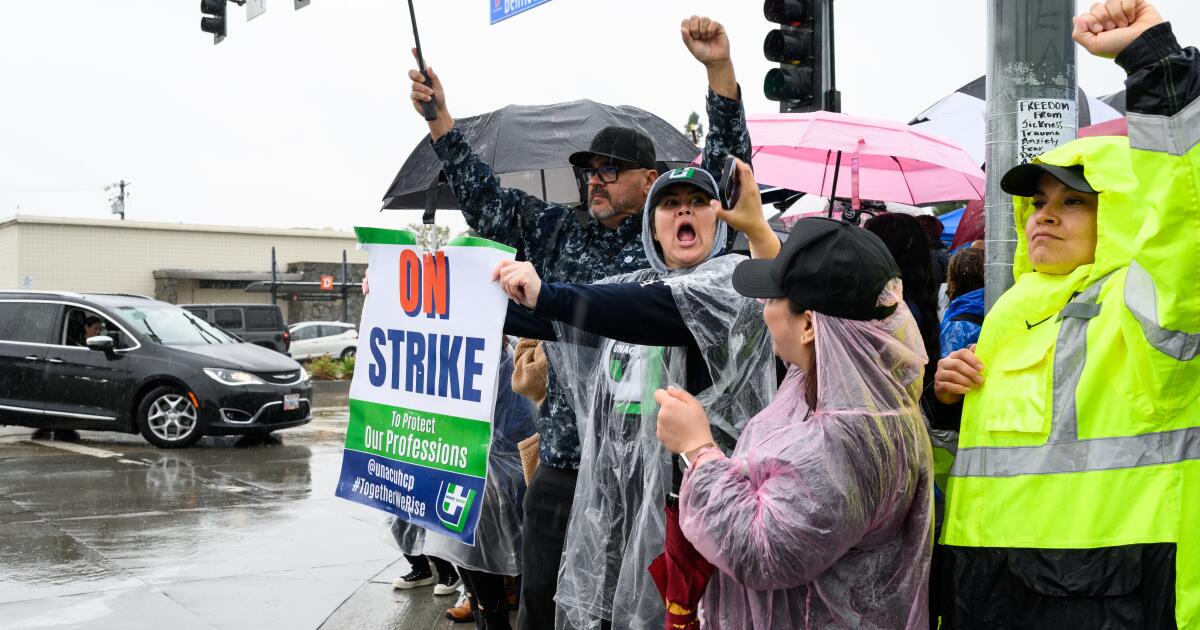
A five-day strike that affected hundreds of Kaiser Permanente clinics and hospitals in California and Hawaii came to an end after the union representing workers said it had “new momentum” to head back to the bargaining table, but no apparent agreement has been reached.
“This strike may be over — but the fight for patient safety is not,” the United Nurses Assns. of California/Union of Healthcare Professionals, known as UNAC/UHCP said in a statement. “Caregivers are returning to work united, energized, and ready to keep up the pressure for a fair contract that puts patients first.”
Kaiser and union officials are set to resume bargaining on Wednesday and Thursday.
The union requested a wage increase of 25% over four years, an ask that union officials have said was needed to compensate for the smaller 2% increases workers received in the first year as part of their 2021 contract negotiations.
The union has also pushed for the additional hiring of more staff, and proposed an internal registry of on-call union nurses, so that the company doesn’t rely on contracted traveling nurses.
Kaiser officials have argued that employees on average earn 16% more than peers in the industry, and that the wage increases proposed raised their “already above-market wages over the 4-year contract.”
Company officials said the company offered a 21.5% wage increase over four years before the strike was called, as well as additional improvements to medical plans and retiree benefits.
Kaiser officials said workers returned to work Sunday at 7 a.m.
During the strike, facilities were staffed with doctors, managers and nearly 6,000 contracted nurses and clinicians to minimize disruption to care, officials said.
On Sunday, the UNAC/UHCP announced the end of the strike, stating that the labor action was “sending a resounding message that patient care and safe staffing must come first.”
The union pointed to new staffing standards released by the Joint Commission, a nonprofit that accredits healthcare organizations, that recognized adequate staffing as a component of providing needed care.
The new standard moves staffing levels away from an employer’s choice that could be affected by budget constraints, to a patient safety standard, the union said in a statement.
“The Joint Commission has finally said what nurses have known all along: Unsafe staffing is unsafe care,” said Charmaine S. Morales, president of the UNAC/UHCP in the statement. “It’s now a national patient safety mandate — and UNAC/UHCP will make sure it’s enforced.”
Officials at Kaiser said it was welcoming back the 30,000 employees who went on strike, but in a statement said the main point of contention at the bargaining table has been wages, not staffing.
“While the Alliance has publicly emphasized staffing and other concerns, wages are the reason for the strike and the primary issue in negotiations,” said Terry Kanakri, spokesperson for Kaiser, in a statement.
During bargaining, “the focus will be on economic issues,” Kanakri said in the statement. “At a time when the cost of healthcare continues to go up steeply, and millions of Americans are having to make the difficult choice to go without coverage, it’s critical that we keep quality, accessible healthcare coverage affordable.”
Meanwhile union officials have blasted the company for holding $66 billion in reserves and expanding projects in other states.


Los Angeles County saw job gains in May, likely driven in part by rebuilding after the January 2025 wildfires, which destroyed or damaged more than 18,000 structures.
Construction added 2,300 jobs since April, while postings for new jobs in the industry jumped 45% over a year ago —indicating rebuilding in Pacific Palisades, Altadena and nearby is helping boost the local economy, according to a report by the Los Angeles County Economic Development Corp.
“This is consistent with the possibility that wildfire rebuilding activity is increasing construction labor demand in the area,” Max Chomas, an economist at the LAEDC Institute for Applied Economics, said at a presentation this week based on California Employment Development Department and other data.
Motion picture and sound recordings also added 2,800 jobs during the month, despite a deep downturn in Hollywood caused by a reduction in streaming filming, runaway production and other factors. The industry lost 6,700 jobs compared with a year ago.
Still, the job growth since April in construction and Hollywood were among the highlights of a month that saw total county payroll jobs — excluding agriculture and certain other sectors — grow by 9,000 jobs, to 4,618,400. Employment was virtually flat from the same time a year ago.
“May was a relatively good month for employment growth,” Chomas said.
The biggest monthly job gainers were the hotel and restaurant industries, which added 3,700 jobs.
Manufacturing, which has been hit by job losses over recent years, added 400 jobs since April. It also saw a 15% increase in job postings compared with a year ago.
That could reflect the resurgence in Southern California’s aerospace and defense industries, which have seen a sharp rise in startups.
Postings for all new jobs were up 1,134, or 2.4%, since a year ago. Chomas noted that May was only one of five months over the last three years that saw year-over-year growth in job postings.
The gains helped stabilize the county’s unemployment rate at 5.2%, matching April’s rate and down from 5.4% in May 2025.
Still, that is higher than May’s 4.3% national unemployment rate, and it masked some weakness in the local economy.
The rate is calculated by a household survey to determine which members are working, looking for work or no longer seeking employment.
It found 18,000 workers had dropped out of the county labor force in May, artificially driving down the unemployment rate, according the California EDD.
Similarly, California recorded a 5.3% unemployment rate in May, on par with April, despite a drop in the labor force.
That rate is higher than every state other than Delaware. In May, California only added 3,100 non-farm jobs month-over-month — a job growth rate that lags behind the nation, according to an analysis by the Inland Empire Economic Partnership and the Lowe Institute of Political Economy at Claremont McKenna College.
The LAEDC’s report also examined the potential effects the growth in artificial intelligence has been having on L.A. County jobs “exposed” to AI, meaning they are vulnerable to AI replacement.
California has been hit hard by thousands of AI-related layoffs in Silicon Valley as the software has been integrated into the tech workplace — even though there is fierce competition for software engineers with skills and expertise in the field.
The report found that since July 2023, job listings in Los Angeles County for AI-exposed positions — such as clerical and translation positions — have lagged behind other jobs. However, it is unclear whether businesses have replaced or are waiting to replace those workers with AI.
It may be that employers overhired for those positions during the COVID-19 pandemic and are now shedding them, since there is a correlation between AI-exposed positions and those jobs that can be completed from home, Chomas said.
The report also examined macroeconomic trends and policy decisions affecting the national, state and Los Angeles County economies — which have been hit by tariffs, the crackdown on immigrant labor and high energy costs, among other factors.
Nevertheless, consumers continue to spend despite affordability strains, and employers continue to hire selectively amid higher interest rates to battle inflation, said institute economist Shannon Sedgwick.
“During the previous decade, we experienced extraordinarily low inflation, near zero interest rates, relatively stable globalization, and abundant capital. So those conditions may have conditioned us to think that environment was normal,” she said.
“But historically speaking, today’s world of higher rates, greater geopolitical uncertainty and tighter labor markets, they may actually be closer to that long-run average,” Sedgwick noted.

A proposal to build a truck parking lot near the Port of Los Angeles is facing backlash from nearby residents.
Port officials say the parking lot would provide much-needed designated space for cargo trucks waiting to pick up loads from the port, helping to ease congestion in the area.
But some neighborhood groups say the proposed staging area would only increase traffic and air pollution in Wilmington.
Gina Martinez, chair of the executive board of the Wilmington Neighborhood Council, said the land in question provides a vital buffer between port activity and residential communities.
“It’s been a bad deal from the beginning,” Martinez said in an interview. “We want open space because we’ve been promised for decades a clear separation from port activities.”
The Los Angeles Harbor Commission signed off on the project in a meeting on June 11, but it was vetoed by the Los Angeles City Council this week.
The veto does not permanently ban the project, but allows for more time to discuss the implications for stakeholders and the community.
Los Angeles City Councilmember Tim McOsker, who introduced a special motion to halt the truck plans, said he was acting on behalf of community residents. McOsker represents Harbor City, Harbor Gateway, San Pedro, Watts, and Wilmington.
“Generally, folks in the community would say, ‘we don’t want the port industrial properties to creep into neighborhoods. We want them to retract or hold the line,’” McOsker told The Times.
The John S. Gibson Truck & Chassis Parking Lot, which was originally proposed in 2023 by the Port of Los Angeles, would cover 18 acres of privately owned land and include 393 truck and chassis parking stalls.
The land is currently designated as open space, though it’s undeveloped and not available for any recreational use. The completion of the parking lot would require a Port of Los Angeles master plan amendment to switch the land’s designation from open space to maritime support.
Martinez said the land should have never been sold to private developers because it’s included in the California State Lands Commission’s tidelands trust, which says certain land near the ocean must be available for public enjoyment.
Building a truck and chassis waiting lot on that space would increase congestion on the freeways and in Wilmington neighborhoods, add particulate matter into the air and increase already-problematic noise pollution from the port, she said.
“Of all the things Wilmington needs, it is not another parking lot for trucks,” Martinez said at a Los Angeles Harbor Commission meeting earlier this month. “It is not the responsibility of our community to take on every single truck that runs through the port.”
At the same meeting, Noel Gould of the Coastal San Pedro Neighborhood Council said the council is supporting the project after working closely with the developers to reach compromises.
The parking lot would prevent port-bound trucks from idling near schools and parks, he said. The lot would also include landscaping with native coastal plants.
“We didn’t start out in a position of support, but we worked very closely with them to get to a place where we felt it was really something that would benefit the community,” Gould said at the meeting.
In an interview, McOsker said there is already space set aside for trucks to wait to access the port.
At the Los Angeles City Council meeting Wednesday, the council unanimously approved what’s known as a 245 motion, which gives the council authority to temporarily veto certain actions taken by city boards and commissions.
“The 245 gives us the opportunity to meet and confer and see if there are revisions or additions or mitigation that can better protect the full community,” McOsker said.
The motion sends the project proposal back to the Harbor Commission for further review.
Supporters of the parking lot say the land is currently uninhabited and requires consistent police presence to deter criminal activities.
The Port of Los Angeles also clashed with coastal communities last year over the possible raising of the Vincent Thomas Bridge. The bridge was already slated to be redecked by the California Department of Transportation, but Port of Los Angeles executive director Gene Seroka proposed raising the bridge height as well.
Raising the bridge would allow larger cargo ships to pass under its deck, helping create jobs and keep the port relevant, Seroka said at the time. Most painfully for local commuters and businesses, it would mean the bridge will be closed for around 28 months rather than the originally planned 16 months.
Last December, the California State Transportation agency rejected the proposal to raise the bridge.
Business
Commentary: Puncturing the myth of Alan Greenspan, whose policies gave us the Great Recession

Noah Cross, the archvillain of the movie “Chinatown,” had the definitive line on how old age brings respectability. “‘Course I’m respectable,” he tells Jake Gittes. “I’m old. Politicians, ugly buildings and whores all get respectable if they last long enough.”
I wouldn’t necessarily slot former Federal Reserve Chairman Alan Greenspan into any of those categories, but the general reaction to his death Monday at age 100 puts the lie to Cross’ observation.
As much as he was revered during his nearly two decades as Fed chairman for protecting the stock market from a series of crashes and near-crashes, his obituaries take a more measured view. The headline on the Wall Street Journal’s main take on his legacy is: “The Myth of Alan Greenspan as ‘The Maestro.’”
Stripped of its academic jargon, the welfare state is nothing more than a mechanism by which governments confiscate the wealth of the productive members of a society to support a wide variety of welfare schemes.
— Alan Greenspan, writing as an Ayn Rand cultist (1966)
The Journal blames Greenspan for fostering “the great credit mania of the mid-2000s” and observes that “the music stopped in 2008, producing the panic that did so much harm to the free-market economy that Greenspan promoted.” That was the Great Recession, which started with the 2008 crash in the housing market and persisted into 2012.
That is from a publication that was more or less in accord with Greenspan’s goals of less regulation and lower taxes. His contemporary adversaries were harsher. “R.I.P. Alan Greenspan: You were charming, thoughtful, powerful, and wrong,” writes Robert Reich, who served as Bill Clinton’s Labor secretary while Greenspan led the Fed.
The Great Recession, “in which in which millions of Americans lost their jobs, their savings, and even their homes — resulted from the deregulation of Wall Street that Greenspan advocated,” Reich wrote. But he had to admit that Greenspan’s “iron grip” over Fed policy forced Clinton “to do exactly what Greenspan wanted — which was to reduce the federal budget deficit and thereby destroy much of the agenda Clinton ran on.”
It would be unfair to depict Greenspan’s influence as invariably pernicious. Social Security advocates still think highly of his work chairing the so-called Greenspan Commission of 1982-1983, which developed a series of changes in benefits and revenues for that program to address a looming, immediate fiscal crisis.
Greenspan led the bipartisan panel “masterfully,” recalls William J. Arnone, the former chief executive of the National Academy of Social Insurance, who witnessed its deliberations as a consultant to the New York Citizens Committee on Aging.
Before the commission’s formation, “Republicans and Democrats fiercely disagreed over underlying data,” Arnone told me. “Greenspan used his expertise as an economic empiricist to convince both sides to agree on a singular, shared set of actuarial facts. Quite an accomplishment.”
To the public, Greenspan was known for his impenetrably cryptic speaking style and for the relative tranquility in the American economy during his tenure, which has been termed “the great moderation” despite recurrent short-term crises.
Greenspan was the second-longest serving Fed chair. But he may have had the weirdest background. Having grown up in an affluent New York household, he was talented enough on clarinet and saxophone to have sat in with Stan Getz’s band and attended Juilliard for a time.
He began his economics education in 1945 at New York University and got as far as a master’s degree, but by then he was already working on Wall Street, where his skill at financial analysis propelled him toward the top echelons of high finance.
Somewhere along the line he fell in with the arch-libertarian Ayn Rand, becoming part of her inner circle of economic cultists. Referring to his dour mien and predilection for charcoal gray garb, Rand called him her “undertaker.”
Greenspan provided a veneer of rigorous economic analysis for Rand’s ideology, which lionized the rich and described them as fighting a ferocious battle with the lazy and grasping hoi polloi. He contributed three essays to her 1966 anthology “Capitalism: The Unknown Ideal.”
His association with Rand was seldom highlighted during his Fed tenure, but even a casual reading of those essays exposes the Randian underpinnings — and the Randian self-contradictions — of his Fed policies.
One essay defended the gold standard, which had been discredited in the 1930s. Greenspan blamed “welfare-state advocates” for the developed world’s abandonment of the gold standard.
He wrote, “Stripped of its academic jargon, the welfare state is nothing more than a mechanism by which governments confiscate the wealth of the productive members of a society to support a wide variety of welfare schemes…. Gold stands in the way of this insidious process. It stands as a protector of property rights” — language that could have come right out of the text of Rand’s “Atlas Shrugged.”
Another essay called for the dismantling of government regulators such as the Food and Drug Administration and the Securities and Exchange Commission. Greenspan’s argument was that the consumer was adequately protected by the businessman’s profit-seeking, which in turn depended on maintaining a reputation for honesty and fair-dealing.
For drug companies, he wrote, “the loss of reputation through the sale of a shoddy or dangerous product would sharply reduce the market value of the drug company.” The same goes for securities brokers — “The slightest doubt as to the trustworthiness of a broker’s word or commitment would put him out of business overnight.”
One might ask what inspired Greenspan’s faith in, well, the faithfulness of business enterprises, given centuries of proof otherwise. Anyway, he refuted his own argument. “The guiding purpose of the government regulator is to prevent rather than to create something,” he wrote. “He gets no credit if a new miraculous drug is discovered by drug company scientists; he does if he bans thalidomide.”
He didn’t bother to question why his trustworthy drug companies had tried to market as a morning-sickness drug in the U.S. a formulation that already had been shown to produce severe birth defects in the children of mothers who took it overseas. (American families were largely saved from this tragedy by Frances Oldham Kelsey, who blocked its importation as an official of, yes, the FDA.)
To stock market investors, Greenspan’s chief legacy was the “Greenspan Put.” This was an implicit commitment by the Fed to counteract sharp declines in the market by pumping liquidity into the economy through the mass purchase of Treasury bonds.
The term comes from the options market, in which a “put” gives the holder the right to sell the underlying stock at a set price in the future, even if the market price has fallen below that price. In effect, it establishes a floor to the investor’s losses in a downturn.
The Greenspan put first appeared on Oct. 19, 1987, when the stock market suffered its greatest one-day percentage crash ever, 20.47%. Greenspan had been in office for only a few weeks, but his Fed issued a statement promising to inject liquidity into the system and cut interest rates. “We will back you,” he told bankers in a series of phone calls.
In truth, Greenspan had no legal authority to make that pledge. In any event, the market recovered the next day, and the Fed’s image as a willing bulwark against market declines was born.
The problem was that the idea that the Fed would act in a market crisis encouraged ever more flagrant risk-taking on Wall Street.
The harvest was a series of crises, notably the 1998 collapse of the hedge fund Long Term Capital Management, which was founded by Nobel economics laureates to pursue abstruse arbitrage trades. It was brought low by market moves that confounded their projections. LTCM was so deeply embedded in Wall Street trading it had to be saved with a $3.6-billion bailout the Fed orchestrated.
The Greenspan put, like so many other such grand schemes, worked well right up until it stopped working. That moment came in 2008, with a crash and a long, throbbing hangover.
Testifying to Congress in 2008, Greenspan acknowledged that maybe self-regulation, that watchword of his economic worldview, didn’t work.
“I made a mistake in presuming that the self-interest of organizations, specifically banks and others, were such that they were best capable of protecting their own shareholders and their equity in the firms…. Something which looked to be a very solid edifice, and, indeed a critical pillar to market competition and free markets, did break down.”
That, he said, “shocked me.” It was a rare admission of blame by a man who, as my former colleagues Thomas S. Mulligan and Don Lee reported in their Greenspan obituary, had told CNBC a few months earlier that he had “no regrets” about his policies.
-

 Minneapolis, MN5 minutes ago
Minneapolis shooting leaves 1 injured near Penn Avenue
-

 Indianapolis, IN8 minutes ago
Storms fade with dangerous heat building through midweek | June 27, 2026
-

 Pittsburg, PA13 minutes ago
Two dead in early morning crash on Pennsylvania Turnpike
-

 Augusta, GA20 minutes ago
Augusta CSRA Habitat for Humanity hosts third annual Build the Band benefit
-

 Washington, D.C23 minutes ago
Kirstin Downey: Hawaiʻi Is Rock Solid At This New Display In DC
-

 Cleveland, OH28 minutes ago
The Cleveland Cavaliers Announce Their Summer League Schedule
-

 Austin, TX34 minutes ago
Texas Ex Jahdae Barron empowers Austin youth at first annual football camp
-

 Alabama38 minutes ago
83-year-old man killed in Alabama boat crash | WKRG.com

