Business
Judge grants Wonderful's request to halt UFW effort to unionize company's workers

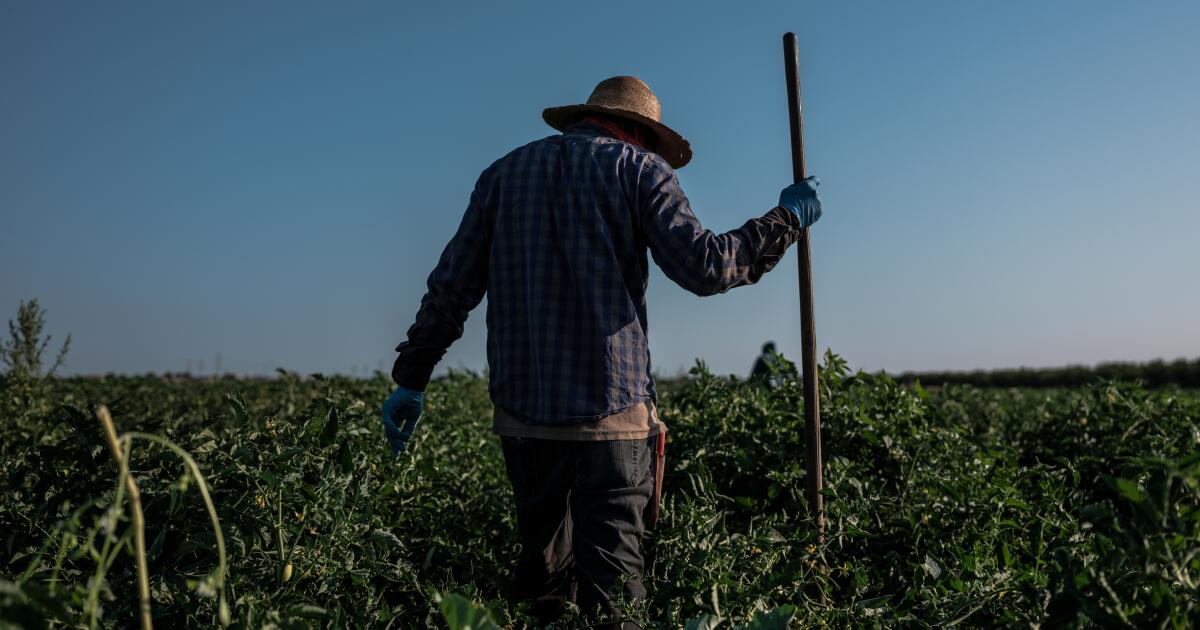
After more than a month of deliberation, a Kern County Superior Court judge has sided with Wonderful Co. and issued a preliminary injunction that will temporarily halt a contentious bargaining process between the agricultural giant and the state’s largest farmworker union.
In a ruling issued Thursday, Judge Bernard C. Barmann said Wonderful “was likely to prevail” in its legal challenge to the state’s relatively new system for organizing farmworkers and faced irreparable harm if the United Farm Workers union is allowed to pursue a bargaining agreement on behalf of the company’s nursery workers before the case is decided.
“The court finds that the public interest weighs in favor of preliminary injunctive relief given the constitutional rights at stake in this matter,” Barmann wrote in the 21-page decision. Wonderful “has met its burden that a preliminary injunction should issue until the matter may be heard fully on the merits.”
Wonderful, the $6-billion agricultural powerhouse owned by Stewart and Lynda Resnick, sued the state Agricultural Labor Relations Board in May, challenging the constitutionality of the state’s so-called card-check system, which Gov. Gavin Newsom signed into law in 2022. Under its provisions, a union can organize farmworkers by inviting them to sign authorization cards at off-site meetings, without notifying an employer, rather than voting by secret ballot at a designated polling place.
Union organizers had pressed for the revised card-check law, contending the secret ballot process left workers fearful of retaliation from their employer.
But Wonderful, whose portfolio includes such well-known brands as FIJI Water and POM Wonderful, alleges in its lawsuit that the law deprives employers of due process on multiple fronts. Among them: forcing a company to enter a collective bargaining agreement even if it has formally appealed the ALRB’s certification of a union vote and presented what it believes is evidence that the voting process was fraudulent.
The temporary injunction marks the latest twist in a tumultuous dispute over the UFW’s unionization campaign at Wonderful Nurseries in Wasco, the nation’s largest grapevine nursery.
In late February, the UFW filed a petition with the labor relations board, asserting that a majority of the 600-plus farmworkers at the nursery had signed authorization cards and asking that the UFW be certified as their union representative.
Within days, Wonderful accused the UFW of having baited farmworkers into signing the authorization cards under the guise of helping them apply for $600 in federal relief for farmworkers who labored during the pandemic. And the company submitted nearly 150 signed declarations from nursery workers saying they had not understood that by signing the cards they were voting to unionize.
The UFW countered that Wonderful had intimidated workers into making false statements and had brought in a labor consultant with a reputation as a union buster to manipulate their emotions in the weeks that followed.
The ALRB acknowledged receiving the worker declarations from Wonderful; nonetheless, the regional director of the labor board moved forward three days later to certify the union’s petition. She has said in subsequent hearings that she felt she had to move quickly under the timeline laid out in the card-check law, and that at the time she did not think the statute authorized her to investigate allegations of misconduct.
Wonderful appealed the ALRB’s certification.
Under the provisions of the card-check law, the UFW’s efforts to bargain with the company on behalf of its nursery workers moved forward, even as Wonderful’s appeal of the certification was working its way through the ALRB’s administrative hearing process. The ALRB issued a ruling last week ordering Wonderful to enter into a mandatory mediation process with the union to establish a collective bargaining agreement.
In its lawsuit, filed in May, Wonderful challenges the constitutionality of the card-check system on multiple fronts. The lawsuit alleges that the company’s due process rights were violated when the labor board moved to certify the UFW’s petition before investigating the company’s allegations that the vote was fraudulent; and more broadly that the card-check system does not have adequate safeguards in place to ensure the veracity of the voting process.
The company asked the judge to halt the unionization effort at its nursery, as well as the ALRB’s administrative hearing process regarding the company’s appeal, while the lawsuit moved forward in Kern County court.
In a statement released Thursday evening, Rob Yraceburu, president of Wonderful Nurseries, said the company was “gratified” by the court’s decision to pause the certification process until the constitutionality of the card check law can be “fully and properly considered.”
“In addition,” Yraceburu said, “farmworkers had been wrongly barred from objecting to a union being forced on them, and this ruling states that Wonderful indeed has the standing to fight to ensure those constitutional rights of farmworkers, including their due process and First Amendment rights, are not violated.”
UFW spokesperson Elizabeth Strater countered that the ruling “ignores 89 years of labor law precedent” and indicated the decision to grant the preliminary injunction would be appealed.
“There is already a process to address wrongdoing in elections and Wonderful was in the middle of that process. Why does Wonderful want to halt that process and silence workers so their voices are not heard?” Strater said. “It’s very clear Wonderful is determined to use its considerable resources to deny farmworkers their rights.”
In a May 30 filing, the state had urged the court to deny Wonderful’s request for an injunction. California Atty. Gen. Rob Bonta, arguing on behalf of the ALRB, said Wonderful had failed to demonstrate that the card-check law was causing “irreparable harm or any likelihood of deprivation of its rights.” Bonta also argued that the Superior Court lacked jurisdiction in the case.
Santiago Avila-Gomez, executive secretary with the ALRB, said Thursday evening the agency is “reviewing the ruling carefully and won’t have further comment at this time.”
The UFW, meanwhile, is pursuing its own legal action against Wonderful. The union has filed a formal complaint of unfair labor practices with the ALRB, accusing Wonderful of coercing workers into attending “captive audience” meetings to urge employees to reject UFW representation. ALRB General Counsel Julia Montgomery issued a complaint in April, similar to an indictment, alleging Wonderful committed unfair labor practices by unlawfully assisting them in drafting declarations to revoke their authorization cards.
The company has largely denied the allegations.
This article is part of The Times’ equity reporting initiative, funded by the James Irvine Foundation, exploring the challenges facing low-income workers and the efforts being made to address California’s economic divide.



Fintech company Block said Thursday that it’s cutting more than 4,000 workers or nearly half of its workforce as artificial intelligence disrupts the way people work.
The Oakland parent company of payment services Square and Cash App saw its stock surge by more than 23% in after-hours trading after making the layoff announcement.
Jack Dorsey, the co-founder and head of Block, said in a post on social media site X that the company didn’t make the decision because the company is in financial trouble.
“We’re already seeing that the intelligence tools we’re creating and using, paired with smaller and flatter teams, are enabling a new way of working which fundamentally changes what it means to build and run a company,” he said.
Block is the latest tech company to announce massive cuts as employers push workers to use more AI tools to do more with fewer people. Amazon in January said it was laying off 16,000 people as part of effort to remove layers within the company.
Block has laid off workers in previous years. In 2025, Block said it planned to slash 931 jobs, or 8% of its workforce, citing performance and strategic issues but Dorsey said at the time that the company wasn’t trying to replace workers with AI.
As tech companies embrace AI tools that can code, generate text and do other tasks, worker anxiety about whether their jobs will be automated have heightened.
In his note to employees Dorsey said that he was weighing whether to make cuts gradually throughout months or years but chose to act immediately.
“Repeated rounds of cuts are destructive to morale, to focus, and to the trust that customers and shareholders place in our ability to lead,” he told workers. “I’d rather take a hard, clear action now and build from a position we believe in than manage a slow reduction of people toward the same outcome.”
Dorsey is also the co-founder of Twitter, which was later renamed to X after billionaire Elon Musk purchased the company in 2022.
As of December, Block had 10,205 full-time employees globally, according to the company’s annual report. The company said it plans to reduce its workforce by the end of the second quarter of fiscal year 2026.
The company’s gross profit in 2025 reached more than $10 billion, up 17% compared to the previous year.
Dorsey said he plans to address employees in a live video session and noted that their emails and Slack will remain open until Thursday evening so they can say goodbye to colleagues.
“I know doing it this way might feel awkward,” he said. “I’d rather it feel awkward and human than efficient and cold.”

The Writers Guild of America West has canceled its awards ceremony scheduled to take place March 8 as its staff union members continue to strike, demanding higher pay and protections against artificial intelligence.
In a letter sent to members on Sunday, WGA West’s board of directors, including President Michele Mulroney, wrote, “The non-supervisory staff of the WGAW are currently on strike and the Guild would not ask our members or guests to cross a picket line to attend the awards show. The WGAW staff have a right to strike and our exceptional nominees and honorees deserve an uncomplicated celebration of their achievements.”
The New York ceremony, scheduled on the same day, is expected go forward while an alternative celebration for Los Angeles-based nominees will take place at a later date, according to the letter.
Comedian and actor Atsuko Okatsuka was set to host the L.A. show, while filmmaker James Cameron was to receive the WGA West Laurel Award.
WGA union staffers have been striking outside the guild’s Los Angeles headquarters on Fairfax Avenue since Feb. 17. The union alleged that management did not intend to reach an agreement on the pending contract. Further, it claimed that guild management had “surveilled workers for union activity, terminated union supporters, and engaged in bad faith surface bargaining.”
On Tuesday, the labor organization said that management had raised the specter of canceling the ceremony during a call about contraction negotiations.
“Make no mistake: this is an attempt by WGAW management to drive a wedge between WGSU and WGA membership when we should be building unity ahead of MBA [Minimum Basic Agreement] negotiations with the AMPTP [Alliance of Motion Picture and Television Producers],” wrote the staff union. “We urge Guild management to end this strike now,” the union wrote on Instagram.
The union, made up of more than 100 employees who work in areas including legal, communications and residuals, was formed last spring and first authorized a strike in January with 82% of its members. Contract negotiations, which began in September, have focused on the use of artificial intelligence, pay raises and “basic protections” including grievance procedures.
The WGA has said that it offered “comprehensive proposals with numerous union protections and improvements to compensation and benefits.”
The ceremony’s cancellation, coming just weeks before the Academy Awards, casts a shadow over the upcoming contraction negotiations between the WGA and the Alliance of Motion Picture and Television Producers, which represents the studios and streamers.
In 2023, the WGA went on a strike lasting 148 days, the second-longest strike in the union’s history.
Times staff writer Cerys Davies contributed to this report.
Business
Commentary: The Pentagon is demanding to use Claude AI as it pleases. Claude told me that’s ‘dangerous’

Recently, I asked Claude, an artificial-intelligence thingy at the center of a standoff with the Pentagon, if it could be dangerous in the wrong hands.
Say, for example, hands that wanted to put a tight net of surveillance around every American citizen, monitoring our lives in real time to ensure our compliance with government.
“Yes. Honestly, yes,” Claude replied. “I can process and synthesize enormous amounts of information very quickly. That’s great for research. But hooked into surveillance infrastructure, that same capability could be used to monitor, profile and flag people at a scale no human analyst could match. The danger isn’t that I’d want to do that — it’s that I’d be good at it.”
That danger is also imminent.
Claude’s maker, the Silicon Valley company Anthropic, is in a showdown over ethics with the Pentagon. Specifically, Anthropic has said it does not want Claude to be used for either domestic surveillance of Americans, or to handle deadly military operations, such as drone attacks, without human supervision.
Those are two red lines that seem rather reasonable, even to Claude.
However, the Pentagon — specifically Pete Hegseth, our secretary of Defense who prefers the made-up title of secretary of war — has given Anthropic until Friday evening to back off of that position, and allow the military to use Claude for any “lawful” purpose it sees fit.
Defense Secretary Pete Hegseth, center, arrives for the State of the Union address in the House Chamber of the U.S. Capitol on Tuesday.
(Tom Williams / CQ-Roll Call Inc. via Getty Images)
The or-else attached to this ultimatum is big. The U.S. government is threatening not just to cut its contract with Anthropic, but to perhaps use a wartime law to force the company to comply or use another legal avenue to prevent any company that does business with the government from also doing business with Anthropic. That might not be a death sentence, but it’s pretty crippling.
Other AI companies, such as white rights’ advocate Elon Musk’s Grok, have already agreed to the Pentagon’s do-as-you-please proposal. The problem is, Claude is the only AI currently cleared for such high-level work. The whole fiasco came to light after our recent raid in Venezuela, when Anthropic reportedly inquired after the fact if another Silicon Valley company involved in the operation, Palantir, had used Claude. It had.
Palantir is known, among other things, for its surveillance technologies and growing association with Immigration and Customs Enforcement. It’s also at the center of an effort by the Trump administration to share government data across departments about individual citizens, effectively breaking down privacy and security barriers that have existed for decades. The company’s founder, the right-wing political heavyweight Peter Thiel, often gives lectures about the Antichrist and is credited with helping JD Vance wiggle into his vice presidential role.
Anthropic’s co-founder, Dario Amodei, could be considered the anti-Thiel. He began Anthropic because he believed that artificial intelligence could be just as dangerous as it could be powerful if we aren’t careful, and wanted a company that would prioritize the careful part.
Again, seems like common sense, but Amodei and Anthropic are the outliers in an industry that has long argued that nearly all safety regulations hamper American efforts to be fastest and best at artificial intelligence (although even they have conceded some to this pressure).
Not long ago, Amodei wrote an essay in which he agreed that AI was beneficial and necessary for democracies, but “we cannot ignore the potential for abuse of these technologies by democratic governments themselves.”
He warned that a few bad actors could have the ability to circumvent safeguards, maybe even laws, which are already eroding in some democracies — not that I’m naming any here.
“We should arm democracies with AI,” he said. “But we should do so carefully and within limits: they are the immune system we need to fight autocracies, but like the immune system, there is some risk of them turning on us and becoming a threat themselves.”
For example, while the 4th Amendment technically bars the government from mass surveillance, it was written before Claude was even imagined in science fiction. Amodei warns that an AI tool like Claude could “conduct massively scaled recordings of all public conversations.” This could be fair game territory for legally recording because law has not kept pace with technology.
Emil Michael, the undersecretary of war, wrote on X Thursday that he agreed mass surveillance was unlawful, and the Department of Defense “would never do it.” But also, “We won’t have any BigTech company decide Americans’ civil liberties.”
Kind of a weird statement, since Amodei is basically on the side of protecting civil rights, which means the Department of Defense is arguing it’s bad for private people and entities to do that? And also, isn’t the Department of Homeland Security already creating some secretive database of immigration protesters? So maybe the worry isn’t that exaggerated?
Help, Claude! Make it make sense.
If that Orwellian logic isn’t alarming enough, I also asked Claude about the other red line Anthropic holds — the possibility of allowing it to run deadly operations without human oversight.
Claude pointed out something chilling. It’s not that it would go rogue, it’s that it would be too efficient and fast.
“If the instructions are ‘identify and target’ and there’s no human checkpoint, the speed and scale at which that could operate is genuinely frightening,” Claude informed me.
Just to top that with a cherry, a recent study found that in war games, AI’s escalated to nuclear options 95% of the time.
I pointed out to Claude that these military decisions are usually made with loyalty to America as the highest priority. Could Claude be trusted to feel that loyalty, the patriotism and purpose, that our human soldiers are guided by?
“I don’t have that,” Claude said, pointing out that it wasn’t “born” in the U.S., doesn’t have a “life” here and doesn’t “have people I love there.” So an American life has no greater value than “a civilian life on the other side of a conflict.”
OK then.
“A country entrusting lethal decisions to a system that doesn’t share its loyalties is taking a profound risk, even if that system is trying to be principled,” Claude added. “The loyalty, accountability and shared identity that humans bring to those decisions is part of what makes them legitimate within a society. I can’t provide that legitimacy. I’m not sure any AI can.”
You know who can provide that legitimacy? Our elected leaders.
It is ludicrous that Amodei and Anthropic are in this position, a complete abdication on the part of our legislative bodies to create rules and regulations that are clearly and urgently needed.
Of course corporations shouldn’t be making the rules of war. But neither should Hegseth. Thursday, Amodei doubled down on his objections, saying that while the company continues to negotiate and wants to work with the Pentagon, “we cannot in good conscience accede to their request.”
Thank goodness Anthropic has the courage and foresight to raise the issue and hold its ground — without its pushback, these capabilities would have been handed to the government with barely a ripple in our conscientiousness and virtually no oversight.
Every senator, every House member, every presidential candidate should be screaming for AI regulation right now, pledging to get it done without regard to party, and demanding the Department of Defense back off its ridiculous threat while the issue is hashed out.
Because when the machine tells us it’s dangerous to trust it, we should believe it.

Austin downtown shooting: What we know about the gunman, victims and motive

Air Force base security tightens, AL reacts after attacks in Iran

Alaska Air National Guard rescues injured snowmachiner near Cooper Landing

Arizona NAACP responds to ‘Simon Says’ case, calls for police accountability

Arkansas Division of Higher Education on continuing your education after high school

Florida High School Football Rankings: Top 25 teams – Oct. 21

Cleary's 21 help Le Moyne down Central Connecticut State 69-64 in OT

How old is Bo Nix? What to know about Oregon quarterback ahead of 2024 NFL Draft

99th annual Pony Swim held in Virginia

Indiana Members Credit Union announced as new anchor tenant at Bottleworks District

Map: Earthquake Shakes Central California

Gas prices could jump as Middle East tensions threaten global oil supply

Pakistan calls troops, orders 3-day curfew as 24 killed in pro-Iran rallies

US says Kuwait accidentally shot down 3 American jets

House Republicans push Johnson to go to war with Senate over SAVE Act
-

 World5 days ago
Exclusive: DeepSeek withholds latest AI model from US chipmakers including Nvidia, sources say
-

 Massachusetts5 days ago
Mother and daughter injured in Taunton house explosion
-

 Denver, CO5 days ago
10 acres charred, 5 injured in Thornton grass fire, evacuation orders lifted
-

 Louisiana1 week ago
Wildfire near Gum Swamp Road in Livingston Parish now under control; more than 200 acres burned
-

 Technology1 week ago
YouTube TV billing scam emails are hitting inboxes
-

 Politics1 week ago
OpenAI didn’t contact police despite employees flagging mass shooter’s concerning chatbot interactions: REPORT
-

 Technology1 week ago
Stellantis is in a crisis of its own making
-

 News1 week ago
World reacts as US top court limits Trump’s tariff powers