Business
Graffitied skyscraper in downtown Los Angeles poised for sale


Oceanwide Plaza, the bankrupt, unfinished development in downtown Los Angeles that became a canvas for trespassing graffiti artists, is officially on the market.
The Chinese owners of the stalled residential, hotel and retail complex towering over Crypto.com Arena have hired real estate brokers to sell the property to buyers who could restart the project after work stopped in 2019. Taggers recently covered its outer walls with graffiti visible from far away.
Likely bidders for the property include large institutional investors such as Blackstone Inc. and BlackRock, and cash-rich overseas sovereign wealth funds from the Middle East, Asia and Europe, property broker Mark Tarczynski said.
“I think there’s a broad range of buyers,” he said, “but the pool of buyers is small because of the size of the project.”
Tarczynski is part of a team from real estate brokerage Colliers and Hilco Real Estate that will market the property, which fills a large city block on Figueroa Street across from the arena and LA Live.
An April appraisal by Colliers submitted in a bankruptcy case involving the project estimated the as-is market value at nearly $434 million, Bloomberg said. Colliers also projected a cost of $865 million to complete the buildings, which are 60% finished.
Real estate developments stall from time to time as developers run out of money; but rarely do they fail in such a high-profile manner as Oceanwide Plaza, which was supposed to be a glamorous addition to the skyline and center of activity in the bustling sports and entertainment district of downtown’s South Park neighborhood.
Beijing-based Oceanwide Holdings bought a sprawling parking lot across from the arena in 2014 and soon set to work on a three-tower complex intended to house luxury condominiums and apartments, and a five-star hotel supported by upmarket stores and restaurants. It was also to include a massive electronic sign intended to help bring a Times Square flavor to Figueroa Street.
The international company ran into financial problems that coincided with a Chinese government decision to restrict the flow of outbound investment. Work stopped on Oceanwide Plaza in early 2019 as contractors building it stopped getting paid.
In February, general contractor Lendlease filed a petition for the involuntary Chapter 11 bankruptcy of Oceanwide Holdings to force a sale of the property and pay creditors who were demanding almost $400 million. Major creditors include Lendlease and EB-5 visa investors, who helped fund construction. Oceanwide also owes back taxes to Los Angeles County and money to repay the city for security put in place in response to the graffiti and other incidents including BASE-jumping paragliders leaping form the towers.
The city allotted nearly $4 million to remove graffiti and secure the property in February. The property is now surrounded by a tall metal fence.
While some real estate observers have speculated that it might make sense to raze the towers to make way for a different development, Tarczynski predicts that the next owner will finish the existing project.
“It’s about two-thirds of the way done, with about $1.2 billion already invested in it,” he said. “Why would you tear down a perfectly good project? It’s unimaginable.”
Oceanwide’s location in the center of downtown’s sports and entertainment district should help entice investors to finish the complex, Tarczynski said.
“Every bit of the potential synergy between Crypto.com Arena, LA Live and Oceanwide Plaza still exists,” he said, “and there is a huge demand for housing and also hotel demand. This remains an attractive project.”
The brokerage team expects to distribute financial information and other facts about the project to qualified buyers early next month and call for offers by the end of July, Tarczynski said. “We hope to be in escrow by October.”

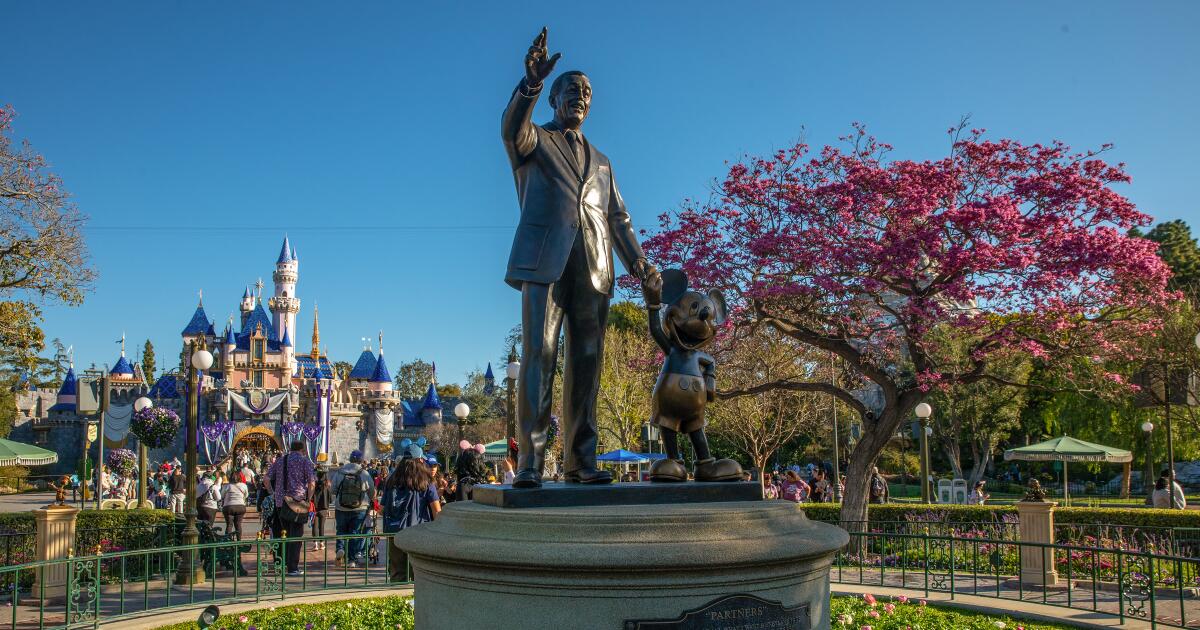
Disneyland Resort in Anaheim will offer $59 tickets for select evening admission to either theme park as part of a new promotion.
The one-day, one-park evening ticket offer will allow attendees to enter Disney California Adventure at 5 p.m. or Disneyland at 7 p.m. Park reservations are still required, as has been the case since the COVID-19 pandemic.
The offer only applies for admission from July 12 through Aug. 5 on Sundays to Wednesdays.
Disneyland Resort is commemorating its 70th anniversary through Aug. 9, and has introduced new shows and additions to rides as part of the occasion.
Walt Disney Co.’s theme parks and experiences business are a crucial boost to its finances, making up about 56% of the company’s operating income last fiscal year.
During the Burbank-based company’s most recent earnings call in May, Disney executives said attendance at its U.S.-based parks was down 1% compared with the prior year, a shift they attributed to “continued softness” in international visitations. However, the company said at the time that it was starting to move past those issues.
Disney’s experiences division reported $9.5 billion in revenue in that fiscal second quarter, up 7% compared with the same period a year ago, something executives said was due to higher guest spending domestically and more capacity on its cruise line.

An aging downtown office complex will be converted into apartments as part of an ambitious plan by local real estate companies to create 4,000 affordable housing units in Los Angeles.
The first project will be a $200-million makeover of the L.A. World Trade Center, a sprawling white elephant of an office complex on Figueroa Street built in the 1970s that will be turned into 512 apartments in one of the largest affordable housing conversions to date downtown.
Future projects being planned in the central city for delivery over the next five years will include other office-to-apartment conversions and new housing built from the ground up.
The 10-story World Trade Center, right, at Figueroa and Fourth streets in downtown Los Angeles, was built in the mid-1970s.
(Myung J. Chun / Los Angeles Times)
Behind the building campaign unveiled Monday are two of the region’s largest real estate companies, Jamison and Kennedy Wilson. Jamison is the city’s most prolific converter of offices to market-rate apartments and currently has a major makeover of a downtown office skyscraper underway for tenants who can pay top rents.
Kennedy Wilson, a real estate investment company based in Beverly Hills, owns Vintage Housing, which builds and operates affordable housing using tax credits and other state and federal financing to help fund it.
Vintage Housing and Jamison’s new affordable housing division, Arden Residential, will take on the campaign to build the housing where qualified tenants will pay rents below market rates.
Rents in the World Trade Center — which will be renamed Sky Castle when it opens in early 2028 — are expected to start at $937 for a one-bedroom unit. Some two- and three-bedroom units would rent for $1,100 and $1,300 per month, respectively, developers said.
Sky Castle will have shared amenities found in more expensive modern apartments, the developers said, such as a fitness center, resident lounge and co-working space. It already has six tennis courts on the roof, which may be converted to pickleball courts, Jamison Chief Executive Garrett Lee said.
The goal is to build higher quality affordable housing by using efficient construction methods Jamison has learned through building more than 8,000 market-rate apartments in the past, Lee said. The makeover of the World Trade Center will mark Jamison’s 15th conversion of an office building to housing.
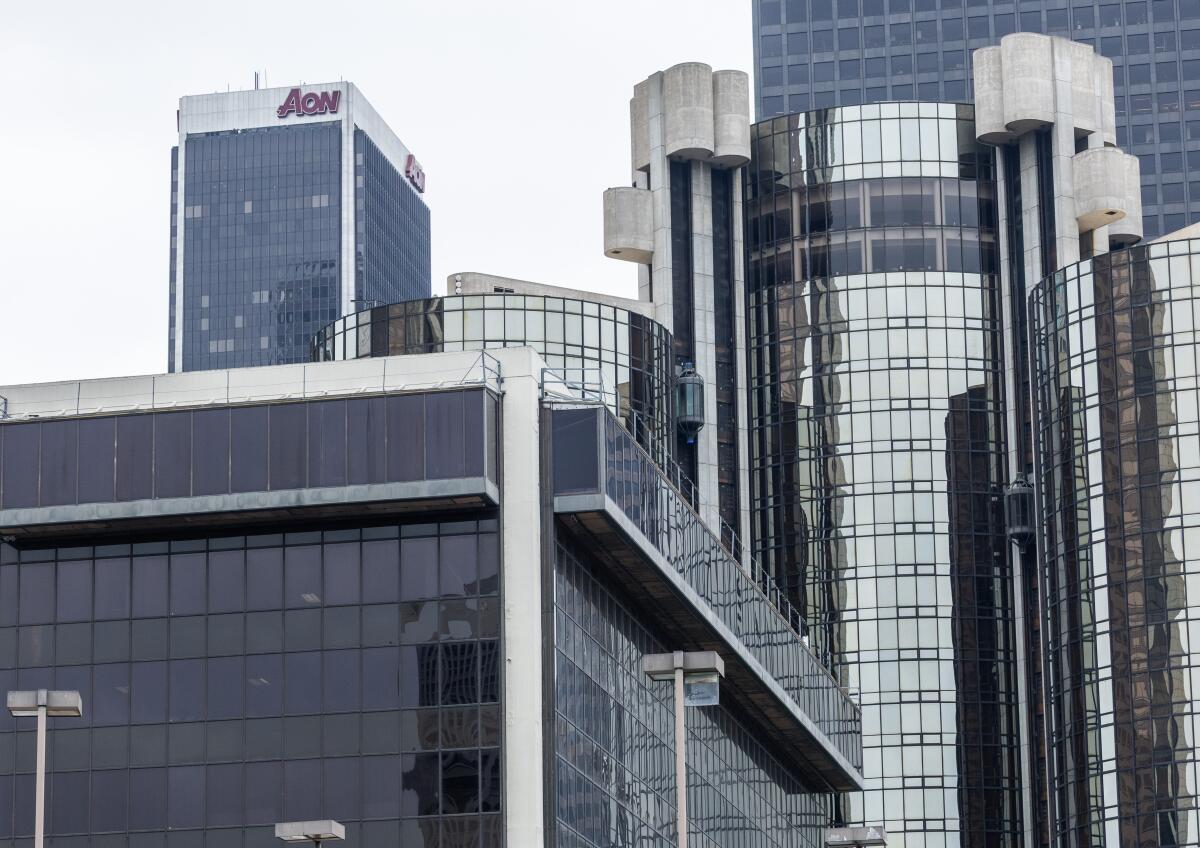
The plan to redevelop the L.A. World Trade Center, bottom left, is one of the largest affordable housing conversions to date downtown.
(Myung J. Chun / Los Angeles Times)
The 10-story World Trade Center was built in the mid-1970s to fanfare saying it would be home to international companies. In 1976, The Times described the center as a place to prepare for an overseas trip where visitors could get passports and visas, as well as exchange dollars for francs, marks, rubles and other currency. There was a language school and branches of U.S., Swiss and Japanese banks.
By the mid-1980s, the 400,000-square-foot office complex covering a city block at Figueroa and Fourth streets had lost its international flavor and was falling out of favor with corporate tenants who were moving into glossy new skyscrapers on Bunker Hill and in other locations.
The building has been cleared of remaining office tenants to allow work to begin in August, Lee said.
Kennedy Wilson is a nationwide operator of market-rate apartments that has also moved into building affordable housing in the last decade, said Nicholas Bridges, global head of capital markets at the company.
Building affordable, workforce housing “in almost all cases requires public subsidies,” Bridges said, and Kennedy Wilson has developed expertise in assembling “a cocktail of public financing sources” that includes low-income housing tax credits and tax-exempt bonds.
In the past, many housing developers have shied away from building affordable housing because assembling the subsidies needed to make construction profitable is challenging.

An artist’s rendering shows what the L.A. World Trade Center could look like after being redeveloped into affordable housing. The new complex is to be called Sky Castle.
(Ian Camarillo)
“It’s complicated,” Bridges said, “and not for the faint of heart.”
Eligible tenants must earn between 30% and 80% of the median income in the area where the housing is built.
Jamison and Kennedy Wilson will develop about 15 affordable housing projects between downtown and the 405 Freeway, Bridges said, many of them in aging office buildings such as the World Trade Center that are already owned by Jamison and are close to public transit.
Substantial potential for affordable housing lies in L.A.’s underused office buildings, he said.
“In this post-COVID world, the way people are utilizing office buildings, particularly older office buildings, has just fundamentally changed,” he said.
It makes sense for developers of conventional multifamily housing to move to building affordable housing, Lee said, because the government supports it through subsidies, zoning reform and the fast-tracking of construction permits. The city of Los Angeles also recently streamlined its adaptive reuse rules to make it easier to convert office buildings to housing.
“There are a lot of incentives pushing us in this direction,” Lee said.

Comcast is spinning off its NBCUniversal entertainment and news media businesses into a separate publicly traded company, a move that would unwind an audacious play the cable giant made for the storied Hollywood assets 15 years ago.
The plan would put broadcast networks NBC and Telemundo, NBC News, cable network Bravo, streaming service Peacock, the Los Angeles-based Universal film and television studios, Universal theme parks and British TV service Sky in a new stand-alone company.
Philadelphia-based Comcast would remain in its core business of distributing pay-TV channels, broadband internet and wireless services.
The spinoff would be the second such move by Comcast in two years. Late last year, the Brian L. Roberts-controlled company cast off most of its cable portfolio, including CNBC, USA Network, MS NOW and Golf Channel to form a new entity called Versant.
But the maneuver failed to budge Comcast’s listless stock, which has languished for years as its primary business lost thousands of broadband customers.
Comcast executives needed to make a bolder move to mollify frustrated investors.
Comcast stock peaked at nearly $26 per share Monday before closing at $24.22, up roughly 4.5% from Friday. Still, the stock remains below its 52-week high of $34.34.
The plan announced Monday would unravel Comcast’s bold decision to acquire NBCUniversal from General Electric Co. in 2011. At the time, Comcast saw tremendous value in marrying NBC’s entertainment operations, including its then-lucrative cable channels, with its cable TV distribution service that Roberts’ late father, Ralph, launched in Tupelo, Miss., in 1963.
“They were two distinct businesses,” longtime cable analyst Craig Moffett wrote in a Monday note to investors. “Having them under the same roof didn’t make either better.”
Consumers shifted to streaming, and Comcast’s attempt to build a top-tier digital service, Peacock, has fallen well short of its goal. Peacock lags behind rivals despite billions of dollars in investment from Comcast.
The concept of unwinding its NBCUniversal operation began in earnest in the fall, when Comcast joined the bidding for Warner Bros. Discovery. Comcast executives knew they could ill afford to spend billions to buy a rival; Wall Street would have pummeled the company.
So Comcast offered to spin off NBCUniversal and pair it with Warner Bros., turning two original Hollywood studios into a new media colossus.
But 43-year-old billionaire David Ellison prevailed in the bidding, agreeing to pay $111 billion to capture Warner Bros. Discovery. Losing the auction forced Comcast to find a different path forward.
On a call with investors, Roberts said the separation would bolster the two firms as they navigate increasing competitive challenges while technology companies continue to transform entertainment.
“We asked ourselves three basic questions,” Roberts said. “One, can these businesses stand alone and have the heft to stand alone in separate companies? Two, do they have a clear, viable capital allocation path to invest? And three, is now the right time? And the answer we came back with was yes to all counts.”
A free-standing NBCUniversal, home of the “Minions” and “Jurassic Park” franchises, probably would be an acquisition target, as media companies have been consolidating in an effort to get more content and mass distribution for their streaming services. Ellison’s Paramount is on track to close its Warner Bros. purchase, which would combine such media assets as HBO Max, CBS, CNN, Paramount Pictures and Warner Bros. studios.
With its Sky business, NBCUniversal has a toehold in Britain and Europe at a time when Amazon and Netflix are flexing their global distribution muscles.
Comcast would be positioned to combine with another cable and internet provider, such as Connecticut-based Charter, which owns the Spectrum television service. Charter is in the process of buying the smaller Cox cable service, which also has operations in Southern California.
Comcast is expected to complete the spinoff next year and will retain an 19% stake in the new entity.
The timetable could put NBCUniversal up for grabs by 2028 — when the company is set to broadcast the Summer Olympics, which will be held in Los Angeles.
Comcast acquired NBCUniversal in 2011. The industry-reshaping deal combined the largest distributor of TV channels with a provider of top-rated TV channels and a movie studio. But the streaming revolution has decimated the cable television business. Traditional TV viewing has been in a steady decline over the last decade. NBC has relied heavily on NFL broadcasts, and more recently, NBA and Major League Baseball games to remain relevant.
NBCUniversal has invested heavily in its streaming service, Peacock, but has been unable to reach the scale necessary for profitability. Comcast‘s stock price has struggled as a result.
Roberts, chairman and chief executive of Comcast, will continue to be involved in the leadership of Comcast and NBCUniversal, working in partnership with the CEOs of both companies.
Mike Cavanagh will remain as CEO of NBCUniversal, and Comcast’s former chief financial officer, Michael Angelakis, will return to run Comcast after the spinoff.
“Perhaps the best part of today’s welcome announcement … is that Mike Angelakis is coming back,” Moffett, the analyst, wrote. “He will now helm the cable business, [which] is unequivocally good news. With Mike Angelakis’s return, Comcast has come full circle.”
Moffett added that, despite Monday’s announcement, the 2011 combination was not a complete bust.
“The deal to acquire NBCU from GE was financially brilliant,” he said. “It was structured so that Comcast paid for just half of the acquisition and then let NBCU’s own cash flow pay for the rest.”
Over the years, Comcast has raked in billions in profit from its media holdings.
Comcast executives on the analyst call played down the notion that the two companies were being positioned for another deal.
“Absolutely not,” Roberts said. “This is the right move to put each company in the strongest position to create value, fully monetize its assets and aggressively pursue its own organic growth strategies.”
Cavanaugh, who has been running the combined company for three years, sounded more like a buyer than a seller.
“Our plan for NBCUniversal and Sky is to build and invest for growth,” he said. “We have the freedom now to explore adjacent businesses where we have the right to play, and that’s thanks to the stability of our company and management team.”
The spinoff announcement comes a week after Fox Corp. announced its deal to purchase the streaming platform Roku for $22 billion. The deal is aimed at ensuring that Fox has a means to get its portfolio of sports, news and entertainment channels into viewers’ homes as the traditional pay-TV business continues to erode.
-
 Florida43 seconds ago
Kids with autism are prone to drowning. Florida is trying to prevent that
-

 Georgia4 minutes ago
Bradenton man wanted for murder is found hiding in Georgia
-

 Hawaii9 minutes ago
Few state bills this year face potential veto – West Hawaii Today
-

 Illinois19 minutes ago
West Suburban hospital sends permanent layoff notices to about 500 furloughed employees
-

 Indiana24 minutes ago
Extreme heat peaks before holiday weekend storms | July 1, 2026
-

 Iowa31 minutes ago
New York Times/Siena Polls in Alaska, Iowa, North Carolina, and Ohio – Siena Research Institute
-

 Kansas34 minutes ago
Kansas State Fair announces Rock Fest with three-band lineup
-

 Kentucky34 minutes ago
Looking for the best hot dog in Louisville? Try these 15 spots

