Business
Federal labor investigators say L.A. poultry plant used child labor and tried to cover it up

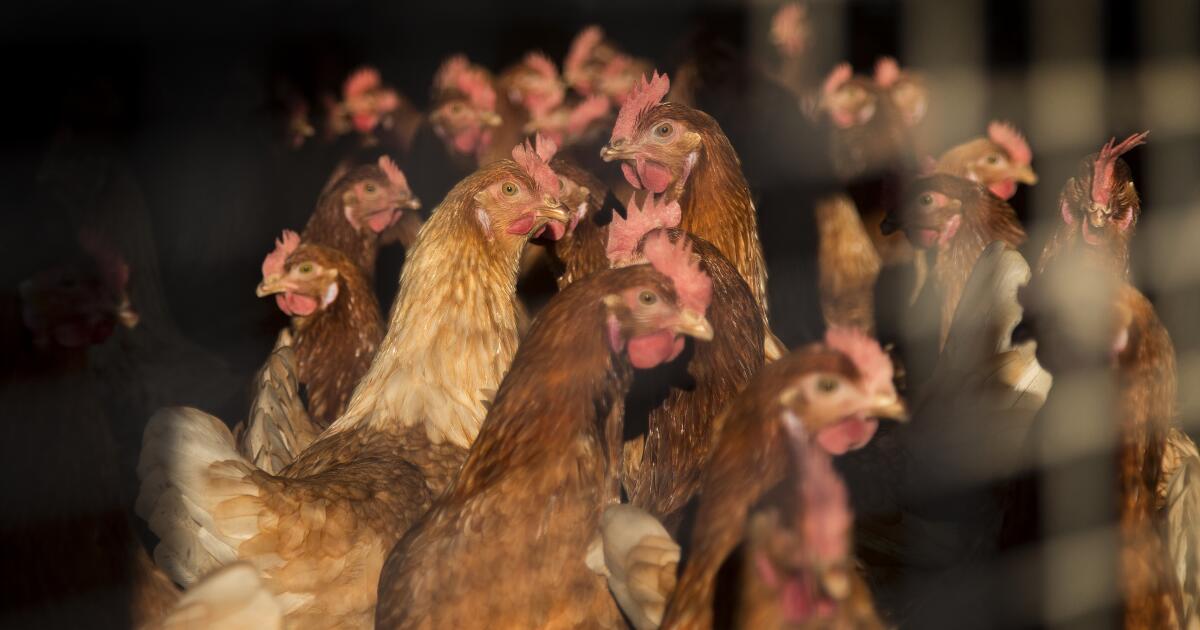
A federal judge issued a temporary restraining order on Monday to block a poultry processing plant in the city of Irwindale from using “oppressive” child labor.
The order came after investigators with the U.S. Department of Labor filed a lawsuit on Saturday alleging the poultry processor and its affiliated companies illegally employed children under the age of 18 to debone raw meat with sharp knives.
The department is seeking action forcing involved companies to forfeit money they made from selling products processed in facilities where minors were allegedly made to work in dangerous conditions.
The judge’s order involves three companies in the San Gabriel Valley — L & Y Food, Moon Poultry and JRC Culinary Group — that are all either owned, operated or managed by Fu Qian Chen Lu, who is also named in the lawsuit.
The Labor Department said in court documents that the companies continued to deliver and sell products even after agreeing to voluntarily refrain from shipping products following accusations of their use of child labor, and refused to provide information to investigators.
The companies hid 794 boxes of processed chicken and seven 1500-pound bins of chicken from investigators visiting the Irwindale facility, according to the court filings .
Federal officials and the poultry companies have presented dueling narratives of the child labor allegations.
Gregory W. Patterson, an attorney representing Chen Lu and other defendants named in the suit, accuses the Labor Department of planting an underage worker in the facility as part of its investigation, a claim the department has dismissed as “baseless.”
The crackdown by federal investigators comes as some of the country’s biggest consumer brands have come under broad scrutiny for child labor in their domestic supply chains amid revelations that children are working throughout American manufacturing and food production.
Investigators discovered children deboning poultry at the plant after visiting the facility in the city of Irwindale on Mar. 20 for a civil search warrant, the lawsuit said. Operators of the facility continued to process products, even after the Labor Department raised objections during its search warrant, in violation of federal laws prohibiting sale of products “tainted by child labor,” according to the lawsuit.
The “hot goods” provision of the Fair Labor Standards Act prohibits companies from selling products from locations flagged for child labor use in the prior 30 days.
U.S. District Judge Otis D. Wright II in his Monday decision issued a temporary restraining order requiring the businesses to stop using child labor, provide the Labor Department with information it is requesting related to its investigation, and refrain from shipping any poultry from facilities accused of employing child labor.
“In light of the immediacy of irreparable harm pending the Court’s review of this action, the Court finds a temporary restraining order warranted,” Wright wrote in his order on Monday.
Barring immediate action, he said, companies named in the lawsuit “will continue to employ oppressive child labor to the risk of minors’ life and limb; hot goods may enter the stream of commerce; and Defendants will continue to thwart Plaintiff’s investigation.”
Patterson, the attorney representing Chen Lu and other defendants, said in an emailed statement that the labor department had a 17-year-old “gain employment with Moon Poultry under false pretenses by presenting a fake government identification” and “directed this person to work in a hazardous area of the Moon Poultry facility in Irwindale.”
Patterson alleged that the Labor Department aimed to manufacture a child labor claim to “strengthen its negotiating hand” in an investigation about overtime wages that had not been paid to workers.
“The defense counsel’s allegations are false. The Labor Department has previously responded to the defense counsel on this issue, but he has nevertheless chosen to press his baseless claims,” said Marc Pilotin, regional solicitor for the Labor Department, in an emailed statement.
The Labor Department has investigated other poultry processing plants in California in recent months.
In December, federal investigators found grueling working conditions at two poultry plants in City of Industry and La Puente operated by Exclusive Poultry Inc. as well as other “front companies” owned by Tony Elvis Bran.
Children as young as 14 stood for long hours cutting and deboned poultry and operating heavy machinery, the labor department said. The workers came primarily from Indigenous communities in Guatemala.
The poultry processor, which supplies grocery stores including Ralphs and Aldi, was ordered to pay nearly $3.8 million in fines and back wages.
An investigation published in early February by the Fresno Bee detailed dangerous and sometimes deadly conditions for primarily Latino immigrant workers at Pitman Farms in the Central Valley, which produces the Mary’s Free Range Chicken brand.




Yamaha Motor Corp. is relocating part of its operations to Georgia and selling its California assets after 47 years.
The company is the latest among a slew of businesses to relocate operations outside the Golden State to cut costs and improve profitability. Many cite high taxes and strict regulations as obstacles to doing business in the state.
Yamaha Motor Corp. U.S.A., the U.S. subsidiary of Yamaha Motor Co., has been based in Cypress since 1979. It will begin its move to Kennesaw, Ga., at the end of this year and complete the moving process by the end of 2028, the company said in an announcement.
The company’s marine and motorsports business facilities already moved to Kennesaw in 1999 and 2019, respectively. The Cypress facility currently houses corporate functions and the financial services business on roughly 25 acres, the company said.
Yamaha said it will sell all its land, offices, warehouses and other fixed assets in California. It will use a sale-and-leaseback arrangement for a temporary period to ensure a smooth transition and business continuity.
“This initiative is positioned as one of the Company’s key measures aimed at improving asset efficiency and enhancing profitability in the United States,” the company said in its announcement of the move. Yamaha “is undertaking structural reforms … in response to cost increases resulting from U.S. tariffs and changes in the market environment,” it said.
Yamaha Motor was founded in Japan in 1955 and began selling its products in the U.S. in 1960. The company got its start making motorcycles for racing and contests, and released its first boat motor in 1960. It acquired land in Cypress in 1978 and established an office there one year later.
Some companies have been vocal about their dissatisfaction with California’s business environment.
Last year, Bed Bath & Beyond’s executive chairman, Marcus Lemonis, said his bankrupt company won’t be reopening any stores in California, where it used to have more than 80 locations.
“California has created one of the most overregulated, expensive, and risky environments for businesses,” Lemonis said in a statement posted on X in August.
Also in August, In-N-Out owner Lynsi Synder announced she was moving her family from California to Tennessee, where she planned to open a new regional headquarters. In-N-Out’s California headquarters remains operational.
“There’s a lot of great things about California, but raising a family is not easy here,” Snyder said on a podcast at the time. “Doing business is not easy here.”
Tesla moved its headquarters out of Palo Alto in 2021, the same year that financial services firm Charles Schwab relocated from San Francisco to north Texas.
Elon Musk moved the head offices of his other companies — SpaceX and X — to Texas in 2024, as did Chevron, the oil giant that was started in California.

Disneyland Resort President Thomas Mazloum has been named chairman of Walt Disney Co.’s experiences division, the company said Tuesday.
Mazloum succeeds soon-to-be Disney Chief Executive Josh D’Amaro as the head of the Mouse House’s vital parks portfolio, which has become the economic engine for the Burbank media and entertainment giant. His purview includes Disney’s theme parks, famed Imagineering division, merchandise, cruise line, as well as the Aulani resort and spa in Hawaii.
Jill Estorino will become the head of Disneyland Resort in Anaheim. She previously served as president and managing director of Disney Parks International and oversaw the company’s theme parks and resorts in Europe and Asia.
Estorino and Mazloum will assume their new roles on March 18, the same day as D’Amaro and incoming Disney President and Chief Creative Officer Dana Walden.
“Thomas Mazloum is an exceptional leader with a genuine appreciation for our cast members and a proven track record of delivering growth,” D’Amaro said in a statement. “His focus on service excellence, broad international leadership and strong connection to the creativity that brings our stories to life make him the right leader to guide Disney Experiences into its next chapter.”
Mazloum had been about a year into his tenure at Disneyland. Before that, he was head of Disney Signature Experiences, which includes the cruise line. He was trained in hospitality in Europe.
In his time at Disneyland, Mazloum oversaw the park’s 70th anniversary celebration and recently pledged to eliminate time limitations for park-hopping, which are designed to manage foot traffic at Disneyland and California Adventure.
Mazloum will now oversee a 10-year, $60-billion investment plan for Disney’s overall experiences business, which includes new themed lands in Disneyland Resort and Walt Disney World. At Disneyland, that expansion could result in at least $1.9 billion of development.
The size of that investment indicates how important the parks are to Disney’s bottom line. Last year, the experiences business brought in nearly 57% of the company’s operating income. Maintaining that momentum, as well as fending off competitors such as Universal Studios, is key to Disney’s continued growth.
In his new role, Mazloum will have to keep an eye on “international visitation headwinds” at its U.S.-based parks, which the company has said probably will factor into its earnings for its fiscal second quarter. At Disneyland Resort, that dip was mitigated by the park’s high percentage of California-based visitors.
Times staff writer Todd Martens contributed to this report.

It has been a bumpy road for the electric vehicle market as declining federal support and plateauing public interest have eaten away at sales.
But EV sellers could soon receive a boost from an unexpected source: The war in Iran is pushing up gas prices.
As Americans look to save money at the pump, more will consider switching to an electric or hybrid vehicle. Average gas prices in the U.S. have risen nearly 17% since Feb. 28 to reach $3.48 per gallon. In California, the average is $5.20 per gallon.
Electric vehicles are pricier than gasoline-powered cars and charging them isn’t cheap with current electricity prices, but sky-high gas prices can tip the scales for consumers deciding which kind of vehicle to buy next.
“We probably will see an uptick in EV adoption and particularly hybrid adoption” if gas prices stay high, said Sam Abuelsamid, an auto analyst at Telemetry Agency. “The last time we had oil prices top $100 per barrel was early 2022 and that’s when we saw EV sales really start to pick up in the U.S.”
In a 2022 AAA survey, 77% of respondents said saving money on gas was their primary motivator for purchasing an electric vehicle. That year, 25% of survey respondents said they were likely or very likely to purchase an EV.
As oil prices cooled, the number fell to16% in 2025.
In California, annual sales of new light-duty zero-emission vehicles jumped 43% in 2022, according to the state’s Energy Commission. The market share of zero-emission vehicles among all light-duty vehicles sold rose from 12% in 2021 to 19% in 2022.
“Prior to 2022, we didn’t really have EVs available when we had oil price shocks,” Abuelsamid said. “But every time we did, it coincided with a move toward more fuel-efficient vehicles.”
Dealers are anticipating a windfall.
Brian Maas, president of the California New Car Dealers Assn., predicted enthusiasm for EVs will rebound across California if oil prices don’t come down.
“If prior gasoline price spikes are any indication, you tend to see interest in more fuel-efficient vehicles,” he said.
Rising gas prices could be a lifeline for EV makers at a time when federal support for green cars has been declining.
Under President Trump, a federal $7,500 tax incentive for new electric vehicles was eliminated in September, along with a $4,000 incentive for used electric vehicles.
In California, the zero-emission vehicle share of the total new-vehicle market was 22% through the first 10 months of 2025, then dropped sharply to 12% in the last two months of the year, according to the California Auto Outlook.
Meanwhile Tesla, the most popular EV brand in the country, has grappled with an implosion of its reputation with some consumers after its chief executive, Elon Musk, became one of Trump’s most vocal supporters and helped run the controversial Department of Government Efficiency.
Over the last several months, Ford, General Motors and Stellantis have pared back EV ambitions.
Other automakers, including Nissan, announced plans to stop producing their more affordable electric models.
The Trump administration has moved to roll back federal fuel economy standards and revoked California’s permission to implement a ban on new gas-powered car sales by 2035.
David Reichmuth, a researcher with the Clean Transportation program in the Union of Concerned Scientists, said the shift in production plans will affect EV availability, even if demand surges.
That could keep people from switching to cleaner vehicles regardless of higher gas prices.
“This is a transition that we need to make for both public health and to try to slow the damage from global warming, whether or not the price of gasoline is $3 or $5 or $6 a gallon,” he said.
According to Cox Automotive, new EV sales nationally were down 41% in November from a year earlier. Used EV sales were down 14% year over year that month.
To be sure, oil prices can fluctuate wildly in times of uncertainty. It will take time for consumers to decide on new purchases.
Brian Kim, who manages used car sales at Ford of Downtown LA, said he has yet to see a jump in the number of people interested in EVs, hybrids or more fuel-efficient gas-powered engines.
Still, if the price at the pump stays stuck above its current level, it could happen soon.
“Once the gas prices hit six [dollars per gallon] or more and people feel it in their pocket, maybe things will start to change,” he said.

GOP-led counties push back against Democrats’ redistricting charge, testing Virginia’s constitutional limits

New Jersey elementary school weighs renaming after President Trump

Videos show standing water inside Detroit elementary school, as source reports sewage smell

SF mayor assures there’s ‘no imminent threat’ after FBI report warns Iran aspires to attack CA

A look at Dallas Cowboys’ 2026 NFL draft picks after Osa Odighizuwa, Solomon Thomas trades

Florida High School Football Rankings: Top 25 teams – Oct. 21

Cleary's 21 help Le Moyne down Central Connecticut State 69-64 in OT

How old is Bo Nix? What to know about Oregon quarterback ahead of 2024 NFL Draft

99th annual Pony Swim held in Virginia

Indiana Members Credit Union announced as new anchor tenant at Bottleworks District

Reporter’s Notebook: Trump’s SAVE Act ultimatum runs into Senate reality

Not ‘a litre of oil’ to pass Strait of Hormuz, expect $200 price tag: Iran

Tornadoes hit Illinois, Indiana and Texas as severe storms sweep US

EXCLUSIVE: ICE says El Paso detention facility will stay open under new contractor after $1.2B deal scrapped

Von der Leyen ‘acting outside of competence,’ Araud tells Euronews
-

 Wisconsin1 week ago
Setting sail on iceboats across a frozen lake in Wisconsin
-

 Massachusetts1 week ago
Massachusetts man awaits word from family in Iran after attacks
-

 Detroit, MI6 days ago
U.S. Postal Service could run out of money within a year
-

 Miami, FL1 week ago
City of Miami celebrates reopening of Flagler Street as part of beautification project
-

 Pennsylvania6 days ago
Pa. man found guilty of raping teen girl who he took to Mexico
-

 Sports1 week ago
Keith Olbermann under fire for calling Lou Holtz a ‘scumbag’ after legendary coach’s death
-

 Michigan2 days ago
Operation BBQ Relief helping with Southwest Michigan tornado recovery
-

 Virginia1 week ago
Giants will hold 2026 training camp in West Virginia