Business
Fear of Trump’s Tariffs Ripples Through France’s Champagne Region


French Champagne producers do nearly a billion dollars’ worth of business with the United States every year. But on Friday in Épernay, the world capital of sparkling wine, the only number on anybody’s lips was 200.
That was the percent tariff that President Trump has threatened to impose on Champagne and other European wines and spirits exported to the United States, in a trade war that exploded this past week after the European Union countered Mr. Trump’s penalties on steel and aluminum with its own duties on American products.
The triple-digit menace landed like a thunderbolt in Épernay, rattling workers in nearby fields, producers in small villages and the venerable houses that line the Avenue de Champagne, Épernay’s central boulevard and a UNESCO Heritage site that oozes tasteful wealth.
“A 200 percent tariff is designed to make sure that no Champagne will be shipped to the United States,” said Calvin Boucher, a manager at Michel Gonet, a 225-year-old Champagne house on the avenue. With 20 to 30 percent of the 200,000 bottles it makes yearly exported to American wine merchants and restaurants, “that business would be crushed,” he said, adding that the price of a $125 Champagne would more than triple overnight.
Épernay sits in the heart of a region that produces the world’s finest bubbly. The United States is its biggest foreign market, with 27 million bottles shipped there in 2023, valued at around 810 million euros ($885 million).
Chardonnay, Pinot Noir and Meunier grapes blanket the rolling hills and deep valleys of Champagne, which covers more than 130 square miles, from the city of Reims to the Aube river. The area is under France’s strict Appellation d’Origine system, which ensures that only the sparkling wine made here, using specific methods, can legally be called Champagne.
With more than 4,000 independent winemakers and 360 Champagne houses, the region produces around 300 million bottles annually, with one billion more resting in cellars. The biggest houses — including Dom Pérignon, Veuve Clicquot and Moët & Chandon, owned by the luxury conglomerate LVMH Moët Hennessy Louis Vuitton — dominate production and exports and account for a third of total sales.
But such figures were of little comfort in the wake of Mr. Trump’s threat. Just off the Avenue de Champagne, Nathalie Doucet, the president of Besserat de Bellefon, a specialty Champagne house that exports 10 percent of its premium production to the United States, said that the trade war made her anxious.
“We are waiting to see what happens, but it’s not good news,” said Ms. Doucet, whose Champagne is made with a laborious low-pressure process that gives it a crisp acidity and fine effervescence.
Champagne already had a tough year with bad weather that had reduced the harvest. Consumption has declined as young people shifted habits and switched to cocktails and artisanal beer. Champagne sales have thinned since the pandemic, falling 9 percent last year.
At the same time, she said, Europe was grappling with wars in Ukraine and Gaza. And now the trade war with the United States, one of France’s traditional allies, over issues that have nothing to do with Champagne, has made her feel like collateral damage.
“It seems like a deliberate punishment,” said Cyril Depart, the owner of the Salvatori wine shop, just off the avenue, which offers a wide variety of artisanal Champagnes. His wife was an export manager for one of the big Champagne houses and had already been crunching numbers on the potential impact.
Leah Razzouki, an Épernay resident whose family has worked in the Champagne business for generations, said she was infuriated. “Many of our friends are small producers and they would be hit very hard,” she said.
The damage of a trade war would spread far beyond Champagne’s regal houses, hitting American importers and distributors and putting numerous small businesses at risk.
Michael Reiss, the president of Vineyard Road, a small distributor in Framingham, Mass., that imports Champagne and wines from Europe and distributes them in New England, said that small businesses like his, including restaurants and retail shops, would be “very hurt.” The unpredictable trade environment could force businesses to cancel planned investments, he added.
Adding to the pain, tariffs applied at the beginning of the supply chain can multiply, as each business handling the product marks it up accordingly, Mr. Reiss said. “So even a 25 percent tariff can easily lead to a 40 to 60 percent increase in prices,” he said.
A 200 percent tariff “would eliminate the possibility of people buying things that bring them joy in their lives,” he added.
Even inside the Champagne Museum bordering the avenue in Épernay, the chatter strayed to Mr. Trump’s tariffs. Sacha Raynaud, whose family owns a small Champagne house, had brought a friend to learn the history of Champagne, which first appeared in the 17th century on the tables of royalty, giving the drink its nickname, “the king of wines.”
“French people are waking up to what’s happening in the United States, and starting to speak about boycotting American products,” she said.
Similar worries circulated in the fields. Working in a buttery morning light, a dozen field hands secured knotted brown vines to wires ahead of the spring growing season on freshly plowed earth in the shadow of the Champagne-producing town of Reuil, just west of Épernay.
Even these jobs were at risk, said Patrick Andrade, who runs a small company that helps maintain Champagne vineyards. The 12 hectare (30 acre) plot belonged to a small house that exports to the United States, he said.
Should sales fall, wine producers would need fewer field hands, and there would be less work for tractor operators, cork makers and bottle makers. In the worst case, he added, it could force Champagne producers to consider ripping out vines.
On Friday, France’s finance minister, Eric Lombard, called the trade war “idiotic” and said he would travel to Washington soon. “We need to talk to the Americans to bring the tension back down,” he told French television.
France’s biggest Champagne houses have stayed conspicuously silent, declining to say anything while waiting to see how Mr. Trump’s threat would play out — and whether European officials could get him to back off.
Among them was LVMH Moët Hennessy Louis Vuitton, which sells nearly 35 percent of its wines and spirits in the United States. The company did not respond to a request for comment.
Outside of LVMH’s Moët & Chandon mansion on the Avenue de Champagne, a group of Americans snapped selfies in front of a statue of Dom Pérignon, the monk who invented Champagne. Inside the stately building, no staff members wanted to talk tariffs.
Even so, locals whispered rumors that the big houses were upset by the tariff threat, but expected that it could quite possibly blow over.
After all, some said, Bernard Arnault, France’s richest man and the head of the LVMH empire, which dominates much of Champagne’s production, has a longstanding relationship with the U.S. president and was invited by Mr. Trump to his inauguration. Perhaps Mr. Arnault’s friendship would prevail at the end of the day, they said.
But for now, that is all just speculation. The reality is that nothing is certain — and uncertainty is bad for business.
Back at the Michel Gonet Champagne house, Mr. Boucher pointed to a display of cuvées that were popular among customers in the United States.
“It’s just a stressful situation because we don’t know if the tariffs will even happen,” he said. “It’s not good for anybody.”
Aurelien Breeden and Ségolène Le Stradic contributed reporting.



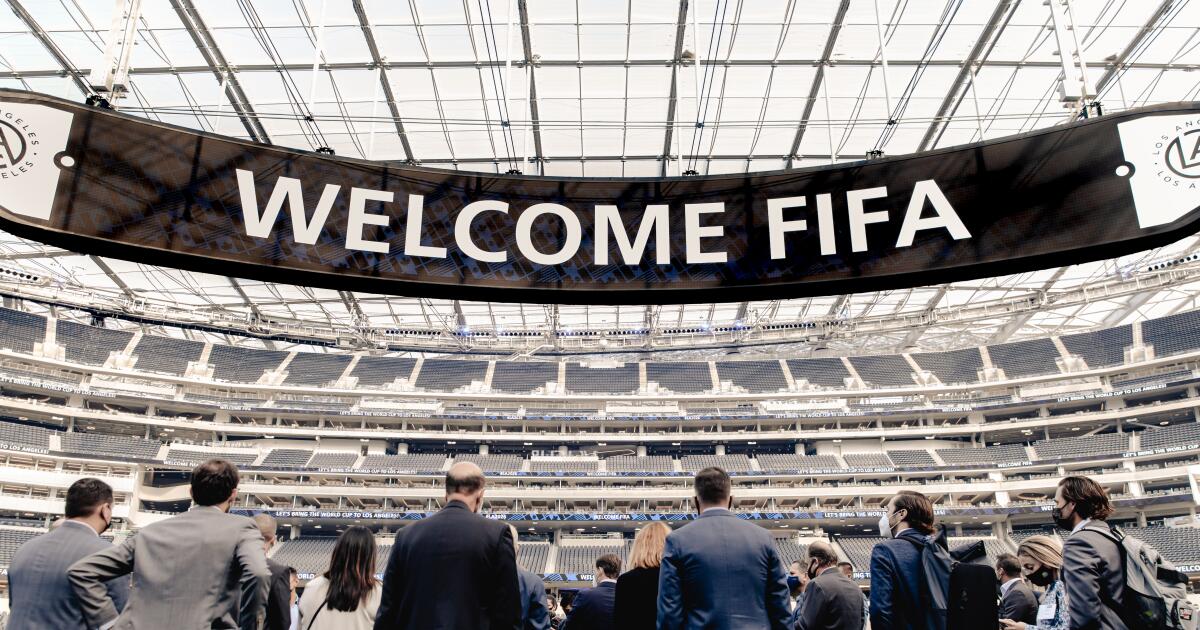
StubHub is getting a red card from some World Cup fans
Two World Cup customers are suing the New York-based ticket-selling company, alleging “false and misleading” advertising that left them without tickets or a refund for the World Cup games they paid to attend.
In federal court in New York last week, two Californians — Julia Reeker Moghal and Reuben Renteria — sued StubHub seeking monetary damages and a ban on the company selling World Cup tickets. The lawsuit aims to become a class action and comes after weeks of fierce criticism and complaints from customers regarding the company’s practices.
Throughout the World Cup, videos have emerged on Instagram and TikTok of StubHub customers describing their nightmare experiences with the ticket-selling platform.
Some said they had purchased tickets to World Cup games as early as November of last year, booked flights and hotels and arranged travel plans, then StubHub notified them days to weeks before the match of a refund for their tickets, which they never requested.
There were similar complaints about last-minute cancellations from people who bought Coachella tickets on StubHub.
In the lawsuit, Moghal said she had purchased three tickets for nearly $2,000 for the June 18 match between Switzerland and Bosnia-Herzegovina at SoFi Stadium in Inglewood, which were then canceled by StubHub. Moghal said she was contacted by StubHub and told her tickets would remain canceled, then was later told the tickets would be available one hour before the game.
When the match began, Moghal said she was at SoFi Stadium, but the tickets never came.
Renteria said he paid around $2,300 for the June 18 Mexico versus South Korea match in Guadalajara, Mexico, but they were canceled
“Devoted soccer fans have traveled from around the world to attend World Cup matches — and they reasonably relied on StubHub to provide the tickets they paid for as well as on StubHub’s warranty,” Blake Hunter Yagman, the attorney representing the two, said in a statement. “Instead of rewarding their business, StubHub sold them World Cup tickets that they either could not provide or on speculation, only to be stranded, in many cases, at the stadium gates without any recourse.”
According to StubHub’s website, its Fan Protect Guarantee states the platform will deliver valid tickets or refund in the event of a ticket issue, and that it will “go out of our way to find replacement tickets” of a comparable value. The lawsuit alleges the replacement tickets many fans were given by StubHub were worse than their original tickets.
FIFA, the World Cup organizer, states in its terms and conditions that the FIFA Marketplace, its own ticket-selling platform, is the only authorized platform for World Cup tickets, and that only tickets purchased through it are guaranteed by FIFA to be valid.
Despite the risk of purchasing through a third-party platform such as StubHub, many fans opted to do so to avoid the 30% FIFA resale tax, believing that the Fan Protect Guarantee would safeguard their order.
Since World Cup tickets began selling on FIFA Marketplace last September, fans have expressed disappointment in the expensive price tag. FIFA utilized a dynamic pricing system for the sale, and as sales phases progressed leading up to the games, the cost of tickets increased tremendously. In March, the extreme cost of tickets prompted 69 members of Congress to write a letter to FIFA urging them to lower their prices.
Tickets for the upcoming Friday match between Spain and Belgium in Los Angeles are selling on StubHub for over $1,300.
StubHub said in various statements to the news and in legal proceedings that ticket cancellations were a result of transfer problems and issues with FIFA’s ticketing infrastructure.
StubHub did not respond to requests for comment.
A FIFA spokesperson responded to this accusation in a statement, saying, “FIFA has no visibility over, or control of, secondary market ticket transactions carried out on third-party platforms. The transactions facilitated on these platforms occur entirely independently of FIFA’s official ticketing platform. With reference to the reliability of the services available to fans on FIFA’s official ticket platform, FIFA rejects any suggestion that the functional issues being experienced by users of third-party platforms with respect to FIFA World Cup 2026 tickets are the result of FIFA’s ticketing infrastructure.”
Business
Commentary: Trump wants to let companies make fewer disclosures, thus keeping investors in the dark

Trump’s SEC is considering eliminating the mandate for quarterly corporate financial reports, but even some big investors call it a lousy idea.
This being the “information age,” it would be understandable if investors sometimes feel inundated with too much information to wade through about the stocks in their mutual fund portfolios.
The Securities and Exchange Commission, bowing like a puppy to the urgings of President Trump, is considering exactly the wrong solution to this supposed burden. It’s proposing to allow public companies to give their investors less information, as though that’s a good thing.
On May 8, the SEC proposed rescinding its mandate that public companies report financial results on a quarterly schedule. Instead, it suggests, semiannual and annual reports should suffice.
This takes an already-unlevel playing field where Main Street investors are already disadvantaged, and makes it more unlevel.
— Dennis Kelleher, Better Markets
The SEC left its proposal open for public comment for 60 days, meaning the window closed Monday. By then, the agency had received more than 68,000 comments, according to a tracker posted online by accounting professor Tzachi Zach of Ohio State.
Almost 99.9% of the comments were negative. Several organizations of institutional investors and auditing professionals, as well as a tsunami of individual investors, expressed opposition.
A similar initiative the SEC aired in 2018, during Trump’s first term, received an overwhelmingly negative response and was eventually dropped.
The tide of opposition coming from individual investors shouldn’t be surprising. “Taking away basic quarterly information means investors are blind for six months at a time,” says Dennis Kelleher, co-founder and chief executive of the investor advocacy nonprofit Better Markets.
That’s especially true for small investors, though perhaps not so much for major institutions, insiders or deep-pocketed individuals. “If you’re a big dog, you’ll get the information anyway,” Kelleher told me. “And insiders, who are trading in their own stock all the time, will have the information. This takes an already-unlevel playing field where Main Street investors are already disadvantaged, and makes it more unlevel.”
Trump set off the latest initiative with a social media post on Sept. 15, advocating the move to a six-month reporting schedule. It read, in part, “This will save money, and allow managers to focus on properly running their companies. Did you ever hear the statement that, ‘China has a 50 to 100 year view on management of a company, whereas we run our companies on a quarterly basis???’ Not good!!!”
As was usual with Trump, his argument was a string of uninformed and irrelevant non sequiturs.
It’s doubtful that eliminating quarterly reports will save much, if any, money. Most 10-Qs are cookie cutter documents disclosing financial figures already embedded in corporate records.
The idea that managers would become empowered to “focus on properly running their companies” if only they were relieved of the burden of preparing a report every three months is just malarkey: Any CEOs who feel the impulse to drop everything and involve themselves in what is essentially an automated process can’t be very good at their jobs.
As for China’s “50 to 100 year view on management of a company,” what would that even mean, even if it were true? China doesn’t operate on a 50 to 100 year corporate horizon, but rather on a string of five-year plans. The most recent of these was adopted by the government in March, covers the period up to 2030, and is its 15th in a row.
Despite the flaws in Trump’s arguments, Trump’s SEC Chairman Paul Atkins, a former corporate lawyer and securities industry consultant, fell into line. Within a few days of Trump’s post, he showed up on CNBC to minimize the potential effect of the change. Private companies rely on semiannual reports, after all, he noted, although the idea of taking private companies as models for publicly traded corporations might not strike experienced investors as the wisest thing.
Atkins cited an enduring chestnut, for which there’s no evidence, that quarterly reporting is responsible for “short-term thinking” in corporate suites (though he admitted that his evidence was “anecdotal”). And he suggested that small investors have ample access to corporate information even without quarterly reports — why, he said, they can just tune in to CNBC!
“To propose change in what our rules are now would be a good way forward,” he said. “So I welcome the president’s putting this up for discussion.”
Something more insidious undergirds the SEC’s proposal than its immediate effect on corporate behavior. The agency rationalizes its proposal as seeking “a tradeoff between reducing regulatory burdens … and promoting efficient financial markets through timely disclosure.”
The problem here, Kelleher points out, is that “reducing regulatory burdens” isn’t part of the SEC’s mission in any way, shape or form. It’s a regulatory agency, and its mission since its founding in 1934 has been to protect investors, not to make things fluffier for stock issuers.
The history of financial disclosure in the U.S. shows a long-term trend favoring more disclosure, not less. In the 1880s, quarterly reporting by railroads and other transportation companies were common.
Early on, pressure for more frequent disclosure came not from government regulators, who barely existed before 1934, but from investors. The reporting of quarterly earnings, notes corporate finance expert Owen Lamont of Acadian Asset Management, was “a bottom-up historical phenomenon reflecting voluntary arrangements between firms and investors, not a top-down phenomenon imposed by law.”
By 1931, according to financial historians, 63% of New York Stock Exchange-listed firms were publishing their quarterly earnings. The Big Board mandated that frequency for most listed companies in 1939. The SEC mandated semiannual reports in 1955 and quarterly reports, as Atkins said, in 1970.
The evidence in favor of dropping the quarterly reports is uniformly thin. Some advocates cite a 2018 op-ed in the Wall Street Journal by JPMorgan Chase CEO Jamie Dimon and Warren Buffett that was headlined “Short-Termism Is Harming the Economy.”
Couple of points about this: First, the target of Dimon and Buffett wasn’t quarterly financial reporting, but quarterly earnings guidance — that is, the practice of some top executives who project their earnings into the future. (This guidance usually comes at the same time they issue their SEC disclosures.)
It’s guidance, they wrote, that is “a major driver” of short-termism in corporate behavior. That’s because management is giving itself a target it feels obligated to meet, even if factors outside its control interfere with the quest.
Furthermore, Dimon and Buffett wrote, “Our views on quarterly earnings forecasts should not be misconstrued as opposition to quarterly and annual reporting.” They called transparency about financial and operating results “an essential aspect of U.S. public markets … so that the public, including shareholders and other stakeholders, can reliably assess real progress.”
Individual investors may be unmoved by the SEC’s proposal because — let’s be candid — how many of them read quarterly earnings reports, anyway? But that’s unimportant, Kelleher says, because other market participants are reading them. “So that information is in the marketplace, and that’s what actually enables price discovery, so stock prices roughly reflect what’s going on at a company, most of the time.”
More to the point, the quarterly reports reflect the highest-quality, detailed information, the information the SEC requires executives to disclose on pain of facing a civil lawsuit from the agency or even criminal liability for faking data. “Main Street investors, whether they read quarterly reports or not, are the real beneficiaries,” Kelleher says.
That’s so. The bottom line is that quarterly financial reporting helps investors. It doesn’t promote short-term behavior and its costs, modest as they are, don’t outweigh its benefits.
Over the decades, scandal-ridden corporations have hidden fraudulent behavior in the interstices between mandated disclosures—think Enron, WorldCom and Tyco, among others. Why give any corporation, even an honest one, the opportunity to disclose less?

The luxury shopping center in Pacific Palisades will reopen next month after more than $100 million in renovations forced by the January 2025 wildfire that devastated the Los Angeles neighborhood.
Palisades Village will reopen Aug. 15, owner Rick Caruso announced Wednesday. The outdoor center survived the blaze that destroyed homes and other businesses but needed refurbishment to eliminate contaminants that the fire could have spread.
Crews are putting finishing touches on mall buildings after tearing them down to the studs, treating the wood and rebuilding the walls, Caruso said.
“Everybody’s working, and stores are moving their products in,” he said. “It’s a really cool feeling that people have really locked arms and are working together.”
An electrician installs lighting for a restaurant at Rick Caruso’s Palisades Village on Thursday. The shopping center is scheduled to reopen mid-August.
(Myung J. Chun / Los Angeles Times)
Pacific Palisades resident Allison Polhill, who is rebuilding the home of 30 years that her family lost in the blaze, said she is “thrilled” at the prospect of returning to the mall she used to frequent. Its comeback is a boost for the community, she said.
“Every single step that we make to reopen our commercial corridors is going to bring more people back into the Palisades,” said Polhill, who expects to move back into her home at the end of August.
A total of 6,822 structures were destroyed in the Palisades fire, including more than 5,500 residences and 100 commercial businesses, according to the California Department of Forestry and Fire Protection.
Caruso previously attributed the mall’s survival to the hard work of private firefighters and the fire-resistant materials used in the mall’s construction.
The $200-million shopping and dining center opened in 2018 with a movie theater and a roster of upmarket tenants, including Erewhon, which may be the only grocer in the heart of the fire-ravaged neighborhood when it opens.
Caruso’s company was able to fill the mall with tenants despite the long shutdown.
Palisades Village is 99% leased, with the majority of tenants returning, said Jackie Levy, chief financial and revenue officer. Nearly one-third of the shops and restaurants are new to the property.
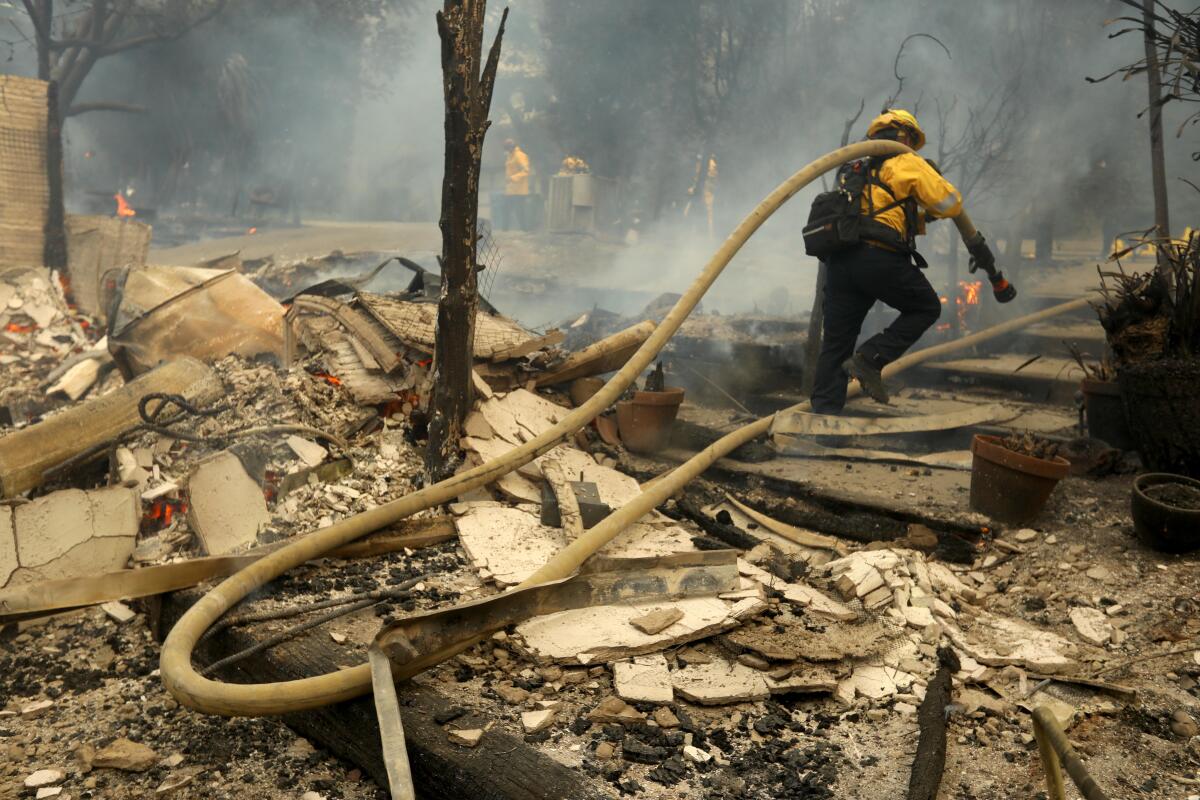
A firefighter carries a hose back to his rig while walking through a destroyed home from the Palisades fire in Pacific Palisades on Jan. 7, 2025.
(Genaro Molina / Los Angeles Times)
Last year, Pacific Palisades-based fashion designer Elyse Walker said she would reopen her eponymous store in Palisades Village after losing her 25-year flagship location on Antioch Street to the inferno.
Other neighborhood shops destroyed in the fire that are reopening at the mall include K Bakery and Loomey’s Toys, which caters to children up to age 12 and used to be across the street from Palisades Elementary Charter School.
“It’s been a journey and I’m excited because I wasn’t sure that there was going to be a place to come back to,” said toy store owner Amanda Rastegar. “Hopefully we can bring some of that magic back.”
Rastegar’s home in the Palisades survived but was damaged by the fire. The family returned about eight weeks ago. Her last memory of the fire was a burning supermarket.
“I just couldn’t wrap my brain around what was happening,” she said. “By the time I left, Gelson’s was on fire.”
Among the returning tenants is Angelini Ristorante & Bar. Well-known Los Angeles chef Gino Angelini said he will be in the kitchen next month for a return of the Italian restaurant.
“We won’t do a big celebrity open,” he said. “We want to have a very soft opening and see our customers come back.”

Construction takes place at Rick Caruso’s Palisades Village on Thursday. The shopping center is scheduled to reopen mid-August.
(Myung J. Chun / Los Angeles Times)
An elaborate celebration would not feel “correct for me,” Angelini said, because the devastation has been “very sad” for so many.
Other new tenants include local chef Nancy Silverton, who has agreed to move in with a new Italian steakhouse called Spacca Tutto. Women’s activewear retailer LESET will open its first West Coast location.
Caruso said he is optimistic that customers will return to the center, even though many Pacific Palisades residents are still dispersed. One tracking system estimated that about 30% of the Village’s customer base was impacted by the fire, he said.
“That means 70% did not get impacted, so there’s a lot of customers still left out there,” Caruso said. Historically, the center drew customers from as far away as Beverly Hills and Calabasas, as well as Malibu, Brentwood and Santa Monica.
He also hopes many will be inspired to visit the revived mall.
“I believe in the goodness of people and I believe that people are going to want to support the Palisades,” he said. “They’re going to want to be there and support the businesses that have had the courage and the heart to reopen.”
-
 Politics5 minutes ago
Iran ceasefire is ‘over,’ Trump says, and orders additional strikes
-
 Science8 minutes ago
Diarrhea-causing cyclosporiasis exceeds 1,000 cases in U.S. What Californians should know
-
 Sports13 minutes ago
Arthur Fery’s fairy-tale Wimbledon run puts British wild card on brink of history
-

 World23 minutes ago
Burnham on course to become next UK PM with backing of 322 Labour MPs
-

 News51 minutes ago
Trump fires last members of election commission, inciting fears of midterm ‘chaos’
-

 Los Angeles, Ca2 hours ago
California teen e-biker baiting police to chase tracked by drone, arrested
-

 Detroit, MI2 hours ago
Our picks for state\nSenate from Wayne Co. | Endorsements
-

 San Francisco, CA3 hours ago
Man reported missing in San Francisco

